• Link to X
  • Link to Facebook
  • Link to Instagram
  • Link to TikTok
  • Link to Youtube
  • About
    • About Us
      • President
      • Board of Directors
      • Board of Advisors
      • Financials
      • Our Methodology
      • Success Tracker
      • Contact
  • Act Now
    • 30 Ways to Help
      • Email Congress
      • Call Congress
      • Volunteer
      • Courses & Certificates
      • Be a Donor
    • Internships
      • In-Office Internships
      • Remote Internships
    • Legislation
      • Politics 101
  • The Blog
  • The Podcast
  • Magazine
  • Donate
  • Click to open the search input field Click to open the search input field Search
  • Menu Menu

Tag Archive for: Poverty In Brazil

Posts

Food & Hunger, Food Security, Global Poverty, Sustainable Development Goals

How Social Gastronomy is Helping Reduce Global Poverty

social gastronomy “Food should not only taste good but also do good for society.” With this motto, Gastromotiva has been helping people in conditions of vulnerability and social exclusion through something as simple as food. Since its foundation in 2006 by chef David Hertz, the Brazilian organization has impacted more than 100,000 people globally through education and social gastronomy initiatives.
How Gastromotiva is Helping Those in Need

According to an April 2018 report published by the World Bank, 50 percent of the Brazilian population between ages 19 and 25 is vulnerable to poverty. In this scenario, Gastromotiva uses the power of education, food and gastronomy as a social change agent. The organization acts on three main areas: education, social gastronomy and food waste reduction.

The first project created by Gastromotiva was vocational kitchen training, culinary classes offered for young low-income people at no charge. During the four-month intensive program, students learn not only technical skills but also concepts such as eco-gastronomy, food waste cooking and personal development. After graduating, they are presented with a variety of employment options at Gastromotiva partner restaurants. This way, students become multipliers and empower others by disseminating their knowledge about social gastronomy in their own communities. So far, 4,000 people have graduated.

In addition to the culinary classes, Gastromotiva also offers food entrepreneur classes and acts on the social gastronomy movement, a human-centered solution to generate opportunity, dignity and inclusion through food. The movement involves establishing partnerships with other organizations, gastronomic businesses, chefs and companies all over the world.

“Social gastronomy goes beyond one chef, one meal, one Michelin star,” explains David Hertz in a TED Talk. “When we are all connected we can feel love and respect and with food, we can transform millions of lives.”

Current Endeavors in Social Gastronomy

Most recently, Gastromotiva launched Reffetorio Gastromotiva, a restaurant school in Rio de Janeiro created by chefs Massimo Bottura, David Hertz and the journalist Ale Forbes, to fight food waste, malnutrition and social exclusion. At Reffetorio, chefs host workshops and gastronomy classes and also prepare 450 three-course meals for homeless people every night with food that would otherwise be wasted.

“We give these people not only quality food but also a moment of peace and dignity when they feel like human beings,” said Gastromotiva’s CEO Nicola Gryczka in an interview with The Borgen Project. Gastromotiva collaborates to achieve, until 2030, various Sustainable Development Goals defined by the United Nations, including no poverty, zero hunger, good health and well-being, quality education, decent work and economic growth, reduced inequalities and partnerships for the goals.

Looking Toward the Future

Besides Brazil, Gastromotiva is currently present in three other countries: Mexico (Mexico City), South Africa (Cape Town) and El Salvador (San Salvador). This year, the management team plans to expand the project to Colombia, Argentina and Turkey, where it will implement a program focused on refugees in partnership with World Food Programme.

Gryczka says that the organization is constantly looking for partners in different countries that can help spread the message of social gastronomy and minimize different global problems.

“Because it’s something that impacts all our lives, food is the easiest way to help people find solutions for social issues, such as hunger, poverty, malnutrition and unemployment,” she points out. This is what Gastromotiva means by “food should do good for society.”

– Júlia Ledur

Photo: Flickr

April 30, 2018
https://borgenproject.org/wp-content/uploads/borgen-project-logo.svg 0 0 Borgen Project https://borgenproject.org/wp-content/uploads/borgen-project-logo.svg Borgen Project2018-04-30 01:30:392024-12-13 17:58:44How Social Gastronomy is Helping Reduce Global Poverty
Economy, Global Poverty, Homeless, Slavery

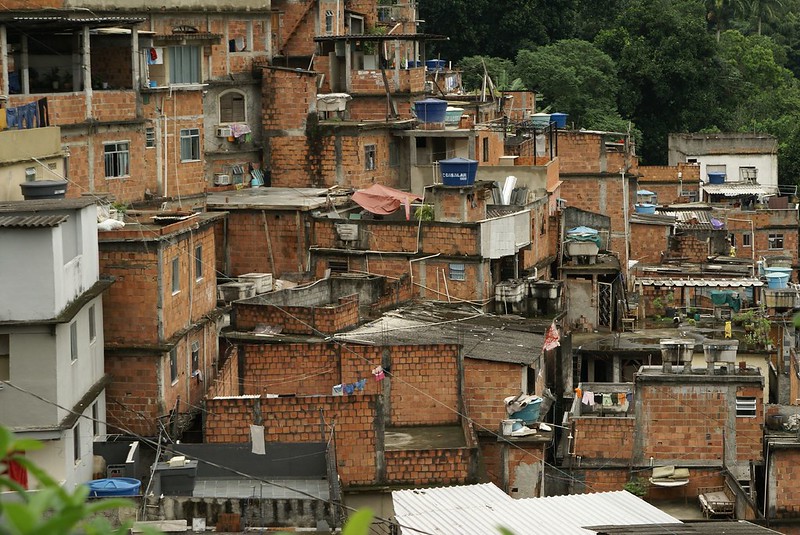
10 Facts About Poverty in Brazil

Facts About Poverty in Brazil
The biggest country in South America is dealing with one of the most drastic poverty issues on Earth. Despite billions of dollars invested in event tourism like the World Cup (2014) and the Olympics (2016), Brazil’s economy has begun to spiral downward as the country faces its biggest decline in over a decade. These crucial facts about poverty in Brazil offer insight on the issues that plague them.

Poverty in Brazil

  1. The homeless population is revolutionary
    One of the recent facts about poverty in Brazil is that squatters there have collectively chosen to occupy abandoned hotels and are now facing the threat of eviction. One example is the Mauá Occupation, which houses over 1,000 people that make up around 237 families. Mauá was a unique idea back in 2007 when the homeless population was barely surviving on the streets and began taking up land by way of force. Now, it has become a full-blown movement. Like many countries, Brazil suffers from gentrification and increased living costs. Brazil’s gentrification has created a revolution of homeless people occupying space both as a protest and out of necessity. This past November, over 20,000 homeless marched throughout the city in direct protest of the housing inequity.
  2. Slavery ended only 130 years ago; inequality still devastating
    In 1888, Brazil became the last country in the Western Hemisphere to abolish slavery, and the social, economic and moral ramifications of it still ripple throughout the nation. This is one of the more subtle and lesser spoken facts about poverty in Brazil because it reflects an ugly part of a recent history. Known as Afro-Brasileiros, black and brown Brazilians make up 51 percent of the nation’s population and suffer from discrimination and exclusion more than their lighter-skinned neighbors. Afro-Brasileiros also make up the majority of the homeless and poor population, and only seven percent of the city’s rich self-identify as such. Despite being known as a racial democracy, 80 percent of Brazil’s richest one percent are white, while only 13 percent of black and mixed-race Brazilians between 18 and 24 are currently enrolled in college. Afro-Brasileiro activism takes many forms; the Quilombos are descendants of slaves fighting for reparations. Another group focuses on the disproportions of blacks dying at the hands of Brazilian police. They have the slogan #VidasNegrasImportam, which translates to “Black Lives Matter.”
  3. New spending cap is making matters worse
    The new spending cap, known as PEC 55, will cut public spending for programs that help the poor. A U.N. official lauded it as the most socially regressive austerity package in the world. With 60 percent of Brazilians opposing it, the 20-year spending freeze inducted by President Temer has been protested and deemed a direct attack on the poor by many analysts.
  4. Unemployment was once slow growing; now it’s much faster
    Since the end of the World Cup in 2014, Brazil’s economy has been steadily declining to a new low. Unemployment grew from about six percent in December 2013 to nearly 12 percent in November 2016, despite almost 30 million Brazilians rising out of poverty between 2004 and 2014. Economic inequality is now expected to increase and around 2.5 million more Brazilians will be forced into poverty in the coming years.
  5. Water everywhere but not much to drink
    Roughly 20 percent of the world’s water supply is in Brazil yet much of the population suffers from a water shortage. The problem is that water is being used to power the economy, not the people. This is actually one of the older facts about poverty in Brazil, as the nation’s water misallocation has always been notoriously underserving. More than 60 percent of the nation’s energy is from hydropower plants while 72 percent of the water supply is consumed by agriculture via irrigation. In fact, Brazil is one of the most water-dependent nations in the world. More than eight percent of its GDP is agriculture and agroindustries, making it the world’s second-largest food exporter. Allocation of most of the nation’s water goes to the business sectors, and between 2004 and 2013, there was only a 10 percent increase in sanitation networks among the poorest 40 percent (i.e., households with toilets).
  6. From an emerging economy to a shrinking one
    Formerly an emerging economy growing at a rate of 7.5 percent in 2010, it shrunk at about the same rate over the last two years. Shrinkage is expected to increase due to President Temer’s privatization plan, and around 57 state assets are set to undergo a privatized makeover. From highways to airports and even the national mint, the privatization is in an effort to increase employment and improve quality of the service provided by the sectors. There is some proof that this could work; back in the 90s, the privatization lead to the considerable modernization of several crucial sectors. The best possible scenario still leaves the majority of the population, specifically the poorest, out of the financial loop.  Attracting international interests is great for the richest population looking to sell land to the highest bidder which happens to be China.
  7. Deforestation of the Amazon by China hurts locals directly
    China’s overwhelming demand for food meets Brazil’s immense agricultural production in a way that primarily benefits the wealthiest of Brazil. The Brazilian government has been selling off large parts of the Amazon to China directly, ironically in an effort to help China’s pollution while hurting Brazil’s sensitive ecology and economy. China’s deforestation of the Amazon temporarily increases employment in Brazilian cities near the forest, but then once first stages of production are over, massive layoffs result in a plummet of employment with the social climate (increased crime and violence) going with it. The massive deforestation even threatens Brazil’s ecological promises involved with the Paris Agreement.
  8. Infant mortality has dropped significantly but could be lower
    As of 2016, Brazil has significantly lowered it’s infant mortality rate from about 53 deaths per 1,000 (circa 1990) live births to about 14. While this is quite an achievement for such a developing country with so many social problems, UNICEF, the organization most responsible for helping the decline, remarked that the indigenous children of Brazil’s mortality rate is twice as high as those of city-born children. This shows that even for countries with relatively low levels of mortality, greater efforts to reduce disparities at the sub-national level are still needed. According to UNICEF, back in 2013 at least 32 municipalities still had an infant mortality rate of 80 deaths per 1,000 live births.
  9. Worker’s Unions are going extinct
    A recent law passed by President Temer allows employers to bypass nearly all hurdles set up by unions by eliminating a “union tax” that generates funding for worker’s unions. Designed to aid multinational corporations and not workers, the “reform” has been criticized by the International Labor Organization (ILO) as being in violation of international conventions. This permits inhumane working conditions and legalizes free labor. Legislation changes like this alter the future of the Brazilian workforce exponentially as multinational companies begin their migration into the Amazon.
  10. The right conditions for slavery
    Temer altered the definition of slavery so that it is defined by the victim’s freedom to leave. Meaning if a worker is kept in all the same living conditions as slavery, but not being physically forced to stay, it is to be considered legal labor. This is an emerging fact about poverty in Brazil because it has not happened yet, but legislatively, the absurd conditions do exist and the threat of slave labor is very real. This critical alteration of the definition has lead to the need for deeper investigations and, in alignment with the new changes, requires a police report with every case, creating more complications with each case. This drastically hurts the effectiveness of the ILOs ongoing fight against slavery which saw the liberation of more than 30,000 slaves in Brazil since 2003. The migration of businesses to the Amazon has made investigations much harder for the ILO and the conditions under which slaves work have gotten more brutal as well.

– Toni Paz
Photo: Flickr

March 2, 2018
https://borgenproject.org/wp-content/uploads/borgen-project-logo.svg 0 0 Borgen Project https://borgenproject.org/wp-content/uploads/borgen-project-logo.svg Borgen Project2018-03-02 19:19:392020-01-08 15:08:5110 Facts About Poverty in Brazil
Global Poverty

10 Important Facts about Poverty in Brazil

Facts about Poverty in Brazil
Brazil’s learning initiatives focus on ending poverty at both the national and international levels. However, the Brazilian economic boom of the last decade seems to have concluded with millions returning to poverty. The following 10 facts about poverty in Brazil provide insight on the country’s current poverty threshold, political state, budget cuts and programs created to combat poverty.

Facts about Poverty in Brazil

  1. Brazil’s poverty line is set at 140 Brazilian reais per month, which roughly converts to $44 at the current exchange rate. Brazilians making less than $528 per year are considered to be in poverty.
  2. According to the World Bank, 28.6 million Brazilians emerged from poverty between 2004 and 2014. The World Bank further estimates that, from the start of 2016 to the end of this year, 2.5 million to 3.6 million Brazilians have fallen below the poverty line.
  3. Several cuts in social services, such as Bolsa Familia, have occurred under President Michel Temer. Bolsa Familia is Brazil’s family allowance program that provides monthly subsidies to qualifying low-income people. Non-labor income, such as Bolsa Familia, is responsible for the nearly 60 percent reduction of people living in poverty. Although increased unemployment pushes more citizens toward the program, fewer people are actually qualifying for coverage. Bolsa Familia’s decline in coverage may correlate with the recent crackdown on fraud, as Temer’s administration found discrepancies regarding 1.1 million recipients.
  4. Former President Luiz Inacio Lula da Silva has been under investigation regarding corruption allegations. Da Silva is appealing a conviction regarding a 10-year sentence for corruption, but he continues to lead preference polls for next year’s presidential election. His campaign promises to refocus on the poor and return to better economic times.
  5. After hosting the 2016 Summer Olympics, Rio de Janeiro has suffered extreme economic unrest. The city struggles to pay thousands of public workers, with many receiving wages in late installments. Further items that have been reduced from the budget include garbage collection and a community policing program.
  6. Brazil’s learning initiative World Without Poverty (WWP), or Mundo Sem Pobreza, educates the world on social protection policies and initiatives to fight poverty. Brazil’s innovative solutions have been documented for international access since 2014 and WWP continues to compile the best practices used by other countries to improve global social protection systems.
  7. The Food Purchase Program, PAA, encourages family farming and increases food availability. The program increases regional and local marketing networks, promotes purchasing of foodstuffs by government, endorses biodiversity and organic food production, supports cooperatives and associations and encourages healthy eating habits.
  8. Cisterns Program, or Programa Cisternas, is a national program to support rainwater harvesting and other social technologies for accessing water. It is a part of the Water For All program where concrete cisterns are built for water storage. Stored water is consumed by households, business facilities and rural schools in the semi-arid region.
  9. Brazil’s semi-arid region frequently suffers droughts. The Cisterns Program’s initial goal was to install one million cisterns for domestic use, which was achieved in 2014 and has since been surpassed. Although the region has experienced a harsh drought since 2012, negative effects, such as child mortality, mass migration and starvation, are no longer widespread.
  10. 43 percent of children under five (almost 250 million) in low and middle-income countries face severe developmental issues due to hunger, malnutrition and violence. The Lancet launched “Advancing Early Childhood Development: from Science to Scale” in Brazil. This study focuses on child development from birth to three years of age, emphasizing the importance of proper care during this critical period. Insufficient care can result in poor academic performance, chronic diseases and other developmental issues.

According to Fox News, the average American spends approximately $1,100 per year, more than double Brazil’s poverty threshold, on coffee. A simple conclusion can be reached from these 10 facts about poverty in Brazil: if every American cut their coffee budget in half, they could help eradicate poverty in Brazil.

– Carolyn Gibson

Photo: Flickr

November 18, 2017
https://borgenproject.org/wp-content/uploads/borgen-project-logo.svg 0 0 Borgen Project https://borgenproject.org/wp-content/uploads/borgen-project-logo.svg Borgen Project2017-11-18 07:30:212019-12-23 08:03:2210 Important Facts about Poverty in Brazil
Global Poverty, Poverty Reduction

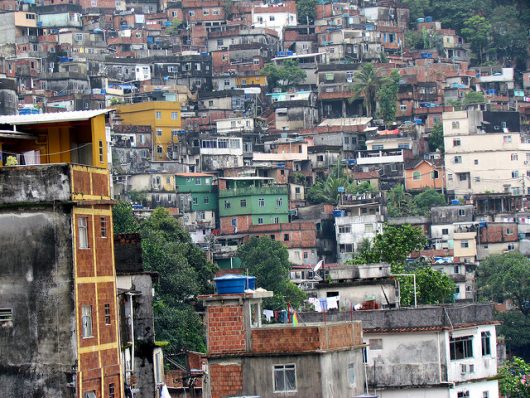
Poverty In Brazil

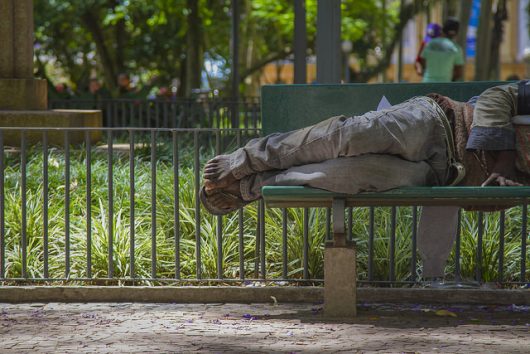
poverty in brazil
Poverty in Brazil impacts all aspects of the country. Last month, thousands stormed the streets of Brazil to protest increased transportation fares. As the protests persisted, the causes of the protests expanded to include government corruption, poor social services, and high taxes, while meanwhile, billions were being spent to host the World Cup and the 2016 Olympics. Amidst this public upheaval, President Rousseff’s approval rating slipped from 73.7% to 49.3% in July. During Rousseff’s election campaign, she promised to eradicate poverty, saying it would be her top priority in office. Many are upset that these changes have not come soon enough.

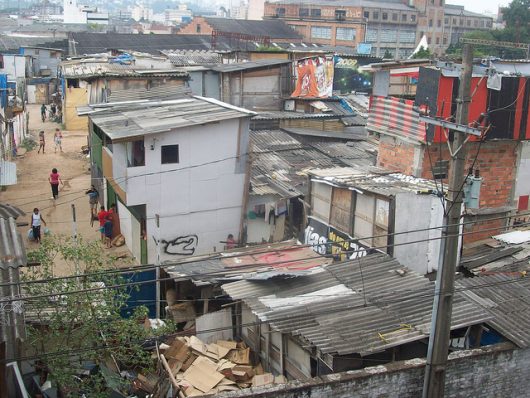
With some of the highest paid executives in the world and an appreciating currency, the Brazilian economy appears to be well off. In addition, poverty in Brazil has been halved in the last two decades. The government is credited with lifting 28 million out of extreme poverty and bringing 36 million into the middle class. But despite being the sixth largest economy in the world, Brazil’s GDP per capita ranks 100th, behind Iran and Costa Rica. In Brazil, poverty disproportionately affects the young and those in the northeast. 8.5% of the population (16.2 million) lives on less than $45/month. Of the 16.2 million living below the poverty line, 4.8 million survive on no income at all.


Poverty In Brazil


To put it simply, Brazil is a nation of stark contrasts. Although the nation has some of the wealthiest in the world, many more suffer from extreme poverty. 26% of the population still lives below the poverty line. Brazil spends a lot of money on social programs, but because these programs are pro-rich, Brazil’s poorest only see 13% of all total benefits compared to 24% at the top. Increased social spending would not alleviate poverty in Brazil. Rather, Brazil must restructure its spending to reach the poorest. Maercio Menezes, professor of economics at the University of Sao Paulo, told the BBC, “Brazil is one of the most unequal countries on the planet… The reduction (of poverty) that has been taking place in the past decades is minor. If you are born into a poor family it is very difficult for you to eventually become rich.”

In June of 2011, President Rousseff expanded the country’s aid programs to reach the nation’s poorest. Rousseff launched a multi-billion dollar social assistance program called “Brazil without Misery,” and its aim is to eradicate extreme poverty from Brazil by 2014. The program expands a cash transfer benefit program started in 2003 by the Bolsa Family, which provided families with cash benefits in exchange for keeping their children in school and following a simple health and vaccination program. Since the program’s inception, it has helped tens of millions of Brazilians by providing food and basic social services. But, according to President Rousseff, Brazil cannot be content with just a big social program – it must do more to reach the nation’s poorest.

“Brazil without Misery” is made up of three components. First, it extends the cash transfer program to reach more people. The program increases the number of eligible children per family from three to five, in order to reach an additional 1.3 million children. Second, the government aims to improve access to health services, education, and improved infrastructure (running water, electricity, sewage disposal). Lastly, the plan intends to improve the economic means available to Brazilians through job creation, vocational-training and microcredit. To assist Brazil, the World Bank has offered $8 billion towards the program.

Several weeks ago, Pope Francis made a visit to one of Brazil’s most infamous slums. The Brazilian government was most worried about protesters during the Pope’s visit, but the Pope showed support for the nation’s poor and even criticized the government for not doing enough. “Here, as in the whole of Brazil, there are many young people… You have a particular sensitivity towards injustice, but you are often disappointed by facts that speak of corruption on the part of the people who put their own interests before the common good.”

In order to eradicate poverty in Brazil, it is clear that a social overhaul is necessary. The stark inequalities within Brazilian society keep the rich wealthy, but prevent the poor from attaining economic security. Social and economic restructuring will not come easily, nor will they come immediately. Moreover, Brazil will need to reassess “Brazil without Misery” once its term is up in 2014 to see if continuation or expansion is required to meet the needs of the nation’s poorest.

– Kelsey Ziomek

Sources:World Bank,Rural Poverty Portal,Rio Times,ISSA
Photo: Paraiba Paradise

August 2, 2013
https://borgenproject.org/wp-content/uploads/borgen-project-logo.svg 0 0 Borgen Project https://borgenproject.org/wp-content/uploads/borgen-project-logo.svg Borgen Project2013-08-02 05:39:552024-05-25 00:12:28Poverty In Brazil
Page 7 of 7«‹567

Get Smarter

  • Global Poverty 101
  • Global Poverty… The Good News
  • Global Poverty & U.S. Jobs
  • Global Poverty and National Security
  • Innovative Solutions to Poverty
  • Global Poverty & Aid FAQ’s
Search Search

Take Action

  • Call Congress
  • Email Congress
  • Donate
  • 30 Ways to Help
  • Volunteer Ops
  • Internships
  • Courses & Certificates
  • The Podcast
Borgen Project

“The Borgen Project is an incredible nonprofit organization that is addressing poverty and hunger and working towards ending them.”

-The Huffington Post

Inside The Borgen Project

  • Contact
  • About
  • Financials
  • President
  • Board of Directors
  • Board of Advisors

International Links

  • UK Email Parliament
  • UK Donate
  • Canada Email Parliament

Get Smarter

  • Global Poverty 101
  • Global Poverty… The Good News
  • Global Poverty & U.S. Jobs
  • Global Poverty and National Security
  • Innovative Solutions to Poverty
  • Global Poverty & Aid FAQ’s

Ways to Help

  • Call Congress
  • Email Congress
  • Donate
  • 30 Ways to Help
  • Volunteer Ops
  • Internships
  • Courses & Certificates
  • The Podcast
Scroll to top Scroll to top Scroll to top