• Link to X
  • Link to Facebook
  • Link to Instagram
  • Link to TikTok
  • Link to Youtube
  • About
    • About Us
      • President
      • Board of Directors
      • Board of Advisors
      • Financials
      • Our Methodology
      • Success Tracker
      • Contact
  • Act Now
    • 30 Ways to Help
      • Email Congress
      • Call Congress
      • Volunteer
      • Courses & Certificates
      • Be a Donor
    • Internships
      • In-Office Internships
      • Remote Internships
    • Legislation
      • Politics 101
  • The Blog
  • The Podcast
  • Magazine
  • Donate
  • Click to open the search input field Click to open the search input field Search
  • Menu Menu

Archive for category: Nonprofit Organizations and NGOs

Information and stories about nonprofit organizations and NGOs

Children, Nonprofit Organizations and NGOs

Spotlight: Giving Children Hope

children_hope_education
Giving Children Hope (GCHope) is a grassroots organization that strives to do just what its name suggests: focus on the social, economic and health needs of impoverished children around the world. GCHope aims to achieve this through disaster relief, health and community development, and vocational training in developing countries.

President and CEO John Ditty and his wife developed the idea of GCHope in 1993 after deciding to make it their lives’ aims to help the world’s disadvantaged youth, both at home in the United States and internationally. Though the program started by merely delivering medical supplies to regions of developing countries with the least access to health care, the Dittys soon realized that they needed to do more.

As they recognized that children were necessarily a part of families and wider communities, the Dittys expanded GCHope to include community medical clinics and micro-enterprises, immediate disaster relief, and increased family health care coverage in some of the world’s most disadvantaged regions.

GCHope doesn’t take its mission statement lightly, and has been working tirelessly for the last 20 years to make a difference in children’s lives in every corner of the globe. In 2008, GCHope led an initiative to send cholera medicines to Zimbabwe after an outbreak.

One year later, in 2009, the group partnered with Not For Sale to establish clinic in Northern Thailand for children rescued from slavery. In order to raise funds for the latter project, GCHope teamed up with the Not For Sale campaign, International Justice Mission, and Free the Slaves to produce a documentary called Call + Response that supported human rights activism against human trafficking.

In 2010, GCHope was one of the first to respond to the Haiti earthquake and begin collecting donated supplies.

GCHope believes that it can empower “disenfranchised communities” and elevate them out of poverty by instilling hope and leadership capabilities into society’s youngest members. When the children in a community are healthy, well educated, hopeful and stable, the cycle of poverty is more likely to be broken.

If children are truly the hope of the future, organizations like GCHope may be the key to unlocking the children’s  potential.

– Alexandra Bruschi

Source: Call and Response, Giving Children Hope, OC Register
Photo: WFP

July 15, 2013
https://borgenproject.org/wp-content/uploads/borgen-project-logo.svg 0 0 Borgen Project https://borgenproject.org/wp-content/uploads/borgen-project-logo.svg Borgen Project2013-07-15 06:47:492024-05-25 00:01:15Spotlight: Giving Children Hope
Nonprofit Organizations and NGOs

Plan International USA

Plan_International_U.S.A_Education
Plan International USA is a nonprofit organization that got started in 1937 by caring for refugee children of the Spanish Civil War. The organization posits that education is a fundamental right, and they direct their energies toward improving access to a quality education and the proper management and governance of education. Donations go toward schools, furniture, supplies, and the proper training of teachers and parent-teacher associations.

Improving access to education for all is a challenging task, especially in those cultures where one group or gender is held in a higher esteem than another. Some societies are very patriarchal and don’t allow for girls and women to receive the education that males do. Plan International U.S.A. has a very visible link on their website to their campaign “Because I Am A Girl”. One story on this webpage deals with the much publicized international case involving Malala, a young girl who pursued her schooling and was attacked by the Taliban for doing so. ”Because I Am A Girl” highlights Malala Day on July 12 as an occasion to demand that all children, especially girls, get the education they deserve. Malala has become a symbol of oppressed children everywhere who are denied their right to an education.

How important is the education of girls to ending global poverty? Plan International U.S.A. reports that 70% of those 1 billion people living in extreme poverty are female. Schooling raises the standard of living of women and gives girls in the developing world the capacity to fight back against injustice. Denying girls this right is costing the developing world $92 billion in potential income.

Plan International U.S.A. is a dedicated organization that champions what is arguably the cure-all for global poverty, education. With projects aimed at getting girls in the classroom and stories of brave children like Malala, the movement is gaining ground. To make a direct donation to helping women and children, please “Protect A Girl” and visit www.planusa.org.

– David Smith

Sources: Plan International U.S.A, Malala Day, Plan U.S.A.
Photo: 

July 14, 2013
https://borgenproject.org/wp-content/uploads/borgen-project-logo.svg 0 0 Borgen Project https://borgenproject.org/wp-content/uploads/borgen-project-logo.svg Borgen Project2013-07-14 13:23:342024-05-24 23:49:42Plan International USA
Nonprofit Organizations and NGOs, Sanitation

From Flying Toilets to Peepoo

Peepoo
Sadly, 40% of the world’s population lack access to basic latrines.

The lack of sanitation is a major world public health issue. Water contaminated by sewage can propagate lethal epidemic diseases such as cholera which develops in fecal secretions. Today, 2.6 billion people lack access to basic sanitation facilities.

Without toilets, people must resort to relieving themselves in plastic bags, which they throw as far away from their home as they can; a phenomenon known as “flying toilets.” In some areas, flying toilets have become a a public health concern.

In slums especially the scarcity of toilets has become particularly worrisome. Dozens of people share the same toilet, and the poor maintenance and virtually nonexistent hygiene of these places makes people more than reluctant to go. Landlords are also not willing to build more facilities, preferring instead to build more houses and rooms that they can rent to earn an income.

Women and children are the most vulnerable to the lack of hygiene. According to Peepoople, “one child dies every 15 seconds due to contaminated water from human excreta.” Just as bad, the lack of privacy makes women prey to rape and sexual harassment, especially at night when they have to look for sanitation facilities. When adolescent girls have their period, they have to stay home from school because they cannot take care of their hygiene.

Peepoople, an organization aimed at providing millions of people with sanitation facilities in the respect of their dignity, has implemented an innovative solution to curb one of the world’s most serious problems. It has created the PeePoo.

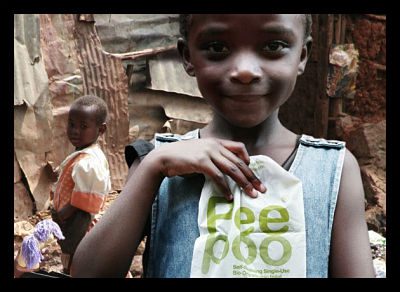
The PeePoo is a bag that “contains five grams of urea, which breaks down waste into ammonia and carbonate,” thereby transforming potentially harmful waste into harmless fertilizer. Biodegradable and designed for the world’s poorest, PeePoo bags only cost $0.03 each.

In the Nairobi slums where Peepoople operates, an incredible micro-economy has emerged after the introduction of the PeePoo bags. For instance, the bags can be used as garden fertilizer, thereby fostering local agriculture and plantation, but they can also be returned to a collection point for a reimbursement of $0.01 per bag.

Seizing the opportunity, some have even made a living off the reimbursement fee. For instance, Mama Lucy, mother of three, told Al Jazeera, “I didn’t have a regular job before the Peepoos were introduced, but I saw an opportunity when people did not want to drop off the bags themselves. Now I do two rounds a day to pick Peepoos from people’s houses. On a good week I earn about a thousand shillings ($11).” Since the introduction of the PeePoo, the number of sexual crimes has also decreased in the Silanga village, according to Mika Mitoko, project manager at Peepoople.

Involving no investment or infrastructure, the PeePoo has proved that easy and cheap solutions can save millions of lives. To learn more about Peepoople, visit their website at: https://www.peepoople.com

– Lauren Yeh

Sources: Peepoople, Al Jazeera

July 14, 2013
https://borgenproject.org/wp-content/uploads/borgen-project-logo.svg 0 0 Borgen Project https://borgenproject.org/wp-content/uploads/borgen-project-logo.svg Borgen Project2013-07-14 04:37:432024-06-04 02:43:56From Flying Toilets to Peepoo
Nonprofit Organizations and NGOs

Spotlight on Plant With Purpose

Plant_with_a_purpose

Who would have known that planting a single tree could pull individuals and entire communities out of poverty? Plant With Purpose has utilized this simple and effective method since the Christian environmental non-profit organization was founded in 1984 by Tom Woolard. After volunteering with a relief agency in the Dominican Republic, Woolard realized that despite their efforts, the crisis of poverty was worsening. He saw that there was a clear connection between poverty and the environment that was not being addressed. Woolard further recognized that much of the world’s poor are rural poor. Many are farmers and therefore rely on the environment for survival. Deforestation across these poor regions has created land that does not provide for production like it used to, creating new hardships for the farmers.

Plant With Purpose focuses on planting trees because they believe it is one of the most effective components of sustainable rural development. Trees provide a means by which farmers can grow crops and in turn support themselves and their families. Trees also play a vital role in protecting our water supply because without trees, water sources vanish. In addition to planting trees, they create economic opportunities through micro-credit loans, micro-enterprise and the implementation of agriculture programs.

Plant with Purpose uses a three-part environmental, economic, and spiritual approach to sustainable development. Their mission for each community is to: 1) improve quality of life, 2) restore relationships between communities, the environment and God, and 3) make self-sufficiency possible.

Since its founding, Plant With Purpose has succeeded in planting 10,092,380 trees. They work in a total of 250 communities throughout Haiti, Mexico, the Dominican Republican, Tanzania, Burundi, and Thailand, and are exploring working in additional countries such as Ethiopia, Kenya, and Guatemala. To determine where Plant with Purpose is most needed, a variety of measures are used including the rate and extent of deforestation, governmental corruption, and the percentage of people living on less than one dollar per day.

“As our focus shifts from the sustainable development of families to the sustainable development of entire villages, the community takes over and Plant With Purpose takes on more of an advisory role,” says Wollard. The greatest reward for Plant With Purpose is a community that doesn’t need them anymore.

– Alexandra Warlich

Source: Interaction
Photo: Stay Classy

July 13, 2013
https://borgenproject.org/wp-content/uploads/borgen-project-logo.svg 0 0 Borgen Project https://borgenproject.org/wp-content/uploads/borgen-project-logo.svg Borgen Project2013-07-13 04:00:132017-02-28 11:55:14Spotlight on Plant With Purpose
Nonprofit Organizations and NGOs, Women and Female Empowerment

Pro Mujer International 101

Pro_Mujer_International_info
Pro Mujer International is a development and microfinance organization helping women in Latin America. They provide financial, health, and human development services to help women break the cycle of poverty. Pro Mujer equips women with the tools and resources necessary to build their own livelihoods through microfinance, business training, and health care support.

Pro Mujer is motivated to affect change in Latin American society. They understand the conditions of income disparity and gender inequality. They believe that when women are given the tools to lift themselves out of poverty, they will also lift their families too. According to Pro Mujer, women are more likely to reinvest in their families to provide education, healthcare and to improve living conditions.

The organization is committed to a client-focused approach that actively seeks results. They strive for integrity, transparency, solidarity and they work to maintain commitment to human development. Pro Mujer was founded by Lynne Patterson and Carmen Velasco in 1990 in Bolivia. Their vision for an organization to help lift women from poverty has today become one of Latin America’s premiere development and microfinance organizations for women. Pro Mujer has since been able to allocate over $1 billion in small loans and services including empowerment training, preventive health education and primary healthcare services.

Examples of the financial services provided by Pro Mujer include small business loans, education and housing loans, savings accounts, and life insurance. Their business and empowerment training programs teach women to be more economically independent and informed decision makers as well as teaching basic financial literacy, and empowerment training on domestic violence, communication and leadership skills. Additionally, Pro Mujer is able to provide healthcare assistance including pre and post natal monitoring, family planning, and sexual and reproductive health services to name a few.

Pro Mujer’s current CEO is Rosario Perez. Perez began her career in private banking where she was charged with leading multinational businesses and teams and executing organizational transformations. She is now responsible for Pro Mujer’s portfolio of more than US $100 million and 1,700 employees. Her employees serve more than 2,547,000 clients in Argentina, Bolivia, Mexico, Nicaragua, and Peru.

– Caitlin Zusy

Sources: Pro Mujer, Mastercard Worldwide

July 11, 2013
https://borgenproject.org/wp-content/uploads/borgen-project-logo.svg 0 0 Borgen Project https://borgenproject.org/wp-content/uploads/borgen-project-logo.svg Borgen Project2013-07-11 18:00:052024-05-24 23:59:48Pro Mujer International 101
Global Poverty, Nonprofit Organizations and NGOs

Heifer International: Sustainable Aid

heifer_opt-1
Many foreign aid organizations and donors provide temporary aid in the form of food, supplies, or direct cash donations. Heifer International is a different kind of organization; Heifer works to provide livestock for impoverished and hungry families so that they will be able to sustain themselves rather than depending on temporary aid. In order to help these people to help themselves, cows, goats, chickens, bees, llamas, and plenty of other options are given in terms of livestock to be donated. These animals help to provide both sustenance and stability to families in need. Agricultural products that the family does not put to use, such as milk, eggs, or honey can also be sold at market for extra income.

Heifer’s goal in this is to ultimately create sustainability for families to allow them to then further their opportunities in life such as provide for education and comfortable living. One of their hopes is also that as one family or group advances in the community that they will share their gift with others around them, allowing the community as a whole to become self-sufficient. With gifts of livestock comes training from Heifer employees, ensuring that the families will make the most of their new additions.

The organization’s projects span the globe, from Cambodia to China to India and Honduras. Their goals with specific projects vary, but include empowering and education of women, environmental conservation, and natural disaster response. A major success story involves a Filipino farmer, Rogelio Abes Jr., who took advantage of Heifer’s gifts and knowledge. Not only did he expand his own farm and income, he shared his livestock and farming techniques with others in the community, and inspired others to rise above poverty through hard work and generosity.

In terms of financials and accountability, Charity Navigator gives Heifer three out of four stars. The organization is entirely transparent with their records and policies, and more than 70% of their income goes to program expenses, while 20% goes to fundraising expenses. Only 6.4% goes toward administrative expenses while the CEO earns .03% of expenses. The only financial issue that arises is the disparity between revenue and program expenses in the past few years, where revenue is significantly higher than program expenses.

On the whole, however, Heifer is working hard against hunger and poverty in many different ways, from school education programs to their Read to Feed initiative that encourages children to read in order to fundraise money for the organization.  Their goals for sustainability seem to be the right direction for food aid to be headed in – while temporary aid can be helpful, it can also breed dependency, and the most important thing is to get people out of situations of poverty and hunger and allow them to be self-sufficient.

– Sarah Rybak

Sources: Heifer International, Charity Navigator
Photo: Heifer International

July 6, 2013
https://borgenproject.org/wp-content/uploads/borgen-project-logo.svg 0 0 Borgen Project https://borgenproject.org/wp-content/uploads/borgen-project-logo.svg Borgen Project2013-07-06 04:47:302024-05-24 23:58:30Heifer International: Sustainable Aid
Education, Nonprofit Organizations and NGOs

A Small NGO on a Big Mission in Bangladesh

Bangladesh-volunteers-association-literacy
Founded in New York in 1998, the Volunteers Association for Bangladesh is a small NGO on a big mission: to change public education for the poor in Bangladesh. The organization, whose members are mostly expatriate Bangladeshis living in the U.S. and Canada, has devoted itself to providing the funds, technical resources, and training necessary to improve Bangladeshi public schools, particularly those in rural areas where most of the country’s poor people live.

Their task could be seen as a daunting one. Statistics from 2009 put the literacy rate among Bangladeshi males at 54%, and among females at only 32%. According to more recent studies, the literacy rate for people in Bangladesh over age 15 is just under 60%. Dropout rates for high school students are estimated at 42%. Figures like these speak to the great educational need that the Volunteers Association for Bangladesh seeks to address.

The VAB has taken a comprehensive approach to meeting these educational needs and tackling the problem of inadequate schooling. Programs in 60 schools across the country are designed to help students from preschool through university. They provide free preschool with a nutritious meal, tutoring for 6th-grade students to help them pass entrance exams for high schools, and scholarships to help high school students pay for tuition and other necessary materials.

The group has also donated supplies like computers and science equipment in order to help 15 public schools better serve their students. In 2005, VAB started a college scholarship program, which has since helped 201 students pay for tuition and textbooks. In addition, they train local university students to work as tutors in the public schools.

All of these efforts are making headway in helping to open up doors to real opportunity for the poor in Bangladesh. The VAB is working to keep expanding its programs, and most recently they have partnered with Microsoft Southeast Asia to start a computer literacy and training program. To learn more about VAB and all of its efforts, visit www.vabonline.org.

– Délice Williams

Sources: Volunteer Association for Bangladesh, The Financial Express
Photo: Voice of America

July 5, 2013
https://borgenproject.org/wp-content/uploads/borgen-project-logo.svg 0 0 Borgen Project https://borgenproject.org/wp-content/uploads/borgen-project-logo.svg Borgen Project2013-07-05 05:27:362017-11-30 11:09:43A Small NGO on a Big Mission in Bangladesh
Nonprofit Organizations and NGOs

Our World’s Young Leaders: Amigos de las Americas

Amigos_de_las_Americas

What does a word leader look like? Presidents, executives, members of Congress, and those with major publicity are probably the first people that come to mind.

Yet there are some leaders that don’t get this same attention. These leaders are in the background, changing communities one step at a time and building life long bonds to international cultures that can’t be diminished.

These leaders are the young students of the Amigos de Las Americas organization. Founded in 1965, Amigos stresses the importance of leaders and advocates out in the communities today. Developing leadership and cultural skills, Amigos sends high school and college students out into international communities, where developed skills are used to implement change in health and education practices.

The community service projects that Amigos have been involved in have a profound impact on the people of Latin America. In just 48 years of operation, Amigos has administered nearly 8 million immunizations, given 63,904 medical screenings and planted nearly 300,000 trees in numerous communities of Latin America. They have constructed health facilities, homes and community centers, as well as nearly 38,000 restrooms.

The influence this organization has on Latin America can’t be overstated, and students have had an overwhelming response. Over two dozen chapters have opened up in America, including a large chapter in Austin. Eighteen states in America host these chapters and are involved in the Amigos organization.

Amigos have already begun planning ahead to the summer projects of 2014. Some of the places where students will participate include Peru, Paraguay, Nicaragua, and Ecuador. The organization accepts donations on their website to help fund these trips and other projects. For more information on how to apply for one of these trips, visit www.amigoslink.org.

There are no limits to becoming a leader. Make a difference now.

– William Norris

Sources: Amigos de las Americas, Austin Amigos
Photo: Amigos de las Americas

July 1, 2013
https://borgenproject.org/wp-content/uploads/borgen-project-logo.svg 0 0 Borgen Project https://borgenproject.org/wp-content/uploads/borgen-project-logo.svg Borgen Project2013-07-01 10:35:342021-06-25 12:57:32Our World’s Young Leaders: Amigos de las Americas
Global Poverty, Nonprofit Organizations and NGOs

Transparency International USA Inspires

Transparency International USA InspiresTransparency International USA, or TI-USA, aims to live up to its name by promoting much-needed accountability in governments and businesses, both at home and abroad.

The task of successfully eliminating global poverty is often precluded by entrenched corruption practices in governments and businesses in both the developing and developed world. TI-USA was founded in 1993 as a chapter of the greater Transparency International movement in an attempt to address this corruption and to “promote transparency and integrity in government, business, and development assistance.”

TI-USA reports that each year, bribery, fraud, collusion, and other various forms of corruption taint over $1.5 trillion in public purchasing. Billions of dollars in illicit assets currently flow out of developing countries that need the money to survive.

TI-USA not only views this behavior as unacceptable and immoral but sees the consequential economic, social and health effects that such corruption may spur. In corrupted governments, most of a country’s assets remain in the top levels of society, placing a greater financial burden on the country’s poor who are often deprived of education, nutrition, clean water and health care.

As a branch of an already well-established nonprofit organization, TI-USA’s chief goal is to make the United States a forefront actor in establishing anti-corruption laws across the globe turning first to addressing transparency issues within the U.S. government itself. By doing this, the U.S. can show its commitment to the anti-corruption goal by reforming its own shortcomings as a model for developing countries to follow.

TI-USA shows that in order to become a leader in global activism a country must live up to the standards it promotes abroad within its own national boundaries.

– Alexandra Bruschi

Sources: Transparency International USA, Business Wire
Photo: Flickr

July 1, 2013
https://borgenproject.org/wp-content/uploads/borgen-project-logo.svg 0 0 Borgen Project https://borgenproject.org/wp-content/uploads/borgen-project-logo.svg Borgen Project2013-07-01 01:20:322024-06-10 03:36:10Transparency International USA Inspires
Development, Global Poverty, Health, Nonprofit Organizations and NGOs

A Look at Lutheran World Relief

A Look at Lutheran World Relief
Lutheran World Relief has been offering emergency aid to people around the world for more than 60 years. The group formed in the aftermath of World War II, which rendered an estimated 20% of Lutherans homeless. In response to this need, 20 Lutheran churches in the US organized themselves to send aid to their fellow church members.

Most of the aid in that initial period went to Germans and Scandinavians, but LWR founders soon came to believe that they should distribute aid to people regardless of their religious affiliation. In the decades immediately following World War II, the organization sent emergency aid to the Middle East, Hong Kong, Korea, and Bangladesh. Currently, they reach out to people needing emergency help on nearly every continent.

Since then the mission of LWR has evolved even further from providing aid for emergency food, shelter, and medicine, to implementing a comprehensive sustainable development program. The organization now works to address needs in a number of areas, including health, agriculture, and the environment. In pursuing that mission, LWR regularly:

  • Helps farmers learn about new techniques and gain access to microcredit loans.
  • Partners with local communities to dig wells to provide clean water.
  • Educates people about malaria and other infectious diseases.
  • Encourages civic participation by fostering grassroots community organizations to help marginalized groups communicate effectively with their governments.

In addition, the groups on the ground emergency programs are designed to continue recovery efforts long after disasters strike.  LWR is committed to helping afflicted communities build resiliency and recover for the long-term.

Over the years, Lutheran World Relief has earned respect around the world for their efforts.  The group has one of the highest ratings from the site CharityNavigator.org, which rates organizations for their transparency and efficient use of donations. To learn more about Lutheran World Relief, or to donate to the organization, visit www.lwr.org.

 – Délice Williams

Sources: LWR, Charity Navigator
Photo: Lutheran World Relief

July 1, 2013
https://borgenproject.org/wp-content/uploads/borgen-project-logo.svg 0 0 Borgen Project https://borgenproject.org/wp-content/uploads/borgen-project-logo.svg Borgen Project2013-07-01 01:14:182024-05-24 23:59:21A Look at Lutheran World Relief
Page 58 of 60«‹5657585960›»

Get Smarter

  • Global Poverty 101
  • Global Poverty… The Good News
  • Global Poverty & U.S. Jobs
  • Global Poverty and National Security
  • Innovative Solutions to Poverty
  • Global Poverty & Aid FAQ’s
Search Search

Take Action

  • Call Congress
  • Email Congress
  • Donate
  • 30 Ways to Help
  • Volunteer Ops
  • Internships
  • Courses & Certificates
  • The Podcast
Borgen Project

“The Borgen Project is an incredible nonprofit organization that is addressing poverty and hunger and working towards ending them.”

-The Huffington Post

Inside The Borgen Project

  • Contact
  • About
  • Financials
  • President
  • Board of Directors
  • Board of Advisors

International Links

  • UK Email Parliament
  • UK Donate
  • Canada Email Parliament

Get Smarter

  • Global Poverty 101
  • Global Poverty… The Good News
  • Global Poverty & U.S. Jobs
  • Global Poverty and National Security
  • Innovative Solutions to Poverty
  • Global Poverty & Aid FAQ’s

Ways to Help

  • Call Congress
  • Email Congress
  • Donate
  • 30 Ways to Help
  • Volunteer Ops
  • Internships
  • Courses & Certificates
  • The Podcast
Scroll to top Scroll to top Scroll to top