• Link to X
  • Link to Facebook
  • Link to Instagram
  • Link to TikTok
  • Link to Youtube
  • About
    • About Us
      • President
      • Board of Directors
      • Board of Advisors
      • Financials
      • Our Methodology
      • Success Tracker
      • Contact
  • Act Now
    • 30 Ways to Help
      • Email Congress
      • Call Congress
      • Volunteer
      • Courses & Certificates
      • Be a Donor
    • Internships
      • In-Office Internships
      • Remote Internships
    • Legislation
      • Politics 101
  • The Blog
  • The Podcast
  • Magazine
  • Donate
  • Click to open the search input field Click to open the search input field Search
  • Menu Menu

Archive for category: Food & Hunger

Information and stories on food.

Food & Hunger

Nigerian Immigrant Becomes a Successful US Chef

Nigerian-Immigrant-Tunde-Wey-Successful-ChefTunde Wey is on a mission to “unfetter diners from the tedium of modern American cuisine.” The Nigerian-born chef came to the United States at age 16 with plans to become a doctor. But, after living in Detroit for 15 years, he finally realized that what he really wanted to do was cook.

Geographically just about the size of Texas, Nigeria’s population totals at about 150 million people. Since the country is the most populous in Africa, Wey always felt perplexed as to why food from his homeland was not more obtainable in the United States.

After co-founding a restaurant in Detroit, the Nigerian immigrant began his own “pop-up” restaurant. He aimed to explore America, as well as to introduce people to the food he grew up with. The name of his business, Lagos, is the name of his hometown in Nigeria.

With Greyhound busses as his primary mode of transportation, Wey impressed diners in New Orleans, Chicago and Buffalo and then headed for the East Coast. He would rent out different spaces, sometimes a restaurant and other times communal kitchens, and make his crowd a delicious feast. After continued success, his one-night, one-man restaurant started selling out.

Each night, the chef brought along with him a bag filled with cooking supplies such as alligator pepper seeds, calabash nutmeg and uda, which is a kind of pepper. Wey likened it to a doctor’s medicine bag. He had no formal training and mostly went by what he observed in his childhood kitchen.

“I learned how to cook from watching my parents, my aunt, a lot of YouTube videos… The benefit that I have is that I grew up with this food, so I know exactly what it’s supposed to taste like,” he said.

In fact, as he gained footing in his own kitchen, Wey became more and more aware of how much he missed his family, who he had not seen in over seven years. It is rare, but in some instances, children are sent over to the United States on their own and then later sponsor family members to emigrate and join them. Charitable groups and advocacy organizations help with this process.

Wey was getting major attention from top-notch chefs and was asked to go to Los Angeles to cook with celebrity chef Roy Choi in February 2015. But, his trip came to screeching halt when a team of border patrol agents stopped his Greyhound bus near El Paso, Texas. They discovered that his Nigerian passport had long expired.

It was back in 2007 when he allowed his student visa to expire. Wey said, “I just thought: I’ll fix this. I’m going to go back to school, finish and adjust my status somehow. And so it was something I kept putting off.” Nearly 50% of all illegal immigrants are in the same predicament. They let their visas expire and fail to renew them.

Wey spent a few months detained in El Paso and felt as though all of his success in America had hit a wall. Fortunately for him, he had a clean record and many friends and family members who managed to raise $6,000 to bail him out and keep him from being deported.

The backup in immigration court means that Wey’s appointment is not until 2017. A judge will then determine his fate: whether he can stay or whether he must say goodbye to all of his dreams and go back to Nigeria. Until then, he plans to keep cooking and has achieved a prime spot for a new restaurant in New Orleans’ St. Roch Market.

Wey is one of 11 million undocumented immigrants currently living in the United States, according to the U.S. Center for Immigration Studies. The Pew Research Center reported in 2014 that illegal immigrants make up 5.1 percent of the U.S. labor force.

– Lillian Sickler

Sources: NPR, Lagos, Metro Times, Eater, Laws, New York Times, Pew Research
Photo: Pinterest

July 29, 2015
https://borgenproject.org/wp-content/uploads/borgen-project-logo.svg 0 0 Borgen Project https://borgenproject.org/wp-content/uploads/borgen-project-logo.svg Borgen Project2015-07-29 09:27:242020-07-07 13:57:22Nigerian Immigrant Becomes a Successful US Chef
Food & Hunger, Food Security, Global Poverty

USA Food Waste: 7 Surprising Facts

usa food wasteWhat’s the number one risk to worldwide health? The answer may surprise you–it’s not AIDS or malaria, but hunger and malnutrition. One in nine people in the world do not get enough food to be healthy and lead an active life. And yet, in countries like the United States, there remains a shocking excess and waste of food products that could be used to feed millions around the globe. As people become increasingly conscious about recycling and the environment, they should also take a moment to turn their attention to how much they put on their plates. The following points are seven eye-opening facts that shed light on just how extensive the problem of American food waste is.

1. Let’s Talk Calories

The volume of American annual food waste might be better understood in terms of calories. The U.S. Department of Agriculture reports that each year, a staggering 141 trillion calories are gone unconsumed. This is equivalent to around 1,300 calories per capita, per day. This is approximately the number of calories consumed by a small adult or child in a day, meaning that these wasted calories could go toward nourishing several hungry people.

2. Just How Much Food Is 141 Trillion Calories?

Not everyone likes to count calories, and even fewer know what exactly a calorie is. To put it in different terms, over a third of the entire U.S. annual food supply is wasted, a total of 133 billion pounds. That equals more than 20 pounds of food per person per month. Most everyone knows what pounds are, and that’s a lot of them.

3. Americans Waste Some Foods More Than Others

According to the USDA, the top three kinds of food thrown away in 2010 were dairy (25 billion pounds), vegetables (25 billion pounds) and grains (18.5 billion pounds). These are three of the essential food groups on the food pyramid.

4. The U.S. Navy Throws Away What It Can’t Fit In Its Boats

The government provides the brave men and women of the U.S. Navy with the food and drink necessary to make their sea excursions bearable, but sometimes it isn’t possible to get all the food that is given to them into the storage space of their vessels, which are often very small. One might suppose that when this happens the food is donated to a local homeless shelter or food bank.

Unfortunately, this is not the case. Because the U.S. government could be held liable for any sickness that might result from the consumption of a donated food product, the Navy is forced instead to throw surplus provisions away. The extra microwave pizzas and cereal pouches might not seem like much, but this wasted food could be used to feed a family in need.

5. Americans Throw Out More Food Than Pretty Much Anything Else

Food waste makes up over a fifth of American garbage, and half of the waste accumulates at landfills. America tosses more food into the trash than paper, plastic, metal or glass—with 5 million tons as the smallest discrepancy.

6. Food Waste Hurts The Environment

The aforementioned landfills are filled with decomposing organic waste that produces methane, a greenhouse gas that is 20 times more dangerous than carbon dioxide. These landfills are the largest producer of methane emissions in the United States, making up almost a quarter of the total emissions, according to the NRDC.

7. On the Bright Side…

The amount of food wasted, not only by the United States but by other nations as well, suggests that alleviating world hunger isn’t a matter of producing more food. Instead, it is a matter of better managing the food that is already produced, by preserving it and distributing it more thoroughly. There is enough food to feed all 7 billion people in the world. It just needs to get to put in mouths instead of in the trash.

– Katharine Pickle

Sources: NPR, Washington Post
Photo: Wikimedia Commons

July 29, 2015
https://borgenproject.org/wp-content/uploads/borgen-project-logo.svg 0 0 Borgen Project https://borgenproject.org/wp-content/uploads/borgen-project-logo.svg Borgen Project2015-07-29 09:02:082024-12-13 17:51:49USA Food Waste: 7 Surprising Facts
Food & Hunger, Food Aid, Food Security, Global Poverty, Hunger

The Zero Hunger Challenge Revisited

Hunger_ChallengeIt is a simple phrase, proven fact and universal goal all in one: Hunger can be eliminated in our lifetime.
This belief launched the Zero Hunger Challenge in 2012, a program that challenged individuals and organizations to recognize and assist the 800 million hungry people around the world.

Started by U.N. Secretary-General Ban Ki-moon, the challenge strives to achieve five outcomes: zero stunted children less than two years, 100% access to adequate food all year round, making all food systems sustainable, a 100% increase in smallholder productivity and income, and zero loss or waste of food.

Ki-moon believes that combining these five elements will create a world with no hunger. The Zero Hunger Challenge encourages participation from a wide range of people and organizations.

Now three years after Ki-moon launched his Zero Hunger Challenge, countries around the world are declaring their own “end hunger” plans.

In May 2015, the United Nations assisted the government of the Lao People’s Democratic Republic in launching the National Zero Hunger Challenge, which joined with other countries to eliminate hunger and malnutrition while also increasing food resources. Also in May, the Royal Government of Cambodia started a National Zero Hunger Challenge to end hunger in their country by 2025.

As more countries join the National Zero Hunger Challenge, the goal to end hunger becomes more and more realistic. The United Nations estimates that ending world hunger will require investments in rural and urban areas so that poorer people can have access to food and can improve their lives.

Recently, the Zero Hunger Challenge has gained more support from church organizations.

The Ecumenical Advocacy Alliance, a global network of church organizations, asks all uninvolved individuals and churches to join the initiative.

Dr. Manoj Jurian, World Council of Churches coordinator, said, “No one should be hungry, especially in a world that already produces more than enough food to feed everyone. We can build sustainable and waste-free food systems that nourish and support all people and empower the smallholder and family farms that produce that vast majority of the world’s food.”

Dr. Jurian also notes that as religious people, churches are committed to ensuring that no person is hungry. The Bible contains many stories about hunger, the most notable being Matthew 1:25, in which Jesus tells his followers, “For I was hungry, and you fed me. I was thirsty, and you gave me a drink. I was a stranger, and you invited me into your home.” In these lines, caring individuals aid someone in need of food and water; like so, Dr. Jurian claims it is part of religious duty to help those in need.

With active participants around the world, world hunger can end in our lifetime. To join the challenge, visit: www.un.org/en/zerohunger/.

– Kelsey Parrotte

Sources: AllAfrica, Ecumenical Advocacy Alliance, United Nations
Photo: United Nations

July 29, 2015
https://borgenproject.org/wp-content/uploads/borgen-project-logo.svg 0 0 Borgen Project https://borgenproject.org/wp-content/uploads/borgen-project-logo.svg Borgen Project2015-07-29 07:58:012024-05-27 09:26:14The Zero Hunger Challenge Revisited
Food & Hunger, Food Aid, Global Poverty, Hunger

FoPo Food Powder and World Hunger

FoPo_Food_Powder

1.76 billion tons of food is wasted globally each year. Food waste is caused by buying or preparing more food than necessary, and not cooking or eating food purchases at all.

To solve this problem and to alleviate world hunger, a group of Swedish master students created FoPo Food Powder. The product is created by turning cheap, nearly expired produce into powder form. By freeze-drying the food, pressure is lowered and water is removed, which results in longer-lasting nutrition in powder form.

Team members Kent Ngo, Gerald Marin, Vita Jarolimkova, Lizzie Cabisidan and Ada Balazy hope that their discovery can help end world hunger and minimize food waste.

The team has three objectives: reduce food waste by turning it into an innovative food product that can be used by people all over the world; extend shelf life while preserving all the nutritional properties and taste; give ugly and expiring food a chance.

“We are not into using a new product or new technology, but creating value out of the inefficiency of the food system,” Marian says.

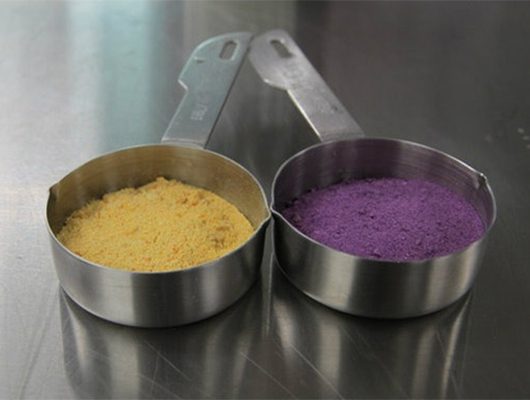
So far, the powder comes in three flavors: banana, raspberry and mango. The powder retains 30-80% of its nutritional value and can be topped on yogurt and ice cream, baked into recipes, and blended into smoothies.

FoPo Food Powder also offers benefits for food producers and retailers. They can donate or sell their unsellable food, buy FoPo and incorporate it into their recipes, and sell FoPo for a source of good nutrition without additives.

Even further, FoPo offers hope for disaster relief, military and space needs, and providing nutrition to impoverished locations.

Since beginning their project in December 2014, the team has discovered that powdered food is becoming more accepted by consumers, and freeze-drying preserves nutritional value better than other techniques.

FoPo won the Ben & Jerry’s Join Our Core crowd-funding and placed runner-up for Thought For Food Summit, a challenge that helps students with projects to make the world a better place. Currently, FoPo is a finalist for MassChallenge, a community that helps early-stage entrepreneurs with their projects.

FoPo also receives support from both the United Nations Food and Agriculture Organization and the Philippines. They are currently launching a test run in natural disaster areas of the Philippines. Local farmers near the test sights will also be donating fruits such as pineapples and mangoes to the trial run.

The team continues to raise awareness and money about their product. With funds, they can find a manufacturer, acquire legal advice and perform further safety testing.

The team hopes to sell to grocery stores and online to big manufacturers in the near future. They also hope to create more flavors of FoPo, see more consumers interested in their product, and feed 9 billion people healthy and nutritious food produced from wasted food.

– Kelsey Parrotte

Sources: FoPo Food Powder, Mashable, Mother Jones
Photo: FoPo Food Powder

July 28, 2015
https://borgenproject.org/wp-content/uploads/borgen-project-logo.svg 0 0 Borgen Project https://borgenproject.org/wp-content/uploads/borgen-project-logo.svg Borgen Project2015-07-28 12:43:382024-05-27 09:26:16FoPo Food Powder and World Hunger
Food & Hunger, Global Poverty

The Role of Sharks in the Global Food Supply

Global_Food_SupplySharks are friends, not food, and these friends are helping to end global poverty.
In the ocean, sharks are at the top of the food chain. Although they are widely regarded as ruthless killers, they play a seriously important role under the sea. Sharks help to preserve marine biodiversity and keep several species of fish from overpopulating. Without sharks, the ecosystem would disintegrate.

Sharks contribute to a healthy underwater ecosystem by consuming slow, unhealthy fish, leaving more wholesome and healthy fish not only for other marine life, but also for people to catch and eat. Therefore, it is important that people are more concerned with the decline in shark populations than an unlikely and highly rare shark attack.

Increased shark populations reduce global poverty by providing a healthy and sufficient food supply to the world’s poor.

Unfortunately, shark populations are primarily at risk due to overfishing. Many developing countries rely on fishing as a source of food and income. Because their techniques are outdated, belief-based and usually harmless, developing countries do not put marine biodiversity at risk.

Moderately developed countries, however, show the greatest parallel between the devastation of shark populations and poverty. Countries and economies transitioning from low to moderate development use semi-modern fishing techniques that are inefficient and harmful to the ocean’s ecosystem. Sharks are killed, and thus so are their contributions to human food supply.

Furthermore, these countries usually have unstable governments that have not instated proper regulations and cannot efficiently control fishing practices.

Fortunately, there is a clear solution: conserve the fisheries and save the sharks. Eliminate devastating fishing techniques by making it a focus of government regulation. Educate communities on the importance of sharks in the preservation of a healthy marine ecosystem and the global food supply.

A 40-year-old iconic American film, Jaws, instilled in viewers a great fear of sharks and the complete devastation they can cause. The likelihood of being attacked by a shark, however, is 1 in 3 million. Fear of sharks must be left in the past because now, sharks are swimming in the right direction, and it is towards the end of global poverty.

– Sarah Sheppard

Sources: Global Citizen, The Conversation
Photo: Flickr

July 27, 2015
https://borgenproject.org/wp-content/uploads/borgen-project-logo.svg 0 0 Borgen Project https://borgenproject.org/wp-content/uploads/borgen-project-logo.svg Borgen Project2015-07-27 14:21:502024-12-13 17:52:14The Role of Sharks in the Global Food Supply
Developing Countries, Food & Hunger, Global Poverty

The Western Diet Nutrition Transition

western_diet

As worldwide poverty rates are reduced, it is expected that a decrease in malnutrition rates follow suit. However, new findings have shown that as people come out of poverty, a new type of malnutrition could take hold, with new and dangerous risks to their health.

The world of public health continues to change with populations and communities when new causes for concerns arise. Oftentimes, as countries become more developed, they become more urbanized. As people come out of poverty they often migrate to cities to find work. The most recent data estimates that by 2050, 70% of the global population will be living in cities. With such a high rate of urbanization, concerns for not only infrastructure, but also for health come up. The traditional health concerns for rapidly urbanized areas include issues of air pollution, overcrowding, trash, water use and infrastructural capacity. Recently, researchers are looking at a new health concern–the adoption of a western diet.

The western diet is characterized by major consumption of refined sugars and fats, animal products and overly processed food in conjunction with less consumption of plant-based foods. Basically, this means people consume more fats, sugars, salts, and meats, and less fruits and vegetables. This translates to more calories with less nutritional benefits. The United States has been coping with this problem for years now, as this type of diet leads to a plethora of health problems including obesity, diabetes and even cancer. We have seen in the United States how instances of “food desserts”—areas with little access to fresh, healthy foods, are related to lower income and urbanization rates and have been battling the outcomes of such. Now the problem has spread to become an even larger global health concern.

As developing countries become more urbanized, though poverty may be reduced, malnutrition and quality of life may remain stagnant, for other reasons. The programs in place that are aimed at alleviating these problems in poverty stricken areas are not targeting this new version malnutrition, which could lead to new dangerous trends. As large corporate fast food chains invest in markets abroad, populations coming out of poverty and into the city will likely be enticed by low prices and availability, similar to developed countries. Often times in developing countries people rely on subsidence farming which provides people with fresh fruits, vegetables, meats and grains. When these people no longer need to farm to survive but are still at fragile income levels, they are likely to fall victim to the cheaper, high caloric, low nutrition foods that will end up harming their health.

The good news is that these developing countries are experiencing economic growth, and individuals are coming out of poverty. Hopefully, as today’s world health leaders are much more aware of the very real risks that a western diet poses on one’s health, the threats to the health of these people and of these nations can be improved without the risk of falling back into a new kind of malnutrition.

– Emma Dowd

Sources: CNN, Huffington Post
Photo: CNN

July 25, 2015
https://borgenproject.org/wp-content/uploads/borgen-project-logo.svg 0 0 Borgen Project https://borgenproject.org/wp-content/uploads/borgen-project-logo.svg Borgen Project2015-07-25 09:04:082020-07-03 16:32:19The Western Diet Nutrition Transition
Development, Food & Hunger, Global Poverty

This Year’s World Food Prize Winner

This Year’s World Food Prize Winner-TBP
BRAC founder Sir Fazle Hasan Abed received the prestigious World Food Prize on July 1 for his unparalleled accomplishments in alleviating global hunger.

The Bangladesh-based development organization combats global poverty in six ways. BRAC develops gender relations, provides grassroots-level services, provides quality health and education, supports small-scale farmers, uses microloans to build an inclusive financial environment, and upholds its values in self-sustaining solutions by using its surplus profits to reinvest back into its poverty reduction programs.

BRAC’s impact is enormous.

The site reports that its 97,000 health providers deliver basic healthcare ranging from maternal and neonatal services to child health services. These services tend to 24.5 million in Bangladesh alone. More than 1 million children found education in BRAC’s 38,000 primary and pre-primary schools, and 9.51 million received degrees. BRAC also provides youth empowerment clubs that have so far trained more than 260,000 teens from disadvantaged backgrounds.

The impact profile continues to report BRAC’s economic support. A total of 5.54 million people benefitted from microloans, totaling to a loan disbursement of $9.73 billion. In addition, 25 million received better hygiene and sanitation thanks to BRAC’s clean toilets.

Women living in poverty found solace in BRAC’s open forums for discussion, protests and proposals for change. Polli shomaj and union shomaj are two of BRAC’s 14,400 community-based organizations (CBOs). So far, there are 13,712 polli shomaj in 55 districts, serving an estimated 55 members per group. Similarly, there are 1,220 union shomaj in 55 districts.

Polli shomaj and union shomaj provide four much-needed services. They help poor communities access government and non-government organizations’ services and resources, protect female representation in rural regions, partner with local government developments and social initiatives, and actively thwart civil violence and conflict, especially against minority populations like women.

The BRAC site further profiles its contributions to the United Nations Millennium Development Goals. Since 1990, BRAC helped slash poverty and hunger in Bangladesh by 50%.

BRAC’s agricultural program developed two species of hybrid rice, one hybrid maize, one inbred rice and one vegetable strain for commercial sale, and more than 200 farmers have been trained in biodiversity creation and conservation. A total of 77,838 farmers practiced agriculture and aquaculture technology demonstrations, and 133,000 farmers learned how tech can improve crop yields. Further, 2,830 people in northern Bangladesh tried green methods in rice harvesting. By 2014, the program positively affected 107,157 people.

In 2012, BRAC’s integrated development programme (IDP) began to address health, education and microfinance in hard-to-reach areas. Two years after its launch, 7,951 people living in ultra poverty received soft loans. Concentrated livelihood planning was a success, as were BRAC’s many other programs in microfinance, social enterprise and investment, disaster relief, environmental protection, climate change reduction, health, nutrition, population, water, sanitation, hygiene, education, migration, advocacy for social change, community empowerment, gender, justice, diversity, human rights and legal services.

Thanks to Sir Fazle’s vision for change, BRAC’s work gave way for sustainable and lasting change, affecting millions of people worldwide.

– Lin Sabones

Sources: BRAC 1, BRAC 2, BRAC 3, World Food Prize
Photo: US News

July 24, 2015
https://borgenproject.org/wp-content/uploads/borgen-project-logo.svg 0 0 Borgen Project https://borgenproject.org/wp-content/uploads/borgen-project-logo.svg Borgen Project2015-07-24 08:34:012020-07-07 14:23:57This Year’s World Food Prize Winner
Charity, Food & Hunger, Food Security, Global Poverty

Heifer International Takes a Holistic Approach to Community Development

heifer_international
Heifer International follows the “teach a man to fish, feed him for a lifetime” philosophy.

The charity organization teaches families living in hunger and poverty how to practice sustainable agriculture and trade. Heifer International provides livestock and other agricultural resources that support financial independence. It also works with public and private partners to ingrain the entrepreneurial drive into the hearts of many developing nations.

Founded in 1944 by Dan West, Heifer is an exemplar in the fight against global poverty.

So far, Heifer has joined forces in more than 125 countries, helping more than 22.6 million families break the cycle of poverty.

In investing in local economies, Heifer has had incredible success.

In 2013, Heifer instituted its Global Impact Monitoring System that collects reference data related to its development work. With this system, the impact is more greatly measurable. This “values-based” system monitors all projects at the group-level and global-level. Heifer further reviews its work by evaluating its projects on five key elements: relevance, effectiveness, efficiency, impact and sustainability.

Heifer projects cover Africa, Asia and the Americas.

The Sahel Program in Africa develops local livestock production in the Sahel region. By providing sheep and goats, the program will impact 516,000 families between 2014 and 2024. The goal is to build resilient and sustainable farming livelihoods.

The Southern Africa Goat Value Chain Program targets food and income security by establishing producers associations, cooperative management and market infrastructures, according to the Heifer site.

The Africa Climate Change Adaption and Mitigation (ACCAM) Program also tackles food security. On the Heifer website, the ACCAM profile lists its goals: creating adaptive climate resilient food systems, increased access to renewable energies, sustainable management of natural resources, increased access to water for agricultural production, sanitation and hygiene, and increased women’s participation in control of resources, leadership and decision-making.

In Asia, Heifer launched similar value chain programs in Bangladesh, India, Cambodia, Nepal, the Philippines and Vietnam. They focus on increasing supplies and management of local commodities such as beef, dairy, goat, swine, chicken and other staple foods.

The GANASOL Agricultural and Livestock Program in Central and South America connects local farmers to market resources. The PROMESA Coffee and Cocoa Program revolves around the coffee, cocoa, cardamom and honey value chains. The PROCOSTA Coastal and Mangrove Ecosystems program addresses climate change, income and food security, and the subsequent issues that affect the mangrove and coastal zones.

This work continues in several other programs, all of which foster self-reliant livelihoods in primarily agriculturally dependent regions.

Heifer International believes in achieving zero hunger by supporting small-scale farmers.

– Lin Sabones

Sources: Heifer, Vimeo
Photo: The Global Journal

July 22, 2015
https://borgenproject.org/wp-content/uploads/borgen-project-logo.svg 0 0 Borgen Project https://borgenproject.org/wp-content/uploads/borgen-project-logo.svg Borgen Project2015-07-22 09:19:552020-07-08 14:36:43Heifer International Takes a Holistic Approach to Community Development
Charity, Food & Hunger, Global Poverty

“Va por mi cuenta” Movement

Malnutrition_in_Mexico
Ending child malnutrition in Mexico is the main goal for the “Va por mi cuenta” (“It’s on me”) movement. They serve more than 20,000 meals per month to children living under vulnerable conditions.

As of today, the “Va por mi cuenta” movement has four “Nuestro Comedor” dining rooms located in the state of Mexico: in Metepec, Chalco and Ecatepec. The fourth dining room is located in Mexico city.

The movement plans to collect a minimum amount of 100 million pesos during a period of 5 years in order to construct ten “Nuestro Comedor” child dining rooms. According to the movement’s website, these dining rooms will provide 2,530,000 meals and feed 2,300 children daily.

“Va por mi cuenta” has the support of different companies, brands, and restaurant chains that, through different mechanics of collection, provide help advance the movement’s prospects.

Some of the brands that collaborate with “Va por mi cuenta” are Alsea, Starbucks, Burger King, Domino’s, PayPal, Flock, X Design, California Pizza Kitchen, Chili’s, and Pei Wei, among others.

Alsea is the responsible for addressing and responding to the concerns and requirements that participants may have. Alsea is also responsible for coordinating the movement’s partnerships.

This foundation canalizes the funds raised by the movement into the construction and operation of “Nuestro Comedor” dining rooms, and it monitors and reports results.

The fast food restaurant chain, Burger King, has also partnered with the “Va por mi cuenta” movement. All Burger King locations in Mexico support the movement by making a donation for every single ice cream cone the restaurant sells.

In 2013, Burger King donated 1 peso for every single ice cream cone that the restaurants sold, and 2 pesos for every double ice cream cone.

Domino’s, the pizza restaurant chain, also contributes to the movement. Domino’s Mexico locations allocate a percentage from the sale of two of their products to the “Va por mi cuenta” movement.

The sale of the restaurant’s “Canelazo Bites” and “Pakecompartas”—a package deal that includes a pizza, chicken strips, and french fries—funds Domino’s donations to “Va por mi cuenta”.

Domino’s also contributes to the movement by encouraging Mexican artists to contribute their own designs for pizza and “Canelazo Bites” boxes. Notable Mexican artists that have contributed to this project and the “Va por mi cuenta” movement are Kari Mayo, Jorge Tellaeche, and amoATO Studio.

The Starbucks coffee chain’s Mexican locations have begun to sell bracelets with the Starbucks and “Va por mi cuenta” insignia written on them in order to contribute to the “Va por mi cuenta” movement. The purpose of the bracelet is to invite children that are most in need to a meal.

By visiting the restaurants that have signed on to help the “Va por mi cuenta” movement, consumers are also becoming a part of the effort by contributing their purchases.

Individuals could also independently contribute to the cause by making donations through Banco Santander, or by contributing an “invite” to meals via PayPal.

The “Va por mi cuenta” movement is fighting to eradicate child malnutrition in Mexico. By constructing “Nuestro Comedor” dining rooms, and with the help of different brands, restaurant chains and corporations, the movement is little by little making a greater impact on Mexican children who suffer from malnutrition.

– Diana Fernanda Leon

Sources: Alsea, Eclecticmex, Dominos, Movimiento va por mi cuenta 1, Movimiento va por mi cuenta 2, Movimiento va por mi cuenta 3
Photo: Movimiento va por mi cuenta

July 21, 2015
https://borgenproject.org/wp-content/uploads/borgen-project-logo.svg 0 0 Borgen Project https://borgenproject.org/wp-content/uploads/borgen-project-logo.svg Borgen Project2015-07-21 14:37:512024-12-13 17:51:58“Va por mi cuenta” Movement
Food & Hunger, Global Poverty, Hunger

Gwyneth Paltrow Reflects on Her Experience with Hunger

Experience_With_Hunger

In April 2015, actress Gwyneth Paltrow accepted the #FoodBankNYCChallenge, which required her to live on a food budget of $29 for one week. Now she reflects on her experience with hunger and the challenge.

Celebrity chef and founder of the challenge, Mario Batali, says, “For one week, walk in someone else’s shoes. Knowledge is power, and by truly understanding what our friends and neighbors are going through, we will be better equipped to find solutions.”

Concerned with the cuts Congress was making to food stamps, Batali sought to encourage people around the United States to experience the difficulty of living on a miniscule allowance.

In addition to nominating Gwyneth Paltrow, he nominated celebrities Sting and Deborah Harry, neither of which participated but donated to the World Food Bank.

Soon after accepting the challenge, Paltrow snapped a picture of her purchases for the week. The caption read, “This is what $29 gets you at the grocery store—what families on SNAP (food stamps) have to live on for a week.” The picture showed brown rice, black beans, a carton of eggs and vegetables.

Her food choices received criticism, especially because the items did not offer the average person’s weekly worth of calories. However, her picture showed how difficult it is to eat healthy while living on food stamps.

Chief marketing and communications officer for the Food Bank of New York City, Silvia Davi, says, “Serving fresh produce is a very big part of what our program offers to families. What we distribute on a regular basis is fresh produce, a lot of the things that were in her image and in her photo.”

Paltrow admits that within four days she quit the challenge and ate chicken and fresh vegetables.

Reflecting on her four-day experience with hunger, Paltrow says, “My perspective has been forever altered by how difficult it was to eat wholesome, nutritious food on that budget, even for just a few days—a challenge that 47 million Americans face every day, week, and year.”

By walking in the shoes of the millions who survive on food stamps, Paltrow is grateful that she can afford to feed herself and her children healthy food.

She says, “I know hunger doesn’t always touch us all directly—but it does touch us all indirectly.”

Most importantly, Paltrow recognizes that hunger impacts millions of people around the world. She declares, “Let’s all do what we can to make this a basic human right and not a privilege.”

In addition to participating in the challenge, Paltrow contributed $75,000 to the Food Bank of New York City.

– Kelsey Parrotte

Sources: Daily News, Upstart Business Journal, Huffington Post, E News, Food Bank for New York City, The Wrap
Photo: ABC Today

July 20, 2015
https://borgenproject.org/wp-content/uploads/borgen-project-logo.svg 0 0 Borgen Project https://borgenproject.org/wp-content/uploads/borgen-project-logo.svg Borgen Project2015-07-20 09:22:582020-07-09 20:20:16Gwyneth Paltrow Reflects on Her Experience with Hunger
Page 49 of 78«‹4748495051›»

Get Smarter

  • Global Poverty 101
  • Global Poverty… The Good News
  • Global Poverty & U.S. Jobs
  • Global Poverty and National Security
  • Innovative Solutions to Poverty
  • Global Poverty & Aid FAQ’s
Search Search

Take Action

  • Call Congress
  • Email Congress
  • Donate
  • 30 Ways to Help
  • Volunteer Ops
  • Internships
  • Courses & Certificates
  • The Podcast
Borgen Project

“The Borgen Project is an incredible nonprofit organization that is addressing poverty and hunger and working towards ending them.”

-The Huffington Post

Inside The Borgen Project

  • Contact
  • About
  • Financials
  • President
  • Board of Directors
  • Board of Advisors

International Links

  • UK Email Parliament
  • UK Donate
  • Canada Email Parliament

Get Smarter

  • Global Poverty 101
  • Global Poverty… The Good News
  • Global Poverty & U.S. Jobs
  • Global Poverty and National Security
  • Innovative Solutions to Poverty
  • Global Poverty & Aid FAQ’s

Ways to Help

  • Call Congress
  • Email Congress
  • Donate
  • 30 Ways to Help
  • Volunteer Ops
  • Internships
  • Courses & Certificates
  • The Podcast
Scroll to top Scroll to top Scroll to top