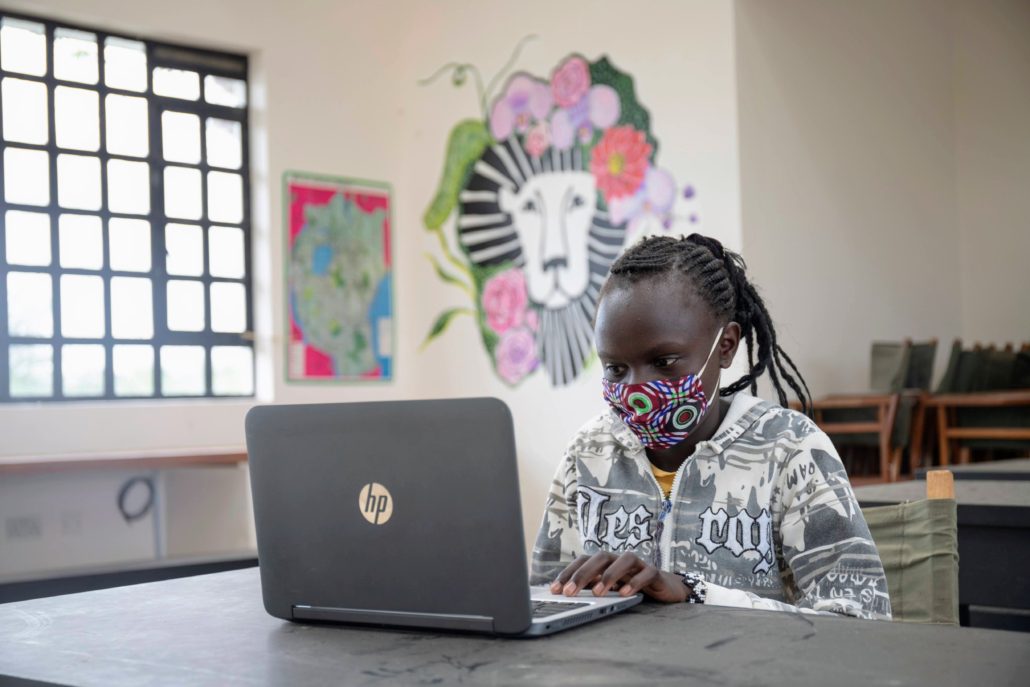
A new resource center in Jua Kali, Kenya is using the community to maximize its impact and create sustainable change. It is working with government and school officials to provide free, life-enrichment services not previously available to locals.
Although Kenya boasts one of the fastest-growing economies in Sub-Saharan Africa, 36.1% of Kenyans live below the national poverty line, according to the latest report by the Kenya National Bureau of Statistics. The Leo Project targets Kenyans aiming to empower marginalized communities.
But how does one accurately identify what a community needs to empower itself and create sustainable change? The team at The Leo Project has come up with a simple solution: just ask. By working with community leaders, schools and locals, The Leo Project has created a model of community-driven, positive social change centered on the idea that Kenyans know best what Kenyans need to create sustainable change.
The Leo Project
Jessica Danforth, executive director of The Leo Project, founded the organization in honor of her best friend Caitlin O’Hara who died of cystic fibrosis in 2016. The mission of the project is to move beyond the limits of a traditional classroom. Moreover, it intends to provide supportive services and create opportunities not traditionally available to vulnerable populations in Nanyuki, Kenya.
Schooling in Kenya is highly focused on students passing two standardized examinations that determine whether they can progress to the next level of education. As such, formal classroom settings tend to only offer subjects or activities pertaining to standardized exams. To address this issue, The Leo Project partnered with two local primary schools to teach students computer skills, digital literacy, coding, music and art. It also worked to provide them with tutoring, a library, counseling and mindfulness services.
“I think part of the reason that we opened the project is to open kids’ eyes to different opportunities that there are available for them,” Danforth said in an interview with The Borgen Project.
Danforth explained that children in Kenya often want to become lawyers, doctors or accountants because they do not have exposure to the alternatives. Part of the mission of The Leo Project is to give them exposure to opportunities in fields such as graphic design, art, coding or therapy.
Creating Sustainable Change Through Community Participation
Since the resource center’s opening in January 2020, The Leo Project’s mission and services have evolved based on conversations with community leaders and members, resting on the idea that Kenyans know what Kenyans need. The Leo Project uses these conversations to both confirm that Kenyans need the services it plans to offer and to discover new areas to dive into.
During pre-opening meetings, heads of schools expressed the need for literacy classes, because parents would come to them unable to read their child’s report card, Danforth said. The Leo Project’s numeracy and literacy classes emerged from this conversation.
Mental Health Services
According to government statistics, around 11.5 million Kenyans have suffered from a mental illness at least once in their lives, but cultural stigmas surrounding mental health prevent people from seeking help and create a lack of qualified professionals who can provide treatment. In Kenya, there are only 88 psychiatrists and 427 psychiatrist nurses trained in the mental health field. As a result, when Danforth and the team approached community leaders and heads of schools about the mental health services they planned to offer, leaders jumped at the idea.
Engaging the Community
“Spending time with the community and actually getting them very involved and hiring people from the local community and not trying to impart our beliefs or our views as an American, I think, is really important,” Danforth said.
Additionally, Danforth explained that the fact that The Leo Project is not a school or government entity has allowed it the freedom to pilot programs, react to real-time feedback and adapt as necessary without the hindrance of bureaucratic red tape.
“We’re hoping that The Leo Project becomes a place where the community can sort of unite as a whole,” Danforth said, “and we’re hoping to educate as many people as possible.” To reach more people, Danforth hopes to replicate this model across Kenya with the first step being to conduct more fieldwork and data analysis in other communities to better understand their needs, noting that every community is different.
The Leo Project currently partners with the Africa Yoga Project, Daraja Academy, Flying Kites and Education for All Children is looking to expand its partner base. The creation of sustainable change in a community is a large-scale project. The more people and partners working on a project, the broader the knowledge-base that shapes that change and the more effective it becomes. As a result, the goal is to partner with as many organizations as possible and, by doing so, make The Leo Project more sustainable in the long run, Danforth said.
The COVID-19 Shift
The Leo Project is located just outside Nanyuki, Kenya and was serving around 4,000 beneficiaries until the coronavirus pandemic hit. Despite having closed its doors in March 2020, The Leo Project has transitioned to providing relief services to its community and those farther away.
Other educational organizations in Kenya have made a similar shift in activities in response to the pandemic. Danforth and The Leo Project team have been in contact with partner organizations to discuss both strategies for aid and best practices in this new environment, applying the project’s pre-pandemic model of communication to ensure a positive impact and basing pandemic-time services on community need.
Danforth explained to The Borgen Project that people had issues getting incorrect information about COVID-19 in Kenya from social media platforms. In an effort to combat this, The Leo Project created an online learning platform where Kenyans can access factual information about the virus. Through this platform, the center has also continued its adult literacy and numeracy, financial literacy and computer classes.
How The Leo Project Inspires Other NGOs
The organization has had a number of other NGOs reach out about using the model for their own projects post-COVID-19, Danforth said. With the help of chiefs, community leaders, government officials and locals, The Leo Project has been distributing two-month supplies of food to the most vulnerable families in the surrounding communities. As of Aug. 18, 2020, The Leo Project reached over 1,000 families and plans to continue this until January 2021 when Kenya has scheduled the reopening of schools.
When the pandemic hit, The Leo Project also hired local women to make masks for distribution and built hand-washing stations throughout Jua Kali and in surrounding communities.
The organization’s model of community participation to create sustainable change has driven its efforts during the pandemic, as it has worked with local leaders, community members and partner organizations to aid Kenyans through the crisis.
– Olivia du Bois
Photo: Jessica Danforth of The Leo Project

Lentil as Anything is not an Ordinary Restaurant
Lentil as Anything
Lentil as Anything embodies a rare business model. The menu does not have any set prices. Everyone is welcome to “pay as they feel,” either through a financial donation or volunteering their skills. The founder, Shanaka Fernando, was born in Sri Lanka before becoming a restauranteur and world traveler. In 2000, Fernando began the first Lentil as Anything in the Australian city of St. Kilda to provide a space for local communities to come together and share a meal “disregarding any existing economic and social barriers.”
At the time, Fernando’s concept was a wild idea. Twenty years later, it has become a booming success. The restaurant chain now claims four restaurants around Australia. Additionally, Lentil as Anything provides more than 1,000 free meals a week to people most in need.
Elzvik’s Story
Elzvik began working for Lentil as Anything when she was studying abroad for a semester. “It’s like every hippie’s dream cafe, except customers are not just wealthy teenagers. They are from various socio-economic backgrounds. Some live on the street outside. Some are just traveling through.”
Elzvik points out that many of the volunteers were once customers themselves. “When they can’t pay, they offer their time,” said Elzvik. Lentil as Anything provides just as many employment opportunities as they do meals. Elzvik comments, “I think many people come to volunteer because it gives them a sense of purpose.”
According to Elzvik, there is no such thing as a boring day at Lentil as Anything. “It is no gloomy soup kitchen,” she states. Spices like nutmeg and cinnamon waft through the kitchen. Volunteers twist lemons and grate ginger. Servers dance around the floor, jotting orders down on their notepad. It is always noisy inside; laughter bounces across the walls. On some late nights, there is yoga or an open-mic night in the upstairs space.
So how exactly does this seemingly utopian cafe operate?
Sustainable Food Sourcing
Elvzik recalls the kitchen being full of “bruised apples” and “funky looking eggplants” that would get thrown out by most restaurants or stores. “Lentil as Anything takes them and turns them into something beautiful,” says Elzvik.
The Department of Agriculture in Australia reports that food waste costs the economy around $20 billion each year. That amounts to about 300kg per person or one in five bags of groceries.
To stock the kitchen, Lentil as Anything takes in unwanted leftovers from nearby stores. The chain stands by its all-vegan menu. The diet is both inclusive and nutrient-rich. Elzvik mentions that many visitors would not be able to afford something as “dense and hearty” as a Lentil as Anything meal. Fast food is typically the most affordable option and Lentil as Anything aims to change that.
Volunteership
The restaurant relies heavily on volunteer servers and cooks, like Elzvik. CNBC reports that around 60% of new restaurants fail within the first year. By a restaurant’s fifth year, that rate jumps to 80%.
Lentil as Anything is not an exception. The restaurant cannot stay afloat on its own. The Daily Telegraph reports that “it costs Lentil as Anything up to $23,000 a week to keep [its] doors open – and customer contributions do not come close to covering costs.”
Before coming to Lentil as Anything, Elzvik had no prior customer service experience. She says that volunteering at the restaurant requires no experience at all. Volunteers attend an orientation and receive the necessary training. “What you learn at Lentil can be applied to any future job, especially working with people in a busy environment,” states Elzvik.
Location Matters
Restaurants like Lentil as Anything might not work just anywhere. “You need the perfect equilibrium,” claims Elzvik. She explains that in order for this business model to work, there must be enough people donating above the requirement to cover those who cannot afford these costs.
One of Lentil as Anything’s strategic locations is Newton in Sydney. Newtown is a diverse neighborhood, socially and economically. The Australian Bureau of Statistics reveals that 67% of the Newtown population works full time, 24% part-time and less than 5% identify as unemployed.
Looking forward
Like many businesses, the pandemic hit Lentil as Anything deeply. On September 25, the restaurant reached out to its social media followers and asked for help to keep Lentil alive.
Lentil as Anything is facing its most significant financial challenge to date. The restaurant is working to raise $300,000 by the end of October. If it does not reach its goal, Lentil as Anything may face closing its restaurant doors forever. Donations can be made through its GoFundMe campaign.
The restaurant’s motto is that everyone deserves a seat at the table. Hopefully, Lentil as Anything can serve as a successful business model for many restaurants around the world to address food insecurity.
– Miska Salemann
Photo: Unsplash
A Kenyan Center’s Aim to Create Sustainable Change
A new resource center in Jua Kali, Kenya is using the community to maximize its impact and create sustainable change. It is working with government and school officials to provide free, life-enrichment services not previously available to locals.
Although Kenya boasts one of the fastest-growing economies in Sub-Saharan Africa, 36.1% of Kenyans live below the national poverty line, according to the latest report by the Kenya National Bureau of Statistics. The Leo Project targets Kenyans aiming to empower marginalized communities.
But how does one accurately identify what a community needs to empower itself and create sustainable change? The team at The Leo Project has come up with a simple solution: just ask. By working with community leaders, schools and locals, The Leo Project has created a model of community-driven, positive social change centered on the idea that Kenyans know best what Kenyans need to create sustainable change.
The Leo Project
Jessica Danforth, executive director of The Leo Project, founded the organization in honor of her best friend Caitlin O’Hara who died of cystic fibrosis in 2016. The mission of the project is to move beyond the limits of a traditional classroom. Moreover, it intends to provide supportive services and create opportunities not traditionally available to vulnerable populations in Nanyuki, Kenya.
Schooling in Kenya is highly focused on students passing two standardized examinations that determine whether they can progress to the next level of education. As such, formal classroom settings tend to only offer subjects or activities pertaining to standardized exams. To address this issue, The Leo Project partnered with two local primary schools to teach students computer skills, digital literacy, coding, music and art. It also worked to provide them with tutoring, a library, counseling and mindfulness services.
“I think part of the reason that we opened the project is to open kids’ eyes to different opportunities that there are available for them,” Danforth said in an interview with The Borgen Project.
Danforth explained that children in Kenya often want to become lawyers, doctors or accountants because they do not have exposure to the alternatives. Part of the mission of The Leo Project is to give them exposure to opportunities in fields such as graphic design, art, coding or therapy.
Creating Sustainable Change Through Community Participation
Since the resource center’s opening in January 2020, The Leo Project’s mission and services have evolved based on conversations with community leaders and members, resting on the idea that Kenyans know what Kenyans need. The Leo Project uses these conversations to both confirm that Kenyans need the services it plans to offer and to discover new areas to dive into.
During pre-opening meetings, heads of schools expressed the need for literacy classes, because parents would come to them unable to read their child’s report card, Danforth said. The Leo Project’s numeracy and literacy classes emerged from this conversation.
Mental Health Services
According to government statistics, around 11.5 million Kenyans have suffered from a mental illness at least once in their lives, but cultural stigmas surrounding mental health prevent people from seeking help and create a lack of qualified professionals who can provide treatment. In Kenya, there are only 88 psychiatrists and 427 psychiatrist nurses trained in the mental health field. As a result, when Danforth and the team approached community leaders and heads of schools about the mental health services they planned to offer, leaders jumped at the idea.
Engaging the Community
“Spending time with the community and actually getting them very involved and hiring people from the local community and not trying to impart our beliefs or our views as an American, I think, is really important,” Danforth said.
Additionally, Danforth explained that the fact that The Leo Project is not a school or government entity has allowed it the freedom to pilot programs, react to real-time feedback and adapt as necessary without the hindrance of bureaucratic red tape.
“We’re hoping that The Leo Project becomes a place where the community can sort of unite as a whole,” Danforth said, “and we’re hoping to educate as many people as possible.” To reach more people, Danforth hopes to replicate this model across Kenya with the first step being to conduct more fieldwork and data analysis in other communities to better understand their needs, noting that every community is different.
The Leo Project currently partners with the Africa Yoga Project, Daraja Academy, Flying Kites and Education for All Children is looking to expand its partner base. The creation of sustainable change in a community is a large-scale project. The more people and partners working on a project, the broader the knowledge-base that shapes that change and the more effective it becomes. As a result, the goal is to partner with as many organizations as possible and, by doing so, make The Leo Project more sustainable in the long run, Danforth said.
The COVID-19 Shift
The Leo Project is located just outside Nanyuki, Kenya and was serving around 4,000 beneficiaries until the coronavirus pandemic hit. Despite having closed its doors in March 2020, The Leo Project has transitioned to providing relief services to its community and those farther away.
Other educational organizations in Kenya have made a similar shift in activities in response to the pandemic. Danforth and The Leo Project team have been in contact with partner organizations to discuss both strategies for aid and best practices in this new environment, applying the project’s pre-pandemic model of communication to ensure a positive impact and basing pandemic-time services on community need.
Danforth explained to The Borgen Project that people had issues getting incorrect information about COVID-19 in Kenya from social media platforms. In an effort to combat this, The Leo Project created an online learning platform where Kenyans can access factual information about the virus. Through this platform, the center has also continued its adult literacy and numeracy, financial literacy and computer classes.
How The Leo Project Inspires Other NGOs
The organization has had a number of other NGOs reach out about using the model for their own projects post-COVID-19, Danforth said. With the help of chiefs, community leaders, government officials and locals, The Leo Project has been distributing two-month supplies of food to the most vulnerable families in the surrounding communities. As of Aug. 18, 2020, The Leo Project reached over 1,000 families and plans to continue this until January 2021 when Kenya has scheduled the reopening of schools.
When the pandemic hit, The Leo Project also hired local women to make masks for distribution and built hand-washing stations throughout Jua Kali and in surrounding communities.
The organization’s model of community participation to create sustainable change has driven its efforts during the pandemic, as it has worked with local leaders, community members and partner organizations to aid Kenyans through the crisis.
– Olivia du Bois
Photo: Jessica Danforth of The Leo Project
Amref Health Africa Fights COVID-19 with LEAP
Amref Health Africa is an NGO based in Kenya that works to empower young Africans. The organization provides people with the skills necessary to become innovative and ethical leaders of Africa. The group created several leadership programs and research programs to transform Africa. Its new program, LEAP, is a mobile phone training platform designed to train employees and students about health precautions and safety outside of the classroom setting.
Who is Amref Health Africa?
Amref Health Africa is an African-led organization founded in 1957 to establish “lasting health change in Africa” with its mission “To increase sustainable health access to communities in Africa through solutions in human resources for health, health service delivery and investments in health.”
The NGO works to improve health care for the people in Africa while also strengthening health care systems. Amref Health Africa has headquarters in Kenya and partners with different organizations around the world to promote power and unity. Amref Health Africa runs 22 global offices and 35 different programs in Africa to bolster health care efforts.
Through Amref Health Africa’s partnership with Accenture, Kenyan Ministry of Health, M-Pesa Foundation, Safaricom and Mezzanine, LEAP, the mobile health learning application, was created. The application has allowed health care workers and students to work effectively outside of a classroom setting.
LEAP’s Benefits during the COVID-19 Pandemic
Recently, LEAP users employed the app to strengthen the COVID-19 response. The program instructs community health workers on how to raise awareness about the virus. LEAP also provides information on the best precaution methods for the community. Thanks to LEAP, health care workers have learned to take the necessary steps to promote safety and awareness in Africa. So far, more than 78,000 community health workers have received training and are using their education to help stop the spread of COVID-19.
In response to the pandemic, LEAP launched a two-month campaign in Kenya. Through the campaign, health care workers received training to identify, isolate and refer suspected COVID-19 cases. Participants also learned how to identify high-risk areas and reduce the transmission of the disease.
Results
The LEAP app allows customization of the training content to fit the needs of the audience. It takes into consideration the skill level of the people using the app and modifications can be made to the language and audio section depending on user preference. LEAP allows personalization to ensure that the app can be effective for all users.
LEAP has strengthened the health care system in Africa by helping to stop the spread of the COVID-19 virus. The mobile training app also addressed the spread of misinformation on the virus by providing accurate COVID-19 information to users. LEAP has provided Africa with the knowledge necessary to arm and defend itself against the COVID-19 pandemic.
– Isha Bedi
Photo: Flickr
Data Literacy is Changing Nepal’s Future
Since 2015, Nepal has been on the rise from a period of political turmoil. The country faced social unrest, economic instability and a shift to a three-tiered government. After a difficult transition, Nepal adopted a new constitution in 2015 and held elections for government members. These democratic changes brought Nepal some peace as well as hope for a better and more consistent future. One key element of a Nepali future hinges on data literacy.
Nepal’s new government aims to achieve the status of a middle-income country by 2030. To achieve this goal, it is imperative that all members of society are able to access and properly use data. Citizens need to have data literacy to inform decision-making, create developmental opportunities and much more.
What is the Power of Open Data?
Prioritizing the collection and making official statistics accessible to the population is essential in boosting policymaking and delivering public services. Professionals possessing data literacy can use data to change these systems in evidence-based ways that better serve the population. For example, education or sanitation fields can improve with a greater understanding of how they currently function within the country. If Nepal wants to transition to a middle-income country by 2030, data collection and analytics will be essential to making evidence-based fiscal decisions.
The public in Nepal has had access to government data since 2007. However, reports state a limited public understanding of how to request such information. There is also a widespread “culture of secrecy” in regard to public data. Another barrier to accessing open data is internet speed and access to an internet connection in private households.
What is Nepal Doing to Encourage Data Literacy?
Nepal launched the Open Data Awareness Program in 2017. It aims to bring awareness to Nepali youth about data literacy, as these youth are the future generation of leaders and policymakers for the country. The program strived to raise awareness through training sessions at colleges and youth organizations. The program then culminated in a hackathon event where youth from all over Nepal collaborated in data-oriented problem-solving.
In 2019, the World Bank worked with Nepal to create a 100-hour Data Literacy Program. The first phase of the program involved 40-hour in-person training on data literacy. During the second phase, program participants trained people in their community using the information learned in the first phase. The third phase was another in-person training, this time 60 hours, involving participants from various diverse Nepali organizations. This training also covered data literacy topics such as python, machine learning and artificial intelligence.
Later that year, the World Bank, Asia Foundation and UKAID collaborated to organize a two-day Solve-a-thon at the Kathmandu University School of Management. This event provided a platform for professionals with backgrounds in programming, research, development and data science to collaborate on data projects to further development in Nepal. These participants worked in teams on different projects that tackled issues such as air pollution, gender equality and tourism. The program held open debates on complex issues and how to use data to find efficient and effective solutions. Youth and professionals were able to come up with interesting prototypes from the Solve-a-thon. Two creations were a chatbot that tracks Nepal’s air quality and a dashboard that monitors tourist flow.
Data Literacy During the Pandemic and Beyond
In most recent news, the Nepal Data Literacy Community on Facebook that emerged from the Data Literacy Programs in 2019, decided to tackle COVID-19, by providing the correct information using open data as its resource. The community came up with initiatives to inform the population as well as collect and spread COVID-19 crisis management information. Its initiatives aim to remove language barriers on information, investigate the relationship between air pollution and COVID-19 mortality, make data on COVID-19 publicly available and analyze global media trends around divisive pandemic narratives.
Other initiatives have also come together to launch Open Nepal, a community knowledge hub. The group produces, shares and uses data to further development in Nepal. The site is a diverse platform for organizations and individuals to share their experiences and bridge the gap in data literacy. Open Nepal involves the public and private sectors to make sure no one is left behind in the fight for Nepali development.
– Giulia Silver
Photo: Flickr
Ecovillages: The New GENeration of Poverty Reduction
The Global Ecovillage Network
The Global Ecovillage Network (GEN) recognizes that all four facets of sustainability must be addressed for maximum poverty reduction. Solely focusing on the economic or environmental impact will not yield optimal results. Embracing, not eliminating, the social and cultural aspects of sustainability should the aim of all communities in order to move toward a better future.
The development of sustainable communities around the globe is a commitment of the GEN. The organization’s outreach programs intend to fuel greater global cooperation, empower the citizens of the world’s nations and develop a sustainable future for all.
Working with over 30 international partners, GEN focuses on five defined regions. GEN Africa was created in 2012 and has overseen developments in more than 20 communities across the continent.
A Focus on Zambia
Zambia is one the countries garnering attention. Over half of Zambia’s population — 58% — falls below the $1.90 per day international poverty line. The majority of the nation’s impoverished communities live in rural regions.
Zambia’s government addresses these concerns by integrating the U.N.’s sustainable development goals into its development framework. With a focus on economic and ecological growth, Zambia could lay the groundwork for the success of its’ ecovillages.
Planting the Seed
The Regional Schools and Colleges Permaculture (ReSCOPE) Programme recognizes youth as the future keepers of the planet. As well as Zambia, the program has chapters in Kenya, Malawi, Uganda and Zimbabwe. The focus is on establishing regional networks to strengthen sustainable efforts. The Zambia chapter along with its 17 newly joined organizations work toward the goal of educating and encouraging communities to find sustainable methods of food production.
ReSCOPE seeks to connect schools and their local environments through the Greening Schools for Sustainable Communities Programme. The program is a partnership between GEN and ReSCOPE and has received funding from the Scottish government. Through education and encouraging sustainable practices, Zambia’s youth have an active role in ensuring future growth.
Greening Schools
Greening Schools strengthens the communities of four schools — the centers of resilience and a source of community inspiration. Beginning with nutrition and food security, students are able to play a part in developmental change. Their hard work includes planting of hundreds of fruit trees. The schools became grounds for hands-on agricultural experience and exposure to the tending of life.
However, the impact was not restrained within the schools. The greening schools inspired local communities to make seed security and crop diversification a commitment. In 2019, these communities “brought back lost traditional crops and adopted intercropping and other agroecological practices.”
As part of their sustainable development goals, the U.N. recognizes the value of investing in ecovillages. Goals 11 and 12 stress the importance of sustainable communities and responsible consumption and production respectively. Educating and advocating for youth to take part in ecovillages addresses this matter.
Coming generations will determine the future, and the youth wield the power to address global concerns like sustainability and poverty. Ecovillages are a great new way to break the cycle of poverty.
– Kelli Hughes
Photo: Unsplash
Solar Microgrids Are Empowering Rural Yemen
Solving a Fuel Shortage and Economic Crisis
Yemen’s energy infrastructure cannot transport power to rural towns and villages. Thus, many of these communities depend upon highly-polluting diesel generators. However, longstanding conflict and crippling embargoes have made fossil fuels scarce and expensive. Moreover, oil prices have fluctuated in recent years, and poverty has skyrocketed. This crisis has affected approximately three-quarters of Yemen’s population. Current estimates indicate that more than two out of five households have been deprived of their primary source of income. It’s also been found that women are more acutely impacted than men.
Now, the energy situation is shifting. The UNDP has provided funding and support to three different groups of entrepreneurs that own and operate solar microgrids. The three are located in Abs in the district of Bani Qais in the northwest and in Lahij Governate in the south. Their stations provide clean, sustainable energy to local residents and at a much lower price. The solar microgrids charge only $0.02 per hour as opposed to the $0.42 per hour that diesel costs.
Such savings for households and businesses have greatly impacted the local economies. Not only can people work after sunset, they also possess more disposable income. According to Al Jazeera, approximately 2,100 people have been able to save money and put it toward creating their own small businesses. These include services for welding, sewing, grocery stores and other shops. So far, a total of 10,000 Yemenis have benefitted from the energy provided by the three solar microgrids.
Empowering New Leaders in Business
The entrepreneurs who founded and now run the microgrid facilities in Bani Qais and Lahij Governate are young men. However, the power station in Abs is completely owned and operated by women. These Abs women receive training in necessary technical skills and study business and finance.
Some expected the scheme to fail due to the sophisticated knowledge it required and the relative inexperience of the facilities’ operators. Well, one year has passed, and the solar microgrids are running at full capacity. The project thus offers a valuable model for creating jobs in a country where civil war has shattered the economy and hobbled basic infrastructure.
Specifically for the women in Abs, though, a steady income and the ability to provide a much-needed service have increased their self-confidence. These women can feed their families and use the university educations they each worked for to a great extent. As the station’s director explained, their work has even earned them the respect and admiration of those who used to ridicule them for taking on what was once considered a man’s job.
Looking to the Future
The success of the UNDP’s project’s first stage shows a possible solution to Yemen’s problem of energy scarcity. The UNDP now works to find funding for an additional 100 solar microgrids. Since civil war began in 2015, both sides have tried to limit each other’s access to the fossil fuels that Yemen depends upon. Pro-government coalition forces have prevented ships cleared by the U.N. from unloading their cargoes in the north. On the other side, Houthi-led rebels have recently suspended humanitarian flights to Sanaa, the country’s largest city and its capital. This is all in the midst of hospitals struggling to care for patients during the pandemic.
The UNDP’s solar microgrids are a source of hope among the many conflicts plaguing Yemen. More still, it is likely others will soon follow in the footsteps of the three initial young entrepreneurs. These solar microgrids stations have empowered Yemeni communities to build better and more sustainable futures and will for years to come.
– Angie Grigsby
Photo: Flickr
The Adventure Project’s Initiatives in India
Clean Cookstoves in India
A particular area of concern for the organization was open fire cooking in India, Many people in India cook over open fires, which leads to about 4 million people dying each year from breathing in toxic cooking smoke. As toxic as the smoke is to people in India, it is just as detrimental to the environment as the percentage of carbon gases in the environment rises. The Adventure Project’s solution to this is clean cookstoves. These environment-friendly stoves save a family 20% of their daily expenses because of the 50% decrease in charcoal use per day. Furthermore, the use of one stove saves six trees from being cut down and also reduces carbon emissions by 1.5 tons.
Handpumps for Water Access
The Adventure Project wanted to create a solution to help with access to clean water in India. Wells provides a source of water and the people in India use handpumps to collect and carry clean water from the wells. The issue is that handpumps often break, and as long as a handpump is broken, people cannot access water. WaterAid partnered with The Adventure Project to run a handpump mechanic business in northern India. The two-year-old business, which trains both males and females, teaches budding mechanics how to fix well handpumps. When a handpump breaks down, villagers call the mechanic shop and someone bikes over to fix it. This means that people are able to fix their own handpumps and assist other villagers with theirs. The business also provides an income for the locals employed there.
Breaking Gender Barriers
Many women are breaking gender barriers by working alongside men in the handpump mechanic business. As the first female well mechanic in Mahoba, India, Ram Rati is inspiring women to follow their dreams. Rati grew sick of the broken handpumps in the village and decided to become a handpump mechanic herself. In her village, traditionally only men ride bikes. At 40 years old, she broke this gender barrier as well by learning how to ride a bike in order to travel around the village and fix handpumps.
By implementing clean cookstoves and creating a handpump mechanic business, The Adventure Project’s initiatives in India contribute to alleviating global poverty.
– Isha Bedi
Photo: Flickr
Sweden’s Long-Standing Commitment to End Poverty
A Leader in Foreign Aid
According to the OECD, Sweden dedicates around 1% of its national income to developmental aid, making it the highest developmental assistance donor. The country’s commitment to policy development issues is the strongest in three categories: peace and conflict prevention, gender equality and women’s rights as well as environmental sustainability. Since 2006, the country has committed to regularly donate a portion of its GNI as official developmental assistance (ODA) and has since kept its word, donating at least 1% or more every year.
The Swedish International Development Cooperation Agency (Sida)
Sida is a government agency of the Swedish Ministry for Foreign Affairs. Sida is responsible for Sweden’s official development assistance to developing countries.
Sida is a prominent international actor with an overall mission to make sure people living under poverty and oppression are able to enhance their living conditions. During the COVID-19 pandemic, Sida allocated $149 million to mitigate the pandemic’s effects on vulnerable communities and populations abroad. Sida has collaborated with many different multilateral organizations to uphold Sweden’s promise of helping the international community during the pandemic..
Sida has bilateral development cooperation with 35 different partner countries from four different continents and consistently supports multilateral organizations in their pursuit of increasing human rights and democracy globally.
A Leader for Women’s Empowerment
The country has shown relentless support for gender equality and women’s rights, highlighting Sweden’s long-standing commitment to ending gender discrepancies around the world. Sweden is a pioneer for many new policies regarding women’s rights. For instance, in 2014, Sweden created the world’s very first feminist foreign policy. Sweden has garnered the support of many foreign bodies and their allies by raising awareness through forums. The most notable being the 2018 Stockholm Forum of Gender Equality. The gathering brought 700 members from 100 different countries to discuss the implementation of new policies to protect women in vulnerable communities from oppressive regimes, further elevating their rights and enabling an inclusive society.
A Leader for Environmental Sustainability
Furthermore, Sweden’s clean carbon footprint is impressive, with a large quantity of the country’s waste recycled. The country has committed to net-zero emissions by the year of 2045 and it has dedicated many resources to encourage countries across the globe to implement sustainable environmental practices. The country has shown continued leadership. In 2017, Sweden had co-chaired the U.N. Ocean Conference with Fiji. In 2018, Sweden also hosted GEF-7 Replenishment, a meeting between contributing and potential participants from all around the world with efforts to eliminate non-renewable energy sources in the near future.
Sweden: A Developmental Assistance Model
Sweden’s long-standing commitment to developmental assistance highlights the country’s leadership skills as an exemplary model for other developed nations. Sweden’s relentless efforts in supporting foreign aid, even during a pandemic, is a model that needs to be mimicked by other developed nations that have the same capacity to help, now more than ever.
– Mina Kim
Photo: Flickr
Examining the Challenges of Life in Mali
Mali is a hot, dry, landlocked country located in Western Africa. With the Sahara Desert dominating 65% of Mali’s land, climate conditions force many into poverty. As the country is among the 25 most impoverished countries in the world, challenges for life in Mali arise as living conditions are inadequate for natives and aid workers.
Poverty in Mali
People living in Mali rely heavily on foreign aid. The most common careers pursued are within the agriculture industry; cotton and gold exports make up 80% of Malians export earnings. Despite living in one of the driest places in the world, Malians greatly depend on farming to provide for their families.
The Borgen Project spoke with Susan Roach, who previously lived with her family in Mali’s capital, Bamako. Roach and her husband were aid workers for the International Society for Humanitarian Action. Roach’s husband taught Malians better farming techniques. Roach says, “a pitiful harvest means starvation and starvation equals poverty.”
However, poor farming conditions are not the only factors that affect life in Mali. A staggering 74.4% of the population does not have access to electricity. Although 80% of Malians have access to water, this number drops significantly in rural areas. As a result, 49% of the population falls under the poverty line due to the lack of access to basic necessities.
The Array of Cultures
There are many different ethnic groups in Mali. Tribes with their own unique language, worldview and cultural traditions live throughout the country. However, 80% of Malians are Muslim and many tribes believe in animism. There are also immense differences in leadership among the Malian government and tribes. While the Malian government is a republic consisting of elected representatives, a council of elders leads the Indigenous people. According to Roach, the honor system is strong in the villages as no one wants to dishonor their family’s name.
“I felt safer in the villages than I ever felt, even in a city in the United States.” Overall, one cannot group Malian culture into one category. “A lot of people think in Africa that they’re all the same. And that could not be any further from the truth,” Roach reflects on life in Mali.
Education for Malian Children
Public education is free for Malians. However, many children are unable to receive an education due to the cost of school fees, uniforms and school supplies. In 2015, on average, boys attended school for eight years while girls attended school for seven. Girls who pursue secondary education often cannot obtain placement and are unable to receive that education.
Roach states that families would rather send their sons to school because they are more likely to quickly find a job to support their families. On the contrary, the social role of girls is to marry and tend to the home. As a result, 25% of Malian women are illiterate. Although education receives funding from the government, the allocation of resources is not equal. Schools in rural areas typically have one teacher educating many students with limited supplies. Yet, in urban areas, school facilities are cleaner and properly staffed.
A Shorthanded Health Care System
To add to the challenges of life in Mali, doctors are scarce and overworked. Roach recalls how her husband would take patients to the hospital and lay them on a mat outside of the doctor’s door. However, the doctor would not be able to tend to the patients for a few days due to overcrowding and overwork. The life expectancy in Mali is 61 years. Fortunately, Mali announced an initiative to provide basic health care for pregnant women and children younger than 5 years old. This initiative costs approximately $120 million and will start in 2022. Additionally, Mali hopes to increase the number of health care professionals and decrease the child mortality rate.
Life in Mali is certainly challenging. Nevertheless, with new government initiatives in motion and various organizations providing aid, Mali is progressing toward a brighter future.
– Bailey Sparks
Photo: Flickr
Making a Difference: 3 Philanthropic Organizations in Greece
3 Philanthropic Organizations in Greece
Looking Ahead
While rebuilding from the financial collapse has been slow, thoughts of a prospering economy remain. Still, philanthropic organizations in Greece are finding ways to make a difference in many lives today. The Organization for Economic Co-operation and Development urges government reform to address poverty and inequality in Greece with hopes of economic recovery.
– Brandi Hale
Photo: Flickr