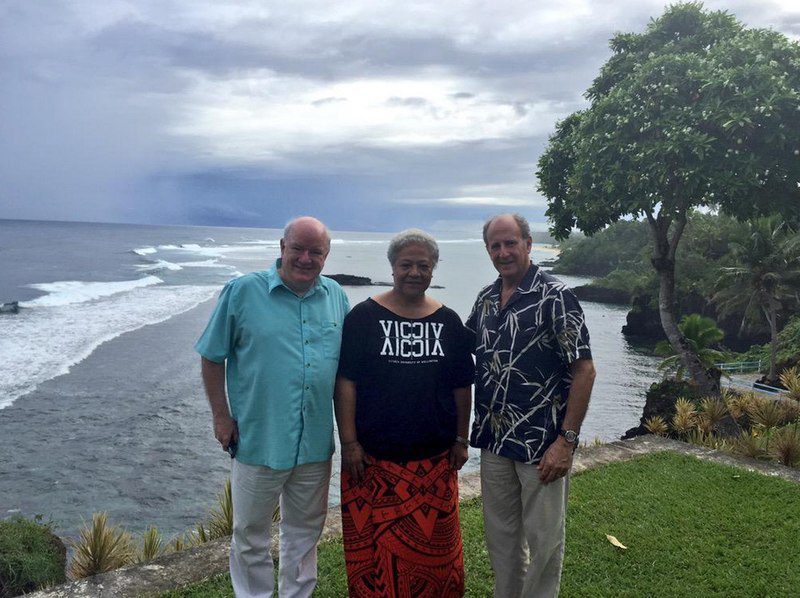
Nicknamed the “Cradle of Polynesia,” Samoa made history in its most recent election cycle. After a months-long dispute that took a court ruling to determine the winner, this island located in the central South Pacific Ocean named Fiame Naomi Mata’afa as Samoa’s first female Prime Minister. As head of the new Fa’atuatua I Le Atua Samoa ua Tasi Party, or FAST, Mata’afa won over Tuilaepa Sailele Malielegaoi, head of the Human Rights Protection Party, who was the prime minister for 22 years.
The Human Rights Protection Party (HRPP) held the office of Prime Minister for more than four decades, and now Samoa is looking at a new future with the FAST party and Mata’afa as Prime Minister. The FAST Party, created in 2020 as a response to the decades-long political domination of the HRPP. Fiame Naomi Mata’afa’s appointment as prime minister sparks an even larger conversation about Samoan women’s role in politics.
Mata’afa’s History
The Pacific region of the world has the lowest amount of female representation in government, and Fiame Naomi Mata’afa is hoping to inspire more women and young girls to involve themselves in local politics. Mata’afa’s upbringing contributes heavily to her passion for politics and women’s representation in Samoa. Mata’afa was born right before Samoa gained independence from New Zealand in 1962, and her grandfather was very active in the Mau, a movement centered around gaining Samoa’s independence through non-violence.
Eventually, her grandfather would go on to become the first Prime Minister of Samoa. Mata’afa also saw influence from her mother who was a Pacific women’s rights activist and brought her daughter to many political gatherings. Her mother would go on to become a Member of Parliament.
To qualify as a political candidate in any capacity in Samoa, one must first be a matai – a respected title meaning chief. These titles cannot pass through inheritance, so when Mata’afa’s father passed away when she was 18, she went to court to claim her father’s title over the claims of others. Named Faime in 1978, Mata’afa became the chief over the Lotofaga village on Upolo, Samoa’s main island.
Men typically hold these titles, but young, unmarried women occasionally have them as well. Mata’afa’s political career skyrocketed following this and at 27, she became a Member of Parliament and has continued to hold this position ever since. Before her victory as Samoa’s first female Prime Minister, she made history when she served as the first female deputy female Prime Minister prior to the recent election.
The Context for Representation and the Election
“At the village governance level, women make up close to 36% of total Matai,” according to U.N. Women. Both women and men serve as ballot chiefs or Matai Polata. Before 1990, when all Samoan citizens gained suffrage, non-Matai could not vote. In 2013, a Constitutional amendment bill passed that required that women fill a minimum of 10% of parliament or five seats. This quota served to increase women’s representation in the Samoan government and people now know it as the 10% act.
Samoa’s most recent election, which ended with Mata’afa’s appointment, came at a time when only 9.8% of Parliament consisted of women. With a 51 person legislature, the HRPP and FAST parties tied with 25 seats each, leaving one independent elected. An additional HRPP-elected woman candidate filled a seat in Parliament to follow the 10% act. The sole independent then ended up voting with the FAST party, creating a locked 26-26 election.
The Samoan Supreme Court reviewed the election, ultimately deciding that the additional candidate that the HRPP party appointed was invalid. As a result, the FAST party candidate, Mata’afa, rightfully won the election to become Prime Minister. While many rejoiced in the celebration of Mata’afa’s victory and appointment as Samoa’s first female Prime Minister, Malielegaoi’s outrage surrounding the decision led to his refusal to step down as Prime Minister. Forcing her swearing-in ceremony to occur outside the locked doors, Malielegaoi even went so far as to lock Mata’afa and her supporters out of Parliament.
Looking Forward
Women’s rights in Samoa have evolved over the past few decades and now the country currently sees about “53% of the total public service” consist of women. In the private manufacturing sector, women also are a majority of the workforce and women own and run more than 40% of small businesses. Management and promotion opportunities for women in the Samoan workforce have also increased over time with chief officer positions and other top leadership roles that women hold.
Fiame Naomi Mata’afa is a role model for young Pacific women. Her political career has broken many barriers that women in the south Pacific region often face. Following in her family’s footsteps, she is working towards a better future for women in Samoa.
– Annaclaire Acosta
Photo: Wikipedia Commons

Samoa’s First Female Prime Minister
Nicknamed the “Cradle of Polynesia,” Samoa made history in its most recent election cycle. After a months-long dispute that took a court ruling to determine the winner, this island located in the central South Pacific Ocean named Fiame Naomi Mata’afa as Samoa’s first female Prime Minister. As head of the new Fa’atuatua I Le Atua Samoa ua Tasi Party, or FAST, Mata’afa won over Tuilaepa Sailele Malielegaoi, head of the Human Rights Protection Party, who was the prime minister for 22 years.
The Human Rights Protection Party (HRPP) held the office of Prime Minister for more than four decades, and now Samoa is looking at a new future with the FAST party and Mata’afa as Prime Minister. The FAST Party, created in 2020 as a response to the decades-long political domination of the HRPP. Fiame Naomi Mata’afa’s appointment as prime minister sparks an even larger conversation about Samoan women’s role in politics.
Mata’afa’s History
The Pacific region of the world has the lowest amount of female representation in government, and Fiame Naomi Mata’afa is hoping to inspire more women and young girls to involve themselves in local politics. Mata’afa’s upbringing contributes heavily to her passion for politics and women’s representation in Samoa. Mata’afa was born right before Samoa gained independence from New Zealand in 1962, and her grandfather was very active in the Mau, a movement centered around gaining Samoa’s independence through non-violence.
Eventually, her grandfather would go on to become the first Prime Minister of Samoa. Mata’afa also saw influence from her mother who was a Pacific women’s rights activist and brought her daughter to many political gatherings. Her mother would go on to become a Member of Parliament.
To qualify as a political candidate in any capacity in Samoa, one must first be a matai – a respected title meaning chief. These titles cannot pass through inheritance, so when Mata’afa’s father passed away when she was 18, she went to court to claim her father’s title over the claims of others. Named Faime in 1978, Mata’afa became the chief over the Lotofaga village on Upolo, Samoa’s main island.
Men typically hold these titles, but young, unmarried women occasionally have them as well. Mata’afa’s political career skyrocketed following this and at 27, she became a Member of Parliament and has continued to hold this position ever since. Before her victory as Samoa’s first female Prime Minister, she made history when she served as the first female deputy female Prime Minister prior to the recent election.
The Context for Representation and the Election
“At the village governance level, women make up close to 36% of total Matai,” according to U.N. Women. Both women and men serve as ballot chiefs or Matai Polata. Before 1990, when all Samoan citizens gained suffrage, non-Matai could not vote. In 2013, a Constitutional amendment bill passed that required that women fill a minimum of 10% of parliament or five seats. This quota served to increase women’s representation in the Samoan government and people now know it as the 10% act.
Samoa’s most recent election, which ended with Mata’afa’s appointment, came at a time when only 9.8% of Parliament consisted of women. With a 51 person legislature, the HRPP and FAST parties tied with 25 seats each, leaving one independent elected. An additional HRPP-elected woman candidate filled a seat in Parliament to follow the 10% act. The sole independent then ended up voting with the FAST party, creating a locked 26-26 election.
The Samoan Supreme Court reviewed the election, ultimately deciding that the additional candidate that the HRPP party appointed was invalid. As a result, the FAST party candidate, Mata’afa, rightfully won the election to become Prime Minister. While many rejoiced in the celebration of Mata’afa’s victory and appointment as Samoa’s first female Prime Minister, Malielegaoi’s outrage surrounding the decision led to his refusal to step down as Prime Minister. Forcing her swearing-in ceremony to occur outside the locked doors, Malielegaoi even went so far as to lock Mata’afa and her supporters out of Parliament.
Looking Forward
Women’s rights in Samoa have evolved over the past few decades and now the country currently sees about “53% of the total public service” consist of women. In the private manufacturing sector, women also are a majority of the workforce and women own and run more than 40% of small businesses. Management and promotion opportunities for women in the Samoan workforce have also increased over time with chief officer positions and other top leadership roles that women hold.
Fiame Naomi Mata’afa is a role model for young Pacific women. Her political career has broken many barriers that women in the south Pacific region often face. Following in her family’s footsteps, she is working towards a better future for women in Samoa.
– Annaclaire Acosta
Photo: Wikipedia Commons
Standardized English and Poverty
Standardized English and Poverty can be attributed to the fact that English ranks as the most commonly spoken language in the world. English originated in England and then spread worldwide through colonization, the internet, print and the spoken word. Because it has spread through colonization, it has also become a marker of social standing globally. English was not always this unified language.
The Bare Beginnings
English has gone through many changes and evolutions throughout its time. Its letters come from the Roman alphabet with partial pronunciation from Anglo-Saxons. For a long time, many different English-speaking groups lived in England. After the conquests in the middle ages and moving the court seat to London, the new speaking norms came from the English of London instead of ancestral Wessex. Manuscripts underwent revisions to translate them in the dialect of London English. Through printing, this way of speaking spread nationwide. Language is constantly evolving, especially vowels, and many shifts occurred. This period also saw the rise of language purists against the perceived threat of different ethnicities and cultures.
British or American?
English contains two orthographies: British English and American English. Both have the same core rules but hold to some different spelling and terms. A great example of this can be seen in the television series, “The Great British Bake Off.” Aside from a change in accents, bakers use different words for the same thing. For example, a baker may say “sponge” instead of “cake.” Even the show has a name change in the U.S., from “The Great British Bake Off” to “The Great British Baking Show.”
These changes are due to time, distance and America’s colonization. The Englishmen who first came to America were poor and desperate for a new life. Therefore, a new dialect quickly formed in America based primarily on the linguistic styles of rural England. Over time, these dialect differences became bigger and bigger until they diverged officially into British English and American English.
Language and Class
Despite only having two specific orthographies, English sports a ton of different dialects. A dialect is a way of speaking specifically to a region or group. One example of this is AAVE or African-American Vernacular English. This dialect likely formed after the transatlantic trade of enslaved people from Africa, who mingled English with their native languages to form a new dialect. Many groups impacted by colonization, such as India and South America, experienced variations of this phenomenon.
Eventually, English’s various strains and dialects were applied to social class in industry-based societies. These linguistic variants are still closely related to questions of education and race in social stratification. Someone speaking AAVE demonstrates that they have less education and are therefore lower in class. Linguistic discrimination occurs when those who don’t use standardized English are barred from promotion for not appearing as educated or intelligent. At times, linguistic prejudice can even result in unfair legal rulings when particular vernaculars are discredited.
How It Haunts Us
The results of language colonization still exist today. India links English to education and class. Ever since Great Britain’s colonization of India, British culture is still considered high class. Skin-whitening products remain popular in India for this reason. Only 20% of the population speaking any English, and only 4% can boost fluency. Of the fluent speakers, 34% earn more money than those who are not. Fluent English-speakers enjoy more opportunities in jobs and education, which both factors heavily into poverty. Therefore, 96% of the population that doesn’t speak English suffer an immediate disadvantage. Fluency offers greater means to escape poverty. Many other countries and minorities harmed by colonization share this classist structure.
Towards Linguistic Equality
Many organizations, such as colleges, are growing increasingly aware of this linguistic class issue. In 2018, Yale Law School’s Environmental Justice Clinic mounted a legal fight against New Mexico’s Environment Department on the basis of language discrimination against native Spanish-speakers. The conversation increasingly revolves around making college a safe place for all dialects and opening the class barrier. Equalizing education access, especially in areas with sparse funding, offers the first step towards mending the classist language barrier. Additionally, advocates hope to stop discrimination through legal bills as well as encouraging more acceptance among the standardized English-speaking populace.
-Audrey Burran
Photo: Flickr
Togo Opens First Data Center in Lomé
Poverty and Economic Development in Togo
Togo has made strides in growth leading up to 2020, but even pre-pandemic, past poverty levels were still high. More than half of the population has been living under the poverty line for years prior to the pandemic, according to the World Bank. The World Bank and the International Finance Corporation have lent the government a hand in improving conditions for its people by putting resources into the financial, energy, transportation and manufacturing sectors, which played a major role in Togo’s jump from 137th to 97th place in the Doing Business 2020 report.
Digital Transformation of Togo’s Economy
With investments into Togo’s digital economy and infrastructure, the country plans to grow in its wholesale broadband market and cheapen service costs for its people. The government aims for a complete structural reformation of the Togolese economy. In the hopes of job creation and modernization of key institutions, Togo’s data center was constructed as a part of the long-term investment into digital technology.
Hawa Cissé Wagué, the World Bank resident representative for Togo, tells the World Bank that the pandemic has displayed the necessity of increasing Togo’s digital infrastructure in order to improve services and economic productivity. So far, Togo’s data center and its development have mildly restored its reputation and its future looks bright as foreign investment ramps up with a number of prominent banks in the region choosing to operate and do business within Togo.
Impact of the Data Center in Lomé
The secure, quality and reliable nature of the advanced technology makes the investment into the data center significant in the long run for the Togolese economy. The locally stationed data center will directly impact the surrounding community by providing employment opportunities within the facility itself but it will also have a ripple effect and extend throughout the country, according to government plans. Distributed data centers offer lower transaction costs as well as convenience when it comes to digital regulations. The centers also come with lower geopolitical risks and are safer for data storage.
– Gene Kang
Photo: Flickr
Gozem Hopes to be the Biggest Super App in Africa
Gojek Super App
The super app Gojek, for example, launched in Indonesia in 2010 and has grown to rank among Fortune’s Top 20 companies, now offering services to several Southeast Asian countries. The super app includes transportation products (goride, gocar and gosend) and shopping functions (gofood, gomart and goshop) that customers can enjoy without having to switch between apps. After seeing the success of Gojek and other super apps in Southeast Asia, one company, Gozem, hopes to turn its platform into the most popular super app in Africa.
Who is Gozem?
Based in Singapore, one Nigerian and two Swiss entrepreneurs co-founded Gozem after appreciating West Africa’s potential as a lucrative business market. Raphael Dana, one of Gozem’s co-founders, visited Togo and Benin on a business trip in 2017. After seeing individuals ride motorcycle taxis throughout both countries, Dana knew he could replicate the success of Gojek in West Africa — especially since it seemed as though no other entrepreneurs “saw [vehicle-hailing] as a business” like Dana did.
In 2018, Gozem launched in Togo as a motorcycle-hailing app, but eventually, the company expanded to include “food and grocery delivery, vehicle financing and a digital wallet.” Gozem has since spread its operations to Benin and Gabon and plans to serve other West African and Central African countries in the future. When asked about Gozem’s premise, Dana explains to CNN that since everyone uses transportation, makes payments and eats dinner, he put “all those key verticals that we all use in our daily life” into one app.
Plans in Motion
The Gozem team does not want to limit its business to only a few countries. By the end of December 2021, Gozem hopes to offer services in Cameroon, and by the end of 2022, Gozem aims to launch in Burkina Faso, Ivory Coast and Senegal. On Gozem’s website, residents of the countries Gozem wishes to service can already provide their name, contact number and email to join Gozem’s communication list.
New York University professor, Anindya Ghose, tells CNN that some communities’ lack of high-speed internet and the potential difficulties of monetizing services are obstacles that Gozem must conquer to become a successful super app in Africa. However, Gozem plans to make money through vehicle financing commissions, “rides and deliveries” and “transaction fees on payments.” Additionally, the fact that consulting firm McKinsey & Company projects super apps to earn “$500 billion in revenues by 2025” makes Gozem optimistic for the future of the company in Western and Central Africa.
Why Africa?
According to Dana, one of the reasons he wanted to launch Gozem in Western Africa is because the region’s “emerging markets” provide less competition for each individual service. In other words, while in developed markets such as the United States, there are too many companies to compete with for an app that can profit in several sectors, Dana believes that the “(African) Francophone market is completely untapped.”
Companies like Gozem understand that the future of business lies in Africa. As technology booms throughout the continent and more individuals become consumers of smartphone services, entrepreneurs should follow Gozem’s example and invest in one of the biggest business markets.
Gozem also prioritizes education with a graduate program to train its potential “managers of tomorrow.” The new jobs created by Gozem allow individuals to earn an income, improving standards of living in African countries plagued by poverty.
– Madeline Murphy
Photo: Wikipedia Commons
Princess Marie and her Philanthropic Efforts
DanChurchAid
DanChurchAid is an organization that works with economically developing nations to combat hunger, poverty, and oppression. It has been operating for over a hundred years, and with the help of donors, volunteers, and partners, it has aided people in more than 120 countries. The group uses popular and political forces to urge political decision-makers to improve living conditions for the underprivileged. Along with their long-term aid in low- and middle-income countries (LMICs), the organization offers relief to disaster-stricken areas. They make sure that communities reemerge more robustly, and are more adequately prepared if disaster strikes again. The group’s mission emphasizes the importance of human rights as well as working with those in need on relevant, sustainable, and practical projects.
Humanitarian Trips
Through her years as a patron, Princess Marie’s philanthropy has shown through her multiple humanitarian trips with DanChurchAid. During a recent trip to Uganda, she visited the Raising Gabdho Foundation in Kampala. There, she learned more about the foundation’s work, and the techniques they developed to cook in a more sustainable way. She also saw a DanChurchAid project called Fresh Fruit Nexus. The Danish International Development Agency first developed this project in Northern Uganda in 2018. Here, Princess Marie visited Ugandan farmers in the Omugo Refugee Settlement. Together with their refugee families, the farmers formed a cooperative in which they collected crops together and had the opportunity to borrow money from each other.
Princess Marie’s philanthropy extends to other countries as well. She has also traveled to Myanmar in the past. In Myanmar, DanChurchAid has provided underdeveloped communities with practical tools to advance their economic status and quality of life. People have worked to financially organize themselves through savings and loan systems. The underprivileged community could use the money to purchase essential tools, such as sewing machines, for economic sustainability. Princess Marie made this humanitarian trip alongside Danish donors who are also passionate about combating global poverty.
Promoting Sustainability and Accessibility
Another project that Princess Marie was active in is a supermarket called Wefood, which is located in the capital of Copenhagen, Denmark. Her Royal Highness worked with DanChurchAid in unveiling the project. Wefood aims to promote sustainability and accessibility by collecting surplus produce daily and selling it. By using this method, they can cut costs by 30 to 50%. The supermarket has aimed to cut back on food waste and provide food to those affected by poverty. This is the first of its kind in the nation.
In addition to Wefood, Princess Marie has also worked with FoedevareBanken, a Danish food bank. This organization also aims to fight food waste and poverty. Similar to Wefood, they work to provide disadvantaged people with sustainable food, and this initiative ensures that all people can have access to nutritious and balanced meals.
Through her advocacy and patronage with DanChurchAid, Princess Marie has effectively influenced the fight against global poverty. After her ten years with the organization, people worldwide eagerly await to see where Princess Marie’s philanthropy will inspire change next.
– Carly Johnson
Photo: Flickr
USAID Programs in Bosnia and Herzegovina
After the conclusion of the Bosnian War of 1992-1995, USAID has been instrumental in charting a path forward for positive economic development in Bosnia and Herzegovina. In fact, since 1996, USAID has helped provide more than $1.7 billion in assistance to foster democratic, social and economic growth. This has significantly improved the standard of living of Bosnian citizens over the past two decades. USAID programs in Bosnia and Herzegovina have been especially noteworthy in their outcomes of significantly reducing poverty.
For instance, USAID’s initial business development loan program aided private businesses in restarting operations and increasing job opportunities for citizens. It helped massively decrease the country’s unemployment rate from 50% in 1996 to 29.3% in 1998. USAID’s 1,600 projects in the country over the past two decades have been crucial in minimizing poverty as well as improving the health and education infrastructure of Bosnia and Herzegovina.
Previous Major Programs
In just three years prior to the outbreak of the COVID-19 pandemic, there were multiple USAID programs in Bosnia and Herzegovina targeting job creation and community investment. There were two notable programs, which began in 2017, that proved key in addressing the aforementioned goals.
The first project, USAID’s Workforce and Higher Access to Markets (WHAM) Activity, underwent implementation in June 2017 and sought to further integrate Bosnia and Herzegovina into E.U. and regional trade markets. The results were notable for jobs with the creation of nearly 2,000 new jobs, allowing for “female participation [at] 31 percent and youth participation [at] 56 percent.”
The second program that USAID launched, called the Diaspora Invest project, began in April 2017. It proved instrumental to investment in Bosnia’s diaspora communities to tackle poverty and enable socioeconomic development. The outcome of the project is evident; as of February 2020, the project has supported 86 diaspora companies, created nearly 300 jobs and has produced around $9.5 million in new investments.
COVID-19 Initiatives
Since the outset of the COVID-19 pandemic, USAID has significantly stepped up its initiatives in Bosnia to address multiple aspects of poverty that have worsened as a consequence of the pandemic. One of the most crucial policies USAID conducted in April 2021 was to coordinate with UNICEF. The coordination provided $4.8 million in additional funding for pandemic relief for the country. Bosnia and Herzegovina plan to use the relief over the next two years. Beyond COVID-19 relief policies, USAID has additionally established two significant programs in the country as part of COVID-19 recovery and poverty reduction in the long term.
As efforts continue to address issues in Bosnia and Herzegovina, USAID programs in Bosnia and Herzegovina will work to tackle different dimensions of poverty in multiple ways throughout the region.
– Gabriel Sylvan
Photo: Flickr
COVID-19’s Effects On Asia’s Economy
The COVID-19 pandemic has caused severe economic disparities globally. Specifically, those living on the Asian continent have experienced significant economic damage and hindrance to their broad economic goals. About 15 million Southeast Asians have become impoverished since the onset of the pandemic in 2019. The delta variant, along with a resurgence of national lockdown measures, has caused another case of economic damage. Through analyzing COVID-19’s effects on Asia’s economy, it is clear that the continent can implement strategies in order to combat these high rates of poverty and economic disparity.
Low Vaccination Rates
Overall, Southeast Asia has lower-than-average vaccination rates compared to the rest of the world. However, some Southeast Asian countries have better vaccination rates than others. Singapore has the highest vaccination rate, at 77.3%, whereas Vietnam has the lowest vaccination rate at 7%. As Southeast Asia is Asia’s major area for good economic production, this has led to a decline in economic growth. These low vaccination rates have allowed COVID-19’s effects on Asia’s economy to be extremely negative as low-income countries have had low vaccine rates due to their economic disadvantage. Around 55% of individuals who live in higher-income countries have been vaccinated with at least one of two vaccination dosages whereas 1% of individuals who live in lower-income countries have received one of two vaccinations.
National Lockdowns
In Southeast Asia, as cases have risen due to the delta variant beginning in July 2021, strict lockdown restrictions have become reimplemented. The implementation of lockdowns worldwide in 2020 was common as countries felt this would be an effective way to quickly decrease the number of people who contracted COVID-19. Lockdowns were extremely effective in decreasing the spread of COVID-19; however, they also caused a negative effect on the global economy. In Asia, lockdowns caused a severe drop in retail sales. For example, vehicle sales in China have been steadily decreasing each month; more recently, they decreased by 11.9% in July 2021. Factories have also stopped production as a response to the surge of cases since July 2021. Southeast Asian countries have also had to enter lockdowns again. This has caused the negative effects of COVID-19 on Asia’s economy to resurface, with yet another decrease in retail sales.
The Delta Variant
The COVID-19 delta variant is more infectious than the original COVID-19 strain, causing a spike in cases for Southeast Asian countries that began in July 2021. The delta variant of COVID-19 has caused both a surge in COVID-19 cases worldwide and a resurgence of the 2020 economic downturn that came with the very beginning of the COVID-19 pandemic. The effects of Southeast Asia’s low rates of vaccination have caused a spike in COVID-19 cases in addition to the delta variant, factoring into the reasoning behind the reimplementation of national lockdown measures.
Looking Ahead
A large and overarching goal of Asia in its entirety is to increase rates of vaccination in each Asian country as a response to this economic decline. The World Health Organization’s (WHO) regional director of Southeast Asia, Dr. Poonam Khetraapal Singh, has a goal to have the Southeast Asian population 40% fully vaccinated by 2021. This strategy against economic disparity uses the COVAX initiative, a plan that WHO put in place that advocates for global access to COVID-19 vaccines. The COVAX initiative especially targets low-income countries and works to help them gain equitable access to not only vaccines but also to COVID-19 testing and treatments.
If Asia successfully increases its vaccination rates, there is hope that the Asian economies will be able to continue with their goals of economic growth.
– Francesca Giuliano
Photo: Unsplash
Vaccine Distribution in Latin America
The COVID-19 pandemic has hit Latin America hard. As of July 2021, about 1.3 million people throughout Latin America and the Caribbean have died from COVID-19 alone, showing the devastating toll that the virus has had on families throughout the region. With such a high death toll and the introduction of new, more dangerous variants of the original virus, the question of vaccine distribution in Latin America has been a topic of discussion among health experts.
Throughout Latin America, vaccination rates overall have remained lower than world averages. Some countries such as Uruguay have a higher vaccination rate. As of September 16, 2021, the country has administered 171.68 doses per 100 people. Chile’s vaccination rate is second to Uruguay, with 159.65 doses administered per 100 people. The two countries with the lowest vaccination rates are Nicaragua, with 10.97 doses per 100 people and Haiti, with 0.44 doses per 100 people.
Vaccine distribution in Latin America unequivocally varies per country. These discrepancies are problematic in combatting the disease throughout the region. Many of the regions with low vaccination rates have some of the highest mortality rates as well, which has caused more need for the vaccine.
Access to COVID-19 Vaccines
The United Nations Educational, Scientific and Cultural Organization (UNESCO) released a report in April 2021 detailing vaccination distribution in Latin America. It included its recommendations and the challenges that Latin America needs to overcome to increase vaccination rates and better the population’s overall prospects. UNESCO gave strategies for vaccination, focusing on impoverished areas that have higher mortality rates. Yet, UNESCO also projects that only approximately a third of people in Latin America and the Caribbean will receive vaccinations by the end of 2021.
Guillermo Anllo, a UNESCO program head for Latin America and the Caribbean, spoke to Reuters in early August. Anllo emphasized how crucial equity is to the distribution of vaccines in Latin America. The pace of vaccination has been slow in the region as a whole due to structural issues. For example, the highest income countries throughout the world have vaccination rates that are 30 times faster than the countries that have the lowest incomes.
Furthermore, economies have experienced damage during the pandemic, especially those in the Caribbean who rely on tourism. This damage to tourism has a ripple effect on the purchasing power of the countries’ governments to obtain more vaccinations, slowing the process in this way as well.
Efforts to Increase Vaccine Distribution
Worldwide organizations and agencies have sent aid to Latin America throughout the spring of 2021. Most recently, the Pan American Health Organization (PAHO) has vowed to increase access to vaccines and to help minimize transmission of COVID-19 in Latin America and the Caribbean. This plan comes from PAHO’s Revolving Fund for Access to Vaccines, which has operated for more than 40 years to distribute vaccines to places in need. PAHO’s COVID-19 vaccine distribution in Latin America will go to the areas and people at the greatest risk in order to adequately and equitably protect the people of these regions.
With more vaccines on the way and a heightened urgency to vaccinate due to spreading variants, more inhabitants of Latin America will hopefully see higher rates of vaccinations and an increase in safety from the virus in the near future.
– Rebecca Fontana
Photo: Flickr
The Reality of Life as a Refugee
The number of people thrown into life as a refugee has increased from 21.3 million people in 2015 to 26.4 million refugees in 2020. While there is no current worldwide count for 2021, the Taliban takeover in Afghanistan is predicted to increase the number of refugees forcibly displaced by at least 515,000 people.
What is Life as a Refugee Like?
Refugees often stay in refugee camps, which provide a haven from the violence or disaster they were facing at home; however, the conditions in these camps are far from comfortably livable. Life as a refugee often includes overcrowding, a lack of food and water and a lack of sanitary methods of eliminating human waste. Refugees may be displaced for 10-26 years on average. In 2016, Brookings reported that “only 2.5% of refugees were able to return to their home countries” and only .001% became naturalized citizens in their countries of asylum.
On average, one out of three refugees suffers from mental health challenges such as post-traumatic stress disorder, depression and anxiety. These mental health challenges cause some to turn to drug use and fosters a dangerous environment in which sexual abuse and assault are rife. A 2017 UNICEF study of the Central Mediterranean refugee crisis highlights that “nearly half of women reported sexual violence and abuse throughout their journeys.”
Action to Aid Refugees
Groups such as the U.N. Refugee Agency and the International Rescue Committee work to ensure that refugees get essential assistance by providing access to food, clean water, sanitation, healthcare and shelter. The U.N. Refugee Agency employs more than 17,878 personnel working in 132 countries and had more than 20 million refugees under its mandate as of 2019. Its budget in its first year was $300,000 which has since grown to $8.6 billion in 2019. Furthermore, the International Rescue Committee has made a vast impact in the Syrian region (Syria, Iraq, Jordan and Lebanon) and Afghanistan in particular. In the Syrian region, the committee has more than 2,000 aid workers and volunteers working to provide access to healthcare, clean water, education and the protection of women and children. Similarly, Afghanistan provides aid to more than 4 million people in approximately 4,000 communities. The organization’s work here promotes healthcare and sanitation in addition to reconstruction projects and education. Turkey, Jordan, Lebanon and Pakistan are among the top countries regarding how many refugees they host.
Additionally, with the number of Afghan refugees that could arise as a result of the Taliban’s take-over, President Biden approved up to $500 million on August 16, 2021, from the Emergency Refugee and Migration Assistance Fund to aid in evacuation and finding refuge. Additionally, in July 2021, Congress passed $1 billion of aid to Afghans for evacuations and visas. Some Democrats in Congress want to add to this amount and “are discussing putting money to help resettle Afghan refugees in the $3.5 trillion tax and spending package.”
How Refugees Affect Poverty in Countries of Asylum
Some citizens in host countries feel that refugees drain host state resources, overexert healthcare facilities, crowd schools and deplete the host state economy. The money host countries spend to aid refugees is high, but the benefit of adding refugees to the economy as refugees recover and rebuild a life in their host countries can far outweigh this. An economic impact study of three Congolese refugee camps in Rwanda in 2015, published by Proceedings of the National Academy of Sciences makes this clear, stating that “an additional adult refugee receiving cash aid increases annual real income in the local economy by $205 to $253, significantly more than the $120-$126 in aid each refugee receives.”
The Connection Between Poverty and Refugees
Refugees face life-threatening poverty in which they lack access to proper food, sanitation, healthcare and many other necessities. The reality of life as a refugee fosters conditions for extreme poverty as refugees are often forced to flee their homes rather quickly with few or no personal belongings. Host countries that are still developing often take in refugees. While this puts a strain on host countries and temporarily increases poverty, when refugees receive the right tools to succeed, they return more money to the economy than they cost. Thus, in order to break this cycle of poverty within refugee communities organizations like the U.N. Refugee Agency and the International Rescue Committee are working to provide the support refugees need to assimilate into life in the places they seek asylum.
– Lily Vassalo
Photo: Flickr
The Historical Battle to Put an End to Poverty in China
In a speech on February 25, 2021, Chinese President Xi Jinping declared that China had eliminated extreme poverty. China defines extreme poverty as surviving on $1.69 a day. Over an eight-year period, President Xi Jinping stated that almost 100 million individuals rose out of poverty in China, ultimately putting an end to poverty in China. As the news of President Xi Jinping’s official declaration of China’s successful fight against poverty spreads worldwide, China’s anti-poverty legislation has become a popular topic for anti-poverty advocates, especially considering the vast history of poverty in China. China’s anti-poverty initiatives and reports have also acquired a fair amount of international criticism as the country continues to claim victory in eliminating extreme poverty.
China’s Battle Against Poverty: A Brief History
Following the impact of Chairman Mao Zedong’s failed Great Leap Forward initiative in the 1950s, approximately 10 to 40 million people died between 1959 to 1961 in what is labeled as the “most costly famine in human history.” However, economic reforms beginning in 1976 reshaped the economy as Deng Xiaoping granted farmers rights to their own plots, which led to better living conditions and more food security.
Since China opened up its economy in 1978, GDP growth has averaged about 10% a year and an estimated 800 million people have been lifted out of poverty over the past 40 years, according to the World Bank. After China joined the World Trade Organization in 2001 and lifted trade barriers and tariffs, growth increased even more as China grew into the economic superpower it is today.
Under President Xi Jinping’s leadership, eliminating extreme poverty in China became even more of a priority. Over the last eight years, China has spent 1.6 trillion yuan, or $248 billion, to put an end to poverty in China. Local officials even traveled door-to-door in some communities, delivering assistance either in the form of loans or farm animals. U.N. Secretary-General António Guterreś describes China’s anti-poverty efforts within the last decade as the “greatest anti-poverty achievement in history.”
China’s Anti-Poverty Infrastructure
China has issued a large number of subsidies to create jobs and build better housing over the last decade in order to put an end to poverty in China. Since 2015, local governments have constructed “more than 700,000 miles of roads.” As the most impoverished province in China, the Guizhou province alone spent RMB 1.8 trillion ($280 billion) on anti-poverty projects. Beijing has invested $700 billion in loans and grants for poverty reduction efforts in the past five years, amounting to about 1% of the nation’s annual economic output, according to The New York Times.
Critics and Sustainable Solutions
With China’s tremendous recent success in ending extreme poverty, critics globally questioned the sustainability of China’s anti-poverty strategies. The World Bank country director for China, Martin Raiser asserts the World Bank’s standing that “China’s eradication of absolute poverty in rural areas has been successful.” However, due to the resources utilized, Raiser is uncertain whether the poverty reduction is “sustainable or cost-effective.”
Critics also point out that China’s poverty relief programs only aid people in extreme poverty and do little to help the population just above the poverty threshold. The government’s poverty aid program eligibility excludes car owners, people with more than $4,600 in assets, homeowners and people who recently rebuilt a house. According to a New York Times report, “people hovering just above the government’s poverty line struggle to make ends meet, but are often denied help.”
The World Bank reports that China’s growth from “resource-intensive manufacturing, exports and low-paid labor” has reached its limits and has led to social and economic imbalances across society. The World Bank also reports that while China is the only major economy that has achieved positive growth in 2020, that growth has been uneven as wealth inequality and other societal imbalances in China have increased throughout the COVID-19 pandemic.
China’s Influence and Anti-Poverty Progress
While organizations, including the World Bank, are urging China to focus on societal imbalances informing sustainable anti-poverty solutions, the recent success of China’s anti-poverty legislation is a significant accomplishment for the nation and the world. As reported by the United Nations, China’s anti-poverty efforts contribute significantly to advancing global efforts to alleviate poverty by 2030, the U.N.’s first Sustainable Development Goal.
China’s anti-poverty work has raised the current standard for all world leaders aiming to combat poverty within their own nations, especially when understanding how far China has come in anti-poverty efforts over the last few years and even the last century.
– Lillian Ellis
Photo: Flickr