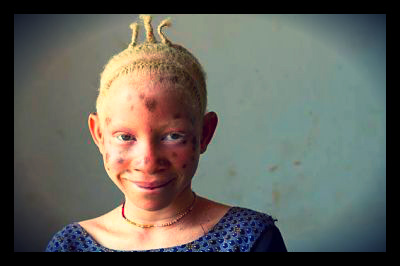
Albinism is a genetic medical condition diagnosed at birth, characterized by lack of pigment in the skin, eyes, and hair. The rare condition is found in 1 in 20,000 people worldwide. Albinism is more common in Africa than other parts of the world. Unfortunately, when it comes to the Democratic Republic of Congo and Tanzania, uneducated communities often react to Albinism in severely discriminatory ways.
Strangers and families alike reject the Albino populations in these regions. Oftentimes, mothers feel extreme humiliation when giving birth to an Albino child, and are mocked. Albino children oftentimes don’t feel loved by their own families. According to the United Nations Development Programme (UNDP), Albinos struggle to find work, access adequate health care, find marriage partners, and enroll in education programs.
Beyond discrimination toward Albinos, many uneducated Congolese and Tanzanian inhabitants believe strongly in several superstitions about the Albino population. To some of these inhabitants, people living with Albanism need to be hunted down by witch doctors, for their body parts are considered to bring luck and wealth on the battlefield. According to United Nations High Commissioner for Human Rights, Ms. Navi Pillay, many of the attacks lead to “dismembering (of) people, including children, while they are still alive.”
One child, in particular, has managed to flee with the help of his supportive family. According to a press release on October 14, 2013, Father and Mother, Anaclet and Solange, are deeply concerned for their son Jeff, a child with Albinism.
For the most part, the family lived a peaceful life. When Jeff was five years old, a member of the Mai Mai militia group broke into the family home, knocked him unconscious and stuffed him into a bag. His father awoke, and with the neighbors help, they were able to get Jeff back. After this attack, the Mai Mai demanded Jeff be given back, or pay 10,000 dollars. If they failed to respond, they would all be killed.
After the initial attack, the family fled, staying with reletives, in North Kivu, but ultimately were forced back to South Kivu to escape fighting between Congalese government and members of the M23 rebel group. They decided to head to Burundi, where they were secure for a while. On August 6, 2013, a grenade was thrown at the family home. At this point, the family reached out for help from the UNHCR, as well as the local government’s National Commission for the Protection for refugee and Stateless People. The family is protected at this time, while officials are figuring out permanent solutions.
The UNHCR has teamed up with a local group called Albinos San Fronières and launched a campaign in Burundi to raise awareness about Albinism. Catherine Huck, UNHCR’s representative in Burundi, hopes, “the partnership will contribute to a greater respect of the rights of people living with Albinism.” Additionally, the aforementioned UNDP, and the Association for the Protection and Development of Albino People in Orientale Province are organizing workshops, which seek to promote the issue among international organizations, and appeal for funding.
– Laura Reinacher
Sources: UNHCR, UN.org, Womennewsnetwork
Photo: NY Daily News

Global Health Scholarships Fund Solutions
In 1997, the U.S. Institute of Medicine identified global health as ‘health problems that are influenced by circumstances in certain countries, but have effects that could impact other nations.’ With globalization becoming such a prominent part of life economically, socially and politically, it is a clear progression that health problems will become “globalized” as well.
Global health scholarships are revolutionizing research that students can do for issues worldwide and helping to create new solutions and strategies for a variety of illnesses. There are many organizations that award global health scholarships, but three large groups are Johns Hopkins University, the American Medical Student Association, and the Bill and Melinda Gates Foundation.
Johns Hopkins University founded the Johns Hopkins Center for Global Health in 2006; it is comprised of the Bloomberg School of Public Health, the School of Medicine, and the School of Nursing. This year, the Johns Hopkins Center for Global Health awarded eight scholarships to students to give them the resources needed for them to pursue solutions to international health issues. Current scholarships winners are hoping to use their scholarships to monitor international health policies, achieve sustainable surgical care in developing countries, conduct infrastructure research in East Africa, facilitate community health programs, train people for public health interventions to prevent the spread of infectious diseases and increase global vision health care.
The American Medical Student Association (AMSA) has a six month long program that AMSA members, who are medical, pre-medical and public health students, can apply for. The program’s purpose is to create new solutions to help the global health outcome of developing countries. Topics covered by this program are how to meet Millennium Development Goals, what exactly global health is (epidemics, new diseases, communicable diseases), and the impact climate change and population growth have on global health.
The Bill and Melinda Gates Foundation also gives global health scholarships in the form of grants. The Gates Foundation gives billions of dollars to help fight global issues and within the last year they awarded $17,819 to The Henry M. Jackson Foundation for the Advancement of Military Medicine to support HIV research being done in Thailand. They also awarded $240,005 to the Center for Disease Control to work in India to create vaccines for enteric diseases and $356,650 to King George’s Medical University to help with pediatric pneumonia in India.
– Olivia Hadreas
Sources: Bill & Melinda Gates Foundation, Johns Hopkins, AMSA
MRSA Needs to Be a Global Concern
On October 11th, a third player on the Tampa Bay Buccaneers football team was diagnosed with methicillin-resistant Staphylococcus aureus, a deadly bacterial infection known as MRSA or staph. According to Buddy Creech, Assistant Professor of Pediatric Medicine at the Vanderbilt University Medical Center, many people carry MRSA on their skin. It is easier for football players to contract it because of the skin to skin contact and open wounds endured by tackles and hits. It is also common to contract it in crowded environments, such as hospitals.
Two out of every one hundred people carry MRSA. The bacteria lives on people’s skin and the inside of their noses. People who have healthy immune systems can fight off the infection with the use of specific antibiotics given out at hospitals. However, for those with weak immune systems, this infection could lead to boils, toxic shock syndrome, septic problems, heart valve problems and even death.
The most important thing when dealing with this bacteria is to sterilize everything during the treatment process. It is not unusual for people staying in hospitals to contract MRSA if the equipment they are surrounded by were not properly sanitized.
The MRSA outbreak in the NFL is a problem for global health. If it is a problem in the U.S., there is no telling how much a concern it could become in developing countries. If this outbreak were to occur in a developing country, it is unlikely that they would have the sterilization equipment necessary to prevent it from spreading. The treatment also requires very specific antibiotics that not many countries have quick access to.
MRSA has already begun to grow as a global epidemic. In Asia, the prevalence of MRSA has grown from 17 percent in 1986 to 40 percent in 2000. In Africa, the presence of MRSA has ranged from 5 percent to 45 percent. MRSA has also been found in Europe, Australia and South America.
– Olivia Hadreas
Sources: UT Southwestern, CDC, Medical News Today, ABC News
Photo: ESPN
biNu Maximizes Cell Phone Abilities
Australian start-up biNu may be pioneering revolutionary cell phone technology. By minimizing the required bandwidth and memory capacity of the user’s phone, biNu brings smart-phone level applications to ‘dumb’ phone users for little to no cost, and emphasizes reliability in weak or spotty networks, which cover a majority not only of the developing world, but the planet as a whole.
$7.5 million in funding from Eric Schmidt and others, and a UN ‘My World Innovation’ Award later, it seems the technology is working.
biNu dramatically widens two data streams currently existing in stunted forms. One of these is headed into the developing world. At least 4 million users in the developing world access the biNu cloud every month, utilizing hundreds of millions of webpages. Phones that were previously only usable to make calls are now empowered with the apps of corporations, governments, NGOs, and more, bringing an unprecedented level of information and communication to poor regions.
This stream is also significant for its profitability – for both biNu and others. Gary Lentell and Dave Turner, biNu’s founders, know first-hand how volatile the tech start-up world can be, having already lost all $75 million they made with their previous business, Sabela Media; biNu’s ability to bring new markets into touch with marketers means it stands to make a profit as the middle man.
But the companies who can present ads to these new markets may be the ones who profit most dramatically – if they can capitalize on the face-time as efficiently as Google has. In this way, biNu is for software what the cell phone was for hardware: a lead forward in terms of inter-connectedness.
The second data stream is headed out of the developing world, to NGOs and research institutions who now have direct access to the people they are trying to help. This second stream has already been dramatically influential, enabling over 100,000 responses to a UN survey which utilized the software.
As more NGOs become aware of biNu’s potential, its ability to make direction connections between aid givers and aid receivers will proliferate and create a more seamless development community – a community which currently suffers greatly from a major divide between those who have the resources and desire to help, and those who require help.
Lentell has repeatedly stated his interests lie dominantly in creating a solid, profitable business – not in helping people, which is only a perk. While many CEOs who express such sentiment earn derision for not being in touch with economic reality, NGOs and the developing world should be grateful to have such a practical mentality heading biNu.
Too many start-ups with the revolutionary potential of biNu sputter and die because of overly idealistic leadership. BiNu’s best chance to bridge the Digital Divide is to focus on itself and its profitability, continue to pursue the best technology and the most reliable investments, and allow its users to dictate how biNu is applied to the developing world.
– Alex Pusateri
Sources: Venture Beat, The Next Web, BINU, BINU: How It Works, INC
3 Easy Ways to Improve Your Life
Sometime the desire to help others is smothered by the strain of life. Work, bills and other obligations can quickly pile up until any offer of assistance is impossible to carry out. But what if you could help others just by living? Here are three super ways to give something back and get some chores done at the same time.
1. Update Your Wardrobe
Cleaning out your closet can be tedious work, but it can also be therapeutic. Experts say that organization can improve a person’s mental and emotional state. Will Edwards, founder of White Dove Books, explains that organization has been proven to lower stress, boost motivation and save someone valuable time and energy. De-cluttering your wardrobe can help de-clutter your mind. Anything that hasn’t been worn in the last six months should be pulled. “Placeholder items” waste valuable closet space. Put unused clothes to use by donating to a local shelter or donating funds from a yard sale to your favorite cause.
For those needing to add to their wardrobe, online retailers offer weekly sales. Some sites, like Amazon, allow shoppers to donate a percentage of their purchase amount to their favorite charity. Beginning at their favorite charity website, donors locate the Amazon link and shop to their hearts’ delight. After checkout, a certain percentage is sent to the selected organization.
Need to compare different retailers? Some search engines donate change for each internet search generated.
2. Clean Out Your Pantry
Have a pantry full of staples that never seem to get used? Clean it out and donate non-perishables to the nearest food bank or volunteer your time. Fall and winter are the busiest times for charities and any assistance is appreciated. For those lacking the time, there are other ways to help others.
Non-governmental organizations worldwide have committed to providing food relief to developing nations. They recognize that people cannot focus on stimulating the economy if they go to bed hungry. Groups like Food for Life provide food relief for millions of impoverished people on a daily basis and donations are readily accepted.
3. Put On Some Music
When the stress of cleaning gets to be too much, turn on some music. It has been reported that music can greatly reduce stress and even reduce pain. Be sure to take a break and buy a new cd or check out a concert. But taking a break from chores does not mean that you can’t give back.
In recent years, musicians have redirected global focus to the plight of the world’s poor. Every genre has at least one song about poverty and recent collaborations have generated an explosion of music relief efforts. Organizations such as Music For Relief have raised over $5 million since 2004 and music providers like iTunes have designed a variety of apps to assist non-profits in fundraising.
– Jasmine D. Smith
Sources: Amazon, Ezine, Food for Life, Huffington Post, iTunes
Photo: All Posters
Imprisoned for Miscarrying?
Last month in El Salvador, a judge sentenced 19 year-old Glenda Xiomara Cruz to prison for 10 years. Her crime? Miscarrying.
In October of 2012, Xiomara, experiencing excruciating abdominal pain and bleeding, sought medical treatment at a public hospital. Unaware that she was even pregnant, as she’d experienced no weight gain and a pregnancy test had come back negative, doctors told her she’d lost a baby. Four days later, the teenager had been reported by the hospital to the police for suspected abortion and charged with aggravated murder. A year later, she’s been sentenced to ten years in prison by a judge who told her “she should have saved her baby’s life.”
Xiomara’s unfortunate fate is the result of El Salvador’s strict abortion law. The law is so strict, in fact, that since 1998 abortions have been completely banned without any exception, even in cases of rape, fetal deformity, or if the mother’s life is at risk.
Twenty-eight year-old Maria Teresa Rivera’s story parallels Xiomara’s and further illustrates the tragic consequences of such a harsh law. Last year, she too sought medical treatment for bleeding and abdominal pain and was reported to authorities by the hospital after suffering a miscarriage. Teresa was sentenced to 40 years in prison for aggravated murder. A textile worker and her family’s main provider, going to jail meant leaving her eight year-old son in extreme poverty.
A study done by the Citizens’ Group for the Decriminalization of Abortion supports the statement that this law overwhelmingly affects those living in poverty. The study found that, since 2000, more than 200 women have been reported to the police on abortion charges — the vast majority of these women were poor, unmarried and with little education. Comparatively, not a single woman has been reported from the richer private healthcare sector — where abortions are believed to be performed regularly.
More than unfairly imprisoning women and tearing apart families, the law also has devastating consequences for women’s health. Bessy Ramirez of San Salvador enunciates one of the numerous harmful effects of the law: “I would be terrified to go a public hospital as there is no benefit of doubt given to young women, we are presumed guilty and jailed.” For poor women, however, public hospitals represent their only medical treatment option.
In addition to deterring women from seeking medical treatment, the law likely also has a role in boosting the occurrences of suicide. Health Ministry figures from 2011 identify suicide as the most common cause of death for 10-19 year-old girls; half of these girls were pregnant. Further, because it is illegal for women to terminate pregnancies even in cases where the mother’s health is threatened, the inability to treat pregnancy complications is the third most common cause of maternal mortality.
Amnesty International’s El Salvador expert Esther Major calls the abortion law “cruel and discriminatory” saying that “women and girls end up in prison for being unwilling, or simply tragically unable, to carry the pregnancy to term. It makes seeking hospital treatment for complications during pregnancy, including a miscarriage, a dangerous lottery.” Unfortunately, as in innumerable other instances, it’s a lottery women in poverty are most likely to lose.
– Kelley Calkins
Sources: BCC, Slate
Photo: Vice
Nigeria Poverty Rising Despite Economic Growth
In the last several years, Nigeria has seen an increase in its economic state. However, Nigeria is a country that follows the profile of African countries: a land rich in natural resources, yet much of its population remains in poverty. Despite the economic growth due to its oil revenue, Nigeria has been hindered by other problems for many years. An unstable government, a lack of cultivated land and the lack of progress made in rural areas all attribute to Nigeria’s high poverty rates.
Nigeria’s government has come under heavy criticism. The country relies primarily on its oil revenue to strengthen the economy, thereby eliminating the need for taxpayers to maintain the government officials’ salaries. The salaries of these high ranking officials often exceed $100,000, while the average family survives on $1.25 per meal. The large discrepancy between the working people and the government officials is no secret; the government corruption occurring in Nigeria is one of the worst on the planet.
The agricultural sector of the country employs roughly two-thirds of the working population. Nigeria is a world leader in production of cassava, yam and cowpea. Nigeria is also a major player in the fish industry. But the country still struggles with starvation levels, and Nigeria relies on large imports of grains, livestock products and other food products.
However, Nigeria has a huge agricultural base that offers great potential for growth and improvement. The agricultural sector has shown progressive improvements over the years, growing by 7 percent from 2003 to 2007. However, the large percentage of potentially cultivated land remains untapped.
Of an estimated 71 million hectares of potentially cultivated land, only about half is under production. There is a lack of productive irrigation methods prevailing over the land. Of the potential workable land, only about 7 percent is being properly irrigated. With an enhanced emphasis on irrigation and other land cultivation techniques, the substantial natural resources of Nigeria could be put to better use.
Urban areas in Nigeria have shown an increase in well-being over the past years. However, much of the rural areas in the country are mired in extreme poverty, living on scraps and from meal to meal. The people who work the fields in the rural areas are practically living off the food they produce, then they sell anything they can to mass production.
Nigeria is a nation that has extraordinary natural resources. However, the nation is held back by its various national issues. With a significant amount of corruption running throughout the government, the head of the country is in dismay. Without a solid government, the backbone of the country is crippled. Having great natural resources is only a positive factor when they are employed to their full potential. By not cultivating the majority of the usable land, Nigeria is limiting itself. Lastly, the lack of development in rural areas hurts the economy as a whole, not only the people residing in those rural areas. Better conditions could help the food production, which in turn would help cultivate the land more effectively. Nigeria has enormous potential, yet the proper leadership and productivity is lacking.
– Zachary Wright
Sources: Punchng, Rural Poverty Portal, BBC News, Daily Mail UK
Pictures: Daily Mail UK
3 Things That Will Help End Poverty
When on the search for a solution to global poverty, activists and politicians come up with various elaborate plans, incentives and government legislations. Often these solutions are built with three very simple ideas that create substantial change to those living in poverty:
1. Education
Constant and good education can change lives. While those in the developing world take it for granted, there are people who live in poverty due to their lack of education. This lack of education is normally a result of the lack of the opportunity or circumstances that require them to work rather than study. The cycle of poverty is such that living in poverty requires the next generation to work to help support the family. The younger children are rarely given a chance to complete their education. The connection between education and poverty, or rather the ability to rise out of poverty, is extremely evident. An education guarantees a job that is better paying, allowing the next generation to continue to be educated instead of working. This breaks the cycle of poverty that rears its ugly head in so many parts of the world.
2. Small Local Businesses
Opportunities for jobs increase with the support and growth of small local businesses. Local businesses don’t only create opportunities; they also bring supplies and resources into a community that would greatly benefit from it. These small businesses range from medical supplies or care facilities to agricultural and technological support. Additionally, such businesses continue to beget more businesses, making the economy flourish and the citizens of the community thrive and follow by example.
3. Technology
Technology can substantially help improve the conditions of the poor. For those working in agrarian communities, advanced technology can yield better crops; technology can help improve education. Internet access can change the face of communications, and mobile phones greatly reduce the damages of natural disasters due to the immediate news they can provide. Access to electricity or any kind of power, would also help bring amenities to those living in poverty that many people take for granted. Finally, technology will significantly improve health care standards in places where it is scarce. The Posner Center for International Development does just this: various organizations come together, come up with ideas that will benefit developing areas in the world, and help bring about these additions that will significantly improve living conditions.
– Aalekhya Malladi
Sources: NY Times, Denver Post
Photo: Foreign Policy
Google Search Terms Reveal Today’s Sexism
With the advent of the Internet, education, science, and advanced technologies never before-imagined by the forefathers of the contemporary world, one issue remains devastatingly current–women are still viewed as the inferior species in society.
UN Women, one of the branches of the United Nations, teamed up with artist Christopher Hunt of Oglivy & Mather to produce an ad campaign to address the pervasiveness and current predominance of the deprecating attitudes towards women.
The graphics feature bleakly lit photographic portraits of women of different races and backgrounds. Superimposed over their mouths like a tied gag is the iconic Google search bar with a drop-down of popular search terms about women. The highly searched queries, done in September 2013, echo archaic sentiments from far beyond the Victorian ages: “women shouldn’t vote,” “women need to be controlled,” and “women need to be disciplined.”
The popular queries reveal the Internet age’s view on sexism in the stark black text, while corrective and forward-thinking sentiments such as “women cannot accept the way things are” are printed almost illegibly in white beneath each woman’s chin. The black, inhibiting text easily overweighs the white restorative text printed on the ads.
The Google search ads reveal a disturbing and bleak truth about the world’s progress in attitude, or lack thereof. In terms of global development, especially with the empowerment of women as one of the MDGs, the question begs to be asked: is enough being done by today’s leading international institutions to advocate the importance of women in the common interest of pluralism and peace?
– Malika Gumpangkum
Sources: Adweek, Design Taxi, Newsfeed
Photo: Times
UNHCR Assists Young Congolese Albinos
Albinism is a genetic medical condition diagnosed at birth, characterized by lack of pigment in the skin, eyes, and hair. The rare condition is found in 1 in 20,000 people worldwide. Albinism is more common in Africa than other parts of the world. Unfortunately, when it comes to the Democratic Republic of Congo and Tanzania, uneducated communities often react to Albinism in severely discriminatory ways.
Strangers and families alike reject the Albino populations in these regions. Oftentimes, mothers feel extreme humiliation when giving birth to an Albino child, and are mocked. Albino children oftentimes don’t feel loved by their own families. According to the United Nations Development Programme (UNDP), Albinos struggle to find work, access adequate health care, find marriage partners, and enroll in education programs.
Beyond discrimination toward Albinos, many uneducated Congolese and Tanzanian inhabitants believe strongly in several superstitions about the Albino population. To some of these inhabitants, people living with Albanism need to be hunted down by witch doctors, for their body parts are considered to bring luck and wealth on the battlefield. According to United Nations High Commissioner for Human Rights, Ms. Navi Pillay, many of the attacks lead to “dismembering (of) people, including children, while they are still alive.”
One child, in particular, has managed to flee with the help of his supportive family. According to a press release on October 14, 2013, Father and Mother, Anaclet and Solange, are deeply concerned for their son Jeff, a child with Albinism.
For the most part, the family lived a peaceful life. When Jeff was five years old, a member of the Mai Mai militia group broke into the family home, knocked him unconscious and stuffed him into a bag. His father awoke, and with the neighbors help, they were able to get Jeff back. After this attack, the Mai Mai demanded Jeff be given back, or pay 10,000 dollars. If they failed to respond, they would all be killed.
After the initial attack, the family fled, staying with reletives, in North Kivu, but ultimately were forced back to South Kivu to escape fighting between Congalese government and members of the M23 rebel group. They decided to head to Burundi, where they were secure for a while. On August 6, 2013, a grenade was thrown at the family home. At this point, the family reached out for help from the UNHCR, as well as the local government’s National Commission for the Protection for refugee and Stateless People. The family is protected at this time, while officials are figuring out permanent solutions.
The UNHCR has teamed up with a local group called Albinos San Fronières and launched a campaign in Burundi to raise awareness about Albinism. Catherine Huck, UNHCR’s representative in Burundi, hopes, “the partnership will contribute to a greater respect of the rights of people living with Albinism.” Additionally, the aforementioned UNDP, and the Association for the Protection and Development of Albino People in Orientale Province are organizing workshops, which seek to promote the issue among international organizations, and appeal for funding.
– Laura Reinacher
Sources: UNHCR, UN.org, Womennewsnetwork
Photo: NY Daily News
5 Best Humanitarian Jobs
For those individuals interested in the humanitarian work force, there are endless career possibilities. With over thousands of nonprofits and organizations to work with in virtually all countries across the globe, a wide variety of jobs are in abundance. But which jobs are the best? While everyone has their own preferences, these are the positions that seem to be most predominantly agreed upon as the best humanitarian jobs.
1. Volunteer
The most versatile and perhaps the most rewarding humanitarian job out there goes by the simple title of volunteer. Volunteers rarely make any money, but most all workers start at this position and are content with the opportunity to change lives.
2. Intern
A large number of nonprofits now offer internship programs, some paid and some unpaid. Depending on the organization, intern jobs can range from anything such as office work to traveling and even manual labor. Internships are a great starting place for people seeking careers in humanitarian work, as many internships feed directly into job opportunities.
3. Consultant
Nearly all humanitarian organizations are made up of several consultants—those who keep communication with important contacts and other outside individuals while answering any questions or concerns that the public might have. These positions are often paid.
4. Program Coordinator
Program coordinators play a vital role in nonprofits, as they are directly responsible for planning and executing specialized tasks for sub-organizations, events, etc. Depending on the organization at hand, these can be paid or unpaid positions.
5. Communications Specialist/Journalist
These jobs are often paid and include a number of important tasks ranging from making contact with other organizations to writing press releases for special functions, providing public relations tactics, and even publishing news as a journalist. This position typically allows for travel opportunities, as well.
– Meagan Hurley
Sources: Devex, Aid Worker Daily, Workforce Humanity
Photo: Cross-Cultural Solutions