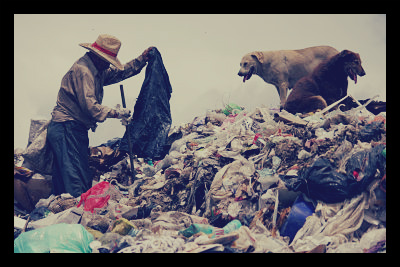
According to Vice, the “basurero”, Guatemala City’s garbage dump, is considered an official neighborhood within the city despite the humanitarian crisis it creates.
Benjamin Reeves, the author of the article, said roughly 7,000 people, including poor families, visit the site every day to look for sellable items that can potentially earn them a few extra bucks.
“Many families have been driven to the basurero by poverty brought on by the global economic crisis coupled with mismanagement on the part of the Guatemalan government,” said Reeves.
The people who live in or near the basurero are called “guajeros”. The work environment of the guajeros is often hazardous. Accidents occur frequently and the air quality makes it difficult for residents to breathe.
The most recent fire broke out in January 2014. Reeves said that the local fire department hardly put any effort in extinguishing “the inferno” that was “fueled by the chemical waste and toxic refuse” below the trash.
“Residents of the basurero complain of chronic congestion, constant headaches, and high rates of asthma and respiratory problems,” Reeves explained.
Although the basurero itself is problematic, the situation for the guajeros is not any better across the street from the mountain of trash.
The “maras”, Guatemala City’s most infamous street gangs, wield more power than NGOs within the neighborhood.
“On a good day, a guajero earns around 40 Quetzales ($5). However, the street gangs regularly extort the workers for about half of their daily earnings, often leaving them with as little as $2.50 for an entire day of back-breaking labor,” said Reeves.
Crimes such as rape, homicide, theft and child abuse are common in the basurero despite the police’s presence. Most of the time they would look the other way or hardly make any effort to maintain order and protect the residents.
While these crimes and fires continue to occur, Reeves argues that the Guatemalan media fails to report the issues related to the basurero.
Why do people live in impoverished conditions in or near Guatemala City in the first place?
According to Gretchen Kroth, a research associate at the Council on Hemispheric Affairs, the extreme poverty and economic inequality affecting the city are due to a civil war, which started in 1960 and ended in 1996.
The conflict fought between the Guatemalan National Revolutionary Unity (URNG) and Guatemalan government in rural locations “forced the migration of many families from the highlands of Guatemala to urban centers, including the neighborhoods adjacent to the landfill,” explained Kroth in a Counterpunch article regarding the education system of the basurero.
Kroth argues that the Guatemalan government today does little to support the poorly structured educational system around the country.
“As public schools are sparsely equipped due to limited government funding a corrupt management, private schools have been established to provide educational services in their place for those who can afford the fee”, she said. But the families of the children who live in the basurero cannot afford paying $20 to $60 a month for education expenses.
As Reeves explained, the guajeros can make up to $5 on a good day. Thus, how can people living in the basurero pay for an education when the money for it does not exist?
To alleviate poverty, more needs to be done in Guatemala apart from receiving the attention of the world, such as the government taking the goal of eliminating poverty seriously and learning how to manage the economy in an honest and transparent fashion.
Each day the government refuses to aid what Reeves calls “a humanitarian crisis”, the lives of the guajeros will continue to be threatened by the conditions in the basurero.
– Juan Campos
Sources: Counterpunch, Vice
Photo: Taringa

Climate Change To Worsen Food Security and Impact Poverty
In a report released by the UN Intergovernmental Panel on Climate Change (IPCC), scientists say that there is cause for concern that global warming makes it more difficult to provide food for the world’s population. The scientists say the negative impacts of climate change on crop yields have been more common than the positive.
Further climate change is expected to slow down economic growth, hinder efforts at poverty reduction and generally diminish food security. Since climate change will negatively impact crop production, food prices will rise and therefore food insecurity will rise. This food insecurity will be especially prevalent in countries with high levels of income inequality and will most affect those that are already poor, thereby undermining efforts to get rid of the cycle of poverty. Indeed, the report mentions climate change as a “threat multiplier” to the lives of people living in poverty worldwide.
However, crop production is expected to increase given the constant improvement of agricultural techniques, which is set to expand production at a rate of 10 percent per decade. Since climate change is expected to decrease agricultural output at a rate of 1 percent per year, this means crop production will go up, but at a slower pace than it would normally, according to David Lobell of Stanford University.
Yet some rural areas in countries such as India do not rely on irrigation techniques to increase crop yield, but rely rather on rainfall. Such places would be affected greatly by the climate change.
The report also stated that climate change would increase food prices within the range of 3 to 84 percent by 2050. Staple agricultural products such as wheat and corn would be most affected, and the report mentions that the countries in Central and South America that grow coffee will be negatively impacted.
Climate change is a reality that we must face right now if we want to help prevent human suffering on a grand scale years from now. We have been warned, now it is up to all of us, including our governments and the private sector, to do something about it.
– Jeff Meyer
Sources: Denver Post, Huffington Post, IPCC: Climate Change, IPCC: Livelihoods and Poverty
Photo: InHabitat
100K Strong in the Americas Program
One of President Obama’s most important initiatives in the Latin American region has been the 100K Strong in the Americas Program. This program was launched in March 2011, and seeks to increase international study in the Western Hemisphere. The idea is to foster a common understanding between the peoples of the Americas in the hopes of bettering inter-American relations.
The Department of State has partnered with the Association of International Educators (NAFSA), and Partners of the Americas, a development agency, in order to realize this vision. The program works by establishing a network of partnerships with foreign governments, universities, and colleges, and the private sector to increase foreign student participation in the U.S. and U.S. student participation in the Americas. The goal of the program is to reach 100,000 Latin American students studying in the U.S. and 100,000 U.S. students studying in Latin America by 2021.
In order to finance this venture, the State Department has set up the 100K Strong in the Americas Innovation Fund, whereby companies can donate money to Latin American and U.S. universities in order to improve cross-cultural student exchange. By current figures, 40,000 U.S. students study in Latin America and the Caribbean while 66,000 Latin American students study in the U.S. each year. Clearly there is work still to be done.
One large obstacle is the fact that many Latin Americans from poorer backgrounds do not have the necessary grasp on the English language that is required to succeed at a U.S. college or university. On the other hand, many U.S. students do not understand or recognize the value of studying abroad at Latin American colleges or universities.
It is hoped that the public-private sector partnership through the Innovation Fund will be able to increase the numbers of students studying in the U.S. and in Latin America.
Through the 100K Strong in the Americas program the U.S. hopes to construct a more understanding relationship between Latin Americans and the U.S. Enhancing cross-cultural contact is necessary for a better working relationship within the hemisphere in the future. By promoting this contact between the future leaders of the Americas, the U.S. is ensuring more successful diplomatic efforts down the line.
– Jeff Meyer
Sources: 100K Strong, U.S. Department of State, U.S. Department of State
Photo: US Embassy
Indictment for the Sake of Democracy
He pleaded not guilty to all of it. To allegations of suspending the constitution and putting forth a state of emergency, making unlawful constitutional alterations and detaining superior court judges, General Pervez Musharraf claimed innocence.
In 1999 Musharraf overthrew Pakistan’s constitution and took the presidency in order to, from his perspective, “restore the country’s honor” at a time of near economic default. Yet some consider this same power grab to have been more along the lines of a military coup. Musharraf’s formal indictment for high treason on March 31, however, relates primarily to his actions after taking office.
In 2007, shortly after his reelection for the Pakistani presidency, Musharraf got scared. The country’s Supreme Court, whose opposition toward Musharraf had been steadily growing, was scheduled to rule on the election’s legality. Insinuating that any justices who failed to sign on to the “provisional constitutional order” would be dismissed from their positions, Musharraf enacted emergency rule in an effort to maintain his withering hold on power. By 2008 the downtrodden president resigned in the face of possible impeachment.
The court cases Musharraf faces at present may have come sooner had he not fled the county following his resignation. Intending to restart his political career, he returned to Pakistan in 2013 only to be met with a barrage of accusations against him. Since his arrival, the former president has prolonged and delayed his hearings with impeccable reliability. Citing health issues and security concerns, the March 31 indictment came on Musharraf’s second attendance at the court out of a total 37 scheduled hearings. And his fateful second trip to court only occurred due to the humiliating risk of arrest that came along with the Pakistani police officers’ visit to his hospital bed at the military hospital in Rawalpindi, where he has repeatedly shown face on account of chest pain prior to a hearing. He has so far complained of a rickety knee, a bad spine, hypertension and a clogged artery, among other creative ailments. In addition to apparently failing health, on two occasions Musharraf somehow managed to discover explosives laying oddly conspicuously in his farm yard outside of Islamabad. Whether or not there is truth to these claims, Musharraf’s future is in a seemingly precarious position.
If he is found to be guilty of the five charges placed against him, Musharraf could be sentenced either to life in prison or be given the death sentence for high treason.
According to some scholars, the trial itself is a sign of democratic progress in Pakistan. Musharraf’s indictment signified the first time any army chief or military dictator faced charges of going against the constitution. As such, the Pakistani court is taking a vital stand in support of constitutional sanctity and democratic values in a manner previously unseen.
– Jaclyn Stutz
Sources: New York Times, Al Jazeera, DAWN, New York Times
Photo: APMLPAK
Dust and Meningitis in the Sahel
Recent research carried out in Niger by Columbia University’s International Research Institute for Climate and Society (IRI) will hopefully allow scientists to be able to forecast meningitis outbreaks in sub-Saharan Africa, and thus prevent potential casualties of the disease.
The research was done by IRI in partnership with the NASA Goddard Institute for Space Studies. They found that environmental and climatic factors such as wind and dust conditions have an incredibly strong correlation with meningitis outbreaks in what is called the “meningitis belt,” stretching across the Sahel from Senegal to Ethiopia.
Bacterial meningitis occurs throughout the world but rates of meningitis in the Sahel and the rest of the belt are much higher. The African Meningococcal Carriage Consortium (MenAfriCar) reports that death rates of the disease are between five and 10 percent. However, long-term effects often ensue, including blindness, hearing loss and brain damage.
The outbreaks occur in the dry season and taper off with the first rains, and researchers have often believed that the mineral dust irritates the epithelial cells lining the nose and throat, allowing for easy passage of the bacteria into the bloodstream.
In the initial phases of the study, researchers collected a number of dust samples from Ghana, Niger and Senegal, examining the dust’s characteristics in order to see which properties might be influencing the spread of the disease.
Along with this information, the researchers also looked into environmental factors such as temperature and humidity and social factors such as reduced ventilation. A number of variables are being taken into account to understand how dust is affecting people’s vulnerability to meningitis.
The hopes of the study are that these climatic factors will help public health researchers to forecast meningitis outbreaks and develop vaccination strategies earlier in advance.
One of the lead researchers in the study, Carlos Perez Garcia-Pando, stated, “We’ve known that the disease is associated to climate and environmental issues for a long time, because it’s very seasonal. The idea was to try to use models and observations from satellites and all kinds of data on potential (climate-related) parameters that might be affecting the disease, and try to use that information to provide advance warning.”
Currently in the Sahel, a new vaccine has been distributed which has decreased the outbreak of meningitis. However, vaccination drives are still delivered in districts that are already suffering outbreaks, and they often come too late.
This study has shown that environmental factors can greatly impact the effectiveness of vaccination programs, and this has great implications for the future of meningitis control strategies across the globe.
– Mollie O’Brien
Sources: Irin News, The Guardian
Photo: National Geographic
Cricket Program in Argentina Fights Poverty
According to the Associated Press (AP), children who live in Villa 21-24, a dangerous slum in Buenos Aires, Argentina, are playing cricket in order to avoid a life of crime and poverty.
The Caacupe community center introduced the sport to the slum in 2009 to “integrate children to a game that traditionally was reserved for Argentina’s upscale private schools”.
Moreover, the AP said that Pope Francis, who is also known as the “slum pope”, was one of the founders of Caacupe and remains connected with its programs.
The community center is praised because children are given the opportunity to do something positive instead of giving into a lifestyle of drugs, crime and frustration.
Although the community center’s aim to help children out of poverty is benevolent, a closer examination is needed regarding Pope Francis and his role in Argentina while serving as a Bishop during the reign of a brutal military regime.
Vincent Navarro, who teaches Public Policy at Johns Hopkins University, is critical of Pope Francis despite some of his good intentions. This is primarily due to his silence during the Argentinean dictatorship in the 70’s and 80’s.
“The dictatorship, established in defense of the more privileged groups in Argentina, was especially brutal to any dissident and opponents of its reign,” Navarro said. “This silence reflected a lack of sensitivity to gross human rights violations carried out by dictatorships with close ties to the Catholic Church.”
Navarro said that the pope claimed that his silence should be excused since it was “a tactical and honest move”. Navarro also gives him credit for encouraging the Church to expand its involvement in fighting poverty and for indicating that poverty is the result of the exploitation under the capitalist system in return for profits.
However, a recent service that honored the fallen members of the Church who sided with the fascist military regime in Spain in the 30’s is another reason Navarro criticizes the Pope and the Catholic establishment.
“It is safe to assume that Pope Francis knows very well that the Catholic Church supported this military coup and dictatorship of General Franco, as evidence of this abounds,” Navarro asserted. “The Catholic Church was one of the major landowners in Spain and opposed the land reform initiated by the democratically elected Republican government.”
Although Pope Francis was one of the founders of the community center that is helping Argentinean children escape poverty today, the Counterpunch article written by Navarro uses historical examples to criticize his refusal to confront the repression of the military regime in the past.
– Juan Campos
Sources: Counterpunch
Photo: Yahoo
Guatemala City’s ‘Basurero’
According to Vice, the “basurero”, Guatemala City’s garbage dump, is considered an official neighborhood within the city despite the humanitarian crisis it creates.
Benjamin Reeves, the author of the article, said roughly 7,000 people, including poor families, visit the site every day to look for sellable items that can potentially earn them a few extra bucks.
“Many families have been driven to the basurero by poverty brought on by the global economic crisis coupled with mismanagement on the part of the Guatemalan government,” said Reeves.
The people who live in or near the basurero are called “guajeros”. The work environment of the guajeros is often hazardous. Accidents occur frequently and the air quality makes it difficult for residents to breathe.
The most recent fire broke out in January 2014. Reeves said that the local fire department hardly put any effort in extinguishing “the inferno” that was “fueled by the chemical waste and toxic refuse” below the trash.
“Residents of the basurero complain of chronic congestion, constant headaches, and high rates of asthma and respiratory problems,” Reeves explained.
Although the basurero itself is problematic, the situation for the guajeros is not any better across the street from the mountain of trash.
The “maras”, Guatemala City’s most infamous street gangs, wield more power than NGOs within the neighborhood.
“On a good day, a guajero earns around 40 Quetzales ($5). However, the street gangs regularly extort the workers for about half of their daily earnings, often leaving them with as little as $2.50 for an entire day of back-breaking labor,” said Reeves.
Crimes such as rape, homicide, theft and child abuse are common in the basurero despite the police’s presence. Most of the time they would look the other way or hardly make any effort to maintain order and protect the residents.
While these crimes and fires continue to occur, Reeves argues that the Guatemalan media fails to report the issues related to the basurero.
Why do people live in impoverished conditions in or near Guatemala City in the first place?
According to Gretchen Kroth, a research associate at the Council on Hemispheric Affairs, the extreme poverty and economic inequality affecting the city are due to a civil war, which started in 1960 and ended in 1996.
The conflict fought between the Guatemalan National Revolutionary Unity (URNG) and Guatemalan government in rural locations “forced the migration of many families from the highlands of Guatemala to urban centers, including the neighborhoods adjacent to the landfill,” explained Kroth in a Counterpunch article regarding the education system of the basurero.
Kroth argues that the Guatemalan government today does little to support the poorly structured educational system around the country.
“As public schools are sparsely equipped due to limited government funding a corrupt management, private schools have been established to provide educational services in their place for those who can afford the fee”, she said. But the families of the children who live in the basurero cannot afford paying $20 to $60 a month for education expenses.
As Reeves explained, the guajeros can make up to $5 on a good day. Thus, how can people living in the basurero pay for an education when the money for it does not exist?
To alleviate poverty, more needs to be done in Guatemala apart from receiving the attention of the world, such as the government taking the goal of eliminating poverty seriously and learning how to manage the economy in an honest and transparent fashion.
Each day the government refuses to aid what Reeves calls “a humanitarian crisis”, the lives of the guajeros will continue to be threatened by the conditions in the basurero.
– Juan Campos
Sources: Counterpunch, Vice
Photo: Taringa
Architectural Award Winner Receives Acclaim for Refugee Work
Celebrated architects are mostly known for the great buildings they design in expensive, multi-million dollar projects. Thus, when the Japanese architect Shigeru Ban was honored with the Pritzker Architecture Prize, it was remarkable in that he has largely been known for his innovation in refugee shelters. The refugee work that Ban has done in his home nation of Japan has helped many displaced by the earthquake/tsunami disaster of 2011, as well as refugees in other parts of the world.
The innovation from Ban comes from his use of disposable and recyclable material. The voters of the award said of Ban, “His buildings provide shelter, community centers and spiritual places for those who have suffered tremendous loss and destruction.” In 2011 the famous Christchurch Cathedral was decimated after a New Zealand earthquake. Ban built a temporary devotional structure out of cardboard tubes for those left without their religious sanctuary, giving the community an outlet in their time of difficulty.
Ban first got involved with refugee structures in the wake of the Rwandan genocide in 1994. Ban saw the conditions the refugees were living in, and he said, “I thought we could improve them.” Working with the United Nations High Commissioner for Refugees (UNHCR) Ban designed tents using paper tent poles that gave a cheap yet efficient and easily transportable shelter for the refugees. The UNHCR made Ban a consultant after his work in Rwanda.
His work in Kobe, Japan after the 1995 earthquake foreshadowed the work he would do in this decade. Ban designed houses made of cardboard for those displaced and even built a “Paper Church community center.” Some of the structures he made in Kobe were “meant to be used for three years were used for 10.” Ban’s work in these places has not only made a lasting emotional impact, but clearly a physical impact on the landscape as well.
The work that Shigeru Ban has done is exactly the type of innovative refugee work that should be encouraged in dealing with burgeoning international crises. Resources are stretched thin when working at so many different levels at once, and innovative minds like Ban’s can help remedy that strain. The Borgen Project and advocacy groups like it encourage funding for this type of innovative relief work.
The work that Ban has done in Japan since the 2011 disaster has capped off a career of humanitarian work. Ban has built partitions for families living in gyms, making life easier in a difficult situation. He even designed a three-story refugee shelter on the grounds of a baseball stadium. Ban sees the work that he has done in his home country as a necessity that is seen too little among the best of his profession. Ban says, “I was very disappointed in our profession. Because we are mostly working for privileged people, with power and money.”
With this recent award and the $100,000 grant that comes with it, one can hope that Ban is starting a wider trend in the architectural profession.
– Eric Gustafsson
Sources: BBC, New York Times, PBS
Photo: CNN
UNHRC to Investigate Civil War in Sri Lanka
On March 27, the UN Human Rights Council (UNHRC) voted to open an investigation in Sri Lanka, based on allegations of human rights abuses and other crimes related to the civil war in Sri Lanka that ended in 2009.
In a press release, Secretary of State John Kerry said that the resolution “reaffirms the commitment of the international community to support the Government of Sri Lanka as it pursues reconciliation and respect for human rights and democratic governance.”
In 2009, Sri Lanka’s 26-year- long and extremely bloody civil war ended when Sri Lanka’s military defeated the Tamil Tiger rebels.
Earlier in March, Sri Lanka detained two well-known human rights activists for 48 hours under their anti-terrorism laws. The government has also denied allegations of human rights abuses, brought to them by various human rights groups.
The resolution calls on the UNHRC’s Office of the High Commissioner for Human Rights to conduct an investigation in Sri Lanka based on allegations of human rights violations on both sides. The 47 members of the council voted 23 to 12 for the resolution, with 12 members choosing to abstain.
Kerry went on to say that the HRC is “deeply concerned by recent actions against some of Sri Lanka’s citizens, including detentions and harassment of civil society activists.”
Navi Pillay, the UNHRC high commissioner, had previously wanted to investigate human rights violations in the country because he believed that the country’s authorities had not made a great deal of progress in their own investigations.
This investigation has been called “long overdue,” as two years after the war ended in 2009, the HRC passed a resolution that commended Sri Lanka’s way of bringing the war to a close.
Prior to the vote on March 27, Sri Lanka’s ambassador to the HRC Ravinatha Aryasinha was not in favor of the resolution that would open a new investigation. Aryasinha said that the resolution would be a “grave threat to the sovereignty of U.N. member states” and that the resolution also went against international law.
Pakistan’s ambassador Zamir Akram also protested the resolution claiming that it based on political motives rather than about human rights. Akram also questioned whether the UNHRC had the resources to open the investigation at all.
India chose to abstain from the vote, claiming that it was concerned about going forward with an independent investigation. This decision was off-putting, as many nations expected India to support the independent investigation. In the past, India supported “tamer” resolutions regarding the war and supported previous proposal to open investigations.
The UNHRC’s investigation will focus on the bloodshed and violations that occurred at the end of the war in Sri Lanka. It was reported that approximately 40,000 civilians were killed at the end of the war, largely due to military offensives.
Additionally, the resolution calls for continuous monitoring of human rights conditions in Sri Lanka. The United States has said that it is important to improve human rights in Sri Lanka in response to the continuing abductions, torture, and extrajudicial killings that are taking place.
– Julie Guacci
Sources: The New York Times, U.S. Department of State, BBC News
Photo: The Independent
Saudi Arabia’s Ban on Female Drivers
Saudi Arabia is the only country in the world that forbids women from driving vehicles. The Interior Ministry, the head of the traffic police in Saudi Arabia, will not issue driver’s licenses to women. Although there is no formal traffic law that specifically prohibits female drivers, females will get arrested and punished by law enforcement for driving. This strict prohibition on female driving can be traced to Saudi Arabia’s cultural and religious identity.
In Saudi Arabia, a strict branch of Sunni Islam known as Wahhabism establishes the laws and rules of the country. Wahhabism segregates males and females in both the private and the public spheres of life. It creates a system that forces women and girls into second-class citizenry confined to the domestic sphere. Females typically rely on the permission of their male guardians (fathers, brothers or husbands) for all activities that they participate in.
They have little independence and agency to make their own decisions and partake in events of their choosing. Professor Jaime Kucinskas at Indiana University argues, “the ideal of feminine piety is associated with home, the need for protection and subsequent seclusion. Driving symbolizes the opposite: freedom in the public sphere.”
Why is this ban on female driving significant? After all, supporters of the ban argue that banning women from driving can protect them from potential dangers on the road and from potential harassment and violence from other male drivers.
However, through this ban, Saudi women have their freedom of movement completely taken away. This ban is only one factor that contributes to the gender disparity in the country and is part of a larger system that makes Saudi Arabia one of the worst countries for women’s rights.
Prohibiting women from driving prevents them from acquiring jobs, contributing to public life and to the formal economy. It preserves women’s dependence upon males and perpetuates the Wahhabism ideal of
femininity.
There have been some small, but meaningful victories in women’s rights in Saudi Arabia. In 2011, Women2Drive started campaigning to overturn the ban by openly driving vehicles in Saudi Arabia. Women are now able to ride bicycles and motorcycles for recreation, but not as a mode of transportation. There is now female representation in the Shoura Council, an advisory body of Saudi Arabia.
Although women’s rights activists are campaigning to end the ban, their larger goal is to transform the social, religious, economic and political systems that oppress Saudi women. Saudi females are taught from a young age of their fragility and of their piousness. National laws and cultural norms prevent Saudi women from becoming empowered and having the freedom of movement and having the freedom to make their own decisions.
– Sarah Yan
Sources: Washington Post, Internations, The Atlantic
Photo: The Telegraph
Reinvigorated Childhood, Courtesy of Shakespeare
Struck by the catastrophic circumstances of their previous lives in Syria, children in the Zaatari refugee camp in Jordan spoke of bullets, bombs and death. Nawwar Bulbul wanted to change that. A prominent soap opera actor until being blacklisted by the Syrian government on account of joining in protests against the regime, Bulbul brought his love for theater with him as he fled.
The Zaatari Camp in northern Jordan has ballooned with the recent inundation of Syrian refugees fleeing over the border and, with a lofty 102,704 residents, according to United Nations High Commissioner for Refugees, currently stands as the world’s second-largest refugee camp. Basic needs such as food and water are met on a marginalized basis by various international organizations attempting to help quell the trauma of the current Syrian crisis, yet children require more than that in order to live with the hope of successful and fulfilling futures. With less than 40 percent of refugee children attending school, there is a huge deficit of arts and culture among traumatized population.
For over two months, Bulbul has worked to bring happiness to the lives of these children. Because of the impressive initiative taken by this actor-turned-director, 100 refugee children come together to rehearse Shakespeare’s “King Lear.” Translated to classical Arabic from its original Bard’s English, the play brings joy to its performers and a renewed sense of childhood innocence to those who have been stripped of such rights and privileges.
One young girl named Ammari, who came to Jordan along with five sisters and a brother, says she feels the transformation.
“I do not feel lonely any more in this place,” she told reporters. She has found something to finally entertain her and take her mind off of the victims of calamity around her.
Though some may claim that this particular Shakespeare tragedy is not suitable for children, Bulbul argues otherwise. He says he took only the roots of the story for the children’s adaptation, and focused primarily on the differences between lying and telling the truth. While Bulbul’s initiative received no support from international organizations and only minimal support from friends in the Syrian community, the past two months of play practice have shown outstanding success for the youth.
In discussions of Shakespeare’s plays, the participants showed behavioral and emotional development. The children involved learned quite a bit about controlling anger as well as the violent and destructive consequences of seeking revenge. For a group that has spent a good portion of life so far living amid death, destruction and humiliation, these are lessons some may have thought unfathomable in previous months.
Yet Shakespeare is not the only poetry in this situation. Bulbul translates from Arabic to mean bird, or oftentimes nightingale, a bird primarily known for singing in the dark. So as Nawwar Bulbul brings the song of hope and joy to the inner darkness of an overpopulated refugee camp, he does, so beautifully, live up to his name.
– Jaclyn Stutz
Sources: Ahram Online, Times of Israel, Global Arab Network
Photo: Times of Israel