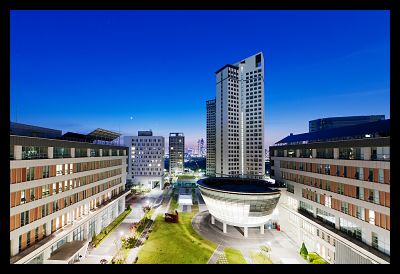
On March 3, 2012, South Korea founded its first American university with a goal to bring degree programs to international universities in hopes of fostering global leaders.
Now, two years later, the school has exceeded expectations, attracting students from 20 countries around the world, including China, Iran, Kenya, Ghana and Uzbekistan.
The State University of New York (SUNY) Korea is one of the campuses of Stony Brook University to open at the Incheon Global Campus (IGC), followed by George Mason University Korea, University of Utah Asia Campus and Ghent University Global Campus. Universities at the IGC are “extended campuses” of universities that are part of a global hub that fosters an atmosphere of industry-university-research cooperation and East-West intellectual and cultural exchange.
At SUNY Korea, students are offered degree programs comparable to prestigious schools in the U.S. where they can enjoy the American education while still being engaged in dynamic Korean culture. In spring 2013, the school saw its first undergraduate class of 38. This fall, the undergraduate enrollment is 133 students.
Still new in development, there’s not much to base statistics off on in order to tell what the graduation rate might be for undergraduates, masters and Ph.D. students. In fact, no undergraduate students have received their diplomas yet; however, this is expected to change in 2016. As the top educational hub in North East Asia, the IGC hosts universities and research institutions in hopes of fostering a diverse population of students from around the globe to become leaders in their fields.
Though SUNY Korea follows that same mission, students can only get degrees in computer science, mechanical engineering and technology systems management. Graduate students, however, can move forward by advancing their fields toward robotics or computational fluid dynamics.
This is not the only difference students are presented with when it comes to a unique university structure. Rather than taking a mix of major requirements and DECs each semester, students may only take major-related courses during their freshman, junior and senior years. However, as sophomores, students are required to spend the year at the Stony Brook campus where they can take a combination of both DECs and major courses.
SUNY Korea is expected to see the Fashion Institute of Technology that will serve as their art program. There’s also a possibility of opening a business program for students down the road, but that is yet to be confirmed.
Since its launch two years ago, SUNY Korea has been able to reach students across the world to foster a technology-driven global hub that brings a whole new level to global education and interconnectedness. As of October 2014, the school has a total population of 230 students, over 30 percent of them international. By 2021, they hope to increase that number to 2,000 students.
With more expansion, SUNY Korea will fulfill their mission in becoming a pioneer of a new global education paradigm without borders.
– Chelsee Yee
Sources: SB Statesman, Korea Herald, SUNY Korea, Scholarship SUNY
Photo: Asia Pacific Regional IGF

Pakistan Mobile Bus Library Program
Last month, the Pakistan Reading Project launched its first mobile bus library program at a government secondary school to promote reading habits for young students.
The program is set to run over the next two years in Sindh and Islamabad Capital Territory with plans to bring reading materials directly to communities as part of a larger mission to improve the quality of education.
It’s all part of the USAID-funded Pakistan Reading Project, a five-year initiative that supports the country’s provincial and regional Departments of Education to improve the reading skills of four million children.
The project does this by improving the quality of primary education, teacher education, policy reforms and community engagement. This includes making supplemental instructional materials more widely available to primary school teachers as well as providing a model that ensures sustainability of the initiatives even through permanent policy changes.
The result? At least 2.5 million children who can read at levels commensurate with their grade standards.
The mobile bus library program is an effort to see this vision come true by bringing age-appropriate reading materials directly to communities that don’t have established libraries.
In addition, trained librarians will be aboard each bus, conducting storytelling sessions in each community that they visit. They will also issue books for students to take home to read. It’s an initiative to help reintroduce and reestablish a national culture of reading that once existed in Pakistan.
At the program’s official inauguration, the Assistant to the Administrator of USAID, Donald “Larry” Sampler, and the President of the International Rescue Committee (IRC), David Miliband, were present to speak on the occasion.
“The Mobile Library Programme is just one element of the USAID-funded Pakistan Reading Project which will help Pakistani children to start their own journeys in the world of books,” said Sampler. “Through this partnership between USAID, our implementing partner – the IRC and the Government of Pakistan, we are taking a multi-pronged approach to help increase literacy.”
The Pakistan Reading Project is a $165 million project that has launched several campaigns as well as television and radio episodes with complimentary print material that highlight the importance of reading to all communities.
With the addition of the mobile library bus program, this project anticipates that they will fulfill their vision in seeing improvement in classroom learning and the reestablishment of a national reading culture.
– Chelsee Yee
Sources: Pakistan Reading Project, USAID, Pakistan Today, Zee News
Photo: PBS
10,000 Girls Empowers Senegal
In the moment of need she had to decide whether she will rise to the occasion or fall under the pressure. After the very sudden death of her 26-year-old daughter who left behind five grandchildren – Viola Vaughn was left searching for the pathway to peace. A native of Detroit, Michigan, she spent had much of her life working in Africa. Sensing a need for a return to Africa, her husband and the five grandchildren headed to Kaolack a small town in Senegal.
With a hopeful heart they moved, little did Vaughn know another sudden tragedy, the death of her husband would occur shortly after the move. Lost in her grief Vaughn devoted all of her time to home-schooling her grandchildren ages four to 12.
Word of Vaughn’s success with her grandchildren began spreading and more and more children wanted to have Vaughn as their teacher. Mothers approached her with stories of their children not doing well in school, within two weeks her classroom went from five to 20 students eager to learn from their teacher. Vaughn became more aware of the increasingly low statistical rates of girls getting an education because of the high demands that are put on them on the home front. Most young girls would only fail because they would not be able to make it to classes and exams leading to high dropping out rates and failed classes. In 2001, Vaughn decided to make it official and turned her grandchildren’s bedrooms into classrooms.
She conducted a system of teaching them how to teach and support one another. Within a mere two years the group grew from five to 20 to now 80 girls who are thriving in school. She received a grant and has hired teachers, she had set a limit to 100 but the enrollment rate is exceedingly increasing. The girls are especially ambitious, wanting to take it to 10,000 students.
In order to raise money to reach their goal of 10,000 students, the girls learned to bake. Vaughn taught them and they are now selling their goodies for profit towards the school. With the rapid fundraising of money the girls were able to buy books, supplies and to support more students. The most amazing part is that they are becoming fully self-sufficient, learning skills beyond math and science.
The girls now have a catering, baking and sewing businesses. More than 1,500 girls are now enrolled in Vaughn’s program in six different locations and the waiting list of 1,000 continues to increase. Growing up some of her students were told they would never make it to high school are now earning their college degrees. She hopes that her girls will help revolutionize the region, and she slowly has done just that. The original school started in Senegal, in the city of Kaolack and has since spread to Kaffrine, Kaymor, Koungheul, Maleme-Hoddar, Ndoffane and Kedougou, all small to mid-size towns in Senegal.
10,000 Girls is empowering, uplifting, motivating and encouraging girls all across the globe that they do have the right to an education and they were born with a purpose.
– Charisma Thapa
Sources: Daily Good, 10,000 Girls
Photo: Inter Press Service News
Poverty Reduction in the New Congress
The recent shakeup of the U.S. Congress could prove to set different standards when it comes to dealing with poverty. In the past, Republicans and Democrats have been at odds about how to handle Americans living in poverty.
Historically, the main difference between the two parties stemmed from a difference in opinion about the funding of social services intended for the lower classes. Republicans contend that spending on social services creates a feeling of entitlement among the poor.
Many social services providers are wondering how their organizations will be affected by the newly elected Republican majority. Democrats and Republicans remain staunchly divided on issues including raising the minimum wage and increasing support for Medicaid and others. Both parties want to help the 45 million Americans living below the poverty line. The problem remains that there are vastly different views on how to tackle this issue.
The economy negatively affects the middle classes as well. Senator Tom Harkins of Iowa supports a bill that raises the minimum wage from $7.25 per hour to $10.10 per hour. He says, “The sluggish recovery has left us with chronic unemployment and a middle class in crisis. For the vast majority of American workers, incomes have stagnated for decades.”
As prices on goods and services rise, American jobs pay relatively the same amount to their employers. The inequality between the upper and middle classes is growing and it seems that corporations and businesses are the only ones who are benefiting.
Marge Clark, a lobbyist for poverty alleviation in the U.S., notes the main reason why poverty in America is growing without a large public response; It is the indifference of of the middle- and upper-class Americans. Inequality and poverty do not garner nearly as much attention as hot button social issues.
Senator Dave Camp (R-Michigan) states that jobs are primarily what lift people out of poverty. So they shift the focus to creating jobs and that regulations should be lifted off companies so that they are better able to produce more jobs. Some say President Obama has stymied job creation. According Senator Camp, taxes and environmental regulations only inhibit job creation.
Whether or not the new GOP majority congress will cut social spending or continue to provide financial services that benefit the poor remains to be seen. What is likely is that anti-poverty groups will seek bipartisan support in congress now that the Democrats are no longer the house majority.
Anti-poverty groups expect a fight. In the past Republicans have sought to cut spending on government subsidized food stamps and other programs many Americans rely on to buy food. In the coming months it will become more evident about how a GOP-led House will respond to this increasingly important problem.
– Maxine Gordon
Sources: Washington Post, USA Today, NPR
Photo: The Nation
SUNY Korea Fosters Global Education
On March 3, 2012, South Korea founded its first American university with a goal to bring degree programs to international universities in hopes of fostering global leaders.
Now, two years later, the school has exceeded expectations, attracting students from 20 countries around the world, including China, Iran, Kenya, Ghana and Uzbekistan.
The State University of New York (SUNY) Korea is one of the campuses of Stony Brook University to open at the Incheon Global Campus (IGC), followed by George Mason University Korea, University of Utah Asia Campus and Ghent University Global Campus. Universities at the IGC are “extended campuses” of universities that are part of a global hub that fosters an atmosphere of industry-university-research cooperation and East-West intellectual and cultural exchange.
At SUNY Korea, students are offered degree programs comparable to prestigious schools in the U.S. where they can enjoy the American education while still being engaged in dynamic Korean culture. In spring 2013, the school saw its first undergraduate class of 38. This fall, the undergraduate enrollment is 133 students.
Still new in development, there’s not much to base statistics off on in order to tell what the graduation rate might be for undergraduates, masters and Ph.D. students. In fact, no undergraduate students have received their diplomas yet; however, this is expected to change in 2016. As the top educational hub in North East Asia, the IGC hosts universities and research institutions in hopes of fostering a diverse population of students from around the globe to become leaders in their fields.
Though SUNY Korea follows that same mission, students can only get degrees in computer science, mechanical engineering and technology systems management. Graduate students, however, can move forward by advancing their fields toward robotics or computational fluid dynamics.
This is not the only difference students are presented with when it comes to a unique university structure. Rather than taking a mix of major requirements and DECs each semester, students may only take major-related courses during their freshman, junior and senior years. However, as sophomores, students are required to spend the year at the Stony Brook campus where they can take a combination of both DECs and major courses.
SUNY Korea is expected to see the Fashion Institute of Technology that will serve as their art program. There’s also a possibility of opening a business program for students down the road, but that is yet to be confirmed.
Since its launch two years ago, SUNY Korea has been able to reach students across the world to foster a technology-driven global hub that brings a whole new level to global education and interconnectedness. As of October 2014, the school has a total population of 230 students, over 30 percent of them international. By 2021, they hope to increase that number to 2,000 students.
With more expansion, SUNY Korea will fulfill their mission in becoming a pioneer of a new global education paradigm without borders.
– Chelsee Yee
Sources: SB Statesman, Korea Herald, SUNY Korea, Scholarship SUNY
Photo: Asia Pacific Regional IGF
Movement for Global Mental Health
The Movement for Global Mental Health (MGMH) is a coalition of individuals and institutions aimed in eliminating the treatment gap for people living with mental disorders worldwide. It is the Movement’s mission to have full and effective participation in society of people with disabilities, including those with mental illnesses. The organization is based on two fundamental principles: scientific evidence and human rights.
The movement began in 2007, stemming from a Call for Action produced in the Lancet series, groups of articles addressing important topics of health that are often neglected by mainstream medical publications. Through a joint effort with partners, MGMH has formed into a space where members are able to discuss ideas and implement activities and programs to assist those with mental illnesses. MGMH aims to improve the availability, accessibility and quality mental health services for people all over the world.
Currently, members consist of over 200 institutions and 10,000 individuals, many of whom are family members of those affected by mental disorders, as well as health care providers, researchers and activists.
MGMH mainly focuses on low- and middle-income countries (LAMI), where people with mental disorders face the most amount of discrimination at all levels in society. Overcoming these social barriers to receive help often poses greater difficulty then dealing with the mental disorder on a personal level.
Although laws are widely in place to protect those with mental illnesses, they are still seen as one of the most vulnerable and marginalized populations. Thus, the MGMH website serves as a platform to share resources, advocacy articles and personal experiences of human rights violations.
The Movement seeks to emulate HIV/AIDS campaigns that have been successful in mobilizing global resources for people in LAMI countries. These types of movements were specific in the call for action and set clear guidelines in how to provide resources for testing and decrease the stigma associated with HIV/AIDS. MGMH hopes to mimic their successes by collaborating with human rights organizations, non-profits and universities to provide higher quality treatment for people with mental disorders, while protecting their basic human rights and increasing research in developing countries.
– Leeda Jewayni
Sources: British Journal of Psychiatry, Movement for Global Mental Health
Photo: Patch
Dance Education Through Movement Choirs
Movement is freedom, flow, connection to oneself. Dancing can be a beautiful form of self-expression and can help you in more ways than one. Studies show that any type of movement improves our creativity, fitness, mental health, relationships with others and ourselves. The Laban Dance Movement Choir is aware of this and opens up the teachings of dance and movement to any human being no matter their size, age, gender, appearance or experience level.
A movement choir’s main goal is for participants to touch and enhance their inner being. Focusing on the simplicity and beauty of the movement, as well as connecting with oneself and others. The union is formed around dance, not designed to perform to an audience but to perform for those participating. Movement choirs are very easily accessible within a community and are known to boost a sense of community morale, brightening moods, forming bonds and increasing the quality of life in an area.
In a typical movement choir, large group of people will typically meet up for a couple hours in the scheduled date and work together to create a beautiful piece of choreography called a “choir.” The idea of a movement choir originated in the 1920s by Rudolf Von Laban, who was a choreographer and performer originally based in Germany and then moved to the UK.
In these days of short conversations, electronics, and everyone in a rush, movement choirs focus on self-expression in the present moment. The connection with the music, people and movement results in a successful movement choir.
No matter the skill level, a movement choir is worth a try if you are looking for a new way to connect with people, establish relationships, do some physical fitness, or learn how to dance in general, no matter what the movement choir is always open to participants.
Currently, movement choirs are most popular in UK and Germany and are slowly but surely becoming a global trend.
– Charisma Thapa
Sources: Positive News, Movement Choir, Laban Guild
Photo: Movement Research
CDA Improves International Efforts
Working off the premise that experience is a good teacher, CDA facilitates collaborative learning processes to analyze the experiences of international efforts.
With this vision comes a mission to encourage communities to engage in peace practice and to support sustainable development.
CDA works with agencies and organizations to identify patterns and lessons across different contexts in order to improve effectiveness. So far its core staff has worked in over 90 countries with local and international partners.
Below is the implementation process of these CDA lessons that often produces new focus questions for improving effectiveness:
Step 1: Development of Training and Awareness Materials
The findings from a collaborative learning process are translated into a form that can be used in different briefings, exposure workshops and extended training events in order to make such findings accessible to other field practitioners.
Step 2: Building Individual Capacity
CDA training programs work not only with organizations but also with individual practitioners to develop the skills needed to implement CDA lessons into their own practices. Mentoring can play a big role in this area when it comes to knowing how to apply specific tools surrounding the framework of a specific organizational setting.
Step 3: Organizational Accompaniment
CDA works directly with partner organizations to incorporate the tools and concepts from its lessons into their routines so that the tools and concepts become a day-to-day practice. This may require training and various forms of coaching to ensure sustainability.
Step 4: Support for Improved Program Design
CDA lessons often require changes in the ways that programs are designed. Thus, it works with partner agencies to promote improvements that will result in better quality programming through design and implementation.
Step 5: Monitoring Progress and Impacts
CDA works with its partners to track the implementation of its skills, tools and concepts gained from CDA programs. This feedback ultimately tells if the application of CDA materials makes a positive difference in the effectiveness of programming.
Step 6: Implications and New Questions
When everyone comes together to share their experiences, new focus questions arise that add to the learning processes — and the cycle repeats!
Since its launch, CDA has been grounded in field experience rather than following a specific theory or model and develops the above process through which organizations learn with each other rather than relying on their experiences alone.
CDA is currently home to the Corporate Engagement Program, the Do No Harm Program and other peace practice programs. For more information, please visit the CDA website at www.cdacollaborative.org.
– Chelsee Yee
Sources: CDA Collarborative, ALNAP, Relief Web
Photo: Flickr
Is the Eurozone Out of Crisis?
However, the German economies’ growth rate recently shrunk to 0.1 percent. This is an unwelcome figure because it was projected to be much higher.
The problem remains. The European Union has yet to bounce back after the 2008 financial crisis. Many countries are still lagging behind with slow growth rates. The European Central bank is at the forefront of the problem.
It is often cited that the European Central Bank fails to boost economic growth. Jean-Claude Juncker, the EU Commissioner, recently revealed a new plan to pump 300 billion Euro into the EU member states in order to stimulate growth.
France and Italy are two big countries that run large deficits and decrease economic growth within the EU. The French government was able to boost their economy through spending, which has propped it up for the time being. However, France’s private sector has continued to perform dismally and bring down the economy.
One of Europe’s major issues continues to be trade. Because the EU relies heavily on exports for revenue, decreased commerce with trading partners has negatively affected their economy. Policymakers believe that the low price of gas will drive down energy costs and have consumers buying more goods.
Germany champions austerity measures while other EU member states and policymakers cringe. Strict control over the financial markets of other countries has done little to benefit the economy. Meanwhile, some people look toward investment as the way the EU could escape from the current economic turmoil.
Lack of private investment in businesses is also a major problem for the EU, and it is something the ECB is looking to address with the 300 billion Euro investment plan.
For the time being, it does not look like the ECB has the ability to pull the EU out of its long-standing recession. Economic growth could be possible with the new spending measures to boost investment; however, the diversity of the Northern economies versus the Southern member states’ economies remains to be a distressing issue for the EU.
Strong economic growth in the U.K. and the U.S. means these countries will be more likely to buy EU exports, which will benefit the EU economy greatly.
– Maxine Gordon
Sources: The Guardian, Bloomberg, DW
Photo: Flickr
Eneza: Kenya’s Mobile Education Platform
Eneza’s mission is to reach 50 million children across rural Africa to help them gain access to information, allowing them to reach their full potential through the most common form of technology in Africa: the cell phone.
In its pilot program, students are provided with cell phones in school in order to be exposed to content that is aligned with its local context, ranging from textbook materials to unlimited quizzes and tutorials.
In addition, schools and parents are also given access to data and tips for helping these children, allowing Eneza to serve as a simple platform that still provides the same quality educational materials found in high-tech institutions.
The mobile software has found its way into 5,000 public schools and plans to expand to Ghana and Tanzania in the near future.
This year, Eneza Education was declared a winner of the 2014 ICT Innovation Awards at the Connected Kenya Summit, an event that celebrates Kenyans who have developed ICT solutions that drive economic and social growth.
Economic development and social growth are exactly what Eneza spurs with its SMS-based system that sends practice exams to students who can subscribe for the equivalent of 10 cents per week, narrowing the gap between those who can afford education and those who can’t.
Since its launch two years ago, this tiny Nairobi-based social enterprise has given children living in rural areas who can’t afford extra fees and courses the opportunity to reach high and broaden their knowledge base.
According to its co-founder Kago Kagichiri, the app has already processed more than 34,000 exams in September and holds a record of 2.5 million users. It has also proven to increase results within the country’s educational system.
“We’ve seen—from our impact study in 2012—that students increased five percent in their scores,” Kagichiri said. “We tested it out in 2013, last year, with teachers being the driving ends of the platform and working with students. That improvement went up to 11 percent.”
Eneza Education joins one of the many mobile innovations in Kenya that continue to boost the country’s economy and revolutionize the meaning of mobile education.
– Chelsee Yee
Sources: Eneza, Take Part, AFK Insider, All Africa
Photo: Flickr
Five Countries with Increasing Youth Literacy Rates
For a developing nation, a low literacy rate can be a major impediment to economic progress. The lack of a skilled work force prevents the development of a thriving economy. A 2012 study by the World Literacy Foundation estimated the economic cost of illiteracy in developing countries at over five billion dollars.
As the world continues to wage war on poverty, global education initiatives are winning key battles on the youth literacy front. In 2000, the U.N. established universal primary education as a Millennium Development Goal. While this ambitious goal has not yet been achieved, primary education enrollment in developing countries rose from 82 percent to 90 percent between 1999 and 2010. The gender gap in youth literacy continues to narrow, and the world youth literacy rate has improved markedly since 1990.
While there is still a long way to go in improving youth literacy in developing countries, these five countries are making huge strides.
– Parker Carroll
Sources: The Guardian, UNESCO 1, UNESCO 2, UNICEF 1, UNICEF 2, USAID
Photo: UNHCR