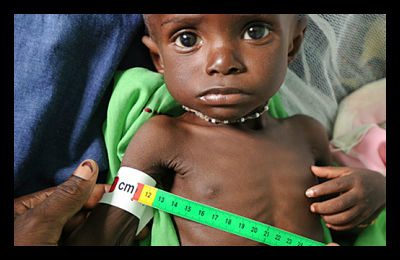
In Mozambique, almost one in two children under the age of five is nutritionally deficient. Poor nutrition contributes to high rates of childhood mortality. Those who are nutritionally deficient are more susceptible to diseases, which further complicates the situation.
Looking at the macro and micro levels of nutrient deficiency, one can see how malnutrition in Mozambique is affecting the country. At the macro level, 44 percent of all children under the age of five are stunted due to chronic illness and poor diet with 18 percent of all children categorized as underweight. Wasting, or acute malnutrition, affects four percent of the adolescent population and is a major concern for Mozambique.
On the micro level, Iron, Iodine and Vitamin A deficiencies are among the main perpetrators. Iron deficiency affects 75 percent of the children who grow anemic and are apathetic, anorexic and energy-less. Iodine deficiency has mental and physical repercussions. Goiter is a condition that is caused by iodine deficiency and affects 15 percent of children between the ages of six and 12 in Mozambique. Iodized salt usage has increased in recent years, however, to combat this trend.
Vitamin A deficiency weakens the body’s immunity against infections. This is a serious side effect and affects the majority of children in Mozambique, at a rate of 69 percent of children. It also affects 11 percent of mothers, who find it hard to breastfeed their children because they are also undernourished.
“It is not just about food,” says Maaike Arts, a nutrition expert at the UNICEF organization in Mozambique. “It is about health, hygiene and sanitation. Diarrhea and worms affect the child’s uptake of nutrients; malaria reduces the levels of iron in the blood. In Mozambique, many women marry and get pregnant as teenagers. There is a significant correlation between mother’s age and the nutritional status of the children.”
UNICEF has been forging their way through the thick of Mozambican hunger with a three-focus attack. UNICEF is scaling up the support of the Basic Nutrition Package in health facilities, implementing community-based nutrition interventions and feeding malnourished children. The WHO is also joining the fight with a plan that has seven individual strategies.
UNICEF’s Basic Nutrition Package aims to prevent children from becoming malnourished in the first place by providing “health units” to the provinces in Mozambique. Activities include the community coming together and learning about good nutrition practices and how to correctly feed the young. These activities focus on the empowerment of mothers, families and communities.
The WHO has created an in-depth plan that includes the following focus areas:
· Activities with impact on teenagers’ nutrition status strengthened
· Interventions with impact on productive, lactating and pregnant women’s health and nutrition strengthened
· Child-oriented nutrition activities in the first two years of birth strengthened
· Household-oriented activities to improve high nutrition food access and utilization strengthened
· Human Resources capacity in nutrition strengthened
· Strengthen national capacity for advocacy, coordination, management and progressive implementation of the Multi-Sectorial Action Plan for Chronic Malnutrition Reduction
· Food and nutrition control system strengthened
Strengthen is the key work in the WHO’s plan. They want Mozambique to gain the capability to provide for itself. The ultimate goal is to reduce chronic malnutrition to 20 perccent by 2020.
With the help of UNICEF and WHO providing the basic needs of nourishment and sustainability, malnutrition in Mozambique can begin to see its downfall. These organizations have studied the land and the people and have determined what is needed in order for this country to get up and running on its own.
– Erik Nelson
Sources: IRIN, UNICEF, WHO
Photo: Lists10

What Are the Impacts of Microfinance, Really?
“The initial narrative around microfinance—that it was going to unleash the entrepreneurial spirit of the poor and lead to significant growth and poverty reduction—was never really all that realistic,” stated Asli Demirguc-Kunt, the Director of Research at World Bank, during a Policy Research Talk held in March 2015 to discuss the role of microfinance in today’s economy.
At its inception, microfinance was envisioned as a beacon of economic hope for the poor, specifically those operating small businesses, who were without access to loans and basic banking services. Given current data findings, it is debatable whether microfinance is reaching the poorest communities. Research provided by the Microfinance Information eXchange, or MIX, examines a handful of institutions and their clientele, stating how the institutions have impacted issues of poverty. One set of data shows the percentage of clients of each institution that are below the poverty line of either their respective country or the U.S. Some of the lowest percentages are three percent, 22 percent and 27 percent, while the highest are 73 percent, 80 percent and 86 percent. We are seeing that in some cases, the banks reach the poorest, but in other cases, the majority of their clients do not fall in this category.
A February 2015 policy brief from Poverty Action Lab, an organization focused on poverty research, drew several conclusions on the results of microfinance, citing its successes and failures. On the positive side, because of the accessibility of credit, some entrepreneurs have increased investments in their businesses and households have experienced greater flexibility in financial management. Although microfinance has proved beneficial in some ways, no major impacts have been seen in the level of client income, female empowerment or investment in childhood education. It was also determined that “demand of many of the microcredit products was modest.”
Robert Cull, Lead Economist of the World Bank Research Department, recognized some positive results of microfinance, but also pointed out that there have been no notable improvements in income per household or wealth, and the level of poverty has not dramatically changed.
Given the varied impacts of microfinance, many question how the industry can be improved. Some are advocating for a move toward digital banking, which would make services more accessible and inclusionary, while also helping banks and their clients to cut expenses. Certain microfinance institutions charge high levels of interest to support themselves, but money saved through an increased use of online transactions may enable them to lower rates so that more customers can borrow affordably. While certain initial expectations of microfinance have not been fulfilled, many agree that the institution has had enough successes that it should remain in place but with reforms.
– Amy Russo
Sources: Devex, The Mix, Poverty Action Lab, The World Bank
Photo: Flickr
DCAF Dealing with Private Military Contractors
As the nature of warfare changes, so do the actors involved. The world is more interconnected than ever, and the role of transnational actors in war has increased the need for more domestic capacity. Private military contractors and private military security communities affect war, for they are (private) players that are not only held less accountable for their actions, but also benefit from conflict. Due to this revolution in military affairs, actors are starting to build relationships and institutions to address this issue. The Democratic Control of Armed Forces, known as DCAF, in Geneva, Switzerland is one of these institutions.
The Democratic Control of Armed Forces Foundation consists of over 62 member states, and is based in Geneva. There are permanent offices in Beirut, Brussels, Ljubljana, Ramallah and Tunis with staff from over thirty countries. DCAF was founded in 2000 as an initiative of the Swiss Government, and is an international foundation whose mission is to assist the international community in pursuing good governance and reform of the security sector. The Center not only provides in‐country advisory support and practical assistance programs, but it is founded on the principles of neutrality, impartiality, gender sensitivity and local ownership. DCAF also “Develops and promotes norms and standards, conducts tailored policy research, and identifies good practices and recommendations to promote democratic security sector governance.”
Switzerland is notorious for their humanitarian contributions to conflict and mass atrocities, as evidenced by the International Red Cross Committee, The Geneva Conventions, and the Swiss’s heavy involvement in the United Nations. Geneva in particular is the home of numerous international organization’s headquarters, including the United Nations, World Trade Organization, International Labor Organization, and the Red Cross (just to name a few).
The Democratic Control of Armed Forces operates globally, with a particular emphasis on Africa, the Middle East and Southeast Europe. Their outreach and policy research programs also cover Southeast Asia, Caucasus and Central Asia and Latin America. DCAF works directly with national SSR stakeholders, bilateral donors to support SSR and to promote coherence, coordination and complementarity, multilateral institutions (in particular the United Nations, the European Union, the African Union), as well as other regional and sub-regional organizations. The Democratic Control of Armed Forces focuses on security sector reform, also known as SSR, and strives for a holistic agenda by combining various capabilities. DCAF’s expertise reside primarily in the realm of parliamentary oversight of the security sector, intelligence governance, private security governance, gender and security and, public-private partnerships and security governance. DCAF works with a diverse base of actors in order to develop security sector reform policies. It has become a tool used to combine the various faces of war and peace in dialogue, debate and discovery.
– Neti Gupta
Sources: DCAF, ISN
Photo: Flickr
Malnutrition in Mozambique
In Mozambique, almost one in two children under the age of five is nutritionally deficient. Poor nutrition contributes to high rates of childhood mortality. Those who are nutritionally deficient are more susceptible to diseases, which further complicates the situation.
Looking at the macro and micro levels of nutrient deficiency, one can see how malnutrition in Mozambique is affecting the country. At the macro level, 44 percent of all children under the age of five are stunted due to chronic illness and poor diet with 18 percent of all children categorized as underweight. Wasting, or acute malnutrition, affects four percent of the adolescent population and is a major concern for Mozambique.
On the micro level, Iron, Iodine and Vitamin A deficiencies are among the main perpetrators. Iron deficiency affects 75 percent of the children who grow anemic and are apathetic, anorexic and energy-less. Iodine deficiency has mental and physical repercussions. Goiter is a condition that is caused by iodine deficiency and affects 15 percent of children between the ages of six and 12 in Mozambique. Iodized salt usage has increased in recent years, however, to combat this trend.
Vitamin A deficiency weakens the body’s immunity against infections. This is a serious side effect and affects the majority of children in Mozambique, at a rate of 69 percent of children. It also affects 11 percent of mothers, who find it hard to breastfeed their children because they are also undernourished.
“It is not just about food,” says Maaike Arts, a nutrition expert at the UNICEF organization in Mozambique. “It is about health, hygiene and sanitation. Diarrhea and worms affect the child’s uptake of nutrients; malaria reduces the levels of iron in the blood. In Mozambique, many women marry and get pregnant as teenagers. There is a significant correlation between mother’s age and the nutritional status of the children.”
UNICEF has been forging their way through the thick of Mozambican hunger with a three-focus attack. UNICEF is scaling up the support of the Basic Nutrition Package in health facilities, implementing community-based nutrition interventions and feeding malnourished children. The WHO is also joining the fight with a plan that has seven individual strategies.
UNICEF’s Basic Nutrition Package aims to prevent children from becoming malnourished in the first place by providing “health units” to the provinces in Mozambique. Activities include the community coming together and learning about good nutrition practices and how to correctly feed the young. These activities focus on the empowerment of mothers, families and communities.
The WHO has created an in-depth plan that includes the following focus areas:
· Activities with impact on teenagers’ nutrition status strengthened
· Interventions with impact on productive, lactating and pregnant women’s health and nutrition strengthened
· Child-oriented nutrition activities in the first two years of birth strengthened
· Household-oriented activities to improve high nutrition food access and utilization strengthened
· Human Resources capacity in nutrition strengthened
· Strengthen national capacity for advocacy, coordination, management and progressive implementation of the Multi-Sectorial Action Plan for Chronic Malnutrition Reduction
· Food and nutrition control system strengthened
Strengthen is the key work in the WHO’s plan. They want Mozambique to gain the capability to provide for itself. The ultimate goal is to reduce chronic malnutrition to 20 perccent by 2020.
With the help of UNICEF and WHO providing the basic needs of nourishment and sustainability, malnutrition in Mozambique can begin to see its downfall. These organizations have studied the land and the people and have determined what is needed in order for this country to get up and running on its own.
– Erik Nelson
Sources: IRIN, UNICEF, WHO
Photo: Lists10
Unitarian Universalists’ Tradition of Service
Martha and Waitstill Sharp had just arrived in Europe as representatives of the American Unitarian Association hoping to support activists fighting the Nazi Party and its policies. Only a few weeks after their arrival, they witnessed firsthand the Nazi annexation of Czechoslovakia. The couple spent the next five months helping as many people flee the country as they could. Artists, students, intellectuals and political leaders all made it to safety with the help of the Sharps. As they were en route to New York, Germany invaded Poland and World War II began.
Martha and Waitstill returned to Europe in June of 1940 to continue their mission. Working mostly in conjunction with other agencies, it is estimated that the Sharps and the Unitarian Service Committee they were a part of saved between 1,000 and 3,000 lives. The USC was formed by the American Unitarian Association as a “committee to investigate opportunities both in America and abroad . . . for humanitarian service as may in its judgment seem desirable and wise,” according to the Unitarian Universalist Service Committee website.
While the Unitarians were working in Prague and later France to evacuate endangered people, Universalists were working in Holland. In 1940, the Universalist Board of Trustees had established a special committee to channel financial aid to Holland.
After the war, Unitarians and Universalists ran a post-war relief program in Holland, as well as an adolescents’ shelter in Verden, Germany. This was the closest the two organizations worked before they became the Unitarian Universalist Service Committee in 1963.
Today, UUSC is on the forefront of many humanitarian battles. It advocates for compassionate consumption by educating people about the ethical practices of the companies they’re buying from. It works for universally affordable clean water in America and abroad by supporting legislation which guarantees access to water. The UUSC humans rights for those most likely to be denied them, either because of race, gender, orientation or religion.
After Typhoon Haiyan in the Philippines, the UUSC launched a special crisis fund focused around survivors who were most likely not to receive the same aid as other victims. The UUSC intends to ensure that every person gets the aid they need with the dignity they deserve.
As the mission statement from website put it, “UUSC advances human rights and social justice around the world, partnering with those who confront unjust power structures and mobilizing to challenge oppressive policies.” The UUSC is a force for good, and has been since the days of hiding students from the Nazis.
– Marina Middleton
Sources: UU World, UUSC
Photo: UUSC Flickr
PAE and South Sudan: A Public-Private Partnership
As of March 31, 2015, there are 259,232 refugees residing in South Sudan. Most have fled due to the constant clashes between Sudan and South Sudan, the army of South Sudan and militias or the aftermath of the Dec. 2013 violence which was allegedly sparked by a coup attempt. The refugees’ new home has almost no infrastructure and is cut off from trade for six months out of the year due to seasonal flooding. Delivery of much-needed humanitarian aid becomes almost impossible.
South Sudan was born a war-torn country. When Sudan gained its independence in 1956, it was with the promise of full political representation for the southern part of the country. When this representation failed to appear, the south mutinied. In Jan. of 2005, an agreement was finally reached to allow the south six years of autonomy, which would be followed by a referendum on independence. In Jan. 2011, South Sudan officially became independent. Since then, the government has been plagued by militias, border disputes and droughts.
Recent partnerships, however, have the potential to improve the lives of South Sudanese refugees. In 2013, the Pacific Architects and Engineers, Incorporated, PAE, partnered with the U.N. Refugee Agency to build necessary infrastructure in the Upper Nile region.
Over the past two years, PAE has drilled over 50 water holes, installed low-maintenance water filters, laid 250 kilometers of road, helped relocate refugees to a less flood-prone part of the Upper Nile region and repaired and maintained an airstrip for easier transportation and aid deliveries. When fighting prompted the temporary evacuation of some 300 humanitarian personnel in 2013, PAE was there to help, saving many lives in the process.
PAE has a long history of building the capabilities of its clients. As a company specializing in infrastructure, aviation, training, national security and logistics, it has worked with NASA, USAID and the U.N., among others. PAE’s immense background of experience and innovation has made the projects in South Sudan a success.
PAE’s experience in South Sudan is only one of thousands of partnerships forged between the private sector and the public sector. PAE’s experience is an example of a business doing well by doing good.
– Marina Middleton
Sources: CIA World Factbook, PAE 1, PAE 2, U.S. Global Leadership Coalition, UNHCR, Youtube
Photo: Reid Steel
ADRA Addresses Community Development
The Adventist Development and Relief Agency (ADRA) is an organization set out to identify and address social distortions and deprivation in developing countries. ADRA focuses its energy on community development through six sectors: Protecting the Vulnerable, Supporting Families, Promoting Health, Providing Food and Water, Establishing Livelihoods and Responding to Emergencies.
Protecting the Vulnerable
ADRA aims to protect children who are sold as sex workers, advocate for women who must fight for the opportunity to learn to read and defend the millions of minorities and others around the world who suffer injustice.
Supporting Families
Families in poverty are the focus on this program. Orphans who are without food or shelter are cared for and looked after. ADRA also provides children with education.
Promoting Health and Providing Food and Water
ADRA wants to reduce the incidences of diseases by encouraging health and wellness. Coupled with improvements in sanitation and access to clean water, the basics of health and wellness can be achieved.
Establishing Livelihoods
By providing microloans and training, ADRA gives men and women the ability to support themselves and their families. This is one of the best ways to help someone escape poverty; with these opportunities, men and women can get back up on their feet and stay there.
Responding to Emergencies
We often see that countries that are in need are also often affected by unforeseen disasters. The ADRA is there to respond to those emergencies. By providing the basic necessities, the short term needs of disaster refugees are
ADRA deals with millions of funds in order to provide these programs. In 2012, $74,330,388 was spent on the functional expenses of the organization. Ninety-three percent of their funding goes toward their programs in the six sectors, while the rest of the seven percent is split between administrative funding and fundraising.
The many programs provided by the ADRA look to apply aid liberally by addressing many different issues involving those in need.
– Erik Nelson
Sources: ADRA, Charity Navigator
Photo: Adventist
Buying Food, a Struggle in the Solomon Islands
A child’s diet for the first 1,000 days of their life is crucial to developing both mentally and physically. Unfortunately, one-third of children under the age of five in the Solomon Islands are considered stunted—too small for their age due to malnutrition. Children who are stunted are often more susceptible to infections and diseases.
The Solomon Islands are not short on food resources. There is a plethora of fish and sea food available; however, it is common for families to not have the funds required to purchase fresh fish or even canned tuna. Of the citizens who live in rural areas, 60 percent rely on food that they grow themselves. The Solomon Islands have ideal conditions for agriculture; however, those living in urban areas do not have access to land and are forced to purchase overpriced food that they simply cannot afford.
According to the Solomon Islands National Statistical Office, many people suffer from “hidden hunger,” meaning while things might not look physically dire, they are actually desperately lacking the proper nutrition to live long, healthy lives.
Solomon Island communities try to look out for each other and share food. Not only do the citizens highly value their family and friends, they also have their own “wantok”—their neighbors and extended family—who they share cheap food with. The cheapest foods can be bought in bulk like rice and noodles, but it can be very dangerous to live off these foods alone. The people of the Solomon Islands experience high rates of anemia and diarrhea from their lack of proper nutrition.
Also contributing to the lack of proper nutrients is overpopulation; the population of the Solomon Islands grows by 2.8 percent each year. More and more people are in need of food, with less and less of it being available due to the small income the islanders receive. Addressing this problem will involve taking a hard look at the economy and finding a way for citizens to receive an adequate income capable of consistently sustaining them.
– Melissa Binns
Sources: CGIRA, SPREP
Photo: Flickr
American Friends Service Committee Brings Peace
The American Friends Service Committee has a specific way to address poverty: striving for peace. The organization was created in 1917 by young adults who wanted to help bring peace during wartime. The committee’s first project was conducted in France, where they helped care for World War I refugees and built homes and hospitals. Since then, the organization has traveled all over the world visiting war-torn areas to provide aid.
The American Friends Service Committee has fought famine in Russia, built orphanages in Poland and Serbia and fed the hungry in Germany and Austria. They not only helped victims on both sides of the Spanish-American War, they also helped people escape Germany in World War II. In 1947, the organization was awarded the Nobel Peace Prize for their commitment to aid.
Now, The American Friends Service Committee has developed even more ways to help. They not only attend to victims of war, but fight for the rights of immigrants, address high prison rates and criminal justice and challenge discrimination. They believe that every human life has value and try to speak up for those who may be voiceless in their communities. They also give speeches around the United States to inform other Americans about their cause and to advocate for peace.
The American Friends Service Committee states that they envision “a world in which lasting peace with justice is achieved through active nonviolence and the transforming power of love.”
“From our experience, we know that peacemaking requires more than merely advocating against one war or another,” says the American Friends Service Committee. “Real peace is more than the absence of war. Rather, we need to change the culture, situations, and systems that lead to violence. When people understand the terrible consequences of violence and witness realistic alternatives, they come together as a powerful force to address the underlying causes and lay the foundation for lasting peace.”
By spending $10.3 million dollars on international aid, this organization is well on their way to having their dream realized.
– Melissa Binns
Sources: American Friends Service Committee, Nobelprize.org
Photo: Flickr
Guatemala’s Fight Against Child Malnutrition
Guatemala has one of the highest rates of child malnutrition in the Western Hemisphere and the sixth highest in the world. Half of all children under five are considered severely malnourished. Malnutrition is highest among the indigenous population and nearly two-thirds of indigenous children do not get enough to eat. In some of the poorest villages that number rises to 90 percent.
This is significantly higher than nearby Honduras and Nicaragua, both of which are significantly poorer than Guatemala. Haiti is the poorest country in the Western Hemisphere and the average Guatemalan earns four times more than the average Haitian, but Guatemala’s childhood malnutrition rates are twice as high as Haiti’s.
The reason child malnutrition rates are so high is largely the result of high levels of income inequality, some of the greatest in the world. Another primary factor is neglect toward indigenous communities on the part of the central government.
In recent years the situation has become worse due to a prolonged drought in many parts of the country resulting in lower crop outputs. This has led to food shortages and higher prices for those who are already too poor to put enough food on their tables.
Child malnutrition is both the result of and a primary cause of extreme poverty, it creates a sort of poverty trap. When children grow up malnourished, their education suffers and they are more likely to drop out of school and have trouble finding employment. They are also more likely to suffer from psychological and physical health defects.
Studies show that high levels of child malnutrition have stunted the growth of Guatemala’s indigenous population. Indigenous Guatemalans are on average several inches shorter than indigenous people in southern Mexico who belong to the same indigenous group and share similar physical and genetic features. The difference is that Mexico has much lower levels of malnutrition.
Due to low rates of tax collection and entrenched corruption, it has been difficult for the Guatemalan government to come up with the resources to tackle the problem. But it has begun to address it and work towards a solution.
Partnering with foreign donors, the Guatemalan government has instituted a program aimed at providing food supplements to some of the country’s poorest villages. The EU has provided 186 million euros (about $200 million) in development aid to Guatemala. Progress is being made and several villages are benefitting, but corruption is hampering the program. Many Guatemalans accuse the government of embezzling much of the money for personal use.
USAID is funding farming cooperatives aimed at boosting income and food security. Several villages that have benefitted from the programs report better crop yields, higher levels of income and reduced levels of malnutrition.
But despite these important victories, there is still a long way to go. Most villages continue to struggle and have yet to benefit from any assistance. But progress is being made and things are moving in the right direction.
– Matt Lesso
Sources: DW, The Economist, USAID
Photo: Flickr
World Social Forum: The Alternative Way to Tackle Poverty
Despite the Bardo Museum attacks in Tunis, Tunisia, the World Social Forum proceeded to convene from March 24 to March 28, 2015. Not only did the forum continue, but also a march was held to demonstrate solidarity for peace in Tunisian society.
Approximately 80,000 people who make some of the world’s top leaders in social justice, economic reform, and poverty eradication came together for the World Social Forum. Some attendees include ActionAid and Oxfam International. They come together to discuss the alternative to capitalism and methods for creating a peaceful, fair, and green society.
WSF was founded in 2001 as the alternative to the World Economic Forum under the belief that another world is possible. The first forum was held in 2002 in Porto Alegre, Brazil. This conference primarily focuses on the one percent group that holds most of the global wealth and political power. In preparation for the event, ActionAid declares that “A more equal society that values everyone depends on citizens holding the powerful to account…We will together champion international cooperation to avoid a race to the bottom.”
The forum typically convenes in the global south to ensure inclusivity and diverse global leaders. The outcome of the initial global civil society meeting resulted in international attention—positive and negative. WSF has received critical attention primarily because some attendees have strong opinions that have resulted in distracting from the main concerns of the forum. In 2003, former UN Secretary General Kofi Annan sent a humbling message that expressed a concern for building relations between governments, businesses, and non-profit non-governmental organizations.
This year’s forum is expected to focus particularly on wealth distribution and poverty. The forum has grown in popularity. Their efforts combined demonstrate a reluctance to remain silent on issues that affect a large portion of the global population. It is unclear what may come out of this gathering, but one must stay attuned to their voices. As a global force that challenges the status quo, their popularity demonstrates a positive global development that says peace and anti-poverty efforts should not be ideas, but rather actions.
– Courteney Leinonen
Sources: ActionAid, Al Jazeera, Global Policy, Thomson Reuters Foundation
Photo: SCN