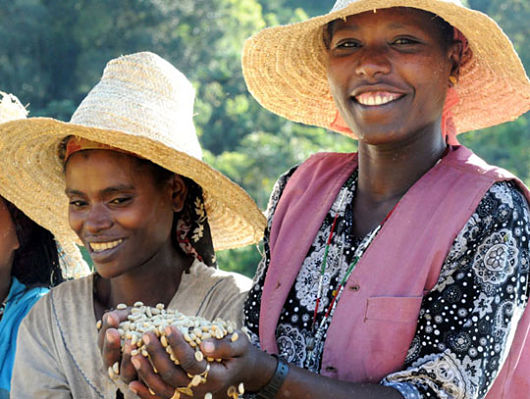
The Gates Foundation and the company TechnoServe have developed a solution to the endemic poverty of smallholder farmers in Africa — The Coffee Initiative. Across Rwanda, Ethiopia, Kenya, Tanzania and more, the Initiative empowers each wrung of the business ladder involved in the coffee-making process, increasing income and lifting communities out of poverty.
Today, around 4.2 million households of smallholder coffee farmers (20 million households) live below the poverty line.
“Without access to technical knowledge, professional processing and milling services, reliable markets or working capital, these farming families are forced to sell their coffee at low prices. Under these circumstances, it is extremely difficult for these farmers to escape poverty, despite the backbreaking work they put into their coffee harvests,” explains the Gates Foundation on its website, Impatient Optimists.
The Coffee Initiative has helped to break this cycle in many communities. TechnoServe adapts its education programs and implementation strategy to the unique cultural, financial and physical context of each farm.
It aims to help communities realize their potential; East Africa is one of the most conducive places in the world for coffee to grow. Ethiopia, Kenya, Rwanda and Tanzania have rich soil, high altitude and temperate climates, enabling them to produce some of the most high-quality coffee in the world.
To help communities reach their full potential, TechnoServe teaches private, coffee export companies how to work with credit, quality assurance, administration and price risk management.
These export companies then sell their newly acquired services to small coffee cooperative farms, enabling increased effectiveness and efficiency for both farms and service providers.
Every level of business involved in the coffee-making process benefits from TechnoServe’s initiative and has the incentive to continue to implement the new techniques they have learned.
“The smallholder farmers earn more, as they can sell the higher-quality beans for a premium to more reliable markets. (Beneficiaries of the program saw their coffee incomes increase by an average of 22% across the region, while that figure rose to 50% in Rwanda.) The coffee service providers, meanwhile, collect a percentage of the sales and thus have strong incentives to continue providing services and financing to the coffee farmers. And the financial institutions have gained a reliable customer base with a strong record of repayment, encouraging them to continue to provide financing,” explains Impatient Optimists.
Technoserve teaches smallholder farmers how to improve the quality, sustainability and yield size of their coffee. Farmers who participated in the education program increased their coffee yields on average by 42 percent.
TechnoServe has built over 266 wet mills, which process raw beans, since 2000. Over 250,000 farmers have benefited from this. TechnoServe also facilitated lasting relationships between small farms and large, corporate coffee roasting companies, which are now purchasing more coffee from East Africa.
“For instance, the ‘Uzuri African Blend’ from Peet’s Coffee & Tea consists entirely of coffee from Coffee Initiative clients and represents the company’s first African coffee blend. Similarly, high-end coffee roasters Intelligentsia and Stumptown Coffee Roasters have marketed individual Ethiopia wet mill client coffees as single-origin products with the cooperative name displayed on the coffee package,” explains TechnoServe.
The Coffee Initiative has made an enduring impact in Ethiopia. Ethiopians have grown coffee for centuries; however, they previously used traditional, dry processing methods. Little attention was given to quality.
Though the climate and altitude were perfect to produce high-quality beans, the region was known for bad coffee. Farmers received very little for their crops and, subsequently, remained impoverished.
In 2010, the Coffee Initiative took action in Ethiopia. One hundred local farms unified into a cooperative called Duromina. TechnoServe helped them with financial planning and built a wet mill so the coop could fully wash its coffee.
Just two years later, a panel of judges voted Duromina’s coffee the best in Africa. “Buyers from Stumptown Coffee Roasters described Duromina’s coffee as an ‘extremely complex yet clean cup that flaunts notes of lemon, cinnamon, sweet hops, ginger and nectarine accented by jasmine,’” says TechnoServe’s website.
Duromina repaid its loan in just one year, rather than the four-year plan. “In 2012, four major international roasters purchased 71 metric tons of green coffee through direct trade relationships with Duromine, paying an average of $3.68 per pound, a 65 percent premium over the international commodity price,” explains TechnoServe.
The community experienced economic stimulation, and with this new income, were able to improve the quality of life. For instance, the cooperative invested in a bridge. Before it was built, during the rainy season the river would flood and cut off community members’ access to markets and medical clinics.
“So many people were injured falling into the river when attempting to cross during heavy rain. We could not benefit from many government services because of the river, and some pregnant women even died because they could not reach the clinic,” said Nizamu Abamecha to TechnoServe, Duromina’s chairmen. Today, because of the Coffee Initiative, more remote community members are able to cross the river during the rainy season.
Farmers have also been able to invest in tin roofs, new furniture and solar power. Many are now able to send their children to primary school, and some can send their children to even secondary school or college.
– Aaron Andree
Sources: Global Dev Incubator, Impatient Optimists, Technoserve
Photo: TechnoServe

Oral Health Care in Poor Countries
The World Health Organization (WHO) says that “worldwide, 60-90 percent of school children and nearly 100 percent of adults have dental cavities.” Oral health care also includes, in part, gum care, mouth pain, oral infections and tooth loss.
What is even worse, is that “oral disease in children and adults is higher among poor and disadvantaged population groups” (WHO).
In parts of the world, access to dental care can be completely lacking. The American Dental Association (ADA) has given a warning for U.S. travelers: “If you are planning a trip out of the country it may be helpful to schedule a dental checkup before you leave, especially if you’ll be traveling in developing countries or remote areas without access to good dental care.”
Such a warning for U. S. citizens shows a need for better universal access to oral health professionals in developing countries. This is especially true for those living in poverty.
There are two studies in particular that highlight the connection between poverty and poor dental health. One comes from an Argentinian study that looked at parental income and education, as well as access to oral health care. The study found that there is a direct correlation between higher dental care and higher poverty indicators.
In another study, WHO reports that in Mexico, 60-70 percent of elderly people have few to no teeth. The report also finds that upwards to 90 percent of Mexicans have untreated cavities. As with the Argentinian study, the higher the poverty the worse oral care was. Their findings are similar to those in poverty all around the world.
What can be done? The situation seems dire and difficult.
One of the best ways to help fight cavities, and other noncommunicable oral diseases, is to promote proper dental care. Schools in the Philippines have made hand washing and tooth brushing part of their everyday curriculum. Dental care has been a consistent reason for children to miss school, but UNICEF has found that for the school children, “tooth-brushing can result in reductions of up to 27 per cent in absenteeism.”
The WHO Global Oral Health Programme is also working to reduce diseases caused by poor oral health care. The focus is not only on proper tooth brushing but also on proper diet, the reduction of tobacco and excessive alcohol use. All areas need to be looked at to help prevent tooth loss, gum disease and some forms of oral cancers.
Much still needs to be done to help maintain proper oral health, especially for those people living in poverty. Access to proper dental care when cavities or oral infections do occur is still lacking.
Thankfully there are programs in place that are thriving, such as the ones in the Philippine schools that are proving to be successful. Hopefully, their model will be used in other regions so that oral health care will improve the world over.
– Megan Ivy
Sources: Mouth Healthy, National Center for Biotechnology Information, UNICEF, WHO 1, WHO 2, WHO 3
Photo: Projects Abroad
Climate Change in Bangladesh
This is especially true for a country where a quarter of the land area is less than 7 feet above sea level. Bangladeshi scientists have estimated that by 2050, 17 percent of the country area will have been submerged. This would displace roughly 18 million people and, in turn, significantly cut the country’s food supply.
Bangladesh is one of the most densely populated and underdeveloped countries in the world. The country has roughly a fifth of the land area of France and contains a population of about 166 Million. This has resulted in an incredibly high population density at 755 persons per km. This set of circumstances poses a serious problem for almost all current climate projections and estimates.
The overpopulation has also caused a great strain upon the country’s remaining fertile lands. Bangladesh lies in the Ganges River Delta which is made up of over 230 rivers and streams. Approximately 55 percent of the country’s low lying geography is arable land, making agriculture one of Bangladesh’s biggest industries. Currently, 45 percent of the country’s workforce lives in and relies upon a suddenly shrinking agriculture industry.
As flooding increases and sea levels rise, there is simply not enough arable land to sustain a country of over 160 million people. The country’s economy is mostly agrarian-based and many residents are subsistence farmers. The floods have completely destroyed many of the county’s rice crops which are a staple of the Bangladeshi diet and crucial for many farmers’ livelihoods.
Historical data shows that floods have increased in frequency, intensity and duration since Bangladesh’s independence in 1971. This past summer, flooding in Northern Bangladesh left half a million people displaced and homeless. The two main rivers of Bangladesh, the Meghna and the Brahmaputra, rose to dangerous levels and completely flooded 14 of the country’s 64 districts. Being displaced from their homes, people sought refuge in makeshift shelters, and in some cases, schools.
In response to these conditions, Bangladesh has initiated a National Plan of Action and National Climate Change Strategy. The programs have begun a process of dredging rivers, raising levees and pumping water to compensate for increased flood conditions. The programs have also focused on creating early warning systems and have built over 2,500 concrete storm shelters. Almost 6,000 km of embankments have been constructed in efforts to combat heightened flood conditions. Additionally, 200 flood shelters have been built as well as almost 5,000 km of drainage channels meant to redirect the flow of floods.
These measures have made a significant impact on short term disaster safety. In 1970, before any sort of emergency response infrastructure, Cyclone Bhola killed an estimated 550,000 Bangladeshis. This stands in comparison to 200 casualties during Cyclone Aila in 2009. While the latter was still a disaster of immense proportions, the disaster preparedness and response measures were clearly evident and effective in terms of saving lives.
In 2013, emergency measures were once again tested when tropical storm Mahasen broke Bangladeshi shores. An estimated one million people from 13 coastal districts were evacuated north to shelters and fortified locations. This was accomplished through a procedure of government alerts, notifications and by collaboration of thousands of volunteers.
A statement by the UN Office for the Coordination of Humanitarian Affairs read, “While tropical storm Mahasen reached the coastline of Bangladesh on Thursday weaker than anticipated, the preparedness work undertaken by the Government and humanitarian partners saved countless lives.” This provides further evidence that the disaster mitigation protocols have been effective.
However, being a developing nation in an increasingly dangerous climate, Bangladesh is still relying upon developed countries and NGOs to jointly make changes in both emissions standards and practices. Acute response tactics can certainly provide temporary solutions for saving lives and crops, but measures with a long term focus are necessary for a solution to a much greater global issue.
– The Borgen Project
Sources: BBC, New York Times, United Nations Environmental Programme, Science Direct
Photo: Oxfam
Health Crisis in Yemen Escalates
On June 15, 2015, United Nations Secretary-General Ban Ki-Moon urged the international community to work towards brokering lasting peace in Yemen, a country caught in a proxy war between Saudi Arabia and Iran.
Mr. Ban told reporters, “The region simply cannot sustain another open wound like Syria and Libya. We must find a way to end the suffering and begin the long road to peace.” The conflict has ravaged the poorest gulf nation and displaced more than one million people. The U.N. relief arm has therefore called for over US $1B in aid to support the country from completely collapsing.
One of the side effects of the devastating civil war in Yemen is the escalating health crisis. According to the World Health Organization (WHO), 15 million Yemenis are in dire need of health services. Those services become even harder to provide due to at least 53 health facilities being damaged – including 17 hospitals, as well as the Operations Room of the Ministry of Health in Sana’a, which manages all the emergency operations in Yemen.
The lack of adequate medical treatment, combined with terrified fleeing civilians leaving behind uncovered drinking water, has led to outbreaks of many diseases including malaria, pneumonia, diarrheal diseases, and dengue fever. Al-Khedhar Nasser Laswar, director of the Aden province’s Ministry of Health Office, stated that since the start of the conflict, over 4000 people have contracted dengue fever and over 140 people have died.
Dengue fever is endemic with annual spikes in the summer months. According to the latest WHO situation report of Yemen, last year’s dengue fever trended 55 cases by week 20. This year, over 300 cases had been reported in the same time frame. As the political situation worsens, those numbers have significantly increased with 38 new cases in week 24 (June 2015) of this year alone.
Unfortunately, providing adequate treatment is not the most daunting challenge health workers face. Aref Ahmed Ali, a coordinator of Yemen’s malaria control program said, “We do not know whether these fevers are coronavirus or something else.” The lack of medical equipment has made proper disease diagnosis currently unmanageable.
As patients enter the hospital, the inability to properly diagnose them has led to cases where some individuals have died within 24 hours of contracting acute fevers. This is on top of those suffering from dengue fever and typhoid. Such has caused alarming concern to spread among healthcare workers and patients alike.
The current health crisis in Yemen is a disaster and will continue to decline unless more aid is sent. Healthcare workers are in urgent need of trauma kits, vaccines, medical and surgical supplies, and fuel to run hospitals. The main concern of these workers is the well-being of their patients, who are also suffering from acute food shortages, crippling their natural ability to fight diseases.
Currently, WHO has revised its humanitarian response plan for June 2015 and requested a total of US $152M to meet the needs of the 15 million Yemenis they hope to serve. WHO’s response to the health crisis in Yemen has been supported by the governments of Japan, Russia, Finland and the Central Emergency Response Fund.
The United States must also answer the call and send foreign aid to help fight the escalating health crisis in Yemen. If the U.S. does not respond, the international community will have to be ready to deal with another full blown humanitarian crisis, perhaps worse than Syria and Libya as Mr. Ban has warned.
– Adnan Khalid
Sources: Al Jazeera, Reuters, UN 1, UN 2, World Health Organization 1, World Health Organization 2
Photo: Malaysian insider
Education Under ISIS: A ‘Generation in Darkness’
Since last summer, the Islamic State of Iraq and Syria (ISIS) has fought to expand its self-declared Muslim caliphate. Now, many fear that the group’s new schools are irreversibly affecting an entire generation of children.
One of ISIS’s key tactics for expansion is the indoctrination of children to support jihad. In the past year, the group has swept through schools in its conquered territories, changing curriculums to reflect its extreme interpretation of Islam.
When ISIS fighters seized the city of Deir Ezzor in Syria, they closed schools and forced teachers to attend retraining sessions in Islamic education. According to Ahmad, a teacher of 14 years in Deir Ezzor, the training did little to address the problems with Syria’s educational system. Instead, ISIS leaders used these courses to weed out potentially disloyal teachers.
ISIS has imposed strict new rules for students as well as teachers. To complete the required training program, teachers must pledge their allegiance to ISIS leader Abu Bakr al-Baghdadi. Male and female students and teachers are taught in separate classrooms or schools. Girls and women also must wear the niqab, a full-body veil that leaves only the eyes visible. The Hisbah, the ISIS religious police force, monitors schools to make sure teachers and students follow the Islamist guidelines.
Recently, ISIS reopened schools in Deir Ezzor, which for now serve only male students and run for just four hours a day. The schools operate out of volunteers’ houses, not the public buildings previously used as schools. According to Ahmad, schools for girls will reopen when female teachers have completed their Islamic education courses.
Ahmad chose to quit teaching rather than remain a part of the worsening education system. Still, he fears for the children in ISIS-run schools. “The Islamic State aims to raise this generation in darkness and to instill aggression and extremism in them,” he explains. “Children are preoccupied with fighting and vengeance…what they learn in the Islamic State schools nurtures and validates such urges.”
In Deir Ezzor, as in many parts of Syria under ISIS control, the extremist group has instated an entirely new curriculum, banning subjects like history, philosophy and music and arts. ISIS leaders claim that these subjects from the formerly secular curriculum conflict with Islamic teachings. Science is a particularly tricky subject. In schools where physics and chemistry are still allowed, teachers must carefully explain to students that scientific laws come from God. The teaching of evolution is completely banned.
In some Syrian schools, new subjects like ‘Islamic jurisprudence’ and ‘biography of the prophet’ have been added to the curriculum. The group has also removed all reference to the country’s name ‘Syria’ from textbooks, replacing it instead with ‘The Islamic State.’
Despite teaching this ISIS-approved curriculum, many teachers are still technically employed by the Syrian government in Damascus. However, ISIS forbids the acquisition of money from the Syrian government and threatens to kill teachers who collect their salaries. One lifelong Raqqa teacher claimed that as of November of this year, she hadn’t received her government salary in over six months. Now living in Turkey, she says that barely 30 percent of eligible students in her Syrian hometown still attend school. “Nobody wants to send their kids to school anymore because they would probably be recruited to fight and kill in the ISIS army,” she explains.
The choice for families, however, is a difficult one. Now that ISIS has destroyed secular schools in areas under its control, parents must decide whether to send their children to a radical Islamist school or no school at all. Even worse is the possibility that their children might be recruited for ISIS’s militant training camps, where young men are indoctrinated with a love of jihad. The camps teach courses on weapons and explosives, and boys as young as eight learn how to behead “infidels” and opposition fighters.
ISIS’s use of education to influence children promises trouble in the years to come. Even the defeat of the extremist group would not entirely wipe away the fundamentalist tendencies of children who have grown up under ISIS control.
One ISIS militant passionately explains how this generation of children has been groomed to inherit the caliphate. “God willing, this generation will fight infidels and apostates, the Americans and their allies,” he says. “The right doctrine has been implanted in these children. All of them love to fight for the sake of building the Islamic State and for the sake of God.”
– Caitlin Harrison
Sources: ABC News, Wall Street Journal, Wall Street Journal 2, Syria Deeply, Vice News
Photo: ABC News
Khaled Hosseini Foundation: 2015 Update
Khaled Hosseini has worked hard to give back to his native country of Afghanistan over the years. His novels show the ravages of poverty, gender discrimination, militant oppression and children being orphaned in Afghanistan. Unfortunately, what he describes in his novels is not limited to fiction.
The United Nations High Commissioner for Refugees (UNHCR) reports that Afghans are displaced due to insurgency, and that the country’s stability is still threatened in 2015. Although the violence continues, many of the previously displaced citizens are returning to Afghanistan, primarily in urban regions. UNHCR also reports that “currently, there is no national asylum and refugee legislation in Afghanistan, so UNHCR is conducting refugee status determination (RSD).”
The Khaled Hosseini Foundation has partnered with UNHCR to help the Afghan people, especially refugees, move out of poverty by providing educational and economic opportunities, building shelters and supplying healthcare for women and children.
Those are broad categories and great initiatives but they are not unreachable: people’s lives are being positively affected through the financial support that the foundation has given, which has gone towards the following programs:
There are many more wonderful programs that the Khaled Hosseini Foundation is supporting through grants and funding, all for the purpose of helping the people of Afghanistan, but most of the programs have the same foci as the ones mentioned above: providing shelter and helping women and children become educated and receive proper healthcare.
The foundation also offers many ways for individuals to become involved and help raise funds and awareness for the people of Afghanistan.
The Khaled Hosseini Foundation is creating an impact among the Afghan people through direct support of vital needs in the communities. Hosseini is also using his influence as an author to open the eyes of his readers to the needs of the Afghan impoverished.
If you would like to learn more about his foundation, click here; to incorporate his books into your lesson plans, visit SOS.
– Megan Ivy
Sources: Khaled Hosseini Foundation, Student Outreach for Shelters, UN Refugee Agency 1, UN Refugee Agency 2
Photo: Yahoo
Corruption in Angola Kills Children
Currently, there are over six million child deaths every year. However, there are few countries on earth more deadly for children than Angola, a Southwestern African province with one-fifth of its children dying before the age of five.
Despite this figure, Angola is also home to one of the most flourishing oil and mining industries, with its highest paid business people earning salaries in the billion dollar range.
Anti-corruption evaluations of Angola’s oil businesses have stated, “The Angolan procurement system is corrupt as procurement laws are inadequately enforced. Foreign investors should note that they are often encouraged to partner with Angolan companies, many of which are front organizations for government officials whose integrity and accountability are frequently questioned by observers.”
Many of these “foreign investors” are U.S. companies, which provide large sums of money to help Angola’s oil economy grow. The oil industry in Angola receives a large proportion of its funding and contributing companies from the Western world, namely Peru and the U.S.
According to the International Business Times, “U.S. oil giants ExxonMobil and Chevron Corp., as well as the UK’s BP and Angolan Sonangol operate other offshore oil projects in the country while Peru’s PlusPetrol and private Angolan-owned Somoil operate two different onshore projects. The American firm Marathon Oil (NYSE: MRO), Italy’s Eni (NYSE: ENI) and Brazilian firm Petrobras (NYSE: PBR) each own various stakes in projects there as well.”
Since the oil and mining sector is a substantial source of the country’s income, corrupt government officials often design their policies around its preservation, even to the neglect of their own people.
Op-Ed Columnist Nicholas Kristof of the New York Times has devoted much time and energy to highlight this overlooked corruption. He has published several reports and documentaries of his findings and experiences in Angola, many of which contain shocking content that is difficult to watch.
Kristof revealed that the Angolan government has reduced its healthcare funding by 30 percent, despite the fact that over 50 percent of Angolans have zero access to any type of healthcare. Highly equipped hospitals and clinic facilities do exist, but the few doctors and nurses working there are uneducated and limited in their ability to assist those in need. Not only are these doctors and nurses uneducated, but they are often forced to sell their drug shipments on the black market in order to earn a decent profit.
Kristoff states, “A generation ago, the United States supported a brutal warlord, Jonas Savimbi, in Angola’s civil war. He lost. Now, because of oil interests, we have allied ourselves with the corrupt and autocratic winner, President José Eduardo dos Santos, in a way that also will also be remembered with embarrassment.”
– Hanna Darroll
Sources: International Business Times, UNICEF, Business Anti-Corruption Portal, The New York Times,
Photo: Reuters
Celebrities Perform Voice-Overs for UNICEF App
A handful of celebrity actors have donated their skills for the creation of a children’s education project, GivingTales, which features Hans Christian Andersen stories, and aims to benefit UNICEF U.K.
Sir Roger Moore, a twenty-year UNICEF ambassador, heads the venture that animated several of Andersen’s tales. Moore implored the help of Ewan McGregor, Stephen Fry, Joan Collins and more, to perform voice-over work to narrate the stories.
Fry is also a UNICEF ambassador, and he posted on Twitter about his involvement with the app. “Fairy tales for [UNICEF]—read by [Ewan McGregor], Joan Collins, [Sir Roger Moore] and me,” Fry said, adding the link to download the app to end of his tweet.
In addition, Collins said she was excited to participate in the cause. “When [the creators of GivingTales] told me about the UNICEF project in which I was going to read a fairy tale to help the children, I thought it would be wonderful,” Collins said.
UNICEF is very keen on keeping up with children in the digital age. According to the UNICEF publication, “Children’s Rights in the Digital Age,” there is an ever-growing presence of children using digital devices in third world areas. “Some two-thirds of the world’s almost three billion internet users are from the developing world, with the numbers growing every day. Many of these new users are children and young people,” the UNICEF publication said.
However, UNICEF also mentioned that with this spurt of internet usage comes introduction to violence, the ability to view unsuitable content and the possibility of internet addiction.
Klaus Lovgreen, the Chairman of GivingTales, said that he wanted to create digital learning material that involved fairy tales that teach positive and valuable lessons. “[Fairy stories] have proven their worth over many years and are sort of mandatory in nature for children,” Lovgreen said.
UNICEF said that a safe online presence for children can be formed by creating easily-accessible content that promotes digital literacy, internet safety education and cyber savviness. The organization, with several other foundations, co-hosted the very first Digitally Connected seminar on children, youth and digital media. Philip Chan, a UNICEF Australia Young Ambassador, said that the technology empowers children because they may not need an adult to supervise them.
The app allows for interactive learning that goads the reader into participating in the story. According to the GivingTales website, the app offers multiple sounds, music, and narrators, granting children the power to customize their experience. According to Lovegreen, underprivileged children will benefit from the GivingTales app that offers “education from these incredible tales and the learnings that come with them by donating 30 percent of the revenue to UNICEF U.K.”
The voice-overs for UNICEF are available on the App Store, the Google Play store, and the Windows Phone store. GivingTales is free on each app store, and it comes with “The Princess and the Pea.” Each additional story is available for four dollars, so that the app can give a portion of their revenue to UNICEF.
– Fallon Lineberger
Sources: Digital Trends, Giving Tales, Look to the Stars, UNICEF
Photo: BBC
Diminishing Poverty Through Improved Coffee Farmers
The Gates Foundation and the company TechnoServe have developed a solution to the endemic poverty of smallholder farmers in Africa — The Coffee Initiative. Across Rwanda, Ethiopia, Kenya, Tanzania and more, the Initiative empowers each wrung of the business ladder involved in the coffee-making process, increasing income and lifting communities out of poverty.
Today, around 4.2 million households of smallholder coffee farmers (20 million households) live below the poverty line.
“Without access to technical knowledge, professional processing and milling services, reliable markets or working capital, these farming families are forced to sell their coffee at low prices. Under these circumstances, it is extremely difficult for these farmers to escape poverty, despite the backbreaking work they put into their coffee harvests,” explains the Gates Foundation on its website, Impatient Optimists.
The Coffee Initiative has helped to break this cycle in many communities. TechnoServe adapts its education programs and implementation strategy to the unique cultural, financial and physical context of each farm.
It aims to help communities realize their potential; East Africa is one of the most conducive places in the world for coffee to grow. Ethiopia, Kenya, Rwanda and Tanzania have rich soil, high altitude and temperate climates, enabling them to produce some of the most high-quality coffee in the world.
To help communities reach their full potential, TechnoServe teaches private, coffee export companies how to work with credit, quality assurance, administration and price risk management.
These export companies then sell their newly acquired services to small coffee cooperative farms, enabling increased effectiveness and efficiency for both farms and service providers.
Every level of business involved in the coffee-making process benefits from TechnoServe’s initiative and has the incentive to continue to implement the new techniques they have learned.
“The smallholder farmers earn more, as they can sell the higher-quality beans for a premium to more reliable markets. (Beneficiaries of the program saw their coffee incomes increase by an average of 22% across the region, while that figure rose to 50% in Rwanda.) The coffee service providers, meanwhile, collect a percentage of the sales and thus have strong incentives to continue providing services and financing to the coffee farmers. And the financial institutions have gained a reliable customer base with a strong record of repayment, encouraging them to continue to provide financing,” explains Impatient Optimists.
Technoserve teaches smallholder farmers how to improve the quality, sustainability and yield size of their coffee. Farmers who participated in the education program increased their coffee yields on average by 42 percent.
TechnoServe has built over 266 wet mills, which process raw beans, since 2000. Over 250,000 farmers have benefited from this. TechnoServe also facilitated lasting relationships between small farms and large, corporate coffee roasting companies, which are now purchasing more coffee from East Africa.
“For instance, the ‘Uzuri African Blend’ from Peet’s Coffee & Tea consists entirely of coffee from Coffee Initiative clients and represents the company’s first African coffee blend. Similarly, high-end coffee roasters Intelligentsia and Stumptown Coffee Roasters have marketed individual Ethiopia wet mill client coffees as single-origin products with the cooperative name displayed on the coffee package,” explains TechnoServe.
The Coffee Initiative has made an enduring impact in Ethiopia. Ethiopians have grown coffee for centuries; however, they previously used traditional, dry processing methods. Little attention was given to quality.
Though the climate and altitude were perfect to produce high-quality beans, the region was known for bad coffee. Farmers received very little for their crops and, subsequently, remained impoverished.
In 2010, the Coffee Initiative took action in Ethiopia. One hundred local farms unified into a cooperative called Duromina. TechnoServe helped them with financial planning and built a wet mill so the coop could fully wash its coffee.
Just two years later, a panel of judges voted Duromina’s coffee the best in Africa. “Buyers from Stumptown Coffee Roasters described Duromina’s coffee as an ‘extremely complex yet clean cup that flaunts notes of lemon, cinnamon, sweet hops, ginger and nectarine accented by jasmine,’” says TechnoServe’s website.
Duromina repaid its loan in just one year, rather than the four-year plan. “In 2012, four major international roasters purchased 71 metric tons of green coffee through direct trade relationships with Duromine, paying an average of $3.68 per pound, a 65 percent premium over the international commodity price,” explains TechnoServe.
The community experienced economic stimulation, and with this new income, were able to improve the quality of life. For instance, the cooperative invested in a bridge. Before it was built, during the rainy season the river would flood and cut off community members’ access to markets and medical clinics.
“So many people were injured falling into the river when attempting to cross during heavy rain. We could not benefit from many government services because of the river, and some pregnant women even died because they could not reach the clinic,” said Nizamu Abamecha to TechnoServe, Duromina’s chairmen. Today, because of the Coffee Initiative, more remote community members are able to cross the river during the rainy season.
Farmers have also been able to invest in tin roofs, new furniture and solar power. Many are now able to send their children to primary school, and some can send their children to even secondary school or college.
– Aaron Andree
Sources: Global Dev Incubator, Impatient Optimists, Technoserve
Photo: TechnoServe
10 Breakthroughs That Will Help Women and Children
Since the Millennium Development Goals were adopted in 2000, global poverty has nearly halved. There have been huge advancements in medicine and more people than before having access to clean drinking water.
However, despite these advancements, women and children are still the most at risk. Because of the uneven progress in reducing global poverty for women and children, the Every Woman Every Child movement was started. Policymakers, donors, healthcare professionals and many others come together to find a solution to the uneven progress in reducing global poverty for women and children.
PATH released a list of Top 10 Technologies in 2015 for Women and Children that will help achieve the Millennium Development Goals. Here is a summary of each:
For Women:
1. Nonpneumatic AntiShock Garment is used to prevent postpartum hemorrhaging. It compresses the body and circulates blood to the vital organs after the mother has given birth.
2. Magnesium Sulfate is a low-cost, effective drug in treating life-threatening convulsions, preeclampsia and eclampsia, all pregnancy-related conditions.
3. Sayana Press is a new form of injectable contraceptive that is packaged in a one-time use, simple to administer needle. This increases women’s access to contraceptives and eliminates the risk of transmitting disease through sharing needles.
For Newborns:
4. Helping Babies Breathe is a program and simulator created to train 1 million birth attendants to make sure the baby takes it’s first breath, regardless of where it is born.
5. Chlorhexidine is a low-cost antiseptic that prevents the disease from entering the baby’s system through the newly-cut umbilical cord.
6. Continuous Positive Airway Pressure Device is designed to help premature babies breathe. It is an air and water pump system that gently flows pressurized air into the baby’s lungs.
For Children:
7. Kit Yamoyo is a bundled package of zinc and oral rehydration solution, which are affordable diarrhea treatment. Cola Life created the Kit Yamoyo to pack with Coca-Cola bottles that are delivered to Africa to spread the cure to diarrhea.
8. Phone Oximeter is a low-cost mobile health platform that allows people to test their blood oxygen levels using a sensor on the phone to test for pneumonia. The device then tells them the diagnosis and treatment options without needing access to a doctor.
9. Rotavac is an effective vaccine to cure rotavirus, the cause of deadly diarrhea. It costs $1 per dose and has already become widely available in India, changing the lives of thousands.
10. Backpack PLUS Project is a toolkit made to empower health workers in areas where the patients may never be within proximity to a doctor. The prototype includes medicines, diagnostics and supplies to increase the number of lives saved.
– Hannah Resnick
Sources: PATH, Every Woman Every Child
Photo: African Union
Major US Solar Panel Manufacturer Plans New Investments in Africa
“Africa’s greatest growth challenge is energy, and there’s a serious need to quickly get additional generation capacity in place to meet increasing energy demands,” says Luc Graré, senior vice president EMEA at REC Solar. In a renewed effort to meet the vast demand for economically sustainable energy resources within developing regions, REC, a U.S. solar panel producer, recently announced ambitions to increase program investments and product installation within Africa.
A total of 621 million people – over two-thirds of Africa’s population – currently live without basic access to electricity. With large-scale power scarcities proving to reduce a developing nation’s economic growth rate by an estimated 2 – 4 percent annually, it is essential to note the multitude of costs associated with energy deficits across Africa.
Last month, a new report published by the Africa Progress Panel estimated that the 138 million African households living on less than $2.50 per day spent over $10 billion last year on energy resources such as firewood, candles, kerosene and charcoal. The report also claims that such impoverished homes annually pay on average 70 times more for energy than a household within a developed city such as Manhattan.
While the North African nation of Nigeria remained a top-10 global producer for oil last year, nearly 100 million Nigerian citizens still rely annually on the burning of charcoal and firewood to provide light and heating within their homes. With toxic byproducts released from the burning of such resources killing an estimated 600,000 people per year – nearly half of them children – it is imperative that we find a more sustainable and economical energy solution for Africa.
While the energy crisis within Africa seldom garners significant media attention, a comprehensive solution to this problem is necessary in order to guarantee successes within other forms of regional development. Researchers of the Africa Progress Panel have noted the potential efficacy of off-grid solar power installments, which would provide both infrastructural support to various development programs and stronger attention to other important socio-economic issues such as health and education.
Energy development experts have noted the largely untapped potential of sub-Saharan Africa, which maintains an admirable environment and landscape for the construction of low-cost, off-grid solar power systems. REC now offers a SolarBox installation kit for a 20-50kW off-grid solar system, which is comprised of multiple solar panel arrays, an inverter, a diesel generator and a deep cycle battery bank, all of which are contained within a single shipping container and exercise immediate deployment capabilities.
These units have been praised by numerous sustainable energy researchers for their efficacy in low costs, ease of transport and off-grid capabilities. REC recently donated a 20kW SolarBox unit to Bantayan Island in the Philippines, a community that was severely affected by the impact of Typhoon Haiyan in 2013. REC has predicted the installation of over 100 GW of off-grid solar panel systems by 2030 within developing residential areas of Africa.
– James Thornton
Sources: The Guardian, Energy Matters
Photo: Awake Africa