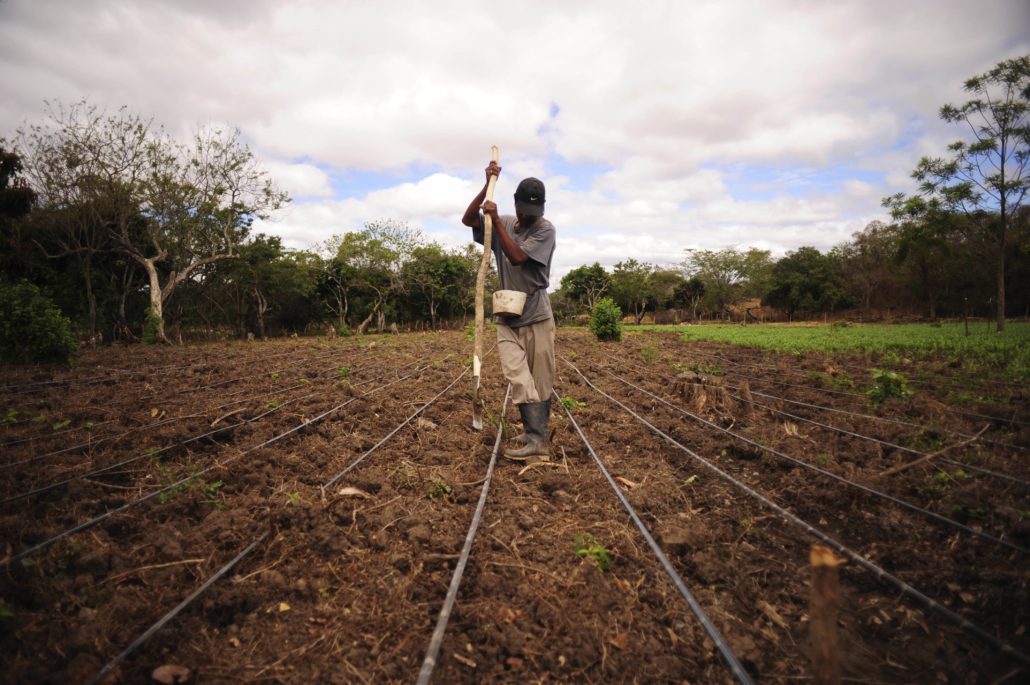
Many Central American countries suffer from droughts and forest fires due to hot temperatures and inconsistent rainfall. Without adequate water, agricultural workers are unable to consistently produce adequate goods each year. They are often forced to rely on crops that don’t need as much water but are less nutrient-rich, such as corn.
Planting crops during the dry season, between December and April, is extremely difficult and even the rainy season between May and July presents a challenge, given inconsistent rainfall patterns. In addition, staple crops like corn do not yield the profits of higher-value crops such as squash, beans, zucchini and watermelon, which not only increase income and quality of life in the region but also improve the diets of farmers, families and locals. Fortunately, a number of local and international organizations are implementing programs aimed at improving farming methods in Central America.
USAID
The United States Agency for International Development (USAID) has been combating unreliable, inconsistent weather patterns via a Honduras-based rainwater harvest program, aptly named Harvest. This consists of a reservoir that gathers rainfall in the winter, providing farmers with a backup water supply during dry months. Crops are watered through a low-pressure drip irrigation system, enabling farmers to plant and harvest three times a year instead of only once.
As a result, farmers have been able to grow and expand their repertoire of crops. Many other organizations have been involved in this initiative, including Development Innovation Ventures, Global Communities, SAG (Secretaría de Agricultura y Ganadería) and local governments.
AGRI
AGRI is a similar Honduras-based project under development that utilizes small drip irrigation systems spanning roughly 10 hectares. It works by locating surface-water sources that can be used for rainwater harvesting and uses water pipes to share water sources between various groups of farmers.
AGRI is also generating deforestation analyses using its terrain Digital Elevation Model (DEM) and other spatial analysis frameworks that analyze drainage basins and upstream areas. Its remote sensors can collect and predict weather patterns while enabling digital soil mapping and hydrologic analysis to estimate water runoff and water balance.
While AGRI hasn’t been formally introduced to Honduras, invest-H (Investment in Honduras) managers and the government are working to expedite its implementation. AGRI is supported by the U.S. initiative Feed the Future as well as Zamorano University, a Honduran university that is currently researching and refining the field validation of AGRI in preparation for its official launch.
MásRiego
MásRiego, meaning “more irrigation” in Spanish, is a Guatemala-based initiative that works to increase water supplies through drip irrigation, rainwater harvesting, reduced tillage, mulch use and diverse crop rotation. The project team provides training and partnerships to Guatemalan farmers to improve farming methods while offering access to microcredit financing and irrigation equipment. As rainfall patterns become more unpredictable, new methods of farming such as conservation and rainwater harvesting must be introduced. Conservation improves moisture retention, soil structure and soil health, while also reducing weeds, manual watering and preparation time.
MásRiego’s goal is to connect 9,000 rural Guatemalan households through these smarter farming methods. They also plan to use local schools to teach students about these new methods as well as inform them about agricultural job opportunities. As a result of unpredictable rainfall patterns and increased competition, farmers entering the field must be educated on the tools needed for success. MásRiego also focuses on helping women and youth grow high-value crops on smaller plots of land to increase the incomes of Guatemalan farmers and the nation as a whole. The program is supported by the U.S. government’s Feed the Future initiative.
Moving Forward
Using the latest farming methods, these organizations are helping to support Central American farmers’ incomes and improve quality of life. The diets of both the farmers and local communities are already being enriched as improved farming and irrigation methods allow for a broader variety of crops to be planted. The Harvest program has also found that more young people are choosing to remain in their countries as new and improved methods make farming a viable lifestyle.
With the technology that AGRI plans to introduce and the conservation methods that MásRiego is implementing, farming will become less of a financial and physical burden. These organizations and others like them will continue to improve farming methods in Central America, with an eye toward expanding into other arid regions in the future.
– Nyssa Jordan
Photo: Flickr

12 Facts About Hunger in Afghanistan
Due to decades of conflict, environmental disaster and economic instability, Afghanistan is one of the world’s poorest nations. One of the largest issues to building national stability for Afghanistan is the remaining issue of food insecurity. Hunger and malnutrition are the biggest risks to health worldwide, according to the United Nations. Hunger prevents people from reaching their full potential by limiting their ability to work and learn. Here are 12 facts about hunger in Afghanistan.
12 Facts About Hunger in Afghanistan
Although there are many challenges in the region to building local capacity to handle food insecurity, there are many Afghani and global organizations that are continuing to help formulate strategies to bring about change. These 12 facts about hunger in Afghanistan shed some light on these issues.
– Danielle Barnes
Photo: Flickr
North Korean Defectors in South Korea
Stories of North Korean defection to South Korea are making headlines in recent years. The brutal stories of defection, whether it be running from the guards at the Demilitarized Zone (DMZ) or escaping capture in transit countries, every North Korean defector has impactful stories of their escape from the hermit kingdom. In 2018 alone, a total of 1,137 North Korean defectors entered South Korea. Eighty-five percent of these defectors were women. These North Korean women are especially vulnerable to human traffickers who aim to sell these women as brides.
North Korean Defectors’ Arrival in South Korea
The stories of the defectors who succeed in escaping to South Korea do not quite end there. Many defectors who arrive in South Korea face economic, mental and cultural difficulties. While the South Korean government has programs and plans dedicated to helping these defectors, there is still room for improvement.
South Korea’s primary method of assistance includes screening and reeducating North Korean defectors in the Hanawon Resettlement Center. Hanawon’s primary purpose is to educate the defectors about living in capitalist South Korea. Hanawon’s education programs range from everyday activities, such as opening bank accounts or taking the subway, to more practical vocational training.
However, the limited education that the North Korean defectors had in North Korea presents a large knowledge gap in comparison to their South Korean counterparts. Many defectors also say that Hanawon’s programs are not adequate enough to remedy the psychological and physical traumas that many defectors experienced during their escapes. After 12 weeks at Hanawon, defectors can settle into South Korean society. Upon exiting Hanawon, the defectors receive a stipend of around 8 million won, or approximately $6,450 USD, to ease difficulties in resettlement.
Further Improvement Needed in the Resettlement Program
While South Korea is making valiant efforts to curb the challenges of defection, there is potential for improvement. For example, a defector who is a single mother will usually resort to short-term, part-time jobs to support her children.
Defectors face additional difficulties after moving to South Korea. Since Korea’s separation in 1953, both North and South Korea developed a radically different culture and government. For the North Korean defectors, South Korea’s democratic, capitalist society proves to be a great challenge to their resettlement.
The challenge of securing stable employment comes from a variety of factors. If a defector had limited education in North Korea, they are likely to have limited literacy. This not only makes securing employment challenging, but it also makes it harder for them to apply for additional financial aid to the South Korean government.
Discrimination Against North Korean Defectors
South Korean discrimination against defectors further exasperates this particular struggle of securing employment. Son Jung-Hun, a North Koran defector who Vice Media interviewed, shared his challenges when South Korean employers would not hire him after hearing his North Korean accent and seeing his small stature.
In 2019, the death of two North Korean defectors in South Korea made international news. Apartment management staff found Han Song Ok, a 42-year-old North Korean defector, and her 6-year-old son Kim Dong-Jin dead in their Seoul apartment. The coroner’s report suggested that both the mother and the child were dead for at least two months. The investigators found no food in their apartment and Han’s bank account was also completely empty. The coroner found determining the cause of death difficult, although many believe that it is likely they starved to death. Han’s acquaintances told the interviewer that Han had been applying for welfare benefits since the winter of 2018. However, because she could not provide proof of her divorce with her husband in China, the South Korean government continued to refuse her request.
Clearly, discrimination against defectors is a large factor making it difficult for them to resettle in South Korea. More specifically, many North Korean defectors in South Korea suffer from the feeling of isolation and alienation. For the defectors who left their families in North Korea, the feeling of separation is immense.
The Guardian’s interview with Kim Ryon Hui, a North Korean defector who wishes to return to North Korea, shines a light on the feeling of alienation that many defectors feel in South Korea. Kim told the Guardian that “no matter how affluent you are if you can’t share that with your family, it would be meaningless.” She also added that South Korea considers North Korean defectors second-class citizens, reaffirming the idea of North Korean discrimination.
Poverty in South Korea of North Korean Defectors
Furthermore, North Koreans’ poverty in South Korea is a complicated issue that demands improvements. While organizations such as the Hanawon are assisting the North Korean defectors, it is still not enough. North Korean defectors desire, and need, further assistance and protection from the South Korean government. Considering the journey the North Korean defectors had to take to arrive in South Korea, improving the economic realities for these defectors should be a priority for the South Korean government.
– YongJin Yi
Photo: Flickr
10 Facts About Human Trafficking in Africa
Today estimates determine that over 40 million people live in modern-day slavery, making it more rampant than it has ever been in human history. A significant amount of this trafficking takes place in Africa. These 10 facts illustrate what human trafficking in Africa looks like and highlights some organizations that are combatting it.
10 Facts About Human Trafficking in Africa
Human trafficking in Africa is a serious problem. However, with the help of organizations like the UNODC and IJM, awareness of modern-day slavery in Africa is increasing. The new legislation is helping to protect vulnerable populations and many African countries are joining the fight to end modern-day slavery.
– Megan McKeough
Photo: Flickr
Top 5 Bizarre Charity Fundraisers Against Poverty
Bold Hope and Paintballs
In 2013, five willing victims took on the pain of being shot with 21,000 paintballs to raise awareness for global child poverty. Non-profit organization Bold Hope published a video featuring the five volunteers being shot with 21,000 paintballs to represent the 21,000 children that die each day due to poverty. Since being posted, the video has amassed more than 800,000 views. Bold Hope is responsible for food aid, vocational training, educational initiatives and medical care in poverty-stricken areas. Areas the organization has supported include Haiti and the Bahamas. There is no doubt that the paintball stunt drew attention and support to bolster these developments.
OneXOne and Charlize Theron
In 2009, actress Charlize Theron auctioned off a kiss to a fan when a charity auction for a South Africa travel package she was conducting did not meet her fundraising expectations. An anonymous buyer won the travel package and the 20-second kiss for $140,000. Theron donated this money to OneXOne, a Canadian organization that focuses on tending to the world’s impoverished children. They provide children in need with necessities such as water, food, recreation and education.
Akanksha Foundation and the Uniform Project
Also in 2009, Sheena Matheiken wore the same dress for an entire year to raise money for the Akanksha Foundation, a non-profit foundation that provides education to impoverished children living in India. Matheiken not only had to wear the dress but also make it look unique every day. By the end of the year, she raised more than $100,000 for the Akanksha Foundation. The stunt was the beginning of the Uniform Project, a web-based organization that challenges the public to participate in challenges like Matheiken’s “Little Black Dress” movement to raise money for various non-profits that address the issue of global poverty.
WaterAid and Feces
Finally, the organization WaterAid used a remote-controlled piece of human feces to raise awareness for impoverished populations living without toilets. The organization posted a video to YouTube in 2010 that featured the plastic toy raising eyebrows throughout the streets of London. WaterAid’s mission is to provide clean water and sanitation to people in need. This advocacy allows for the development of healthier communities, which can help alleviate poverty. The remote-control poo stunt garnered more than 400,000 views on YouTube. This proves that even the most bizarre charity fundraisers can efficiently tackle global poverty.
These are just a few examples of the most bizarre charity fundraisers to tackle global poverty. By thinking outside of the box, the people behind these stunts successfully drew attention and ample financial support to the cause. It goes to show that fundraising can be particularly effective when it is engaging, creative and fun.
– Harley Goebel
Photo: Flickr
Education in Slovakia: A Lifelong Effort
Improving Farming Methods in Central America
Many Central American countries suffer from droughts and forest fires due to hot temperatures and inconsistent rainfall. Without adequate water, agricultural workers are unable to consistently produce adequate goods each year. They are often forced to rely on crops that don’t need as much water but are less nutrient-rich, such as corn.
Planting crops during the dry season, between December and April, is extremely difficult and even the rainy season between May and July presents a challenge, given inconsistent rainfall patterns. In addition, staple crops like corn do not yield the profits of higher-value crops such as squash, beans, zucchini and watermelon, which not only increase income and quality of life in the region but also improve the diets of farmers, families and locals. Fortunately, a number of local and international organizations are implementing programs aimed at improving farming methods in Central America.
USAID
The United States Agency for International Development (USAID) has been combating unreliable, inconsistent weather patterns via a Honduras-based rainwater harvest program, aptly named Harvest. This consists of a reservoir that gathers rainfall in the winter, providing farmers with a backup water supply during dry months. Crops are watered through a low-pressure drip irrigation system, enabling farmers to plant and harvest three times a year instead of only once.
As a result, farmers have been able to grow and expand their repertoire of crops. Many other organizations have been involved in this initiative, including Development Innovation Ventures, Global Communities, SAG (Secretaría de Agricultura y Ganadería) and local governments.
AGRI
AGRI is a similar Honduras-based project under development that utilizes small drip irrigation systems spanning roughly 10 hectares. It works by locating surface-water sources that can be used for rainwater harvesting and uses water pipes to share water sources between various groups of farmers.
AGRI is also generating deforestation analyses using its terrain Digital Elevation Model (DEM) and other spatial analysis frameworks that analyze drainage basins and upstream areas. Its remote sensors can collect and predict weather patterns while enabling digital soil mapping and hydrologic analysis to estimate water runoff and water balance.
While AGRI hasn’t been formally introduced to Honduras, invest-H (Investment in Honduras) managers and the government are working to expedite its implementation. AGRI is supported by the U.S. initiative Feed the Future as well as Zamorano University, a Honduran university that is currently researching and refining the field validation of AGRI in preparation for its official launch.
MásRiego
MásRiego, meaning “more irrigation” in Spanish, is a Guatemala-based initiative that works to increase water supplies through drip irrigation, rainwater harvesting, reduced tillage, mulch use and diverse crop rotation. The project team provides training and partnerships to Guatemalan farmers to improve farming methods while offering access to microcredit financing and irrigation equipment. As rainfall patterns become more unpredictable, new methods of farming such as conservation and rainwater harvesting must be introduced. Conservation improves moisture retention, soil structure and soil health, while also reducing weeds, manual watering and preparation time.
MásRiego’s goal is to connect 9,000 rural Guatemalan households through these smarter farming methods. They also plan to use local schools to teach students about these new methods as well as inform them about agricultural job opportunities. As a result of unpredictable rainfall patterns and increased competition, farmers entering the field must be educated on the tools needed for success. MásRiego also focuses on helping women and youth grow high-value crops on smaller plots of land to increase the incomes of Guatemalan farmers and the nation as a whole. The program is supported by the U.S. government’s Feed the Future initiative.
Moving Forward
Using the latest farming methods, these organizations are helping to support Central American farmers’ incomes and improve quality of life. The diets of both the farmers and local communities are already being enriched as improved farming and irrigation methods allow for a broader variety of crops to be planted. The Harvest program has also found that more young people are choosing to remain in their countries as new and improved methods make farming a viable lifestyle.
With the technology that AGRI plans to introduce and the conservation methods that MásRiego is implementing, farming will become less of a financial and physical burden. These organizations and others like them will continue to improve farming methods in Central America, with an eye toward expanding into other arid regions in the future.
– Nyssa Jordan
Photo: Flickr
Universal Eye Care in Rwanda
Rwanda has become the first low-income country to provide universal eye care to its citizens. This is in an attempt to reach out to those suffering from largely preventable visual disabilities. In Rwanda, a country in Central/Eastern Africa, 34 percent of its population struggles with vision impairments. The most common vision impairment in Rwanda is shortsightedness, and 80 percent of these cases are preventable.
Vision Impairment is a Big Problem
Approximately 2.5 billion people worldwide require vision or eye care. Moreover, 32,700 per 1 million people living in Africa have some form of vision impairment. Vision impairment has proven to increase the challenges a person faces when trying to escape poverty. Without the ability to see well, children may struggle in school and parents can struggle at work.
Without the ability to learn easily, one may have difficulty finding a job, and the ability to work easily can make it difficult for one to keep whatever job they may find. Vision-related disabilities are a big problem among impoverished communities where eye care is difficult to find. These disabilities often only reinforce the cycle of poverty.
The Vision 2020 Initiative
Rwanda signed the Vision 2020 initiative in 2002, formulating a plan to meet the needs of the 34 percent of Rwandans in need of primary eye care. With the help of the Vision for a Nation Foundation, the Rwandan government has managed to provide universal eye care in Rwanda to its 11.8 million inhabitants. This is possible by training more than 3,000 nurses in an eye health course and sending these nurses to visit all 15,000 of the country’s villages to offer their help.
This nationwide program has deployed its nurses to all 502 health clinics throughout the country and has performed more than 2.4 million eye screenings. It has also provided more than 1.2 million basic eye treatments to Rwandans in need. Additionally, it has worked hard to establish a source of medications and glasses from Asia that supply all the health clinics.
The Government of Rwanda completely overtook the finances and management of the health program in January 2018. The Rwandan government was ready to fully support the program without further help from the Vision for a Nation Foundation, 16 years after signing the initiative. This marks Rwanda as the first developing country to give universal eye care to its citizens.
In a nation where only 19.8 percent of inhabitants have easy access to electricity, providing eye care for the entire population of the country is quite an impressive feat. Rwanda’s initiative is a leading example of African health care reform. This shows that it is possible to offer eye care on such a large scale in impoverished countries. One can only assume what Rwanda’s next move will be in furthering its health care availability.
– Amanda Gibson
Photo: Flickr
9 Health Care Facts about Laos
9 Health Care Facts About Laos
As it stands, health care in Laos is still underdeveloped. However, the nation’s recent economic growth provides an opportunity to remedy the problem even though a majority of the current health care system is funded by foreign sources. As with all struggles, the desired outcome will take time. With enough cooperation with other countries and non-profit organizations, Laos has a chance to create a sustainable health care system for its citizens. Increasing health education among Laotians will be one key to improving public health in Laos. This can be done through the help of nonprofit organizations and others aiding in efforts to educate countries on sanitation and health.
– Robert Forsyth
Photo: Flickr
4 Technologies for Equal Food Distribution
One of the leading causes of malnutrition is the lack of equal food distribution. According to the World Economic Forum, Americans spend 6.4 percent of their income on food. Meanwhile, households in impoverished countries can spend up to 80 percent of their income on food. These numbers show a clear uneven trend in distributing food to people in need. Equal food distribution is also at risk from another influencer on poverty: population growth. Even in developed countries, the current rate of food distribution will eventually be unable to keep up with population growth. Distributing food to people in need will soon become an issue for not just underdeveloped countries, but for developed countries as well.
One way of solving the growing issue of food distribution is through the utilization of new technologies. A combination of developing technologies, new economic models and support from global leaders could lead to curbing the problems behind food distribution for both the developing and underdeveloped world.
Text Message-based Farmer Assistance
In Egypt, Sudan and Ethiopia, farmers have access to a service that functions through text messages. Provided by CGIAR, an organization focused on water, land and ecosystems, farmers can send a message through SMS (short message service) to request updates on the best way to grow their crops. People know this service as ICT, or Information and Communication Technology. According to CGIAR, farmers send one message code when they want to see an update on their crop growth and water-use efficiency compared to other farmers using the service. Based on this data, experts monitoring the farming data can identify irregularities and alert the farmer. One issue that CGIAR sees going forward is funding. Maintaining its database would require more funding than what farmers or smallholders have already offered. However, this service would be able to help farmers, in areas of need, increase the amount their farms produce.
Using ICTs to help feed people in need has shown promising results. An ICT service will help improve irrigation and water drainage in Egypt. This service has seen a 25 percent increase in crop yields during its first phase of implementation. Magrabi Farms has also implemented ICT to allow the proper irrigation of over 8,000 acres of land.
Farming and Machine Learning
Increasing farm production is a common method of tackling the issue of distributing food to people in need. Sciforce says that almost every step of farm production uses machine learning. Machine learning, according to Sciforce, is “the scientific field that gives machines the ability to learn without being strictly programmed.” Farmers can use machine learning to:
Find which genes would help a crop survive in adverse weather conditions.
Manage the soil and help farmers understand the ecosystem they are growing in.
Manage water and allow farmers to be more efficient with their irrigation systems.
Improve the prediction of crop yield.
Fight disease and weeds by using a calculated distribution of agrochemicals that only target specific plants.
Machine learning accomplishes all of this by analyzing decades of farming records. It uses a combination of algorithms and scientific models to best apply the trends from decades of farming data.
NBC News reported that Carnegie Mellon University roboticist George Kantor claimed that machine learning could increase the variety of grain sorghum from 100 different variants to 1,000. Machine learning could do this by examining the crop’s genetic code.
Weather Forecasts
Another way to ensure that countries are able to distribute food to people in need is by improving distribution itself. The Weather Company’s Agricultural Head, Carrie Gillespie, stated that “A lot of food waste happens during distribution…” Suppliers often use weather forecasts when distributing food to people in need. Due to distribution including the harvesting process, these weather reports can help farmers know when the soil is at its best for harvesting.
3D Printing
While this may seem like an idea from a sci-fi movie, 3D printing is a technology that may soon allow food printing. Jordan French, CEO at a 3D food printing startup called BeeHex, explains that 3D food printing could allow for customization of food products based on the certain wants and needs of the consumer. This could include developing food with certain nutrients that an impoverished community may be lacking, much like the recently FDA-approved golden rice, which emerged to treat a global vitamin A deficiency.
Jordan French also theorizes that 3D printing food could eliminate the need for distribution altogether, as it would create a bridge between the producer and the consumer.
The market for 3D-printed food is rising in profits by 46 percent each year until 2023. Mark Crawford of ASME.org alludes that this is due to how the technology could provide a solution to distributing food to people in need.
These technologies aim to tackle the challenges of distributing food to the impoverished for the sake of equal food distribution. Improving farming quality through databases and machine learning, watching the weather to allow for better distribution and even bypassing the need for food production are just some developing technologies that have the potential to assist the world’s hungry.
– Jacob Creswell
Photo: United Nations
4 Humanitarian Costs of the Libyan Civil War
In the wake of the Arab Spring revolts in Egypt and Tunisia, protests broke out in Benghazi, Libya in February 2011. The protest was over the arrest of human rights lawyer Fethi Tarbell. When the government responded with greater and deadlier force to suppress the protests, demonstrators took up arms against the Qaddafi regime. NATO forces intervened in support of the rebels, who found and killed Qaddafi in October of that year. Libya has experienced a civil war between the Libyan National Army and the General National Congress. The ongoing conflict has had severe consequences for the Libyan people. Here are four humanitarian costs of the Libyan Civil War.
4 Humanitarian Costs of the Libyan Civil War
International Response
These four humanitarian costs of the Libyan Civil War have significant negative effects on local civilians. In response to the civil war and its effects, organizations like the U.N. sought to provide aid to the Libyan people. The UNHCR has instituted a Quick Impact Project (QIPs) in Libya. It is a small project that helps support those in need with health, education, shelter or water and sanitation sectors. UNHCR provides vital assistance to refugees and migrants at 12 disembarkation points in western Libya. Other activities include working to end the detention of refugees and asylum seekers, resettlement, family reunification and voluntary repatriation.
– Sarah Frazer
Photo: Flickr