4 Technologies for Equal Food Distribution
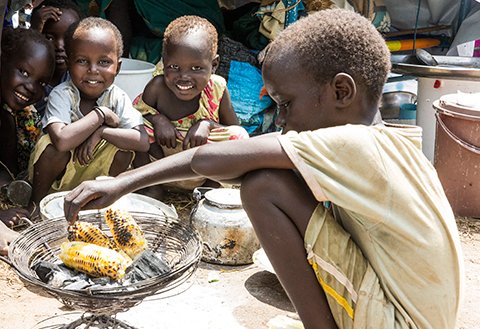
One of the leading causes of malnutrition is the lack of equal food distribution. According to the World Economic Forum, Americans spend 6.4 percent of their income on food. Meanwhile, households in impoverished countries can spend up to 80 percent of their income on food. These numbers show a clear uneven trend in distributing food to people in need. Equal food distribution is also at risk from another influencer on poverty: population growth. Even in developed countries, the current rate of food distribution will eventually be unable to keep up with population growth. Distributing food to people in need will soon become an issue for not just underdeveloped countries, but for developed countries as well.
One way of solving the growing issue of food distribution is through the utilization of new technologies. A combination of developing technologies, new economic models and support from global leaders could lead to curbing the problems behind food distribution for both the developing and underdeveloped world.
Text Message-based Farmer Assistance
In Egypt, Sudan and Ethiopia, farmers have access to a service that functions through text messages. Provided by CGIAR, an organization focused on water, land and ecosystems, farmers can send a message through SMS (short message service) to request updates on the best way to grow their crops. People know this service as ICT, or Information and Communication Technology. According to CGIAR, farmers send one message code when they want to see an update on their crop growth and water-use efficiency compared to other farmers using the service. Based on this data, experts monitoring the farming data can identify irregularities and alert the farmer. One issue that CGIAR sees going forward is funding. Maintaining its database would require more funding than what farmers or smallholders have already offered. However, this service would be able to help farmers, in areas of need, increase the amount their farms produce.
Using ICTs to help feed people in need has shown promising results. An ICT service will help improve irrigation and water drainage in Egypt. This service has seen a 25 percent increase in crop yields during its first phase of implementation. Magrabi Farms has also implemented ICT to allow the proper irrigation of over 8,000 acres of land.
Farming and Machine Learning
Increasing farm production is a common method of tackling the issue of distributing food to people in need. Sciforce says that almost every step of farm production uses machine learning. Machine learning, according to Sciforce, is “the scientific field that gives machines the ability to learn without being strictly programmed.” Farmers can use machine learning to:
-
Find which genes would help a crop survive in adverse weather conditions.
-
Manage the soil and help farmers understand the ecosystem they are growing in.
-
Manage water and allow farmers to be more efficient with their irrigation systems.
-
Improve the prediction of crop yield.
-
Fight disease and weeds by using a calculated distribution of agrochemicals that only target specific plants.
Machine learning accomplishes all of this by analyzing decades of farming records. It uses a combination of algorithms and scientific models to best apply the trends from decades of farming data.
NBC News reported that Carnegie Mellon University roboticist George Kantor claimed that machine learning could increase the variety of grain sorghum from 100 different variants to 1,000. Machine learning could do this by examining the crop’s genetic code.
Weather Forecasts
Another way to ensure that countries are able to distribute food to people in need is by improving distribution itself. The Weather Company’s Agricultural Head, Carrie Gillespie, stated that “A lot of food waste happens during distribution…” Suppliers often use weather forecasts when distributing food to people in need. Due to distribution including the harvesting process, these weather reports can help farmers know when the soil is at its best for harvesting.
3D Printing
While this may seem like an idea from a sci-fi movie, 3D printing is a technology that may soon allow food printing. Jordan French, CEO at a 3D food printing startup called BeeHex, explains that 3D food printing could allow for customization of food products based on the certain wants and needs of the consumer. This could include developing food with certain nutrients that an impoverished community may be lacking, much like the recently FDA-approved golden rice, which emerged to treat a global vitamin A deficiency.
Jordan French also theorizes that 3D printing food could eliminate the need for distribution altogether, as it would create a bridge between the producer and the consumer.
The market for 3D-printed food is rising in profits by 46 percent each year until 2023. Mark Crawford of ASME.org alludes that this is due to how the technology could provide a solution to distributing food to people in need.
These technologies aim to tackle the challenges of distributing food to the impoverished for the sake of equal food distribution. Improving farming quality through databases and machine learning, watching the weather to allow for better distribution and even bypassing the need for food production are just some developing technologies that have the potential to assist the world’s hungry.
– Jacob Creswell
Photo: United Nations
