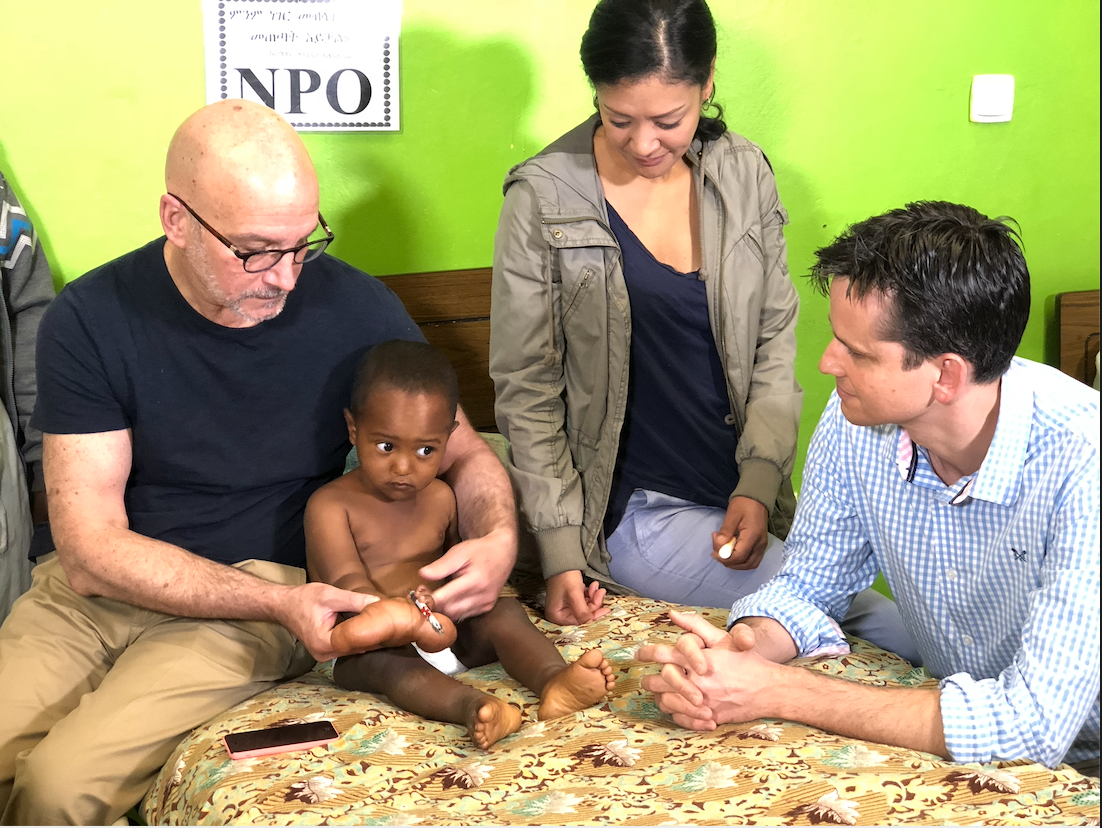
Touching Hands is a nonprofit that provides free hand surgery to those in need around the world. The organization serves international and domestic communities, such as Ethiopia, Ghana, Haiti, Guatemala, Honduras, the United States and Nepal. These interviews detail the intricacies of the organization Touching Hands and its international impact.
Dr. Scott Kozin, M.D., Founder of Touching Hands and Chief of Staff for Shriners Hospitals for Children in Philadelphia, PA.
Q: What was the process of becoming the founder of Touching Hands?
A: “In 2014, I was President of the American Society for Surgery of the Hand, and I wanted to make outreach a pillar of the organization. At that point, there were only four pillars: education, research, organizational excellence, and patient care. During my presidential year, I had a singular goal to have one international outreach mission, which was based in Haiti, the poorest country in the hemisphere. My presidential speech passionately pleaded with doctors and surgeons, stating, ‘We have been so lucky—just look at everything we as an organization have accomplished. Now is the right time to give back.’ The membership responded with their hearts, souls, expertise, and money. The mission to Haiti was a success and a turning point for Touching Hands, which has blossomed over the last six years. We currently have an outreach director who sits on the 13 member Hand Society council and provides a ‘seat and a voice at the table.’ We accomplished our goal and established outreach as a pillar of the organization.”
Q: Can you describe the outreach missions and how you organize the teams for the missions?
A: “Teams vary in size per each mission. There could be a handful of people to 40 people on any given mission. The team members include hand surgeons, nurses, and anesthesiologists. Many of the doctors and nurses who attend the missions cannot afford a week away from their practice, so we subsidize members with a $1,500 stipend that usually covers the cost of their travel and accommodations. We also try to include a community element to each trip, such as visiting an orphanage, building a school or constructing stoves.
“What really resonates with me about Touching Hands and participating on missions is the Carpe Diem principle. When you are in another country with a team of people whom you love and whom you love working with, there is a common goal. There is no competition; we are all just working towards the same objective. The principle goal is to help the people in need as much as we can. It’s a great thing to do—going on outreach missions—but there are more missions to do and more patients to care for across the globe. There’s always more to do.”
Dr. Rick Gardner, M.D., Orthopedic Surgeon and Medical Director for CURE Ethiopia
Q: Why do you do what you do?
A: “Oh, why do I do what I do? Well, I think for me I’m doing exactly what I’m supposed to do. I’m helping children in a developing world setting and giving them care that we take for granted in the Western World. It gives me deep satisfaction and fills my life with purpose–helping these children.”
Q: Can you explain the relationship between Touching Hands and your practice in Ethiopia? What impact have you seen?
A: “When I started working for Cure International in Ethiopia, I wanted to help children and train the local surgeons. Here in Ethiopia, there is a population of over 109 million people, and when I started working here seven years ago, there were just 60 orthopedic surgeons. Government healthcare resources were predominantly focused on trauma care with little resources or expertise to care for children with musculoskeletal disability. We care for children throughout Ethiopia, some having to travel for five days to come to our hospital.
[So,] when I heard of Touching Hands, I immediately got into contact with Dr. Scott Kozin. I had a patient called Rahel, born with a mirror hand [Ullnar Dimelia], a very rare congenital condition where the child has eight fingers. He had cared for many similar children and came to visit our hospital for the first time six years ago. He did incredible work, reconstructing her hand, restoring function and appearance. He and Dr. Duretti Fufa have made annual trips since then, caring for children with brachial plexus palsy, congenital hand pathology, Volkmann contractures, chronic burns and many others. They have revolutionized the breadth and quality of our upper limb service and we pass on these techniques to our Ethiopian residents and fellows.
“Touching Hands transformed our level of care here in Ethiopia. Dr. Kozin and Dr. Fufa have taught us how to take care of these children and restore their lives. They have provided world-class care to these children and have enabled us to continue that level of care throughout the year. Dr. Kozin and Dr. Fufa continue to visit us each year. They have been a huge blessing to us.”
Dr. Fraser Leversedge, M.D., Chief Section fo Hand Surgery at the University of Colorado, Touching Hand’s Team Leader
Q: Can you describe the impact you have seen on your missions to Honduras?
A: “Since 2014, I have traveled twice a year to the Ruth Paz Hospital in San Pedro Sula, Honduras with Touching Hands. In Honduras, our medical teams – made up of members from all over North America – are given the opportunity to witness the impact of helping those who were previously unable to work, care for their families, or contribute to society. By restoring hand function, we are impacting their lives tremendously—not only helping the patient, but influencing the lives of his or her family, coworkers, and community. We [also] do not just help for a week and then leave. We believe in the importance of ‘teaching them how to fish [rather than giving them a fish].’ [Through Touching Hands,] we teach the local surgeons and trainees how to perform procedures that they may not have been taught beforehand. We are passing along our educational expertise to allow them to increase the services they provide to their patients and communities.”
Q: Why do you think it is important for doctors to consider outreach as part of their practice?
A: “I think certainly in the United States or other countries who are fortunate enough to have well-educated, funded and safe medical practices, outreach allows doctors to reset and remember why we do what we do. It also gives healthcare providers [surgeons, anesthesia providers, nurses, and therapists] and all the volunteers a sense of appreciation for what we have.”
The website for Touching Hands provides multiple options for those interested in getting involved with the cause, including volunteering, information regarding outreach missions and donating directly towards Touching Hands’ efforts.
– Kacie Frederick
Photo: Dr. Scott Kozin, M.D.

5 Facts About Tuberculosis in Mozambique
5 Facts About Tuberculosis in Mozambique
– Will Sikich
Photo: Flickr
10 Facts About Poverty in Pakistan
Founded during the partition of India and located in South Asia, the Islamic Republic of Pakistan has the fifth-largest population in the world, with a population of more than 220 million. Cornerstones of Pakistani culture include incredible cuisine, iconic architecture and the popular game of cricket. However, like so many nations across the globe, Pakistani citizens must confront the harsh reality of extreme poverty. Here are ten facts about poverty in Pakistan.
10 Facts About Poverty in Pakistan
With continued efforts, poverty in Pakistan will hopefully decrease. The Citizens Foundation is one of many nonprofits that have been working to improve the quality of life for underprivileged Pakistani citizens. In 25 years, the Citizens Foundation has created 1,652 schools, providing proper education to more than 266,000 children who would not have had it otherwise. These schools also combat gender inequality in Pakistan, as they have all-female faculty and a 50% student gender ratio.
However, there is still work that is necessary to combat poverty in Pakistan. In Pakistan, gender disparities compound the unjust realities of poverty. Poverty rates in rural areas are more than five times higher than those in urban areas. Yet, similar to global trends, the amount of people living in poverty in Pakistan has clearly been decreasing in recent years. This is in large part due to individuals and organizations dedicating themselves to the cause of ending poverty. These continued efforts will help fight and eventually end poverty in Pakistan, and in turn, will make the Republic a more just and equal country for all those who call it home.
– Ehran Hodes
Photo: Flickr
Interviews with Members of Touching Hands
Touching Hands is a nonprofit that provides free hand surgery to those in need around the world. The organization serves international and domestic communities, such as Ethiopia, Ghana, Haiti, Guatemala, Honduras, the United States and Nepal. These interviews detail the intricacies of the organization Touching Hands and its international impact.
Dr. Scott Kozin, M.D., Founder of Touching Hands and Chief of Staff for Shriners Hospitals for Children in Philadelphia, PA.
Q: What was the process of becoming the founder of Touching Hands?
A: “In 2014, I was President of the American Society for Surgery of the Hand, and I wanted to make outreach a pillar of the organization. At that point, there were only four pillars: education, research, organizational excellence, and patient care. During my presidential year, I had a singular goal to have one international outreach mission, which was based in Haiti, the poorest country in the hemisphere. My presidential speech passionately pleaded with doctors and surgeons, stating, ‘We have been so lucky—just look at everything we as an organization have accomplished. Now is the right time to give back.’ The membership responded with their hearts, souls, expertise, and money. The mission to Haiti was a success and a turning point for Touching Hands, which has blossomed over the last six years. We currently have an outreach director who sits on the 13 member Hand Society council and provides a ‘seat and a voice at the table.’ We accomplished our goal and established outreach as a pillar of the organization.”
Q: Can you describe the outreach missions and how you organize the teams for the missions?
A: “Teams vary in size per each mission. There could be a handful of people to 40 people on any given mission. The team members include hand surgeons, nurses, and anesthesiologists. Many of the doctors and nurses who attend the missions cannot afford a week away from their practice, so we subsidize members with a $1,500 stipend that usually covers the cost of their travel and accommodations. We also try to include a community element to each trip, such as visiting an orphanage, building a school or constructing stoves.
“What really resonates with me about Touching Hands and participating on missions is the Carpe Diem principle. When you are in another country with a team of people whom you love and whom you love working with, there is a common goal. There is no competition; we are all just working towards the same objective. The principle goal is to help the people in need as much as we can. It’s a great thing to do—going on outreach missions—but there are more missions to do and more patients to care for across the globe. There’s always more to do.”
Dr. Rick Gardner, M.D., Orthopedic Surgeon and Medical Director for CURE Ethiopia
Q: Why do you do what you do?
A: “Oh, why do I do what I do? Well, I think for me I’m doing exactly what I’m supposed to do. I’m helping children in a developing world setting and giving them care that we take for granted in the Western World. It gives me deep satisfaction and fills my life with purpose–helping these children.”
Q: Can you explain the relationship between Touching Hands and your practice in Ethiopia? What impact have you seen?
A: “When I started working for Cure International in Ethiopia, I wanted to help children and train the local surgeons. Here in Ethiopia, there is a population of over 109 million people, and when I started working here seven years ago, there were just 60 orthopedic surgeons. Government healthcare resources were predominantly focused on trauma care with little resources or expertise to care for children with musculoskeletal disability. We care for children throughout Ethiopia, some having to travel for five days to come to our hospital.
[So,] when I heard of Touching Hands, I immediately got into contact with Dr. Scott Kozin. I had a patient called Rahel, born with a mirror hand [Ullnar Dimelia], a very rare congenital condition where the child has eight fingers. He had cared for many similar children and came to visit our hospital for the first time six years ago. He did incredible work, reconstructing her hand, restoring function and appearance. He and Dr. Duretti Fufa have made annual trips since then, caring for children with brachial plexus palsy, congenital hand pathology, Volkmann contractures, chronic burns and many others. They have revolutionized the breadth and quality of our upper limb service and we pass on these techniques to our Ethiopian residents and fellows.
“Touching Hands transformed our level of care here in Ethiopia. Dr. Kozin and Dr. Fufa have taught us how to take care of these children and restore their lives. They have provided world-class care to these children and have enabled us to continue that level of care throughout the year. Dr. Kozin and Dr. Fufa continue to visit us each year. They have been a huge blessing to us.”
Dr. Fraser Leversedge, M.D., Chief Section fo Hand Surgery at the University of Colorado, Touching Hand’s Team Leader
Q: Can you describe the impact you have seen on your missions to Honduras?
A: “Since 2014, I have traveled twice a year to the Ruth Paz Hospital in San Pedro Sula, Honduras with Touching Hands. In Honduras, our medical teams – made up of members from all over North America – are given the opportunity to witness the impact of helping those who were previously unable to work, care for their families, or contribute to society. By restoring hand function, we are impacting their lives tremendously—not only helping the patient, but influencing the lives of his or her family, coworkers, and community. We [also] do not just help for a week and then leave. We believe in the importance of ‘teaching them how to fish [rather than giving them a fish].’ [Through Touching Hands,] we teach the local surgeons and trainees how to perform procedures that they may not have been taught beforehand. We are passing along our educational expertise to allow them to increase the services they provide to their patients and communities.”
Q: Why do you think it is important for doctors to consider outreach as part of their practice?
A: “I think certainly in the United States or other countries who are fortunate enough to have well-educated, funded and safe medical practices, outreach allows doctors to reset and remember why we do what we do. It also gives healthcare providers [surgeons, anesthesia providers, nurses, and therapists] and all the volunteers a sense of appreciation for what we have.”
The website for Touching Hands provides multiple options for those interested in getting involved with the cause, including volunteering, information regarding outreach missions and donating directly towards Touching Hands’ efforts.
– Kacie Frederick
Photo: Dr. Scott Kozin, M.D.
5 Facts about Poverty in Finland
Many know Finland as one of the happiest countries in the world. Not only do people know Finland for the iconic Northern Lights, but they also consider it to be one of the least poverty-stricken countries in all of Europe. Finland has the fourth-lowest poverty rate in OCED countries and a Gini coefficient of .27, which is lower than the United States. Here are five facts about poverty in Finland.
5 Facts About Poverty in Finland
Concluding Thoughts
The probability of someone becoming poor in Finland is actually lower than the probability of them becoming poor in all of Europe. In 2016, the chance of someone in Finland being at risk of poverty was approximately 16% compared to 22% in the European Union as of 2019. Finland also has one of the highest Human Development Indexes (HDI) with a placement of number 12 out of 189 countries. Its HDI has been increasing for nearly two decades now and sits at a .925 as of 2018. One can attribute Finland’s success as a country to an increased life expectancy at birth since 1990, an increased number of expected and mean schooling since 1990 and an increase in its Gross National Income (GNP) per capita since 1990. These five facts about poverty in Finland show that overall, Finland is one of the most prosperous countries in Europe due to the exceptional education system, low poverty rate and expanding economy.
– Hena Pejdah
Photo: Flickr
Analyzing the US Space Force Budget
The U.S. Space Force (USSF) emerged as the newest branch of the Armed Forces in December 2019. It lies within the Department of the Air Force, which means the Secretary of the Air Force is responsible for its overall operations. While the USSF is a pioneering endeavor meant to expand U.S. capabilities to protect Americans, the $15.4 billion proposed U.S. Space Force budget for the fiscal year 2021 is a sum that would prove transformative in fighting global poverty. The following are examples of what $15.4 billion could do in this fight, as well as a comparison to U.S. funding allocated to foreign aid in general.
The US Space Force Budget and Foreign Aid
Contextualizing Funding
Foreign aid not only helps millions of suffering people all over the world but also addresses the root causes of many violent issues. As such, increasing funding for poverty eradication would serve U.S. security well. The U.S. Space Force budget is just one case that shows how effective a larger amount of foreign aid spending could be. In the long term, this would not only increase U.S. security but international security as well, lowering the risk of violent conflict involving the U.S. in the future while alleviating the suffering so many find themselves enduring.
Photo: Flickr
Poverty in Switzerland
The media often refers to Switzerland as one of the wealthiest countries. It is a country that others view as a model for a liberal-market economy. Its human development index (HDI) ranking is second in the world. Despite this, it still requires aid to support hundreds of thousands of residents struggling to make ends meet. In fact, the poverty rate grew from 7.5% in 2016 to 8.2% in 2017. Here is some information about poverty in Switzerland.
Poverty and Welfare in Switzerland
In 2020 (income 2019) about 8.5% of the Swiss population or 772,000 were poor. The Swiss poverty rate had decreased from 9.3% to 5.9% from 2007 to 2013, but since 2014, it has been trending upward. People most affected include households in which no adult is working, single-family households with children and people who have no education beyond compulsory education. Age also factors into poverty in Switzerland. Those 18 and younger along with those who are 64 and older are more likely to struggle with poverty .
Most poor people qualify for Swiss welfare. Known as the “basket of goods,” it is a monthly payment to provide for basic necessities. Basic needs include food and clothes, for which individuals will receive CHF1,000 ($961.70), as well as CHF1,000 for housing and CHF200 ($192.34) for health insurance as of 2020. Welfare recipients must find the cheapest housing and those 25 and under must live with their families. Welfare pays only for public transportation, not for a car. Persons who receive welfare may also have to meet with a budget advisor to help improve financial stability. As people earn more money, the government lowers their payments. About half of the people on welfare stay on it for less than a year, 20% need one to years to get off welfare and eight percent need up to six years.
NGOs Fighting Poverty in Switzerland
Beyond the Swiss government, there are a number of non-governmental organizations (NGOs) providing assistance in Switzerland. Caritas Switzerland is one of the oldest, and is working to “reduce poverty in half.” Caritas is a global organization, with the goal to reduce poverty globally as well as provide emergency relief and post-natural disaster reconstruction. Caritas emerged in Switzerland in 1901, working to provide aid for those who experience financial disadvantages such as single mothers, retirees and refugees. The NGO’s services in Switzerland include Caritas groceries for the poor, a Caritas “Culture Card” so poor people can attend cultural events and a debt advisory service.
A second major NGO supporting Switzerland’s poor is HEKS/EPER which, in 2019, ran 162 projects in 32 countries, including Switzerland. In Switzerland, HEKS/EPER is focusing on supporting asylum seekers, job integration and legal services. HEKS/EPER also created the project HEKS Wohnen, a program to assist those who may be socially disadvantaged, including those with addiction problems and mental illness, to find living quarters and successfully integrate into society.
Despite the uptick in Switzerland’s poverty rate, the support of NGOs such as HEKS/EPER, Caritas Switzerland and the government welfare reform programs provide aid and assistance to those living in the country. With these support systems in place, Switzerland should have the ability to reverse its higher poverty projections.
– Allison Lloyd
Photo: Flickr
4 Facts About Healthcare in Yemen
4 Facts About Healthcare in Yemen
Despite barriers to outreach, such as inadequate funding, there is an ongoing effort to stabilize and improve the state of healthcare in Yemen amid the violence of civil war. Efforts by the United Nations and numerous other humanitarian organizations are occurring to combat health issues related to circumstances of war, malnutrition and disease, while also providing Yemeni people with tools and training to treat and prevent further health complications.
– Emily Butler
Photo: Flickr
5 Facts About Poverty in Thailand
With the second-largest economy in Southeast Asia, Thailand is a relatively wealthy country. Its vibrant culture, delicious food and beautiful scenery attract millions of visitors a year, greatly contributing to its economy. In addition to the tourism industry, Thailand exports many commodities like rice, rubber and coconuts. The country also produces goods like textiles, cement and plastics.
Though Thailand’s poverty rate has decreased by 65% since 1988, impoverished living conditions are still a pressing issue in the country. Here are five facts about poverty in Thailand.
Despite these five facts about poverty in Thailand, the country has many success stories in terms of poverty alleviation. Everyone in the country has access to electricity, water sanitation is excellent and education rates are high. However, to ensure every single citizen of Thailand is free from poverty, the government’s efforts are crucial in economic development and producing innovative jobs for vulnerable populations.
– Borgen Team
Photo: Pixabay.
Updated: June 16, 2024
7 Facts About Tuberculosis in Zambia
7 Facts About Tuberculosis in Zambia
These facts show that the health crisis of tuberculosis in Zambia exposes a dire need for increased accessibility of healthcare and better methods of diagnosis and treatment. The recent efforts in management and care of tuberculosis show promise of effective tuberculosis management and an overall healthier population.
– Jennifer Long
Photo: Flickr
4 Facts about Poverty in Slovakia
The current population of Slovakia is 5.4 million and 80.7% is Slovik. Slovakia does not have a high percentage of migrants, with only 0.2 migrants per 1,000 persons. Also, less than one-eighth of the population lives in poverty. Although poverty is not as severe in Slovakia as in other countries, poverty affects certain demographics more heavily. Here are four facts about poverty in Slovakia.
4 Facts About Poverty in Slovakia
Concluding Thoughts
These four facts about poverty in Slovakia show that it has a low poverty rate in comparison to other countries. Access to clean water and other human necessities are available for some; however, poverty in Slovakia disproportionately affects minority groups. These groups do not have the same access to essential human needs and it affects their everyday lives. There is hope, however, because organizations, such as Habitat for Humanity and The Environmental Training Project, are working to provide necessary resources for developing communities.
– Brooke Young
Photo: Flickr