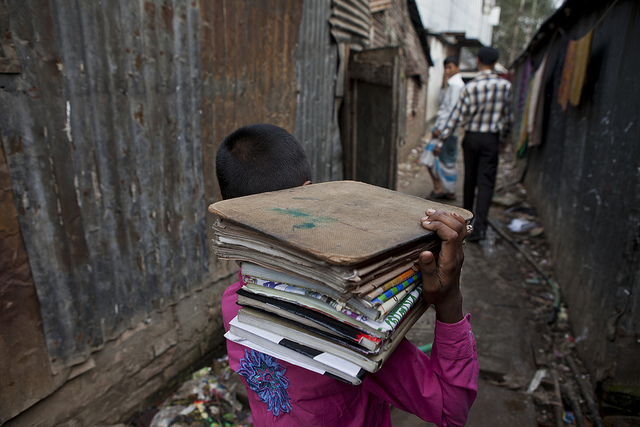
Information and stories on social activism.

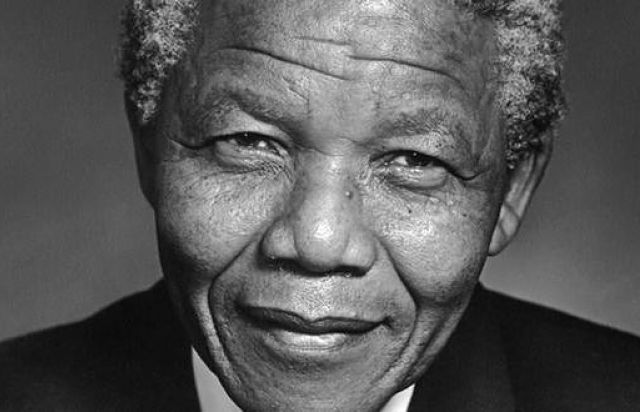
Mandela Quotes on PovertyPoverty can be an all too common sight, particularly when images and statistics saturate social media placing a wedge of detachment between the impoverished and those not impoverished. There are more than 640 million people suffering from extreme poverty today. To each of these people, poverty carries a burden difficult to understand from the perspective of those that just hear, read or see it on the news. Poverty is a hardship that is not nearly as simple as lacking food, clothing or shelter.

Nelson Mandela, the former first black president of South Africa and anti-apartheid revolutionary, had constantly implored the world to re-open its dulled senses to the tribulations of poverty. From his years as a lawyer and human rights activist, he successfully overturned apartheid in South Africa and ventured beyond the borders to end the injustice of poverty in all nations.

“He proved that equal respect and treatment of every person is and must continue to be an achievable reality everywhere in the world,” Ruth Messinger, president of American Jewish World Service, said in a statement. “Nelson Mandela was a modern-day prophet for human dignity whose voice was heard around the world.” Below are the top five Nelson Mandela quotes on poverty that invite a renewed and clearer understanding of how his views on poverty can inspire the world.

Top 5 Mandela Quotes on Poverty

  1. “Like slavery and apartheid, poverty is not natural. It is man-made and it can be overcome and eradicated by the actions of human beings.” – London’s Trafalgar Square in 2005.
  2. “Massive poverty and obscene inequality are such terrible scourges of our times — times in which the world boasts breathtaking advances in science, technology, industry and wealth accumulation — that they have to rank alongside slavery and apartheid as social evils.” – London’s Trafalgar Square in 2005.
  3. “Do not look the other way; do not hesitate. Recognise that the world is hungry for action, not words. Act with courage and vision.”
  4. “Overcoming poverty is not a gesture of charity. It is an act of justice. It is the protection of a fundamental human right, the right to dignity and a decent life.” – London’s Trafalgar Square in 2005.
  5. “In this new century, millions of people in the world’s poorest countries remain imprisoned, enslaved and in chains. They are trapped in the prison of poverty. It is time to set them free.”

These five quotes depict a powerful image of poverty that scrutinizes aspects of status beyond just its basic definition. Mandela chose to focus on an optimistic possibility of overcoming poverty as opposed to becoming overwhelmed by the tragedy of it. The attitude of those who witness poverty can be a force large enough to reinvigorate the world to push for the change it needs.


– Alice Lieu
Photo: Flickr

human trafficking relief organizations
Around the world, there is an ongoing epidemic that is often hidden in plain sight­: human trafficking. According to the United Nations, there are over 27 million slaves in the world today and this number threatens to increase as the demand for certain goods and industries increases.

Although this is a crisis is facing many people, there are several organizations that have stepped in to bring attention and relief to this global epidemic. The following are five human trafficking relief organizations that everyone should be aware of.

Five Important Human Trafficking Relief Organizations

  1. Freedom United: This organization works to combat human trafficking by encouraging direct involvement from people who visit its site. Freedom United does not exactly implement solutions to change and provide relief for victims, but rather it rallies for other people to get involved in order to produce change. The organization has made great strides in its efforts to end human trafficking which is why it is one of the five most important human trafficking relief organizations.Since its launching, it has acquired over 18 million actions taken to end human trafficking. The organization also has 5.9 million fans on Facebook and 79 global partners, including the United Nations University, helping to create effective change for issues facing the world’s most vulnerable.
  2. Urban Light: Founded by Alezandra Russell in 2009, Urban Light is dedicated to helping a sector of human trafficking victims that is often overlooked by mainstream media: boys. This is the reason why it is one of the five human trafficking relief organizations everyone should know. After visiting Thailand, Russell decided to leave her home in Washington, D.C., and relocate to Thailand to begin Urban Light. Since its founding days, it has helped over 3,000 boys and has provided over 10,000 meals.A few steps included in its method to restore the lives of vulnerable young boys include: health, which provides victims with education and awareness resources as well as screenings to make sure victims are healthy; education, which provides victims with educational resources to help them finish their education; outreach, such as frequenting clubs and bars in Thailand where victims of human trafficking are usually located and providing them with the opportunity to leave their vulnerable situation in order to get help; and legal support, such as working with victims to help them obtain legal identification cards to devoid any illegal circumstances and providing the opportunity for victims to be represented in court.
  3. Abolishment 21st Century (A21): Founded by Christine Caine in 2007, this organization works with women and girls who are victims of human trafficking with its own unique campaigns. A reason why this is one of the major human trafficking relief organizations to know is because it is a multinational organization, assisting girls in nations in Europe, Asia, Africa as well as the United States and Australia.A21 uses a three-step methodhttp://www.a21.org/content/our-solution/gn9pjs to help victims reintegrate into society. The method includes:Reach: The reach method consists of the Walk for Freedom campaign, where volunteers host public demonstrations highlighting the harsh realities of human trafficking today. Other campaigns also include Can You See Me, which bears a similar approach to educate men, women and children of the harsh realities facing victims of human trafficking in the world today.
    Rescue: The next portion of A21’s mission focuses on collaborating with law enforcement and the government to help prosecute captured human traffickers. Representatives also help with the legal process by defending victims in court.
    Restore: The last method in its solution focuses on providing victims the opportunity to re-integrate themselves into society, by providing them with prime accommodations for recovery that include housing, medical treatment, top-class educational resources, counseling, employment and enterprise opportunities.
  4. Rapha House: Rapha House was founded in 2003 by Joe Garman after he witnessed the near trafficking of a young woman in Cambodia. Since then, Rapha House has served as a safe house for victims of human trafficking. The organization contains several programs to help young, high-risk victims as one of the five human trafficking relief organizations everyone should know.One of Rapha House’s programshttps://raphahouse.org/programs is Safety House, a facility where young girls are given free housing, education and meals to protect them from the exploitation they face in the outside world. Another program is Kids Club, which provides boys and girls from impoverished backgrounds with education, housing and healthcare needs. Training and Reintegration provide victims of human trafficking with the skills they need to re-enter society. The program includes vocational training, such as sewing classes, produce farming as well as business training, among other programs.
  5. Prajwala: Founded in 1996 by Sunitha Krishnan, this organization seeks to address human trafficking in India. Prajwala uses a course of action that includes prevention, rescue, rehabilitation and reintegration.For prevention, the organization has established Implementation Programs as well as Community Based Prevention Programs to combat the issue of human trafficking. The rescue method uses the following planned rescue operations: Rape Victim Support Program, Victim Witness Protection and VIKALPA, which is a police-NGO partnership that seeks justice for victims. Rehabilitation works by providing victims with psychological rehabilitation, economic rehabilitation and civic rehabilitation and reintegration works by providing victims with family reunions, marriage and independent living.

These five human trafficking relief organizations are just a small number compared to the larger amount of efforts established to help eradicate the statistics of human trafficking worldwide. Although great efforts have been made to address human trafficking, the world still awaits a day when slavery will be abolished for good, but it is up to those who are aware of the dire situation to make this happen.

– Lois Charm
Photo: Google

Fashion companies that address extreme poverty
Some would say that fashion is their life. Others say they don’t care about what they wear. For fashion companies that address extreme poverty, finding a middle ground can make all the difference. Companies like the ones below would argue that fashion can both impassion the apathetic and give cause to the already passionate.

Raven and Lily – Empowering Women. Alleviating Poverty.

Live thoughtfully. With this as one of her life axioms, Kirsten Dickerson created her unique and ethical brand of fashion, Raven and Lily, in 2008. In 2013, Dickerson met a group of female Afghan artisans living for decades as refugees on the Pakistan border. The experience moved her to expand her business.

Since then, Raven and Lily formed 17 partnerships throughout 10 countries while employing more than 1,500 women. Dickerson provides jobs and educational opportunities as well as an ethical and sustainable product. “We are genuinely trying to think through all levels of our production practices and how people on the planet are affected,” Dickerson said.

By providing steady employment, including fair wages and education, Raven and Lily has established itself among the fashion companies that address extreme poverty on the most foundational of levels.

Accompany – Where Every Purchase has a Purpose.

If asked about its mission, Accompany will say its first priority is to help human beings. Ranked among the fashion companies that address extreme poverty head-on, the organization has an uncomplicated approach to the way it does business. Its three-tier system ensures the products have a purpose by:

  • Being handmade.
  • Abiding fair trade practices.
  • Having philanthropy at the center.

The results of this system are exponential: cultural heritage is preserved for generations to come, self-sufficiency is rooted in a new-found education and services are provided to the community at large. In short, change happens.

Socially-conscious industries help create that change. When Jason Keehn founded the organization, his vision was to leverage a thriving industry for global communities in need. As they boldly proclaim on their website: Welcome to a New Style Culture. It’s a culture that seems to be shared by all fashion companies that address extreme poverty.

Apolis – Advocacy through Industry.

With Apolis, the name says it all—a name that means “global citizen.” When they created their company in 2004, brothers Raan and Shea Parton believed business could be the impetus for social change. They have taken that belief, along with their investment in people, and have created a model for other fashion companies that address extreme poverty.

A certified B Corporation, Apolis meets high standards with regard to social and environmental performance, transparency and accountability. When asked about their brand of activism, Shea Parton stated, “[it’s] really about how you can go into an impoverished country and find a resource or product or raw material that allows you to bring it into the marketplace and to give an opportunity rather than charity.”

This mindset likely formed from a young age, according to Parton, who says “our parents knew that if we stayed in Santa Barbara, we would never know how good we had it.” With constant travel to countries like Uganda and India, the Parton brothers learned perspective early on, and they have put their perspective into action.

Bloom + Grace – Beautifully Made. Ethically Sourced. Globally Minded.

Bloom and Grace was founded in 2013, a jewelry company resulting from an inspired founder. When Dani Lachowicz found herself working in sub-Saharan Africa, she seized an opportunity she knew would change the lives of children in developing countries. Partnering with the U.N. Foundation’s Shot@Life campaign and with local artisans, proceeds from Bloom and Grace go toward life-saving vaccinations.

Just how life-saving are vaccinations in developing countries? Here are some facts:

  • A child dies every 20 seconds from a disease that can be prevented by a vaccine.
  • The World Health Organization, UNICEF and the Global Alliance for Vaccinations have already seen a 99 percent reduction in polio and a 78 percent reduction in measles-related deaths.
  • Increasing access to vaccines can prevent 1.5 million deaths each year.

It is Bloom and Grace’s hope to empower communities and to promote entrepreneurship, while also living up to their namesake by allowing children the opportunity to bloom by the grace of socially-conscious patrons.

Krochet Kids, Intl. – Creating Jobs. Changing Lives.

Kohl Crecelius, Stewart Ramsey and Travis Hartanov founded Krochet Kids, Intl. from a shared high school hobby of crochet. Krochet Kids Intl. looks for ways to empower people to rise above poverty and provides life-changing job opportunities for women in need in Uganda and Peru.

With each purchase, consumers are invited to meet the maker of their product and are encouraged to write a note of thanks and encouragement. With this very personal approach to business and a partnership with We Are Capable, an organization with 10 years of experience fighting extreme poverty, the organization is able to stay committed to its desired areas of impact:

  • Women in poverty-stricken regions
  • Job opportunities
  • Education

Fashion companies that address extreme poverty understand that behind every fabric is a face, and behind every accessory is an opportunity for access to those who wouldn’t otherwise have it.

– Daniel Staesser

Photo: Flickr

Top Civil Rights Leaders
During the earlier years of U.S. history, slavery and oppression created some of America’s oldest top civil rights leaders. Susan B. Anthony, Chief Joseph, Rosa Parks and Martin Luther King Jr. are only a few of the many people who fought back in the face of adversity.

Paving the Way

1851: Susan B. Anthony and Elizabeth Cady Stanton are two big names in women’s civil rights. Together, they worked toward social and political advances for women. They established the American Equal Rights Association, which aimed to earn women and African American men voting rights. Other accomplishments were forming the Women’s Loyal National League, which gave women a political platform, and writing an amendment that was proposed to the Senate every year for 40 years. These two women are responsible for some of the rights American women have today.

1853: Harriet Tubman is one of the most well known civil rights leaders associated with U.S. slavery. Tubman helped more than 300 slaves reach freedom with the well-known Underground Railroad. Tubman saved her own money, and supporters donated funds to help her continue her mission to free enslaved African Americans. While Tubman is most famous for her work with the Underground Railroad, she also provided invaluable services during the Civil War.

1877: In an effort to avoid the slaughter and oppression of his tribe, Chief Joseph led the Nez Perce people on a 1,400-mile journey from the Wallowa Valley (now Oregon) toward Canada. This four-month long venture was treacherous for the Nez people. Many of the original 700 had lost their lives and the remaining could not continue, which forced Chief Joseph to surrender just 40 miles from the Canadian border. Although he admitted defeat in the end, Chief Joseph is one of the top civil rights leaders because he stood up to fight for what he believed in while facing an oppressive government.

These inspirational people carved the road for the next civil rights leaders to come a century later.

Civil Rights Movement

1955: Rosa Parks faced discrimination on a bus ride, where she was asked to give up her seat to a white man. She refused, which led to her arrest and her rise to civil rights leadership. Her wrongful arrest led to the Montgomery Bus Boycott, a protest by 17,000 African American citizens. This caused a substantial drop in revenue and a Supreme Court ruling to desegregate the Montgomery buses, because the law was deemed unconstitutional. Parks received severe backlash after the boycott and even lost her job as a tailor, but she still persevered. Parks is one of America’s top civil rights leaders because she continued the fight for African Americans and created change.

1963: Dr. Martin Luther King Jr. is maybe the most famous champion of human rights. He led peaceful marches and demonstrations protesting the discrimination African Americans faced in the U.S. His movement inspired the Civil Rights Act of 1964, and his words are often the inspiration of equality speeches today. Dr. King was faced with arrest, hate and violence from the people of Birmingham, Alabama. Yet he stood tall in the face of controversy and remained peaceful throughout his civil rights leadership. He preached of a world in which people were no longer divided by race, a message which still resonates with many today.

1965: Malcolm X faced racism all his life and channeled it through anger for a significant portion of his activism. He was known for a radicalized activism during the Civil Rights Movement and was viewed as a black nationalist who had an alternative approach to change. It was widely known that his delivery of the message of change contrasted Dr. King’s peaceful message. However, toward the end of his civil rights leadership, he had an apparent ideological change. Unfortunately, like many other civil rights trailblazers, he was assassinated before he could see a significant change in America.

The Fight Continues

The effortless work of past civil rights leaders has not ended; they merely passed the torch on to activists fighting today. Some of the current top civil rights leaders are:

Tarana Burke: Burke fights for the rights of victims of sexual assault and abuse. She is also the creator of the Me Too movement.

Alicia Garza, Patrisse Cullors and Opal Tometi: Creators of the Black Lives Matter group, which protests police brutality and institutional racism.

Chad Griffin: President of Human Rights Campaign, which is one of America’s largest gender and sexual minorities civil rights organization.

Nihad Awad: The leader of the Council on American-Islamic Relations, an Islamic advocacy organization that monitors hate crimes, profiling and discrimination against Muslim Americans.

Benjamin Crump: A civil rights attorney who speaks and represents cases for minorities who have experienced police brutality.

Michelle Alexander: Alexander is a civil rights lawyer who works against the systematic racial oppression of the African American men that disproportionately fill the nation’s prisons.

Throughout history, people have fought for their own civil rights around the world. Whether it was Nelson Mandela creating a national strike against the South African government, Malala Yousafzai journaling girl’s right to education, or Mohandas (Mahatma) Gandhi refusing to get out of his first-class seat on a train—activism is everywhere and has a ripple effect. Through protesting and standing up for their own rights, these former and current activists have made the top civil rights leaders list.

– Courtney Hambrecht


how to write the President
The President of the United States may seem out of reach to everyday constituents who do not hold any government office. Fortunately, the U.S. democracy is such that essentially anyone can reach the White House. The official website of the president, whitehouse.gov, makes information for contacting the nation’s highest office readily available. Web visitors can find phone numbers, with telecommunications options available for the deaf or mute, online. Furthermore, there is a form built into the site for easy email correspondence.

Though calling and emailing are fast and convenient communication methods, there may be a circumstance that calls for a letter. While the website provides basic information about how to write the president, there are a few other things a potential correspondent may want to consider:

The Paper

The White House recommends that correspondents compose their letter on 8.5 by 11-inch paper, which is the standard size for most ruled and printer paper. There are no guidelines about weight, color or fiber; communicators are free to choose whatever paper they feel is appropriate. That being said, the letter is going to pass through many hands once it arrives at the White House, so durability is an important consideration.

The Method

Choosing between a typed letter and a handwritten letter is an important decision about how to write the president. While handwritten letters tend to come across as more personal, they may be illegible. Should a correspondent choose to send a handwritten letter, use a dark ink pen and write neatly. Avoid using cursive or writing small. For typed letters, stick to a 10 to 12-point font size and avoid flowery, cursive-looking fonts.

The Message

Threats aside, correspondents can write the president about any number of topics. Whether someone wishes to voice their support or frustration, advocate for policy, give their opinion or share a personal anecdote, the White House is receptive to correspondence from the public. Letter writers should keep in mind that the president holds the highest office in the nation, and that alone garners some level of deference. Regardless of personal political opinion, it is wise to use a respectful tone when addressing the president, even if the purpose of the letter is to express discontent.

Enclosures

The White House cannot accept monetary contributions in any form. If a correspondent chooses to enclose any additional documents or photographs, it is likely that they may not be returned. Furthermore, these items may be damaged during the security screening process.

The Volume

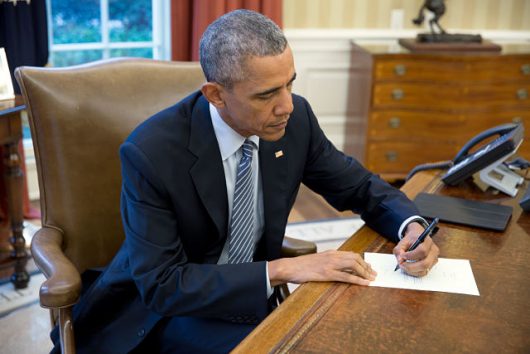
The White House receives tens of thousands of letters and packages on a daily basis. The Office of Presidential Correspondence is the government body that receives all of these letters. Within this office, staffers, interns and volunteers are tasked with the responsibility of reading all of these letters. Generally, correspondents should not expect that their letter will actually be read by the president, although there is a chance that it may. Former President Obama made it his policy to read ten letters every night, chosen by the Director of Presidential Correspondence. President Trump may hold his own letter-reading regimen.

Though there is no real way to ensure that any particular letter makes it to the president’s desk, Fiona Reeves, who served as the Director of Presidential Correspondence during the Obama administration, provided a few insights in an interview with 99% Invisible. Reeves explained that her team sought out mail “that is geographically diverse . . . [with] different writing styles . . . and ways of communicating.” The point of passing letters on to the president is to give him a sense of what really matters to the American people. A pointed letter that helps the president feel the country’s pulse may very well find its way to the Oval Office.

Mailing

The final consideration for how to write the president has to do with the mailing. Correspondents should address their letters to:

The White House
1600 Pennsylvania Avenue NW
Washington, DC, 20500

Ensure to include a return address on the letter. Place a stamp in the upper right corner and mail as usual or visit a local post office for expedited mailing options. Choosing to write to the White House is an empowering civic opportunity available to anyone. Sending mail to the president is an opportunity to advocate for policies that alleviate global poverty.

– Chantel Baul

Photo: Google


The stories of female Afghan writers and reporters are critical to the journalistic landscape of a country that sharply discriminates against women. Founded in 2015, Sahar Speaks brings these unique voices to light, providing mentoring, training and publishing opportunities for Afghan female journalists.

According to the organization, the name “Sahar” translated into English means “dawn,” meant to imply that a new period in time is commencing in which women can share their narratives and bring them to light. The program is transforming the journalism career path, allowing female correspondents to participate in international media and fostering their representation in the global field.

Women represent a marginalized group in Afghanistan and many cannot even openly speak with men. While the press corps is comprised of 9,000 journalists, only about 1,000 are female. After the 2001 expulsion of the Taliban, many news offices were established in Afghanistan by foreigners who primarily hired men and their close relatives. Until the origination of Sahar Speaks, no female reporters worked at foreign news outlets in Kabul.

British-American journalist Amie Ferris-Rotman founded the program to address this issue of gender inequity, giving women a platform through which they can freely communicate their perspectives. The project has helped to support insight into the lives of Afghan women whose experiences and accounts have been absent from the public eye.

While Afghan men or people from different countries are usually the ones telling the stories of Afghan women, the organization aims to return agency to Afghan female correspondents. Sahar Speaks has trained 22 Afghan female journalists and has prepared them for work on an international level. Through the program, budding reporters are paired with mentors and learn foundational journalism skills while addressing the challenges that they may face in the workplace.

Women face obstacles such as security threats and social barriers, including disapproval from family, yet Sahar Speaks aims to equip these women with the confidence to tell accurate stories. In 2016, 12 members of Sahar Speaks were selected to have their work published in The Huffington Post. Subjects ranged from the experience of having to dress like a boy in order to attend school to the practice of being married as a child. In 2017, journalists worked with The Huffington Post again to tell visual stories.

Alumnae of Sahar Speaks have gone on to pursue careers at the BBC, al Jazeera and The New York Times. In the fall of 2017, Ferris-Rotman collaborated with her mother, Lesley Ferris, to stage the stories that journalists had developed for The Huffington Post into a theatrical production.

Working with Ferris’ London-based drama company, Palindrome Productions, the performance debuted at Theatre 503 and brought to life three half-hour plays based on the experiences of the Afghan reporters. By presenting issues of gender and cultural restrictions through this medium, the production brought new attention to commonly overlooked conditions and sources of conflict, raising awareness on an international level.

Sahar Speaks is doing the essential job of giving Afghan women a voice in international media that has been absent for too long a time. By training reporters and equipping them with the skills they need to pursue a career in journalism, the organization is creating a changing culture where women can share accounts and seek out equity in society. While the perspectives of Afghan women have been obscured until recently, Sahar Speaks is shining a light on a new era where women will be empowered to express their stories and join a global discussion.

– Shira Laucharoen

Photo: Flickr

Article 19The United Nation’s Universal Declaration of Human Rights states in article 19 that “everyone has the right to freedom of opinion and expression; this right includes freedom to hold opinions without interference and to seek, receive and impart information and ideas through any media and regardless of frontiers.”
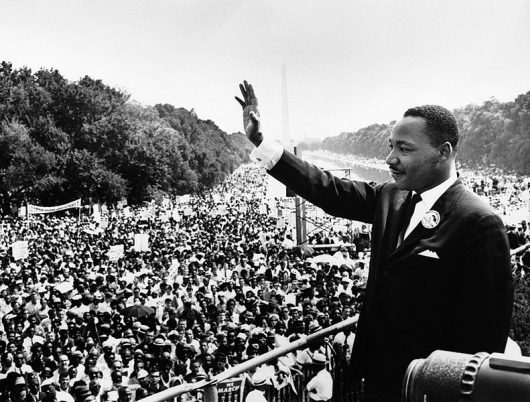
Named after this assertion, Article 19 is a human rights organization whose mission is to protect the freedom to speak globally. The group has worked in many different nations to address censorship, access to information and equality and hate speech, among other subjects.

Founded in 1987, Article 19 is based in London but has regional offices throughout the world, working with 100 organizations in more than 60 countries. The organization protects free speech on a global level by lobbying governments, intervening in individual incidents of rights violations and shaping legal standards relating to media and access to information.

With a commitment to combatting censorship, Article 19 has advocated on behalf of journalists arrested in Gambial, as well as Tanzanian politicians imprisoned for insulting the president. It has launched a petition that calls for a binding agreement for Latin American and Caribbean governments to guarantee access to information and justice in environmental matters, asserting that openness and transparency can help to monitor political corruption.

The organization has also written on the need for hate speech to be addressed in Myanmar and has taken a stance on racial discrimination in Tunisia, stating that racism inhibits pluralism of voices. Article 19 is a founding member of the International Freedom of Expression Exchange, a global network of 119 organizations committed to defending the basic liberty of freedom of expression. The nongovernmental organization raises awareness, acts through advocacy coalitions, forms petitions and conducts conferences and workshops.

Article 19 is also a founding member of the Freedom of Information Advocates Network, a group connecting organizations and individuals promoting access to information. The coalition runs projects such as a discussion list of lawyers, academics and civil society representatives concerned with the right of access.

In March 2017, Article 19 participated in a session of the U.N. Human Rights Council to draft The Global Principles on Freedom of Expression and Privacy, a document that will protect the openness of the media and safeguard the liberties of individuals and organizations internationally. The document is intended to inform policy makers and legislators in navigating liberties online and offline.

The Global Principles on Freedom of Expression and Privacy affirms the right of individuals to exercise freedom of expression anonymously and to use secure communication tools, while calling for the regulation of mass surveillance, describing this practice as interfering with privacy and freedom of expression. Additionally, the plan calls for the protection of confidential information given to companies online, as well as the right for confidential journalistic sources to not be disclosed. Through these measures, The Global Principles on Freedom of Expression and Privacy safeguard fundamental liberties in light of the digital age.

Article 19 is taking a stand against political censorship, the spreading of misinformation and the challenges that journalists face across multiple countries, calling for greater transparency and accountability. The organization operates on an international level, envisioning a world where freedom of expression and information are held in value. Navigating the digital era and the dangers of an oppressed media presence, Article 19 continues to fight for a diverse global community of voices, intervening in cases across the world and engaging in policy work to advance human rights.

– Shira Laucharoen

Photo: Google

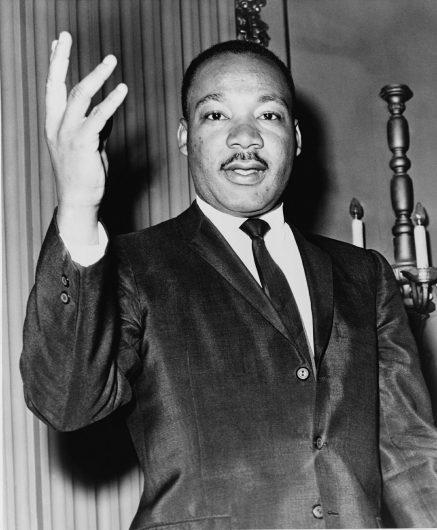
Martin Luther King, Jr.'s quotes about nonviolence
Although his main intent was to fight for the equality of African-Americans during the 1960s, Martin Luther King, Jr.’s quotes about nonviolence are still relevant today. As of 2017, Colombia, Yemen, El Salvador, Pakistan and Nigeria are the top five most dangerous countries in the world.

Colombia faces drug trafficking and frequent acts of terrorism. Pakistan is in the midst of a religious war in which innocent bystanders have become collateral damage. Nigeria is terrorized by two extremist groups, Boko Haram and ISIS of West Africa.

However, violence is not only a common trend in these countries but in a large percentage of the world. From the Caribbean to Africa and even parts of Asia, violence is an epidemic.

Violence is an ongoing cycle that is hard to break, and no one seems to have understood this more than Dr. King. He preached of the power and strength of nonviolent actions. He understood that peaceful protest and other nonviolent protests could strike real change.

Martin Luther King, Jr.’s Top Quotes about Nonviolence

  1. “In spite of temporary victories, violence never brings permanent peace.”
  2. “We adopt the means of nonviolence because our end is a community at peace with itself. We will try to persuade with our words, but if our words fail, we will try to persuade with our acts.”
  3. “Here is the true meaning and value of compassion and nonviolence, when it helps us to see the enemy’s point of view, to hear his questions, to know his assessment of ourselves. For from his view we may indeed see the basic weaknesses of our own condition, and if we are mature, we may learn and grow and profit from the wisdom of the brothers who are called the opposition.”
  4. “Nonviolence is a powerful and just weapon, which cuts without wounding and ennobles the man who wields it. It is a sword that heals.”
  5. “Nonviolence is absolute commitment to the way of love. Love is not emotional bash; it is not empty sentimentalism. It is the active outpouring of one’s whole being into the being of another.”
  6. “World peace through nonviolent means is neither absurd nor unattainable. All other methods have failed. Thus we must begin anew. Nonviolence is a good starting point.”
  7. “I refuse to accept the view that mankind is so tragically bound to the starless midnight of racism and war that the bright daybreak of peace and brotherhood can never become a reality… I believe that unarmed truth and unconditional love will have the final word.”
  8. “I have tried to offer them my deepest compassion while maintaining my conviction that social change comes most meaningfully through nonviolent action.”
  9. “I am convinced that even violent temperaments can be channeled through nonviolent discipline, if they can act constructively and express through an effective channel their very legitimate anger.”
  10. “In the nonviolent army, there is room for everyone who wants to join up. There is no color distinction. There is no examination, no pledge, except that, as a soldier in the armies of violence is expected to inspect his carbine and keep it clean, nonviolent soldiers are called upon to examine their greatest weapons: their heart, their conscience, their courage and sense of justice.”

From Martin Luther King, Jr.‘s quotes about nonviolence, many have been and continue to be given the power to envision peace. If humans across the globe could comprehend Dr. King’s lesson, the world would finally be able to achieve peace.

– Cassidy Dyce

Photo: Wikimedia Commons


social justice and economic justice
There is an enduring and powerful relationship between social justice and economic justice. Social justice has many definitions. 
The most common definition, according to the Oxford Dictionary, is: “Justice in terms of the distribution of wealth, opportunities and privileges within a society.”

The definitions that are most applicable to alleviating poverty, however, are:

  • The idea that every person should have equal rights to basic liberties and needs, and inequalities should be arranged to the greatest benefit for those considered lowest in society.
  • From the Huffington Post: “…promoting a just society by challenging injustice and valuing diversity. It exists when all people share a common humanity and therefore have a right to equitable treatment, support for their human rights and a fair allocation of community resources.”

However, the current functioning of global society violates each of these definitions almost completely, and therefore expresses the lack of and need for social justice in all areas of the world, especially developing nations.

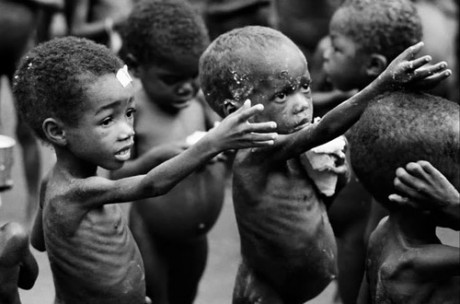
The United Nations Development Programme reports shocking statistics from poverty elimination research, detailing that as of 2000, there were 323 million people living on less than $1 a day, 185 million people who were undernourished and 273 million people without access to improved water sources in sub-Saharan Africa, the most impoverished region overall.

These harrowing numbers from sub-Saharan Africa were accompanied by information stating that 44 million primary age children were not in school, 23 million primary age girls were not in school, five million children under five years old were dying each year and 299 million people were without access to adequate sanitation. These statistics demonstrate that simple economic failure and injustice is not an isolated issue, but rather closely parallelled by social failure and injustice as well.

In contrast, the statistics from central and eastern Europe are staggeringly different. Only 21 million people were living on less than on $1 a day, only 33 million people were undernourished, only 29 million people were without access to improved water sources, only three million primary age children were not in school, only one million primary age girls were not in school, less than a million children under five years old were dying each year and an insignificant amount of people were without access to adequate sanitation as of 2000, so low that it was not even reported numerically.

As can be clearly seen, there is a direct correlation between social justice and economic justice, and a very large gap between developed nations and impoverished countries. The more economically impoverished a nation remains, the more social injustice thrives and prevails. The greater the poverty, the fewer people are given fair and equal access to basic needs and rights.  

To start fighting such global, national and statistical chasms and deprivations, the United Nations’ Millennium Development Goals have started targeting social justice, specifically to help achieve the goals of:

  • Eradicating extreme poverty and hunger
  • Promoting gender equality and empowering women
  • Ensuring environmental sustainability

The hope is that the new information and educational awareness of the relationship between social justice and economic justice will kickstart the alleviation of poverty by focusing on the social injustices in each region and developing country to foster a new approach for decreasing poverty overall.

– Lydia Lamm

Photo: Wikimedia Commons

Top Nine Nelson Mandela Quotes About Education

Nelson Mandela was a man who carried varied and numerous titles throughout his life. He was, among other things, a revolutionary, nonviolence anti-apartheid activist, philanthropist, human rights activist, the first black president of South Africa and a Nobel Peace Prize winner. He even went through 27 years in prison for his efforts to bring harmony and equality to South Africa. One of his great legacies was his contributions to education.

Nelson Mandela Quotes about Education

Mandela recognized education as a great vehicle to bring equality of opportunity to the world. Here are nine Nelson Mandela quotes about education:

  • “I have cherished the ideal of a democratic and free society in which all persons live together in harmony and with equal opportunities.”
  • “Education is the most powerful weapon which you can use to change the world.”
  • “The power of education extends beyond the development of skills we need for economic success. It can contribute to nation-building and reconciliation.”
  • “A good head and good heart are always a formidable combination. But when you add to that a literate tongue or pen, then you have something very special.”
  • “Young people must take it upon themselves to ensure that they receive the highest education possible so that they can represent us well in future as future leaders.”
  • “Without language, one cannot talk to people and understand them; one cannot share their hopes and aspirations, grasp their history, appreciate their poetry, or savour their songs.”
  • “No country can really develop unless its citizens are educated.”
  • “Education is the great engine of personal development. It is through education that the daughter of a peasant can become a doctor, that the son of a mine worker can become the head of the mine, that a child of farm workers can become the president of a great nation. It is what we make out of what we have, not what we are given, that separates one person from another.”
  • “It is not beyond our power to create a world in which all children have access to a good education. Those who do not believe this have small imaginations.”

The man’s inspiring life story has touched even more people’s lives than his quotes about education. The many funds and foundations he established during his lifetime continue to help and advocate for the causes he cared about; such causes include the Nelson Mandela Children’s Fund, The Nelson Mandela Foundation and The Mandela Rhodes Foundation.

Institute for Education and Rural Development

As for the education sector, in particular, The Nelson Mandela Institute for Education and Rural Development provides education for rural children in South Africa that encounter educational barriers such as collapsing classrooms, leaking roofs, shortages of desks and shortages of teachers.

The institute creates tools and methods to develop teacher training systems, works with the community, refurbishes classrooms and helps students develop their language skills as well as their confidence.

The Gift of Education

The gift of education is indeed something to be celebrated. To work towards Mandela’s honorable vision of a free and equal society, the world will require the knowledge, resources and insight that education brings. The Nelson Mandela quotes about education featured above express why education is so important.

Education is an investment essential to empowering individuals to reach their full potential and to make their own positive impact on the world.

– Connie Loo

Photo: Flickr