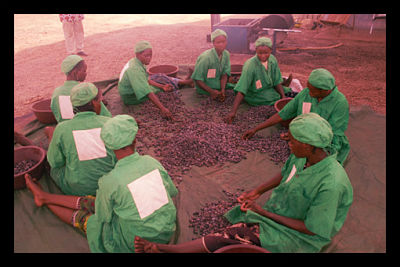
Aid for Trade is a holistic approach to incorporating developing economies into global trade networks by assisting them in increasing exports and market access. Aid for Trade was initiated at the WTO Ministerial Conference in 2005, and the program has since increased its scope to include building production capacity (financial services, businesses, and industry), trade-related infrastructure (communications, energy, transportation), and trade policy and regulations.
When the Aid for Trade initiative began, it was unclear whether it would receive funding or be successful. Now that it has been implemented for over a decade, it is time to reexamine the links between trade, development, and poverty reduction that Aid for Trade aims to strengthen.
The principle behind Aid for Trade is that increased trade should benefit inhabitants of developing countries, whether or not they are directly involved in the program. One Aid for Trade program teaches Ugandan farmers how to grow and process dried fruit to be sold into the European cereal market. The farmers involved should benefit from increased income, market access, and productivity, and Uganda should benefit from increased exports.
Most evaluations of the effectiveness of Aid for Trade programs take place within 18 months of a given program’s initiation. This is not enough time to measure whether the program has truly been successful at reducing poverty in a sustainable way. Additionally, evaluations often do not take into account a program’s impact on those not involved; how did the fruit-growing education program impact farmers who did not receive additional training and support?
A new study on European trade assistance aid, commissioned by NGOs Traidcraft and the Catholic Agency for Overseas Development, suggests that there may be “hidden losers” to Aid for Trade initiatives. For example, South African fruit growers increased exports to Europe after trade sanctions were lifted. They earned higher wages and improved their standard of living. However, the demand for cheaper fruit also caused some growers to lower wages and to replace full-time employees with temporary, often migrant workers, who did not enjoy the benefits.
The study also found that the majority of trade assistance goes to middle-income countries rather than to the least developed countries (LCDs) that Aid for Trade is directed towards. Little evidence exists to prove Aid for Trade’s effectiveness in reducing extreme poverty; this is likely a result of short-term program evaluations that take place before real impact can be measured, as well as lack of donor interest in, and therefore funding for, impact evaluations.
Overall, there are many obstacles to determining whether or not Aid for Trade has been successful thus far. More thorough, accurate, and long-term evaluations of poverty rates are necessary in order to determine the tangible successes or failures of Aid for Trade.
– Kat Henrichs
Sources: OECD, International Center for Trade and Sustainable Development, The Guardian
Photo: European Commission

Life for African Mothers Supports Neonatal Care
Almost half of all deaths in recent years in the Somaliland region of Somalia have been neonatal; that is to say that many children die in the first few days of their lives. Thankfully, organizations like Life for African Mothers are working to combat the issues of maternal health and frighteningly high infant mortality rates in many regions of Sub-Saharan Africa.
Life for African Mothers began providing medication to treat maternal health issues back in 2008 after U.K. Somalis solicited the aid on behalf of the residents of their homeland. The organization also provides crucial medication to hospitals and clinics in parts of Nigeria, Chad, Liberia, Sierra Leone, and Uganda. Once delivered to Somaliland, that medication is distributed by The Somaliland Nursing and Midwifery Association to the many clinics that receive support from the organization. Ambassadors from Life for African Mothers recently visited the region and inspected the hospital facilities that receive their aid and found that the labor and delivery areas were clean and serviceable.
The latest data available from the World Health Organization still states that the entire country of Somalia has one of the highest rates of neonatal mortality on Earth. While great aid organizations continue in their efforts to change this depressing figure, it is critical that they not be left to complete the task by themselves.
– Kevin Sullivan
Source: Wales Online, WHO
Photo: Life for African Mothers
Where are Iraqi Women Now?
The end of a ten-year war seems like a time of hope, of rebuilding and starting over. Yet, for Iraqi women, hope does not seem like it’s in the cards. The last ten years have not been a time of progress for them. Rather, it has been a time of regression, in which many of their rights have been taken away, either by law or by the increasing amount of violence occurring in Iraq.
On paper, it looks like the women of Iraq are increasingly engaged with civil society. With elections happening in April, pictures of Iraqi women of different political parties are appearing throughout the city of Baghdad, giving a glimpse of equality amongst men and women. However, in reality, women are not making much of a political appearance, though not through the fault of their own. Iraqi Prime Minister Nouri al-Maliki has not elected a female to a single Senior Cabinet position and only one Department is headed by women: The Ministry of Women’s Affairs.
Violence in the streets of Iraq is also resulting in a loss of freedom for Iraqi women. It is no longer safe for them to walk in the streets alone, leaving many stuck inside their homes. According to many women’s groups, the increase in violence and poor security for women is the result of “the social and economic pressure that families face, the lack of public and political will to stop it, and the increased religious conservatism that often justifies the violence”. The lack of political will to stop it can be seen in the replacement of the Family Statutes Law, with one giving cultural and religious groups control of regulating family affairs, meaning that tribal leaders and religious groups can decide on issues involving divorce, marriage, custody, and inheritance using religious laws or cultural ways of living. Often times, these laws and ways of living do not favor women. This is a large setback for women because it means that women are not guaranteed equal treatment under the law.
The Iraq of today is worse for women than the Iraq of 1980. Yet, this has not discouraged Iraqi women from still standing up for women’s rights and hoping for change. Political participation is one way for women to gain freedom, yet, much more must be done to ensure equality is in their future.
– Angela Hooks
Source: CNN
Photo: CNN
Millennium Consumption Goals Demand Sustainability
Currently, humanity uses natural resources 1.5 times quicker than the Earth can replenish them. Among the heavy consumers, the world’s richest 19% consume 85% of the total global output, which is 60-fold what the world’s poorest 19% consume. Although this type of consumption has a negative effect on the Earth, it has a less obvious effect on the world’s poor.
According to Professor Mohan Munasinghe, this type of over-consumption is not only too taxing on the Earth, but it also lessens the supply of natural resources to the world’s poor. The effect of this shortage is the increase of price for resources and basic products which heightens tensions among the impoverished.
By consuming sustainably, the world’s rich will both help impoverished communities and the environment. To help aid in the fight against over-consumption, Professor Munasinghe is an advocate of the Millennium Consumption Goals.
The Millennium Consumption Goals are a set of benchmarks which help reduce consumption without drastically changing the lifestyle of the world’s rich. These benchmarks were designed to be used in accompaniment with the Millennium Development Goals (MDGs) established by the UN. Since their creation, the MDGs have made a huge impact in reducing the amount of global poverty. Perhaps, with a little effort, the Millennium Consumption goals can have the same effect.
– Pete Grapentien
Source: The Irish Times
Moss: The Key to Ending World Hunger?
An Australian researcher may have fortuitously discovered a way to reduce world hunger. Professor and Geneticist John Bowman was studying the reproductive cycles of moss in pursuit of a common ancestor of all land plants. In doing so, he discovered a way for “high-yield, drought-resistant plants” to “clone themselves via their seeds” in a process called apomixis. The implications of such a discovery means cheaper and more accessible hybrid seeds for farmers in developing countries.
Since farmers would no longer have to continuously buy seeds (the seeds multiply themselves), the costs and risks (droughts, increased prices of seeds) associated with farming could diminish. This could mean more crops and less hunger and malnutrition in developing countries.
Professor John Bowman and his partner, Dr. Keiko Sakakibara, were able to achieve apomixis by removing the gene KNOX2 from moss. The doctors explain how plants take different forms in “alternating generations.” In one generation, the plant would be in diploid state, meaning that each cell has two sets of DNA (in humans, the sperm and egg), and in the next generation, it would be haploid, which is the “tiny single-cell sperm and eggs that we produce contain only the male or female DNA.” When the scientists removed KNOX2, it caused the diploid generation to become a haploid generation, thus allowing the moss to create identical seeds of the mother.
Although the process has not been mainstreamed yet, Professor Bowman is already excited about its potential to reduce world hunger. He may not have begun the experiment with the intention of ending hunger, but Bowman is eager to help as many people living in poverty and hunger as possible.
– Mary Penn
Source: The Sydney Morning Herald
Does WTO’s Aid for Trade Reduce Poverty?
Aid for Trade is a holistic approach to incorporating developing economies into global trade networks by assisting them in increasing exports and market access. Aid for Trade was initiated at the WTO Ministerial Conference in 2005, and the program has since increased its scope to include building production capacity (financial services, businesses, and industry), trade-related infrastructure (communications, energy, transportation), and trade policy and regulations.
When the Aid for Trade initiative began, it was unclear whether it would receive funding or be successful. Now that it has been implemented for over a decade, it is time to reexamine the links between trade, development, and poverty reduction that Aid for Trade aims to strengthen.
The principle behind Aid for Trade is that increased trade should benefit inhabitants of developing countries, whether or not they are directly involved in the program. One Aid for Trade program teaches Ugandan farmers how to grow and process dried fruit to be sold into the European cereal market. The farmers involved should benefit from increased income, market access, and productivity, and Uganda should benefit from increased exports.
Most evaluations of the effectiveness of Aid for Trade programs take place within 18 months of a given program’s initiation. This is not enough time to measure whether the program has truly been successful at reducing poverty in a sustainable way. Additionally, evaluations often do not take into account a program’s impact on those not involved; how did the fruit-growing education program impact farmers who did not receive additional training and support?
A new study on European trade assistance aid, commissioned by NGOs Traidcraft and the Catholic Agency for Overseas Development, suggests that there may be “hidden losers” to Aid for Trade initiatives. For example, South African fruit growers increased exports to Europe after trade sanctions were lifted. They earned higher wages and improved their standard of living. However, the demand for cheaper fruit also caused some growers to lower wages and to replace full-time employees with temporary, often migrant workers, who did not enjoy the benefits.
The study also found that the majority of trade assistance goes to middle-income countries rather than to the least developed countries (LCDs) that Aid for Trade is directed towards. Little evidence exists to prove Aid for Trade’s effectiveness in reducing extreme poverty; this is likely a result of short-term program evaluations that take place before real impact can be measured, as well as lack of donor interest in, and therefore funding for, impact evaluations.
Overall, there are many obstacles to determining whether or not Aid for Trade has been successful thus far. More thorough, accurate, and long-term evaluations of poverty rates are necessary in order to determine the tangible successes or failures of Aid for Trade.
– Kat Henrichs
Sources: OECD, International Center for Trade and Sustainable Development, The Guardian
Photo: European Commission
Congressional Support for the Global Fund
On March 21, 2013, Congress reaffirmed its support for the Global Fund by passing a continuing resolution that ensures support and funding for the Global Fund to Fight AIDs, Tuberculosis and Malaria. Even with increased tension within Congress over budget cuts and a very tight budget, Congress has shown it understands how necessary and critical the work done by the Global Fund and its affiliates is in fighting these life-threatening diseases.
The Global Fund has helped combat these diseases and improve health by focusing on development assistance. A large part of its strategy has to do with providing the funds necessary in development and implementation of new technology and interventions that have and will continue to change the trajectory of these dangerous diseases. This funding comes from a lot of different sources, yet, the United States is by far the largest donor. With the US’s aid, the Global Fund is able to finance interventions in more than 150 countries across the globe.
This means that the world is on track to halve the amount of people affected by tuberculosis by 2015 (as compared to the 1990s numbers). Elimination of malaria in many territories is occurring and will continue to occur with the help of the Global Fund. New infections of HIV are on the decline in many countries as awareness and preventive methods are becoming more and more common. With the continued support of the United States – which comes across through Congress’ support of the bill – these numbers will only improve. The number of people affected by tuberculosis will continue on a downward spiral. More and more territories will be malaria free and HIV prevention will be a bigger concern than treating HIV.
– Angela Hooks
Source: allAfrica
Photo: The Global Fund
Scientists Use iPhone Microscope to Diagnose Parasites
Consider the public health benefits of having the ability to use an electronic device the size of a mobile phone to diagnose diseases usually requiring expensive lab equipment and logistical support. Well thanks to a group of innovative scientists operating in a remote area of Tanzania, the iPhone microscope could usher in the future of a technologically driven global health policy.
Using nothing more than an iPhone, a flashlight, tape, and a camera lens; scientists were able to use their iPhone microscope to detect parasitic worms in a group of 200 students located on the Tanzanian island of Pemba. Isaac Bogoch, a Toronto-based physician remarked, “To our knowledge, this is the first time the mobile phone microscope had been used in the field to diagnose intestinal parasitic infections.”
Parasitic worms – clinically regarded as Helminth infections – affect nearly 1.5 billion people, according to the World Health Organization (WHO). By utilizing the iPhone microscope, health care workers will be able to analyze samples quickly and in close proximity to the patient, allowing for immediate parasitic identification and treatment. Thus far, the iPhone microscope diagnoses have been 70 percent accurate, and with greater zoom capabilities and higher resolution, is expected to improve in the near future.
The potential benefits of the iPhone microscope in alleviating global health outbreaks is promising due to its portability and ergonomic efficiency. By utilizing readily available technology such as the iPhone microscope to combat disease, aid workers have found an indispensable ally in the mobile phone market.
– Brian Turner
Source: CNN
WHO Claims More Funding Needed to Fight TB
March 24th will be World TB Day, a day to raise awareness of tuberculosis and the numerous TB deaths each year. As the day of awareness approaches, the World Health Organization, along with The Global Fund, have sent out a plea for more funding into medicine research and distribution.
The WHO claims that $1.3 billion is the annual funding required to effectively combat the disease. In 2011 only $0.5 billion was made available for TB research to find a cure. As TB has historically changed to become vaccine-resistant, it is critical that funding continues to come in and grows in volume. Dr. Margaret Chan, director of the World Health Organization (WHO), is worried by the shortcoming in research funding at a time when the number of medicine-resistant examples of the disease are increasing.
Along with working to increase funding to TB research, the WHO and The Global Fund are trying to make existing TB medications more easily available in the developing countries that are most often effected by the disease. They continue to work with big pharmacy companies like AstraZeneca, Johnson & Johnson, and Otsuka to lower the cost of medications for people who currently can’t afford them. They are also allying with Medicins Sans Frontieres (MSF), also known as Doctors Without Borders, to help address the many issues that surround the efficient distribution of such medicine. Learn more about the efforts of MSF.
– Kevin Sullivan
Source: PM Live
Photo: Top News
How Foreign Aid Can Eliminate Poverty
According to the Oxford University Poverty and Human Development Initiative, the poorest nations in the world may be brought out of poverty in twenty years if current rates of development continue – a sure sign that foreign aid and global relief programs are working.
Oxford released the study after the United Nations published a report documenting that poverty reduction drives were exceeding all expectations. The study also noted that this was the first time in history that poverty has been beaten back so dramatically and quickly.
This type of shining development is the effect of the investment of foreign aid and development projects in helping communities establish higher standards of living and the infrastructure to help sustain those standards of living. The UN pointed out that trade had become an important factor in improving conditions in impoverished countries such as Afghanistan, Sierra Leone, Rwanda and Ethiopia.
As Secretary of State Kerry pointed out during his first address, eleven of the top fifteen trading partners of the United States were once beneficiaries of foreign aid. If advocacy groups continue to work toward sustainable development in impoverished nations, it’s possible a few of these countries will make that list in the coming decades. Among the current countries pushing forward, Rwanda, Nepal, and Bangladesh are the countries in which poverty is declining the quickest, followed closely by Ghana, Tanzania, Cambodia and Bolivia. In the three former countries, if poverty continues to decline at this rapid rate, it is projected that the global community can eliminate poverty within the current generation’s lifetime.
– Pete Grapentien
Source: The Guardian
Sir Richard Branson Makes Pledge to Give
Sir Richard Branson and his wife, Joan, have joined a handful of billionaires who have pledged much of their wealth to charity. Branson joined Warren Buffett and Bill Gates as the latest billionaire to make such a pledge as part of The Giving Pledge, started by Microsoft founder Bill Gates.
Branson, the UK’s fourth richest person, whose net worth is estimated at $4.2 billion, declared half of his wealth to charity in an open letter in which he also said that he would like to use a majority of his wealth to “make a difference in the world” through “entrepreneurial approaches,” also saying that money and objects do not bring happiness.
The entrepreneur behind the Virgin Group of companies, Branson went on to state that he and his wife realized how little they valued material possessions after a series of disasters caused them to lose a number of personal items, including a house in London that burnt down and one in the British Virgin Islands that was struck by lightning.
Richard Branson asserted that he and his wife would like a portion of their fortune to go towards creating a “healthy, equitable and peaceful world for future generations to enjoy.” The Giving Pledge, started three years ago by Gates, has already seen a around 30 additional American billionaires pledge a good amount of their wealth to charity.
– Christina Kindlon
Photo: Time