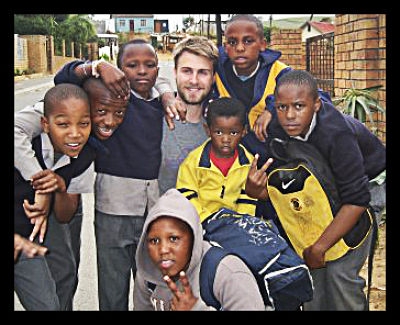
Chris O’Sullivan may not be a celebrity, but he definitely is not your average wait-for-the-employer-to-call college graduate. O’Sullivan’s Travels is much closer to Gulliver than Sullivan. Unlike Gulliver, however, he not only reaches out to the world but lets the world reach back—the world of South African students struggling with disadvantages and the world of donors given the opportunity to really make an impact and watch their money make a huge difference.
After graduating with a degree in Education from Shippensburg University, O’Sullivan traveled to the Stellenbosch region of South Africa to aid a school of 1,800 students divided amongst only 40 teachers with few supplies at their disposal. Despite the creativity, passion, perseverance, and best intentions, one teacher can only do so much with 50 students and limited resources.
O’Sullivan taught English and math to 6th grade students and experienced first hand the disadvantages these students and their teachers faced. In a world numbered one to three, first world students have pencils, pens, markers, crayons, posters, desks, charts, graphs, computers, iPhones, and 20 peers. In the second world students have pencils, pens, maps, graphs, paper, a few posters, a computer, mobile phones, and 35 peers. In the third world students have a pencil, some paper, their creativity, ambition, determination, and their teacher’s knowledge to rely on.
Two years later, 2 months from now, O’Sullivan is returning to Kayamandi to again lend his skills and experience. O’Sullivan is not returning empty-handed. He is bringing his network of support. His goals for this trip are twofold: First, he wants to give South Africa to the South Africans. Having a slim-to-none chance of ever going on vacation to a domestic or foreign destination, O’Sullivan wants to bring the beauty and wonder of South Africa to the students of Kayamandi. “Imagine living on the doorstep of Disney World and never being able to step inside.” So many of the students have never ridden in a van, slept in their own bed, eaten in a restaurant, or even seen the ocean (South Africa has 2,798 km of coastline!). His second goal is to stock the school with supplies. Pencils, paper, posters, books and magazines will go a long way towards improving the education the students receive.
The count down has begun. Two months to go. O’Sullivan has spent the last year working numerous part time jobs to pay for his trip and received support from friends, family, and a larger network.
Chris O’Sullivan is not a celebrity. Not by television standards anyway. But, ask any student in Kayamandi, South Africa, and you can bet they’ll know who he is.
– Katherine Zobre
Sources: O’Sullivan’s Travels, CIA World Factbook
Photo: O’Sullivan’s Travels

History of the World Bank: Successes
Despite the depressing news of the last part in this three-part history of the World Bank, the global lending institution has had a great number of successes that improved the livelihoods and well being of millions of people.
Immediately after establishment in 1944, the World Bank set up offices around Europe and started work. The first recipient was France. $250 million was used for reconstruction of factories, roads, and other essential economic and social infrastructure. Europe was not the only focus of the new institution. India received assistance and expertise from the World Bank in harnessing the “River of Sorrows.” Once a source of major floods, the River of Sorrows was transformed by power generator, sanitation, and irrigation projects.
In 1971, the World Bank built a worldwide network of agriculture research centers resulting in the creation of a scientific partnership and massive increases in agricultural production via technology adoption. This initiative allowed countries to better fulfill their growing populations’ nutritional needs. This decade also saw investments in renewable energy (1973, El Salvador) and the establishment of national programs for water pollution controls.
With projects like the long-standing water deal signed by India and Pakistan and the establishment of the International Development Association, the World Bank started focusing on a ‘basic-needs’ approach to development. Pursuant projects included helping subsistence farmers (1973) and eradicating River Blindness in 1974 allowing more people to participate in the development of their communities and nations.
Milestone projects include the 1984 donations for food-for-drought victims through the World Food Program for sub-Saharan African countries. Other note-worthy initiatives include stopping ozone damage (1989) and protecting forests (1991) through which the World Bank implemented the Montreal Protocols on the environment and halted all financing to commercial logging in primary tropical forests such as the Amazon. The World Bank also played a role in developing job-creating projects under Nelson Mandela in South Africa in 1991. The World Bank joined the post-conflict reconstruction team after the war in Yugoslavia in 1995. In 2000 and 2001, the World Bank declared war on HIV/AIDS and the next year started delivering vaccines through the Global Alliance for Vaccines and Immunization. 1997 marked the beginning of the Heavily Indebted Poor Countries initiative, which eventually led to the Jubilee Drop the Debt campaign to relieve poor countries of crippling debts. The next year the Freud and Corruption hotline was set up to help combat corruption associated with World Bank projects.
The World Bank took the opportunity of the turn of the century to embark on a project of groundbreaking proportions: a war on HIV/AIDS. Over these 13 years that the World Bank has been engaged in this project, AIDS drugs have dropped in cost from $10,000 per person annually to less than $100. Additionally, 1.5 million women were provided with drugs to prevent them from transferring the disease to their child. On a global scale, 50,000 grass-roots organizations in 50 countries have received funding to combat AIDS. Some of these projects resulted in huge decreases such as those in India (preventing 3 million cases), West Africa (22% decrease in 4 years) and Rwanda’s 76% increase in use of health systems.
Between 2000 and today, the World Bank has successfully undertaken projects in health, education, and financial sectors. Health projects include fighting TB, food crises responses, and recovering from natural disasters. Education projects approach it as not only a necessity for economic growth and development, but also a moral imperative and human right. 2010 marked a record high of financing education projects at $5 billion. $5 billion accomplished training for 3 million teachers and renovating/building 2 million classrooms all affecting an improved education for 105 million children.
The moral of the story: raising the living standards of the world’s poor is a multifaceted and difficult task. The World Bank has had a mixed record of getting successful results. However, their institutional framework is extremely valuable and their experience of both successes and failures is invaluable.
– Katherine Zobre
Source: World Bank
Photo: UNESCO Bangkok
Grow Africa: Agriculture First
The call to end global poverty by the year 2030 has been sounded, but the real question is, where do we focus? Grow Africa is a partnership platform that seeks to accelerate investments in Africa’s agricultural sector by bringing public and private partners together. Their goal is to increase private sector investments, enable multi-stakeholder partnerships, and expand knowledge and awareness of the most effective practices and initiatives.
Because most of Africa’s poorest people live in rural areas on small farms, the goal to increase rural productivity seems a good place to start. The acceleration and improvement of the agricultural sector would lead to a quickening of the process of urbanization. This growth would undoubtedly support economic stability and success. The increased food supply will also aid tremendously in the fight against hunger.
Grow Africa has initiatives in many African countries including Ethiopia, Ghana, Kenya, and Rwanda. These programs focus on commercial agriculture, local investments in commodities, and the strengthening of infrastructures such as irrigation canals and hydropower. Their first annual report showed over $3.5 billion in investments across the eight countries supported by Grow Africa. These investments allowed for around $300 million in sales from farmers as well as 800,000 smallholders that were reached and provided with training and sourcing.
While Grow Africa is focused on only one part of the developing world, if their reports continue to be positive and foster growth and development, other organizations and investments would very likely begin to pour into other developing regions such as Asia. In order to ensure long-term economic success, it is important to focus first on the development of agriculture. This focus will allow for a dramatic decrease in hunger-related deaths as well as an increase in economic stability, not only for farmers but for all those living in developing countries.
– Sarah Rybak
Sources: Grow Africa, The Globe and Mail
10 Facts on Global Road Safety
According to the World Health Organization’s new report titled “Global Status Report on Road Safety 2013: Supporting a Decade of Action”, approximately 1.24 million people die every year on the world’s roads. Another 20 to 50 million sustain nonfatal injuries as a result of road traffic crashes. Road traffic injuries are estimated to be the eighth leading cause of death globally with an impact similar to many communicable diseases. Current trends suggest that by 2030 road traffic accidents will become the fifth leading cause of death unless urgent action is taken. Road traffic injuries are estimated to cost low- and middle-income countries between 1–2 % of their gross national product, estimated at over US$ 100 billion a year. Hence this is a serious problem that gets in the way of poverty eradication.
The following are findings from the report about worldwide road safety:
– Maria Caluag
Source: WHO
Photo: Facebook
More than a Tourist: O’Sullivan’s Travels
Chris O’Sullivan may not be a celebrity, but he definitely is not your average wait-for-the-employer-to-call college graduate. O’Sullivan’s Travels is much closer to Gulliver than Sullivan. Unlike Gulliver, however, he not only reaches out to the world but lets the world reach back—the world of South African students struggling with disadvantages and the world of donors given the opportunity to really make an impact and watch their money make a huge difference.
After graduating with a degree in Education from Shippensburg University, O’Sullivan traveled to the Stellenbosch region of South Africa to aid a school of 1,800 students divided amongst only 40 teachers with few supplies at their disposal. Despite the creativity, passion, perseverance, and best intentions, one teacher can only do so much with 50 students and limited resources.
O’Sullivan taught English and math to 6th grade students and experienced first hand the disadvantages these students and their teachers faced. In a world numbered one to three, first world students have pencils, pens, markers, crayons, posters, desks, charts, graphs, computers, iPhones, and 20 peers. In the second world students have pencils, pens, maps, graphs, paper, a few posters, a computer, mobile phones, and 35 peers. In the third world students have a pencil, some paper, their creativity, ambition, determination, and their teacher’s knowledge to rely on.
Two years later, 2 months from now, O’Sullivan is returning to Kayamandi to again lend his skills and experience. O’Sullivan is not returning empty-handed. He is bringing his network of support. His goals for this trip are twofold: First, he wants to give South Africa to the South Africans. Having a slim-to-none chance of ever going on vacation to a domestic or foreign destination, O’Sullivan wants to bring the beauty and wonder of South Africa to the students of Kayamandi. “Imagine living on the doorstep of Disney World and never being able to step inside.” So many of the students have never ridden in a van, slept in their own bed, eaten in a restaurant, or even seen the ocean (South Africa has 2,798 km of coastline!). His second goal is to stock the school with supplies. Pencils, paper, posters, books and magazines will go a long way towards improving the education the students receive.
The count down has begun. Two months to go. O’Sullivan has spent the last year working numerous part time jobs to pay for his trip and received support from friends, family, and a larger network.
Chris O’Sullivan is not a celebrity. Not by television standards anyway. But, ask any student in Kayamandi, South Africa, and you can bet they’ll know who he is.
– Katherine Zobre
Sources: O’Sullivan’s Travels, CIA World Factbook
Photo: O’Sullivan’s Travels
Colin Brannen to Cycle for World’s Poor
Age is but a number for Colin Brannen, a 76-year old from London who plans to ride his bike from Newcastle-Upon-Tyne to London and back to raise awareness to end global hunger. The former teacher does not own a car and will take time along his route to stop and talk to people about global hunger and the IF Campaign. This campaign tackles the idea that the world makes enough food for everyone, and yet not everyone has enough food.
Brannen’s goal is to get to London to take part in the IF campaign’s rally in Hyde Park on June 8. The rally and campaign is being supported by Christian Aid and over 200 different development organizations. Brannen has been a Christian Aid organizer for over 30 years. Throughout his ride he will discuss with people what Christian Aid is doing to support the IF campaign.
According to Brannen, campaigning is increasingly important in current times. Poverty reduction is not all about raising money, although that is important, it is equally about raising awareness and inspiring action. Brannan hopes to bring change and encourage the government to be more supportive of the fight against poverty.
As an avid cyclist, Brannen has cycled to raise awareness for social and justice issues throughout his life. In 1998, he cycled to Birmingham for the G8 conference and part of the way to Cologne, Germany in 1999 for another G8 rally. In 2004, he cycled to Brighton for a trade justice event. Christian Aid is asking people to show their support for ending global hunger by attending the rally. In a world where we produce enough food for everyone, it is inexcusable that one in eight people still go hungry.
The IF campaign is calling for G8 leaders to take action at the meeting in Northern Ireland later in June and continue to fight hunger. For more details go to the Christian Aid website at www.christianaid.org.uk/if.
– Amanda Kloeppel
Source: Christian Today
Neglecting Environment Prolongs Global Poverty
The actions and decisions of humans have had negative effects on the environment and the world’s natural resources. However, research suggests not all humans deplete resources unnecessarily; the poor are often best at sustaining the environment because they recognize its direct connection to their survival. According to The Centre for Science and Environment, wealthier nations are to blame. The Centre speculates that if impoverished nations developed and consumed at the rate of the West, two more planet Earths would be needed to produce enough resources and absorb the waste.
So, if wealthy nations are consuming at an alarming rate while poorer nations excel at sustaining their environment, why is the latter suffering economically?
The answer is simple, but sad; industry frequently exploits less developed countries. They send their most environmentally unfriendly ventures to the Third World to circumvent the high cost of doing such work in the developed world. As a result, large-scale deforestation occurs to make land available for lease to international companies. Prime agricultural land is damaged by harsh pesticides and fertilizers to produce cash crops for wealthier countries and ten times the amount of water a typical Indian family should consume in one day, if they get water at all, is used for meat breeding for richer nations.
Disregarding the environment when addressing poverty leads to an incomplete solution because the two are directly related. The natural resources needed to lift people out of poverty, though sustainable, are not unlimited. Thus the environment can only sustain us for as long as we sustain it.
– Dana Johnson
Source: Global Issues
Photo: UN
Duflo Talks Social Experiments to Fight Poverty
Esther Duflo is the founder and director of the Jameel Poverty Action Lab (J-PAL), a research network that evaluates social experiments to fight poverty. It’s concerned less with wide-ranging policy than with specific questions. Esther Duflo takes economics out of the lab and into the field to discover the causes of poverty and means to eradicate it.
In Esther Duflo’s TED Talk, she brought up three specific questions people care about:
When you ask the general question of whether millions dollars of aid are good or bad for Africa’s development, no one seems to be able to produce an exact answer. No one knows and no one can do the control experiment to prove his or her point, because Africa is a singularly unique continent whose development cannot be so easily compared to other regions of the world. But when you specify that big idea into small questions, social experiments, in some areas, may answer these questions. This may not answer people’s big questions like whether or not donating to African charities is a good or bad thing, but they definitely can tell us what we should do to help make Africa a more stable and prosperous continent.
– Caiqing Jin (Kelly)
Source: TED Talk
Richard Crespin Joins USGLC
Richard Crespin has joined the U.S. Global Leadership Coalition (USGLC) as the Director of Business Outreach. He will be responsible for working as a USGLC ambassador, engaging Americans about the importance of international affairs programs in strengthening markets for U.S. goods and services. He will convey how investing abroad creates jobs in the United States and helps to keep the US secure.
USGLC is excited that Crespin has chosen to join their team. USGLC believes Crespin’s experience as a business leader with experience in corporate opportunity and corporate responsibility will mesh incredibly well with their organization’s goals and mission. Crespin provides the USGLC a unique opportunity to demonstrate how U.S. engagement abroad is good for business at home.
Crespin’s resume boasts substantial experience working in the private, public, and civil sectors. He was worked as the Executive Director of the Corporate Responsibility Officers Association. He has also worked with noteworthy companies and organizations including the American Red Cross, the Inter-American Development Bank and the Department of Defense. He attended George Washington University and Harvard Business School. Currently, he works for the U.S. Chamber of Commerce Foundation, the Editorial Board for the Sustainable Business Forum and on the Board of Directors for the Society for International Development among others.
Crespin has stressed the importance of investing in foreign economies. He has said that American presence in these markets is a, “surefire way to grow our own economy and create quality jobs across the country.” As the new Director of Business outreach, Crespin says he is excited to work with businesses to build support for new tools of development and diplomacy.
The USGLC provides an excellent platform for outreach. The USGLC is a broad-based network of 400 businesses and NGOs, national security and foreign policy experts and business, faith-based, academic and community leaders. Members support a smart power approach that elevates diplomacy along with defense, in effect building a better and safer world.
– Caitlin Zusy
Source USGLC
Photo Twitter
Smart Consumers Can Help Poor People
Coffee is the second most-traded commodity and one of the most consumed drinks around the world. The consumption of coffee is a universal business within its own, for its demand is incredibly high worldwide. Drinking coffee has become almost second nature to many who can afford it. American author and journalist, Sarah Vowell, says that she realized that drinking a mocha, although seemingly trivial, was in fact “to gulp down the entire history of the New World.” She continues on to say that the modern mocha is nothing less than a “bittersweet concoction of imperialism, genocide, invention, and consumerism served with whipped cream on top.”
Taken into consideration how big of a role coffee plays in people’s lives today, one would think that people would know where their coffee was coming from and what kind of conditions it was produced in. However, the truth is to the contrary because many people have no idea what conditions coffee producers undergo. Approximately 25 million farmers depend on coffee production/sales to make their living, and many of them live in poverty. The coffee market is prone to severe fluctuations due to changes in climate which in turn affect the growth patterns of coffee plants. Due to the longevity of the growth of coffee plants, producers cannot react quickly to changes in coffee demand. Thus, this is where smart consumers can help poor people, and in particular, coffee producers.
As smart informed consumers, people can buy certified fair trade coffee which basically means that farmers and coffee producers are paid a fair and stable price regardless of changing conditions. A recent Oxfam Australia survey reports that more than 85% of consumers want more fair trade products in their supermarkets, and 60% believe that their consumer decisions can make a difference in the lives of producers and farmers in less-developed countries. Marcial Valladolid, from CACVRA, which is a small producer organization in Peru, expressed how coffee cultivation used to disappoint him because the money he made was not remotely close to cover the cost of his coffee production. CACVRA uses its fair trade premium to “support and improve organic cultivation and certification.” By joining this cooperative, Marcel is content that he was able to receive some profit, and he is hopeful for a future with more fair trade.
It is no wonder that coffee was once described by Neil Gaiman as “sweet as sin,” taking into account all the producers and farmers horribly affected by our enjoyment of their produce. Majority of coffee producers live in developing countries including Brazil, Colombia, Vietnam, Indonesia, Ethiopia, and Mexico. Luckily, our enjoyment can come as a better price as the conditions can change because certified fair trade products are becoming increasingly available and accessible through independent grocers, major supermarkets, and retail stores. Thus, making the switch to becoming a smart consumer could not be any easier today. Make the switch today and change people’s lives.
– Leen Abdallah
Sources: AU News, Good Reads
Photo: Google, Google
Cook It, Wash It, Peel It or Forget It
As any traveler knows, after a long plane, train, and/or bus ride, all you want to do is take a shower, change your clothes, take a nap and get some grub! The last thing you want is to wind up back in bed or the bathroom with a sour stomach…or worse, the hospital. While there are several sources of health risk to travelers, the most common is contaminated food and water. Travelers trying exotic and exciting foods should follow these simple rules: cook it, wash it, peel it or forget it! And do not forget about ice. Freezing water does not remove contaminants and even alcoholic drinks are risky with contaminated ice.
There are several other sources of risk: poor sanitation and other diseases. Before you go, check out the World Health Organization (WHO) and with the Center for Disease Control (CDC) for risks at your destination. It is also extremely important to get any vaccinations recommended for your destination. The CDC has detailed documentation on requirements for each country.
Many diseases and infections are transferable between people. Sick people are also an indication that there may be a disease source near by—such as insects or poor sanitation. It is also important to be aware of how much sun/cold/oxygen you are exposed to. Too much sun exposure can lead to severe sunburns and dehydration. Sun block is expensive and not a common feature in many developing countries’ convenience stores. Observe local customs for avoiding the extreme weather and bring sunblock with you.
Most importantly for food, however, cook it, wash it, peel it or forget it.
– Katherine Zobre
Source: CNN
Photo: Lee-Reid Family Travels