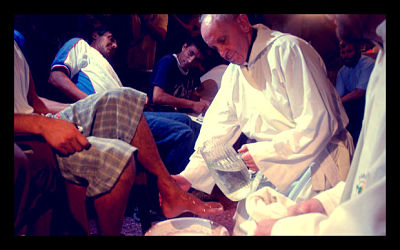
Pope Francis will deliver an encyclical this summer on the subject of climate change. In preparation for the speech, the Vatican’s Pontifical Academy of Sciences held a heavily attended workshop on April 28 in Rome. Included among the guest groups were the Committee For A Constructive Tomorrow and the Heartland Institute.
Another prominent guest, Cardinal Peter Turkson, asserted that “irrespective of the causes of climate change,” Christians are obligated to help the poor. Therein lies a complicating factor: Christians must now consider altruism without unwittingly aggravating the causes of climate change.
This brings to light a much more generalized question regarding religion’s role in the alleviation of poverty, or lack thereof. Fundamentalist Christians, for example, would read the Bible and disregard any pontifical command to pay attention to climate change.
The picture becomes even cloudier when politics are factored in. Most Evangelical Christians and Mormons are conservative Republicans who believe that the scientific evidence supporting the phenomena of climate change is inaccurate and/or falsified.
Katharine Hayhoe, a climate scientist and Evangelical Christian, attempts to bridge the gap between science and evangelical faith. She is a member of a statistical minority; according to the Yale Project on Climate Change Communication, only 44 percent of evangelicals believe that global warming is both real and the result of human behavior. Some politicians even believe that God would not let human behavior destroy the planet.
Hayhoe debunks biblical arguments such as those saying that bad things still happen even with a Judeo-Christian God in existence because that God grants free will to His people. “That’s really what climate change is,” she explains, “It’s a casualty of the decisions that we have made.”
She goes on to hypothesize that many evangelicals fear the concept of climate change for two reasons. First, they erroneously believe that all scientists are atheists. Second, their typically conservative political viewpoints biases them against any and all potential “big government” interventions.
To make matters of religion and politics even more complicated, most Jews lean politically left and are beginning to take active steps as a community to alleviate climate change. The Reconstructionist and Reform movements tend to be the most liberal, followed by the Conservative and Orthodox Jews. Generally, the more traditional the sect is in its practice of Judaism, the less environmentally active that movement tends to be.
Consequently, researchers find a startling, ironic commonality between the most observant Jews and the most observant Christians. It appears that the more conservatively a religious sect’s people practice that religion, the less likely they are to take steps to stop climate change.
Adding fuel to that fire, it is the poorest populations that suffer the most from the effects of climate change. The one demographic that both Jewish and Christian ideologies make the most efforts to help is the very group that falls on the receiving end of their most devout groups’ inaction.
So what is to be done? Should the secular American population vote in politicians who choose religious freedom over environmental activism, or vice-versa? Maybe the next election cycle will bring forth more people like Katharine Hayhoe, but then again, maybe not. Only time and ballots can tell.
– Leah Zazofsky
Sources: Slate, The Heartland Institute, Yale Climate Connections
Photo: Telegraph

Hugh Jackman Releases Video for Global Citizen
Actor Hugh Jackman, best known for his role as “Wolverine” Marvel’s X-Men series, recently released a video urging others to help end global poverty through the platform Global Citizen and through the initiative of the Global Poverty Project. “The world has the resources, the policy leaders have the ideas, the question is, do we as global citizens have the will?” asks Jackman in the new video.
This is not the first video Jackman has made regarding the issue of global poverty. In 2013, globalcitizen.org released an impactful video where Jackman explains the organization’s “Live Below the Line” fundraiser. Four thousand people took part in the fundraiser by living below the poverty line, or surviving off of two dollars a day for five days. Their efforts raised $440,000 toward ending extreme poverty. “Lines can’t help it, they separate things. But we can also be the ones who color outside those lines. We can voyage out to cross over lines for the sake of each other and for the planet,” explains Jackman.
Now, Jackman is focusing on the positive: global poverty has been cut in half in the past 20 years. Poverty now has the potential to be completely eliminated by 2030. This year is crucial as world leaders will be making important decisions regarding the future of extreme poverty. Global Citizen remarks that the year 2015 could be a “turning point.”
Global Citizen launched in 2012 and quickly gained the support of many celebrities, including rapper Jay-Z, actress Katie Holmes and singer Carrie Underwood. Every year, Global Citizen hosts a festival attended by many celebrities. In order to win the opportunity to attend, steps toward ending poverty must be taken, such as signing online petitions.
“I am thrilled to be a part of this year’s Global Citizen Festival to further the movement to end extreme poverty,” Jackman was quoted as saying at last year’s festival, which was held in Central Park. “This is a cause that has been close to my heart for many years, and I look forward to joining 60,000 Global Citizens in Central Park as we change the world for the better.”
Jackman’s dedication to the cause is admirable, and chances are this is not the last call-to-action we will see from him.
– Melissa Binns
Sources: Global Citizen, Huffington Post, People
Photo: Zimbio
Energy Poverty Affects Sub-Saharan Africa
Lack of electricity is more than just an inconvenience—it is life-threatening. Two out of every three people in sub-Saharan Africa do not have access to electricity. Sub-Saharan Africa and parts of Asia comprise 95 percent of all people without electricity. While this region hosts only 13 percent of the entire world’s population, at least 48 percent of sub-Saharan Africans make up the total population of people without electricity globally. The already at-risk economies continue to fail due to the lack of electricity affecting health and education. Thirty percent of all schools and health centers are without electricity. Without proper health and education, the chances of escaping poverty are slim to none.
“Energy plays a big role in this: from mass communications to the refrigeration of vaccines,” says Richard Bridle, an energy analyst with the International Institute for Sustainable Development’s Global Subsidies Initiative. “We don’t usually talk about how the global economy will benefit because that isn’t the key motivation, though economic growth will certainly benefit if we enhance health, education, clean water, sanitation, heating, transport, cooking add communication services.”
Some argue that putting more investment in infrastructure would fix the issue, but this notion has proven itself to be easier said than done. “Infrastructure can only be deployed and operated in a financially sustainable electricity sector that can recover costs, make investments, provide reliable electricity and meet social and environmental obligations,” explains Bridle. “So, really, it is the lack of a viable electricity sector that is the key gap.”
The funding needed to give sub-Saharan Africa electricity by 2030 is reportedly an enormous amount that affected nations would have to pay themselves. The best shot at fixing this is outside support, which is why many are eagerly waiting to hear about the 2015 version of the U.S.’s Electrify Africa Act. This bill would ensure progress on the issue.
“Energy poverty matters for the same reason that poverty matters,” Bridle says. “We have a duty to ensure that those less well-off then ourselves have access to a good standard of living and equal opportunities.”
– Melissa Binns
Sources: Fuel Fix, World Finance
Photo: United Nations Foundation
Outernet Delivers Information Equality
An estimated 60 percent of the world’s population has no Internet access. Of the people with regular Internet access, several million can only access censored information. Syed Karim, founder of Outernet, plans to change all that.
In 2012, Karim founded Outernet to bring the Internet to the remotest parts of the globe. To him, information is a human right as basic as food or water, and the Internet is the best information delivery system in history. Outernet is a datacasting company that could change the way isolated communities receive Internet. Using hardware of its own design, the company can bounce prepackaged streams of data off small satellites and onto Wi-Fi-enabled devices anywhere in the world.
Outernet’s hardware innovations come in three forms. The first is the durable 24-inch satellite dish that receives the data stream. Designed like a folding colander, the dish can expand and contract by unfolding a series of overlapping panels. It can fold down small enough to fit into a bucket, making it easy to transport. Instead of the small motor most satellite dishes use to rotate, the Outernet dish articulates on a threaded screw that makes it extra durable, especially under windy conditions. Outernet has also perfected a device called a Lantern that serves as both a data stream receiver and a portable Wi-Fi hot spot. Lanterns are about the size of water bottles and can receive almost any information on the Internet.
Perhaps the most impressive of Outernet’s accomplishments is its fleet of CubeSats, shoebox-sized satellites that bounce uni-directional data down to Earth’s surface. This past March, the U.K. Space Agency agreed to fund the fleet of CubeSats. By 2016, Outernet plans to have three of the tiny, inexpensive satellites in orbit, each delivered by piggybacking on launches for larger projects. “It costs about $100,000 per kilogram,” Karim said. “The cost of the launch is much more expensive than the satellite itself.”
The service Outernet provides is not the same as conventional Internet access. It works more like a conventional radio. The signal is one-way and generalized. As Syed Karim put it, “When you talk about the internet, you talk about two main functions: communication and information access… It’s the communication part that makes it so expensive.” Because the service is only information, not communication, it is also much harder to jam. The signal sent from Outernet’s CubeSats is almost impossible to censor.
If Outernet succeeds in its mission, basic information will become available to everyone, everywhere. Censorship will be, if not a thing of the past, then at least much more difficult to pull off. Farmers in rural India could request price predictions for the upcoming year before deciding what to plant. Schools in rural Africa could download the most up-to-date lessons and facts to learn from, and not rely on old, potentially inaccurate textbooks. Information could become as widely distributed as food or electricity, and the world could take one more step toward equality.
– Marina Middleton
Sources: World.Mic, Outernet, Gizmodo, Wired
Photo: Indie GoGo
Poverty and Crime
Crime is problematic because it counteracts the purpose of microenterprise when introduced to a poverty ridden area. Crime is considered to be a major hindrance to a country’s development according to the United Nations. Therefore, crime needs to be addressed in order to have a lasting effect on increasing any country’s well being.
One problem that impoverished individuals face is the inability to secure resources and develop extended networks to increase their potential for opportunities. One in four children are in a family that is on welfare. It affects not only macro but microeconomic levels, thus nurturing instability.
Neighborhoods have characteristics that affect their inhabitants; crime and health problems alike have been linked to these characteristics. Studies have shown that increased collaboration and shared beliefs in these areas allow for more results to counter the negative effects of poverty.
Neighborhoods with concentrated poverty isolate their residents from the resources and networks they need to reach their potential and deprive the larger community of the neighborhood’s human capital. Unemployment is a contributing factor, as is education. A correlation has been found between less education and an increase in crime. There is also a correlation between poverty, violence and drug use as poverty increases the effects of violence and increases illegal drug use.
Crime and poverty occur in geographically concentrated areas. There is a high correlation between where crime occurs and poverty stricken areas. Various crimes occur in these areas, but violent crimes occur at a much higher rate compared to more prosperous communities.
Community policing is a method that has been successful in the past, alleviating crime issues. A stabilized community provides results that demonstrate that crime can decrease in poverty stricken areas.
The areas where poverty and crime are concentrated need safe microenterprise opportunities that have the potential to be fruitful, without worry for macro and microeconomic consequences due to crime.
– Erika Wright
Sources: Hud User, Poverties.org
Photo: Flickr
The Shoe That Grows and Helps Save Lives
According to the World Health Organization, about 300,000 people are infected with parasitic worms around the world. Between 10,000 and 135,000 of them die each year due to these parasites. These deaths could have been prevented with something as simple as adequate footwear.
Many people who live in poverty do not have access to adequate shoes that fit and have no holes in the sole. This is dangerous. Sanitation in poverty-stricken areas is not reliable, and it is not uncommon for children to go barefoot almost all the time in areas where sharp objects and human waste are on the ground. Without shoes, exposure to human waste can lead to parasitic worm infestations that come with a host of side-effects, “…including abdominal pain, diarrhea, blood and protein loss, rectal prolapse, and physical and cognitive growth retardation,” according to the Centers for Disease Control and Prevention.
Kenton Lee, a designer, inventor and reverend, wants to make these illnesses a thing of the past. He has collaborated with the company, Proof of Concept, to design a simple way to keep children from contracting soil-borne illnesses. The project, launched by charity, Because International, has partnered with organizations in Ecuador, Haiti, Ghana and Kenya to bring his solution to the children who need it most.
The Shoe That Grows is an inexpensive, durable sandal that can expand up to five sizes. Made from compressed rubber, leather and common metal snaps, the shoe comes in two sizes, large and small. The small shoe lasts from kindergarten to fourth grade, and the large lasts from fourth to about ninth grade. The materials are easy to repair and replace, even in countries with few resources. Because they are also very light, it is easy to transport large shipments of the shoes wherever they need to go. A donation of 50 pairs of shoes can fit into a duffel bag and be treated as a carry-on item for an airplane flight.
While an individual pair of shoes costs about $30 to make, larger orders bring the price down to $12 or even $10 each.
The project’s website has successfully distributed hundreds of shoes through its “Fill a Duffle” campaign. For $10 a pair, a duffel bag is filled with about 50 pairs of shoes. Once full, the duffel is sent to areas in need, and donors can even choose the areas they want their donation to reach.
The shoes are sold out right now, but will be available to donate and to buy in America again come July.
– Marina Middleton
Sources: World.Mic, In Habitat, Geek.com, The Shoe That Grows
Photo: Because International
Religion’s Role in Climate Change and Poverty
Pope Francis will deliver an encyclical this summer on the subject of climate change. In preparation for the speech, the Vatican’s Pontifical Academy of Sciences held a heavily attended workshop on April 28 in Rome. Included among the guest groups were the Committee For A Constructive Tomorrow and the Heartland Institute.
Another prominent guest, Cardinal Peter Turkson, asserted that “irrespective of the causes of climate change,” Christians are obligated to help the poor. Therein lies a complicating factor: Christians must now consider altruism without unwittingly aggravating the causes of climate change.
This brings to light a much more generalized question regarding religion’s role in the alleviation of poverty, or lack thereof. Fundamentalist Christians, for example, would read the Bible and disregard any pontifical command to pay attention to climate change.
The picture becomes even cloudier when politics are factored in. Most Evangelical Christians and Mormons are conservative Republicans who believe that the scientific evidence supporting the phenomena of climate change is inaccurate and/or falsified.
Katharine Hayhoe, a climate scientist and Evangelical Christian, attempts to bridge the gap between science and evangelical faith. She is a member of a statistical minority; according to the Yale Project on Climate Change Communication, only 44 percent of evangelicals believe that global warming is both real and the result of human behavior. Some politicians even believe that God would not let human behavior destroy the planet.
Hayhoe debunks biblical arguments such as those saying that bad things still happen even with a Judeo-Christian God in existence because that God grants free will to His people. “That’s really what climate change is,” she explains, “It’s a casualty of the decisions that we have made.”
She goes on to hypothesize that many evangelicals fear the concept of climate change for two reasons. First, they erroneously believe that all scientists are atheists. Second, their typically conservative political viewpoints biases them against any and all potential “big government” interventions.
To make matters of religion and politics even more complicated, most Jews lean politically left and are beginning to take active steps as a community to alleviate climate change. The Reconstructionist and Reform movements tend to be the most liberal, followed by the Conservative and Orthodox Jews. Generally, the more traditional the sect is in its practice of Judaism, the less environmentally active that movement tends to be.
Consequently, researchers find a startling, ironic commonality between the most observant Jews and the most observant Christians. It appears that the more conservatively a religious sect’s people practice that religion, the less likely they are to take steps to stop climate change.
Adding fuel to that fire, it is the poorest populations that suffer the most from the effects of climate change. The one demographic that both Jewish and Christian ideologies make the most efforts to help is the very group that falls on the receiving end of their most devout groups’ inaction.
So what is to be done? Should the secular American population vote in politicians who choose religious freedom over environmental activism, or vice-versa? Maybe the next election cycle will bring forth more people like Katharine Hayhoe, but then again, maybe not. Only time and ballots can tell.
– Leah Zazofsky
Sources: Slate, The Heartland Institute, Yale Climate Connections
Photo: Telegraph
‘My Village, My Home’ Tool Helps with Vaccination
Small villages can be like family, and viewing their communities like houses is helping nurses save lives. One in five children worldwide are not receiving vaccinations for dangerous but preventable diseases. According to the World Health Organization, this is not up to par with the expectations that were set for the year 2015.
However, with the introduction of “My Village, My Home” to health workers, children who still need to get a vaccination can be documented. Introduced by the Maternal and Child Health Integrated Program to 28 different health centers in India in 2011, “My Village, My Home” is a tool used to keep track of the vaccinated children in the community.
Each child in the village receives a “plank” that makes up the foundation of the sketched house. The oldest children are at the bottom of the drawn home. Once a child is vaccinated, their plank is shaded in, turning the plank into a metaphorical brick. The idea is that a strong, well-built house is the safest place to live. The less shaded bricks there are, the weaker the house is. A new house can be drawn each year to document newborns.
A study conducted by USAID shows that keeping records of vaccinated children in this simple way makes a significant difference. When the concept was implemented in Deoghar and Jamatara, districts in eastern India had poor vaccination rates. Today, only a mere 1.9 percent of children remain unvaccinated. USAID is attempting to spread the word and encourage health workers to make a point of congratulating parents who make the decision to vaccinate their child.
“By using the tool, I am able to count all the [children] in my community with their immunization status on a single chart,” says Esther Das, a health worker in an Indian village called Chandradeepa. Das, who was acknowledged in 2014 at a celebration for “India’s three-year freedom from polio” as the district’s best performer, credits “My Village, My Home” for making a huge difference for the infants in her community. With any luck, word of this tool will spread to more communities and save even more lives.
– Melissa Binns
Sources: USAID, MCHIP
Photo: Usnews.com
Learning from China to Reduce Poverty
In 2000, the Millennium Development Goals were established. These eight goals focused on halving world poverty by 2015; however, that benchmark was met after five years, proving that reducing poverty is not only necessary but possible. According to The Economist, a large contributor to this decline in poverty is China who “pulled 680 million people out of misery in 1981-2010, and reduced its extreme-poverty rate from 84% in 1980 to 10% now.”
China developed a system that took many people out of poverty, and it is this system that could help other nations do the same. During the 30 years that poverty was reduced in half, China was focusing on strengthening its economy. By letting smaller businesses grow, it helped millions of people flourish in a country which had the most poverty.
But how can we learn from China and apply this to the rest of the world so that poverty can be eradicated by 2030 as the World Bank hopes to see?
The World Bank has worked closely with China in the past with the Southwest and Qinba Mountains Poverty Project. Focused on developing a more efficient way to monitor the rates and locations of poverty within the country, this system has helped China succeed in developing better agricultural practices, education and improving access to clean drinking water. Although their projects have been successful, the World Bank and China continue to work together to reach people who are still living in poor conditions.
Their partnership has implemented a Sustainable Development in Poor Countries Project. “The project will pilot new ways to provide poverty reduction assistance to the poorest communities by enabling communities to select and implement initiatives themselves,” says the World Bank. Jim Yong Kim, president of the World Bank, strongly believes that it is possible to end poverty by 2030. Learning from China and applying similar methods in South Asia and Sub-Saharan Africa, where poverty levels have risen in some areas, can help make this goal a reality.
Along with the efforts of the World Bank, the U.N. is also trying to maintain the development progress China has made. The Division for Sustainable Development, or DSD, aims to eradicate poverty as well as educate people to continue to thrive. With these new projects in place, it is possible to see poverty end in our lifetime.
– Kimberly Quitzon
Sources: The Economist, The World Bank, YaleGlobal Online
Photo: Chinadaily US Edition
Poverty in Madrid
Due to the economic crisis and government spending cuts, family incomes have fallen to the levels of 10 years ago, placing three million people in extreme poverty in Madrid. According to the national income data, 60 percent of the population is living in poverty.
In Madrid, more than one million people live on 484 euros per month. Approximately 760,000 live on only 242 euros. Overall, there are 1.3 million people who are at risk of poverty, included those who are under the poverty threshold; an estimated total of 20.3 percent of the population, many of whom are women.
Around 17 percent of the population is suffering from severe poverty; from absolute poverty, 12 percent. Rates have since increased due to this crisis.
The annual wage per family is 7,300 euros. For each adult that is a part of the family unit, half of the annual wage is included, leaving 30 percent for each child. Therefore, a family with two children is living lower than the relative poverty line if they have an annual income of 15,330 euros.
As of 2007, the number of people living in extreme poverty was over 29 percent with the average annual income being 3,650 euros. The range continues to increase and is four percent higher than in 2008. Single parent homes with one or more children are living under the poverty line and exceed 37 percent of the population. Of that number, 11.7 percent are considered to be living in extreme poverty.
As of 2012 the spending power of Spain was 18,500 euros per capita. It has decreased since 2001. There has been a steady decrease in income that primarily affects those who live among what are considered standards of impoverished living known as “relative poverty.” Almost 22 percent of, or 10 million, Spaniards live in relative poverty. This is a figure that is 2.2 percent higher since 2008.
As of 2006, the amount of resources that have been available has dropped by five percent. And since the economic collapse in 2007, the income of the bottom poor has decreased by 30 percent, while the wealthy have increased their income by 20 percent.
Equilibrium needs to be restored by refocusing on Millennium Development Goal 1, as well as preparing to implement and follow the successors of the MDGs: the Sustainable Development Goals. Based on the above numbers, it is obvious that there remains a lot of work to be done in order to reverse, and eventually eradicate, extreme poverty and hunger in Madrid.
– Erika Wright
Sources: El Pais, West-Info
Photo: Flickr
How Rwanda Reduced Its Child Mortality Rate
In 2000, the United Nations came up with the Millennium Development Goals, a list of things the world wanted to accomplish in impoverished countries by the year 2015. Rwanda in particular has been reported to have reached one of these goals: reducing child mortality by two-thirds. In 2000, when the goal was made, 90 children died before age five in every 1,000 live births. Now, the average is 46—the equivalent of 17,000 fewer deaths per day.
Rwandans can now say they have the highest average annual reduction of child mortality rates in comparison to other countries who are striving to reach the same goal. It is believed that in total, 590,000 children have been saved since the MDGs initiative was implemented. UNICEF has regarded this accomplishment as “one of the most significant achievements in human history.”
In order to see how this goal was met, BBC News spoke with public health researcher Claire Wagner, Jose Manuel Roche of Save the Children U.K., Randy Wilson of Management Science for Health and Dr. Fidele Ngabo, who is the head of the division for maternity, child and community health in Rwanda.
Dr. Ngabo believes that training and hiring more health workers played a significant role in reducing the rate of child mortality. “We had four top killers – malaria, diarrhea, pneumonia, and malnutrition – diseases which can be treated by simple intervention,” Ngabo explained. “So we selected 45,000 community health workers at each village so when the children are sick, instead of spending one or two hours going to a health facility, the community health workers can give the treatment in less than 10 minutes.”
Wilson hopes that his company’s introduction of a text-message system called “RapidSMS” also helped reduce the rate of child and maternal deaths. Doctors were trained to use the text-messaging system to communicate quickly and efficiently about their patients so that actions can be decided on immediately if needed. Reducing delays in treatment reduces preventable deaths.
Wagner, who works for Rwanda’s Minister for Health Dr. Agnes Binagwaho, credits Dr. Binagwaho for working hard to save lives.
“Fifteen years ago when Rwanda actually launched its community-based health insurance program, it gave the first health insurance to Rwanda’s poorest million inhabitants, which is a signal to the world that this is going to be a new health sector that is focused on local ownership of the country’s future. Ninety-eight percent of Rwandans are now covered,” said Wagner. “The minister will always say that ‘if you give me a penny to help my grandmother, I’ll make sure that it also works for my granddaughter.’ She ensures that all of the investments that are coming in should go to build a strong health system.”
This accomplishment is excellent news for Rwanda, and hopefully other countries will follow suit and take similar actions to reach the MDGs.
– Melissa Binns
Sources: BBC, United Nations
Photo: Flickr