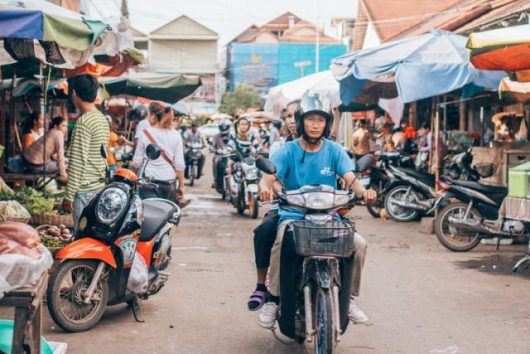
Infrastructure relies on quality, sustainability and cost to determine project investment and execution. Infrastructure in Cambodia, a nation geographically located in Southeast Asia, has drastically advanced over the last few decades, but its overall success and development still lag behind its neighbors. Not without reason, Cambodia infrastructure falls below standard as a result of its nasty civil war, consequently coinciding with the conflict in Vietnam.
A Civil War Disruption
In the 1960s and 1970s, Cambodia was rife with disturbance and disorder. Not only had civil war erupted, but the nation also lurched into the conflict in Vietnam. A small country, the wrath of the communist organization Khmer Rouge effortlessly spread like wildfire. Additionally, civil war wreaked havoc at all ends of Cambodia.
Neighbors to the Vietnam War, Cambodia experienced upwards of 700,000 Cambodian deaths in the American effort to protect themselves from Vietnam.
By 1975, Khmer Rouge took reign in Cambodia, which was headed by a communist by the name of Pol Pot. Believing intellectuals would threaten the communist nation he envisioned, all hospitals, colleges and factories were shut down, and all lawyers, doctors and teachers were either killed or forcibly evacuated from their country.
The freedoms and rights of remaining laborers were rendered nonexistent for the mere fact that the individual intellectual’s aptitude to question authority and create rebellion could pose threat. A paranoid Pol Pot used genocide and exodus to abolish any and all uncertainty.
Existing Infrastructure in Cambodia
There is a limited train network in modern day Cambodia. Railways connecting the rural to the urban, as well as Cambodia to its neighbors, are absent. The country boasts 22,227 miles of highways, of which only 11.6 percent are paved. Moreover, much of the population, especially in rural areas, have no access to electricity, and Internet access in Cambodia is extremely expensive relative to local income levels.
On a brighter note, the network of roads in Cambodia is improving as the country is in the midst of hyper-focusing on road construction. The goal remains to connect the outside with the in, the rural with the urban.
Currently, stretches of road outside the capital city of Phnom Penh are being financed by both the national government and foreign aid. Yet, the quality and sustainability of projects get called into question when external aid is involved. For instance, maintenance of such infrastructure is challenging with limited resources, ultimately leading to deterioration after just a couple of years.
Japan and China Chime In
In efforts to uplift Asian neighbors, Japan and China seem to be some of Cambodia’s largest and most involved foreign aid donors and contributors. Leaders amongst these nations seemingly agree on an advanced push for “quality infrastructure” investment in Asia.
Recently, Japanese Prime Minister Shinzo Abe announced a $110 billion injection into Asian infrastructure funding over five years. However, according to VOA News, “in order for Cambodia to retain its growth momentum, which over the past decade has seen the economy grow at an average of 7 percent annually, infrastructure investment will need to be somewhere between $12 billion and $16 billion between 2013 and 2022.”
Even if infrastructure development simply begins at road construction, representatives at the Japan International Cooperation Agency (JICA) in Cambodia state that such an improvement will link Cambodia to its neighboring countries, ultimately advancing trade and boosting foreign investment.
In terms of China, they provide an even more immediate fix for infrastructure than can Japan, but the quality is often called into question.
According to VOA News, director of the Center for Policy Studies in Cambodia, Chan Sophal, states that some donors “require a long procedure before we can get a loan and develop the infrastructure, so maybe there is a time/cost [decision] in there. But for other donors, like China, we get the funds quickly and can do it quickly, but there could be an issue with cost and quality.”
Australia, too?
Yes, Australia’s investments in infrastructure in Cambodia are committed to constructing, improving and maintaining rural roads as well as infrastructure damaged in recent natural disasters.
Australia has set precedent to infrastructure projects. Its vision for 2015-2020 includes $45.4 million and collaboration with companies to help connect households and families to resources, services, amenities and utilities.
Its vision for 2014-2020 includes $22.6 million and the Rural Roads Improvement Project Phase II. Co-financed by the Asian Development Bank, the Cambodian government, Korea, France, the Nordic Development Fund and the Strategic Climate Fund, this lofty project will guarantee rehabilitated roads to be climate-resilient and provide 365-day access to schools, hospitals and markets.
Nationwide Improvements
Not only will improved roads increase commuter mobility, but the enhanced quality is predicted to reduce the crash rate by 20 percent. Moreover, labor for improving such infrastructure in Cambodia promises to allocate at least 20 percent of unskilled jobs to women.
According to The Cambodia Daily, secretary-general for the Council for the Development of Cambodia, Sok Chenda, believes that Cambodia does not simply “want growth around Phnom Penh, Siem Reap and Sihanoukville…We need to improve rural infrastructure too to create balanced development.”
Such a perspective is both necessary and promising, and the world waits with bated breath to see how Cambodia continues to improve.
– Mary Grace Miller
Photo: Unsplash

7 Things to Know about Girls’ Education in Georgia
Twenty-three years ago, Georgia committed itself to the goal of removing all discrimination against women. This pledge occurred at the Fourth World Conference on Women in 1995, where the involved nations signed an international convention that called on each country to create an action plan.
While social norms continue to reinforce a gender divide that undermines girls’ education in Georgia, a lot has changed since the momentous convention. Here are seven things to know about girls’ education in Georgia.
7 Important Facts About Girls’ Education in Georgia
Increased Opportunities
With more national awareness and international assistance, Georgia has worked to promote educational opportunities for girls. Laws like the ban on early marriages help keep girls in school for longer and further their career goals.
– Mark Blekherman
Photo: Flickr
Girls’ Education in Uzbekistan
Uzbekistan’s developmental capacity is, to some extent, contingent on the inclusion of young girls and women in the formal education system. Though work is being done to improve girls’ education in Uzbekistan, there is still a long way to go. Access to early education for girls is scarce in Uzbekistan. The U.N. uses a mechanism called gross enrollment ratio (GER) to analyze the education levels of its member states.
Pre-primary Education
Pre-primary school enrollment ratios for girls (ages 3-6) have been around 26.5 percent in the last 10 years. While pre-primary education may seem to be an inconsequential aspect of education for young girls, a study from the World Bank linking preschool attendance to employment outcomes in Uzbekistan shows that it is rather important to girls’ futures.
The Government of Uzbekistan and The Global Partnership for Education (GPE) have both recognized the need to improve pre-primary education. With financial support from the GPE, The Ministry of Preschool Education plans to expand early childhood care and education, with the ultimate goal of achieving 100 percent enrollment by 2021.
Education and the Role of Women
The foundational laws and reforms in Uzbekistan have created an education system that is compulsory for primary school (ages 7-10) and secondary school (ages 11-18) boys and girls. However, practice school attendance, particularly for girls, has not been universal due to socio-cultural and socio-economic barriers. In recent years, the government has worked to remove those barriers and integrate underserved populations into the education system; a majority of those populations includes girls.
Between 2008 and 2017, the GER for girls’ primary education increased from 92.6 percent to 102.28 percent, remaining relatively equal with that of male students during the same time period. In 2017, the enrollment ratio for females in secondary school was 92.42 percent, lower but still relatively equal to their male counterparts.
Girls’ education in Uzbekistan is lacking most at the tertiary, or university level. The GER for females in tertiary schools (ages 19-23) is just 6.33 percent. However, this meager statistic is not a reflection of young women’s unwillingness to pursue higher education or a satisfaction with the status quo. It is, rather, a reflection of a lack of funding, high tuition costs and an outdated societal expectation that young women take on traditional, household roles after secondary school.
The Future of Girls’ Education
Changing the landscape of girls’ education in Uzbekistan requires structured and integrated reforms at every level. Extracurricular activities are another tool that can be used to expand and strengthen girls’ education in Uzbekistan. Encouraging girls to explore activities and career paths seldom held in the past can have an empowering effect. This was exemplified in early 2017 when the UNDP held a “technovation challenge,” in which hundreds of young female programmers collaborated to tackle social issues, including education, using their programming and innovative skills.
“The idea that ‘it is too hard for girls and women’ is as outdated as it is offensive, and yet we still hear it,” according to the event’s press release. At the end of the challenge, the girls in attendance were able to meet and hear from the Uzbek women that make up a small portion of the tech workforce now. In terms of cultural change, events like the technovation challenge are some of the most impactful as they dispel the notion that investing in these girls’ education is unnecessary. It puts on display the untapped potential within the Uzbek female population and changes the perceptions of those who still hold “outdated” understandings of the role of women in society.
The UNDP and the Women’s Committee of Uzbekistan have also put their monetary resources to use in order to provide grants to female university students. Monetary investment will prove to be a vital part of expanding girls’ education in Uzbekistan given the high tuition costs. This, alongside the structural and cultural changes being implemented, can break down barriers to girls’ education in Uzbekistan in the short-run and the long-run, expanding the potential paths of all women in Uzbekistan.
– Julius Long
Photo: Flickr
Uncovering 10 Facts About Hunger in Cuba
The Republic of Cuba is home to nearly 11.5 million people and has lasted through a communist regime for more than 50 years. U.S. sanctions were designed to dislodge the leader, Fidel Castro, and his regime; surprisingly, the island of Cuba has survived long after the collapse of its biggest supporter, the Soviet Union.
During the last 50 years, the government of Cuba has worked to eliminate poverty and hunger; however, many analysts argue that the economic system envisioned by Fidel Castro has not lived up to its plans. The Revolution was centered around the idea of eliminating a class structure, yet, the country has been left poor.
Nevertheless, the government of Cuba has continued its support of Castro’s ideology and is now working to eradicate issues such as hunger. To learn more about the country’s shortcomings and successes, here are the top 10 facts about hunger in Cuba.
Facts About Hunger in Cuba
Independence and Eliminating Hunger
Currently, the small island of Cuba imports 60-80 percent of its food. State officials are encouraging the continuation of cooperative farming to avoid dependency on other nations. Additionally, urban farming started in the 1990s and is regarded by the government as an acceptable mean to supplement the monthly rations.
The island of Cuba is working very hard to eliminate hunger. These top ten facts about hunger in Cuba demonstrate both the areas in which the goals of the regime have fallen short, as well as the successes of Castro’s vision.
– Stefanie Babb
Photo: Unsplash
Leaves of Green? Environmental Degradation and Poverty
At a historic United Nations Summit in New York in September 2015, countries from all over the world adopted the 2030 Agenda for Sustainable Development. This agenda aims to end poverty and inequality while protecting the environment and ensuring sustainable development. To do this, the agenda established 17 Sustainable Development Goals (SDGs) to be accomplished by 2030. These SDGs emphasize the relationship between environmental degradation and poverty and how sustainable development is critical to achieving these goals.
Sustainable Solutions
Sustainable development is defined by the U.N. as “development that meets the needs of the present without compromising the ability of future generations to meet their own needs.” Such a practice involves using natural resources in a way that will leave future generations with a healthy planet and enough resources for survival.
Earth has only a limited amount of natural resources, and how people and countries currently use these are unsustainable. Current consumption patterns and national policies of developed and developing nations alike are severely damaging the environment and jeopardizing the future of the planet.
Inefficient use of resources, wasteful consumption, pollution and waste are all key factors in environmental degradation. These practices also contribute to global poverty; poverty, in turn, then damages the environment. This vicious cycle will not end unless countries and individuals change their practices.
How Countries and People Harm the Environment
Natural resources are currently allocated to meet the wants of the few instead of the needs of the many. Developed countries account for 24 percent of Earth’s population but consume 70 percent of the world’s energy and 60 percent of its food.
Though developed nations are more energy-efficient than developing nations, consumption is so high that they still contribute a great amount to pollution. The extremely high demand of these countries leads to extensive deforestation so more land can be used for agriculture.
Developing nations further contribute to environmental degradation through inefficient energy use and environmentally-harmful practices like resource stripping. Countries resort to these harmful practices for a variety of reasons. Natural resources account for a majority of many developing countries’ exports. In an attempt to grow their economies, countries overexploit these natural resources.
In addition, a large part of many developing countries’ budgets is used to repay their debt, leaving little money to fund sustainable development programs. Many nations “believe they cannot afford the luxury of environmental protection” and feel forced to accept long-term environmental damage to meet their immediate needs.
Many poorer individuals in developing countries feel the same. They depend on natural resources for their livelihoods, which leads many to deplete these resources in order to survive.
How Harming the Environment Harms People
This environmental degradation disproportionately affects the poor, particularly those in developing nations. Overconsumption in wealthy countries means many people in poor countries don’t have enough food. One billion people worldwide are hungry, yet 1.2 billion are obese.
Air and water pollution are health hazards. Lack of clean water and air and poor sanitation and nutrition leaves people vulnerable to diseases and causes extremely high rates of death among children.
Poor people are also more susceptible to natural disasters, as they are more likely than wealthier individuals to live in areas where earthquakes, hurricanes, floods, fires and other disasters are common. These disasters destroy people’s livelihoods and homes, often forcing people to move to other areas. These environmental refugees can cause overcrowding and environmental stress in the areas they move to, which worsens both environmental degradation and poverty.
Unless people and countries change their practices, both environmental degradation and poverty will worsen. Natural disasters are becoming both more extreme and more common because of industrialization and human actions. As the world population continues to grow, more and more people will be hungry, live in overcrowded conditions and ultimately, live in poverty. Promoting sustainable development is crucial to a better future.
How to Change
Governments, businesses, organizations and individuals: all have a role to play in the effort to protect the environment and end poverty.
Wealthy nations must change their policies that are detrimental to the environment. Expressing support for the U.N.’s Sustainable Development Goals and implementing policies that align with these goals provides an example for other nations and encourages them to behave the same.
Foreign aid to developing countries can stabilize their economies, make them more financially and technically capable of focusing on environmentally-friendly development and help them establish practices that are consistent with the SDGs.
Accountability and Responsibility
Governments should also encourage individuals to take more responsibility for living sustainably and educate people on how to do so: eat less meat, shop locally, reduce food waste, use less plastic, recycle, switch to alternative forms of energy — the list goes on and on. (See here for more ways you can live sustainably). Businesses can do many of these actions as well as change their practices to be more environmentally-friendly.
“Saving our planet, lifting people out of poverty, advancing economic growth… these are one and the same fight” said Ban Ki-moon, the previous U.N. Secretary-General. “Solutions to one problem must be solutions for all.” Environmental degradation and poverty are directly related; to end one, the world must address both.
– Laura Turner
Photo: Flickr
Reducing Food Insecurity in Haiti: Oxfam Livelihoods
Since 2011, Oxfam Livelihoods Program has been influential in Haiti’s Artibonite Valley, working with rice farmers in the region. Due to extreme food insecurity, a vast majority of families in Haiti rely on local agriculture for survival. Oxfam’s Haiti Livelihoods Program aims to increase rice production, improve production techniques, empower local farmers and decrease food insecurity in this small country.
The poverty rate in Haiti falls just below 60 percent, with 24 percent of Haitians living on less than $1.23 per day. Only 6 percent of the Artibonite Valley’s inhabitants are unaffected by hunger, and 43 percent are extremely food insecure.
The Program
This is in large part due to the natural disasters that plague the country. Within the last ten years, Haiti has experienced hurricanes, floods, droughts and an earthquake, ranking fifth among countries most likely to have a natural disaster. Approximately 98 percent of the nation is at risk to experience one or more of these disasters, as well as epidemics. A lack of sanitation and health services increases the risk of fecal waterborne diseases, including cholera.
Oxfam began its Artibonite Valley Livelihoods Program in 2011 following the earthquake that struck the country the year before. Up to 80 percent of the nation’s rice is produced in this valley, making its success and growth crucial to reducing food insecurity in Haiti. Additionally, food production, processing and marketing are essential components of Haiti’s economy, employing more than 70 percent of the population. Oxfam states that they are helping Artibonite’s residents to “overcome barriers and realize the potential of the valley.”
The program relies on partnerships with local organizations, including government agencies, NGOs and microfinance institutions. Oxfam has been working with the Ministry of Agriculture to ensure that program accomplishments have long-lasting effects.
On a local level, Oxfam works with local farmers groups, women’s associations, water users organizations and training centers. The process of improving systems of agricultural production, processing and marketing includes upgrading irrigation and drainage canals to decrease flooding, training youth in the mechanical skills needed for agriculture, helping farmers expand and diversify their sources of income, improving access to agricultural credit and promoting the System of Rice Intensification (SRI).
The System of Rice Intensification
The SRI is a critical component of improving farming systems around the world, enabling farmers to produce more food in a way that is cost-effective and sustainable, using less water, seeds, fertilizer and labor. This increase in production helps meet local food needs, helping to reduce food insecurity in Haiti. SRI also decreases pollution and the negative effects agriculture can have on the environment. Farmers in Madagascar, Vietnam, Cambodia, India and Mali have adopted SRI methods.
Recommended SRI practices include spacing rice seedlings farther apart and transplanting them when they are young to reduce crowding and strengthen root systems, using integrated pest management instead of herbicides, applying water intermittently rather than continuously, using organic matter to enrich the soil, aerating the topsoil and removing weeds with manual weeders.
As SRI requires no additional machinery and farmers can easily make site-specific adaptations that will meet their needs, SRI is affordable for small-scale farmers, in addition to being environmentally friendly and aiding in the reduction of food insecurity. An evaluation of the Livelihoods Program from 2011 to 2014 found that SRI had succeeded in more than doubling rice production in some farms.
Program’s other methods
The Artibonite Valley Livelihoods Program also employs other methods for transforming Haiti’s environment and improving conditions for its inhabitants. Oxfam has been facilitating networking across geographic areas to improve cross-learning and coordinating, improving the technical, business and administrating capacities of community organizations, raising awareness among Haitian consumers on the importance of local production and supporting the newly developed National Federation of Haitian Rice Producers.
Oxfam also addresses gender inequality in Haitian agriculture by ensuring women are participating in all activities and by holding workshops on gender issues, advocacy and campaigning. In 2014, the program was found to have improved women’s roles in the public and economic spheres and increased their decision-making within their households.
Possible improvements of the Program
The 2014 evaluation of the Livelihoods Program did, however, note a few areas in need of improvement. First, the program did not help increase the competitiveness of the goods produced, causing farmers to have continuing difficulties selling their products. The program also did not provide solutions for access to fertilizers, seeds and irrigated water.
Recommendations for program improvement include ensuring all projects are locally-appropriate, increasing the adoption of SRI by working with the Ministry of Agriculture and distributing data on SRI techniques, creating a reliable system to monitor crop yield and looking for more efficient and affordable farming equipment.
Overall, Oxfam’s Artibonite Valley Livelihoods Program has made great strides in improving rice production and continues to be an integral part of decreasing food insecurity in Haiti and improving the overall livelihoods of its residents.
– Sara Olk
Photo: Flickr
Understanding the Economics of US-Mexico Immigration
Recently, immigration has been at the forefront of political controversy given its potential for economic impact on both nations. The underlying economics of U.S.-Mexico immigration offers a glimpse into the roots of the issue and how it is being addressed today.
Escaping Drug Activity
Currently, a great deal of the migrants come from economically and politically troubled states where a great deal of blame is directed at drug organizations battled by federal governments. The poorer states tend to have a disproportionate amount of drug-related activity, which can bottleneck growth to the drug-elite in the states.
Take, for example, Michoacán. The state is a leader in the most migrants sent to the United States and has also been noted as one of United States’ five states to avoid when traveling in Mexico. While the state is 15th in GDP, it accounts for 57 percent of Mexico’s ‘very poor’ population.
Seeking Economic Stability
Drug activity, however, is only a part of the problem. While job prospects are available, the pay rate is very low. Unemployment sits around the three percent mark, but the minimum wage rate is just below five dollars. The high opportunity cost of those working in cartels serves as a major factor in why many may join. For others, crossing the borders to the north is a better option.
Of the 50 states, California receives the most of the legal and illegal immigration from Mexico (37 percent). Consequently, the state and private organizations have taken significant measures to try and remedy underlying economic stressors and ensure smooth transitions for immigrants in the U.S.
Decrease in Emigration
Over the years, factors in the economics of U.S.-Mexico immigration have shifted. Although there is increased media coverage, emigration from Mexico has actually decreased. Since 2008, the number dropped from 6.4 per 1000 residents to 3.3 and has continued to fluctuate around the number.
Part of the reason is that conditions in the United States, while better, are not easy to access. Stanford scholars at the university’s Immigration Policy Lab found that a high cost of naturalization actually prevents low-income immigrants from becoming citizens. The fee to apply for citizenship in the United States is $725, a steep price for numerous immigrants.
Outside Aid
To address the economic issues in Mexico, Mexican organizations such as ProMéxico have tried to change the image globally by attracting foreign investment. At the core of its goals is the belief of “obeying the principle of the common good and contributing to sustainable development.” As the organization develops over the next few years, it hopes to expand its reach and deepen its impact.
Similarly, American initiatives have followed suit. LatinSF is a public-private partnership between the San Francisco Office of Economic and Workforce Development and the San Francisco Center for Economic Development that works to “promote business and trade between San Francisco and the Latin American region.”
Starting a formal connection between San Francisco and the Latin American region is key for mutual development. This effort helps individuals working in Mexico and provides an opportunity for immigrants arriving in the United States.
Academic and Technological Influence
Once immigrants are in the United States and settle in states like California, local universities pitch in. UC Berkeley and Stanford University each have their own Immigration Law Clinics which offer “law assistance to economically disadvantaged immigrants.”
The clinics help prep immigrants, regardless of immigration status, with interviewing, document filing and other legal matters. Private organizations such as the ACLU and Immigrant Legal Resource Center have contributed in the same way as well.
The issue is not just being addressed by the legal field. Studies conducted at UC Berkeley have led to new developments such as an app that recognizes immigrant concentrations and government funds that are not being allocated to the correct locations.
By correcting spatial differences, Jasmin Slootjes, executive director of the Interdisciplinary Migration Initiative, notes that the initiative is “providing local officials with the facts about immigrant communities and their service needs.”
Unweaving the Complex Economics of U.S.-Mexico Immigration
The immigration issue is undoubtedly complex. It is important to remember, however, that the underlying economic factors are the first steps to resolving the issue.
Addressing the problem will require the continued effort of both proactive organizations like ProMéxico and universities that help immigrants acclimate to a new world, and such combined efforts should make a world of impact.
– Mrinal Singh
Photo: Flickr
Hopeful Future of Decreasing Child Labor in Mexico
Mexico has a population of 116 million, and half of the population lives below the poverty line. These impoverished conditions make the people of Mexico desperate for work, including young children, and such a struggle creates a significant amount of child labor in Mexico.
Child Labor and Exploitation
Children are exploited on a daily basis in Mexico and are put in danger doing their jobs. In an interview with Aljazeera, a 16-year-old boy named Albino, who has been out of school since he was 12, stated: “You just devote yourself to your work and you’re proud that you no longer play with small children.”
Albino says he only gets to see his family every 20 days and he gives them half of all the money he makes. He does regret leaving school, but he is glad he can help his parents with money.
Albino’s story is not unusual; actually, his tale is very typical for child laborers in Mexico. Young children often have to provide for themselves or help provide for their families, which causes many of them to go into dangerous work for very low pay. About 3.5 million children in Mexico work carrying wood or cement, or as servants.
Typical Child Laborer Jobs and Risks
It’s estimated that of the children that work in Mexico, 40 percent are not old enough to work legally and 60 percent are working in conditions considered dangerous to their mental and physical health, and safety.
These children are working jobs in fields, on the streets, in dangerous factories and around many other unsafe places with horrible working conditions. Children go up and down the streets just to sell various objects to anyone willing to buy, and such a sale will barely provide food for that specific day in Mexico. Children working in the fields work sunrise to sunset (or even longer), and 1 out of 4 workers is 13 years old or younger.
Influential Allies
The government has tried to help combat the issue of child labor in Mexico. In 1997, a program called Prospera started and it offers “conditional cash transfers” to Mexican citizens. This stipend is supposed to be an incentive for Mexican families to keep their children in formal education while attending workshops on things like sex education and family planning.
Another program that offers “conditional cash transfers” is a program called Oportunidades. Much like ‘Prospera,’ participating families will get money from the government provided that the children stay in school, all family members get regular medical check-ups and mothers attend health workshops.
Although child labor in Mexico is prevalent, it has dramatically decreased over the past decade. This can be attributed to parents having a better education and to government programs like Prospera and Oportunidades intervening in difficult situations.
Improvement on the Rise
There are 40 percent fewer children aged 12-14 years in the labor force compared to just ten years ago, and there’s also been a dramatic increase in the number of children remaining in school. In addition, 93 percent of children from 12-14 years old are attending school.
These numbers will continue to grow if new generations continue to acquire an education, allies provide needed support and Mexican citizens do not enter the workforce at such young ages.
– Ronni Winter
Photo: Flickr
Infrastructure in Cambodia: Building the Future
Infrastructure relies on quality, sustainability and cost to determine project investment and execution. Infrastructure in Cambodia, a nation geographically located in Southeast Asia, has drastically advanced over the last few decades, but its overall success and development still lag behind its neighbors. Not without reason, Cambodia infrastructure falls below standard as a result of its nasty civil war, consequently coinciding with the conflict in Vietnam.
A Civil War Disruption
In the 1960s and 1970s, Cambodia was rife with disturbance and disorder. Not only had civil war erupted, but the nation also lurched into the conflict in Vietnam. A small country, the wrath of the communist organization Khmer Rouge effortlessly spread like wildfire. Additionally, civil war wreaked havoc at all ends of Cambodia.
Neighbors to the Vietnam War, Cambodia experienced upwards of 700,000 Cambodian deaths in the American effort to protect themselves from Vietnam.
By 1975, Khmer Rouge took reign in Cambodia, which was headed by a communist by the name of Pol Pot. Believing intellectuals would threaten the communist nation he envisioned, all hospitals, colleges and factories were shut down, and all lawyers, doctors and teachers were either killed or forcibly evacuated from their country.
The freedoms and rights of remaining laborers were rendered nonexistent for the mere fact that the individual intellectual’s aptitude to question authority and create rebellion could pose threat. A paranoid Pol Pot used genocide and exodus to abolish any and all uncertainty.
Existing Infrastructure in Cambodia
There is a limited train network in modern day Cambodia. Railways connecting the rural to the urban, as well as Cambodia to its neighbors, are absent. The country boasts 22,227 miles of highways, of which only 11.6 percent are paved. Moreover, much of the population, especially in rural areas, have no access to electricity, and Internet access in Cambodia is extremely expensive relative to local income levels.
On a brighter note, the network of roads in Cambodia is improving as the country is in the midst of hyper-focusing on road construction. The goal remains to connect the outside with the in, the rural with the urban.
Currently, stretches of road outside the capital city of Phnom Penh are being financed by both the national government and foreign aid. Yet, the quality and sustainability of projects get called into question when external aid is involved. For instance, maintenance of such infrastructure is challenging with limited resources, ultimately leading to deterioration after just a couple of years.
Japan and China Chime In
In efforts to uplift Asian neighbors, Japan and China seem to be some of Cambodia’s largest and most involved foreign aid donors and contributors. Leaders amongst these nations seemingly agree on an advanced push for “quality infrastructure” investment in Asia.
Recently, Japanese Prime Minister Shinzo Abe announced a $110 billion injection into Asian infrastructure funding over five years. However, according to VOA News, “in order for Cambodia to retain its growth momentum, which over the past decade has seen the economy grow at an average of 7 percent annually, infrastructure investment will need to be somewhere between $12 billion and $16 billion between 2013 and 2022.”
Even if infrastructure development simply begins at road construction, representatives at the Japan International Cooperation Agency (JICA) in Cambodia state that such an improvement will link Cambodia to its neighboring countries, ultimately advancing trade and boosting foreign investment.
In terms of China, they provide an even more immediate fix for infrastructure than can Japan, but the quality is often called into question.
According to VOA News, director of the Center for Policy Studies in Cambodia, Chan Sophal, states that some donors “require a long procedure before we can get a loan and develop the infrastructure, so maybe there is a time/cost [decision] in there. But for other donors, like China, we get the funds quickly and can do it quickly, but there could be an issue with cost and quality.”
Australia, too?
Yes, Australia’s investments in infrastructure in Cambodia are committed to constructing, improving and maintaining rural roads as well as infrastructure damaged in recent natural disasters.
Australia has set precedent to infrastructure projects. Its vision for 2015-2020 includes $45.4 million and collaboration with companies to help connect households and families to resources, services, amenities and utilities.
Its vision for 2014-2020 includes $22.6 million and the Rural Roads Improvement Project Phase II. Co-financed by the Asian Development Bank, the Cambodian government, Korea, France, the Nordic Development Fund and the Strategic Climate Fund, this lofty project will guarantee rehabilitated roads to be climate-resilient and provide 365-day access to schools, hospitals and markets.
Nationwide Improvements
Not only will improved roads increase commuter mobility, but the enhanced quality is predicted to reduce the crash rate by 20 percent. Moreover, labor for improving such infrastructure in Cambodia promises to allocate at least 20 percent of unskilled jobs to women.
According to The Cambodia Daily, secretary-general for the Council for the Development of Cambodia, Sok Chenda, believes that Cambodia does not simply “want growth around Phnom Penh, Siem Reap and Sihanoukville…We need to improve rural infrastructure too to create balanced development.”
Such a perspective is both necessary and promising, and the world waits with bated breath to see how Cambodia continues to improve.
– Mary Grace Miller
Photo: Unsplash
Combating Ignorance: 10 Facts About Poverty in Vietnam
In terms of poverty reduction, Vietnam has seen leaps and bounds in the last two decades. Ever since it opened up its markets to international businesses in the mid-1980s, its GDP has grown rapidly from about 2 percent to an average of 6 percent over the last twenty years. Significant economic and political reforms in 1986 by then-leader-Đổi Mới made this possible. As Hanoi continues to improve the country’s living standards, here are the top 10 facts about poverty in Vietnam of note.
Top 10 Facts About Poverty in Vietnam
Historic Improvement
These top 10 facts about poverty in Vietnam showcase a historic improvement in the quality of life for its poor. Despite lagging public confidence in the government, Vietnam can expect a bright future for its economy if it maintains its rapid growth and becomes more responsive to the needs of its citizens.
– Alex Qi
Photo: Flickr
Historically Impactful Facts about Poverty in Sierra Leone
Poverty has held a tight grip on Sierra Leone for as long as most people can remember. Sierra Leone remains one of the least developed low-income countries in the world. With a population of around six million people, the level of poverty is vast. The poverty status is well-known, although not many people know its extent or how it became this way. To clarify, here are the top 10 facts about poverty in Sierra Leone.
Key Facts About Poverty in Sierra Leone
Projected Progress
Sierra Leone, while being underdeveloped, is still a very young country. There is progress each year that will only continue from here. Many foreign aid agencies are invested in the progression of poverty alleviation in Sierra Leone and wish to assure peace and security.
– Samantha Harward
Photo: Flickr