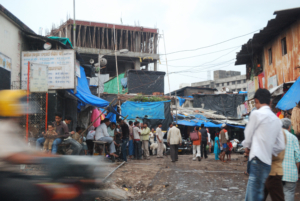
Mumbai, India plays an integral role in improving living conditions in Dharavi. Being a port city, Mumbai is the commercial capital of India, having operations in the manufacturing and finance sectors. Mumbai is also home to many Bollywood films. The population of Mumbai estimates over 20 million residents. The reason for this increase is because of the squatter settlements. One major squatter settlement is Dharavi, which is home to 1 million people. Dharavi is located between two railway lines on a low-lying land once a garbage dump. A highway that divides the formal city from the informal city determines which areas are slums and which areas are not. A slum is a term that people use to identify unauthorized and illegal residents. Slums often lack basic amenities, including safety measures.
The Characteristics of Squatter Settlements
- Noisy, overcrowded and smelly.
- Cardboard houses.
- Lack of proper sanitation.
- Increase of population and disease.
- Strong sense of community.
Despite the stigma of slums, Mumbai is home to well educated, middle-class people who simply do not have adequate housing. Mumbai has been its own micro-industry. For example, it is most prosperous in the making of pottery.
Facts About Mumbai
The world’s population is 7.3 billion since 2011 and the highest growth is in low-income developing countries. Today, 50 percent of the world’s population lives in urban areas. Urban growth, also called rapid urbanization, is often located in low-income developing countries, as well as emerging and developing countries. The cause of urban growth can be due to natural diseases and migration. Moreover, the job prospects are low and crime and pollution levels rise when the population increases.
The population of Mumbai continues to increase in thousands each year. Some have cited that this could be because of the “push and pull factor,” which is when people leave rural areas for a more urban way of life. Lack of employment or housing can also push people out of rural areas. However, there may be some benefits for urbanization such as increased cultural wealth, more knowledge and skills in the city community and increased economically active elements of the community.
The Vision Mumbai Project
The Vision Mumbai project is improving living conditions in Dharavi by replacing squatter settlements with higher quality flats. With this project, there would be more schools, more shops, better health care centers, better roads and more jobs. Estimates determine the cost to improve the living conditions of Dharavi as 2 billion euros, however.
The current slum redevelopment is based on the government’s initiatives in 1995. Today, private developers can purchase slum land from the government at 25 percent of the fair market value and redevelop it. This means utilizing a plan and developing tools to control population density. Further, they can use building designs to secure safety and health initiatives.
With purchasing and obtaining 70 percent of slum dwellers’ consent, the project is moving forward by removing the dwellers and re-housing them in a free of cost multi-story building. However, the project will only provide this to slum dwellers who can show proof that they occupied the residence prior to Jan. 1, 2000.
Also, on other land areas, the developers may construct other buildings and sell them on the market as a free sale component. An example of this would be the Imperial Towers, the tallest building and one of the most expensive in India. It is obvious the redevelopment initiative has brought growth to the country as real estate in this area has grown since then.
The Slum Redevelopment Authority
The government of Maharashtra implemented an oversight agency called the Slum Redevelopment Authority in 1997. This agency was responsible for evaluating and approving slum redevelopment proposals. In the past two decades, it reestablished and rehabilitated .15 million tenements, as well as approved .12 million more that are waiting to begin.
Another step in improving living conditions in Dharavi includes the implementation of a motorized concrete producer. On April 1, 2012, Dharavi received a motorized rickshaw that weaves around the slums carrying 15-liter buckets of slow-setting concrete. Due to this innovation, residents can add on to their homes. Houses are more spacious, stronger, safer and more comfortable. This adds to a better quality of life for each resident and a start to better living conditions in Dharavi.
– Michelle White
Photo: Flickr

Inspirational Books with Advocate Authors
Book lovers or activists on the search for an inspirational read should find interest in this book list. From stories of equal access to education to serving the world’s poor, here is a list of five inspirational books with advocate authors.
5 Inspirational Books with Advocate Authors
– Hannah White
Photo: Flickr
The Reduction of Poverty in Calgary
Over the last 6 years, poverty in Calgary reduced. From 2015 to 2017, the rate dropped from 9.8 percent to 6.9 percent in 2019. Vibrant Communities Calgary (VCC), a nonprofit organization, has advocated for communities under the poverty line since 2005. Delving into its own independent research, the results have improved with the assistance of Enough for All (E4A). This is a city-based poverty reduction strategy where its citizens, people in business, educators and government officials come together to discuss ways to solve this issue in their community. Back when it started in 2013, many community organizations and government officials made progress regardless of status.
Enough For All
The provincial government introduced the Alberta Child Benefit, which increased and indexed income support programs to the cost of living. Meanwhile, the federal government released Canada’s first national poverty reduction strategy. Most recently, E4A has already made an impact through its partnerships in over fifteen community service areas where poverty has decreased. Some have stated that the ongoing vision of this strategy has shown progress as “a community where there is enough for all,” hence the name of the project. The mission is to resume its goodwill by creating opportunities to align and leverage the work of hundreds of organizations and thousands of its Calgary’s citizens to reduce poverty in the city. It has a target of reducing Calgary’s 2015 poverty level by 30 percent by 2023. This is one of the plans that the city of Calgary intends to use to reduce poverty in the year 2020.
Market Basket Measure
When applying the Market Basket Measure to the incidence of low income in Calgary, there has been a decrease in the city’s poverty situation. It is unclear if this qualifies as a downward trend. Market Basket Measure is a measure of low-income based on the cost of a specific basket of goods and services representing a modest, basic standard of living. This includes the costs of food, clothing, footwear, transportation and shelter among other expenses for families made up of two adults ages 25 to 49 and two children ages 9 to 13. A working group of federal, provincial and territorial officials included its definition of disposable income, led by Human Resources and Skills Development Canada (HRSDC) between 1997 and 1999.
Calgary’s City Council and the United Way of Calgary adopted this program unanimously, as well as the area’s Board of Directors back in 2013. Vibrant Communities Calgary received the steward of the strategy, acting as a backbone organization to guide the implementation of the strategy while the community acts to make helpful changes within the city. In the last five years, Calgary has experienced an increase in unemployment and an economic slump, despite the addition of 7,000 more jobs in Calgary. Despite the unemployment rate at 7.2 percent in Cowtown, it has improved steadily.
Poverty in Other Areas of Canada
Canada has an official poverty line. With the release of the Canadian Poverty Reduction Strategy, Opportunity for All, the federal government has announced that the Market Basket Measure will be the single measure for measuring and reporting on income poverty moving forward. The establishment of a single poverty line should create alignment across municipalities, provinces and territories.
The minimum wage is infinitely closer to the living wage. The gap between Calgary’s living wage of $16.45 per hour and the provincial minimum wage of $15.00 per hour is at a historical low of only 8 percent. Social assistance incomes continue to fall short of the poverty line. Despite a recent increase, benefit levels for income support are still about 50 percent of the poverty line.
Poverty in Alberta
The province of Alberta collectively has a poverty rate of 5 percent among children, cutting the rate in half from 2015 to 2017. In the same time frame, there were 622,000 children living below that line. This is a 2 percent drop with an 8.2 percent decrease within the past decade overall. Dating back to 2007, there were more than 1.1 million children living under the line. The major reason for this improvement is due to the Canada Child Benefit (CCB), as well as the Alberta Child Benefit. The CCB gives tax-free monthly payments to eligible families to help with the cost of raising children under 18 years of age. Additional perks include child disability benefits for children with physical and developmental disabilities. This is another way that poverty in Calgary is reducing in 2020 while helping the province do so entirely.
As for the Alberta Child Benefit (ACB), there is an increase in income support programs that aid the cost of living, community hubs and a national poverty reduction strategy involving the city. While the city is planning to further improve its unemployment rate, government officials and community organizers have developed another program. Poverty continues to be the day-to-day reality of more than 120,000 Calgarians within the province. The ACB is a tax-free amount that goes to families with children under 18 years of age with a yearly salary below $43,295. There is no income requirement, which is similar to the Alberta Family Employment Tax Credit, a tax-free amount that goes to families that have a working income and children under 18 years of age.
With the number of plans put in use, along with an outpouring of support within the community, Calgary has made headway in giving its citizens a chance to hope for a better outcome of its future. These ideas have shown that one of Canada’s most populous and prosperous cities can improve as poverty in Calgary continues to reduce.
– Tom Cintula
Photo: Flickr
Health Care Progress in the DRC
The Democratic Republic of the Congo (DRC) has faced various issues surrounding health care in the past several decades and some have amounted to significant setbacks for the nation. However, the country has seen health care progress in the DRC in recent years and international organizations are looking forward to the future.
Improving Vaccines for Citizens
International partners have been able to pair with the government in the DRC to initiate this health care progress, and the country has been polio-free for four years as a result. The lack of infrastructure and geographical size of the DRC makes it particularly difficult to reach milestones in health care progress. The United States Agency for International Development has been a vital component of health care progress in the DRC serving over 12 million people spanning a multitude of different provinces. The organization has additionally remained committed to providing HIV/AIDS support in 21 concentrated zones. These focused zones are crucial for health care progress in this region.
In addition to the international organizations doing their part to help health care progress in the DRC, the country’s Ministry of Health has been working diligently in recent years to improve vaccines and their means of storage. Keeping vaccines in the appropriate cooling storage containers and fridges has proved especially difficult due to the DRC’s tropical climate. In a 2018 plan, the Ministry of Health aimed to provide immunizations to almost 220,000 children and improve vaccine storage conditions. Partnerships with outside organizations have helped to deliver 5,000 solar-powered fridges specifically intended for vaccine storage and they will distribute more later on.
Progress in Hospital Conditions
One of the first dependable and reliably functional hospitals opened in Kavumu through an initiative called First Light. This hospital garnered a brand new electronic medical records system to make keeping track of patient history astronomically easier than before. The hospital staff received tablets to mobilize the system and expedite the process of patient diagnosis and care. With this technology, the hospital is able to treat nearly three times more patients than it was able to without these resources – originally, doctors were only able to see approximately six or seven patients per week.
The hospital also implemented a motorcycle ambulance program so patients no longer have to walk or have others carry them to emergency care in order to tackle the issue of having no ambulance access in the city. This program utilizes motorcycle sidecars specifically to transport patients, which was a successful method that people originally used in South Africa.
The Future of Health Care in the DRC
The World Health Organization (WHO) has continuously been an important player in the health care progress of the DRC. It has partnered with non-governmental organizations to deliver medicines and various other resources to hospitals and clinics in areas where people have limited health care access. In the interest of continuing the progression of the country and establishing a functional health care system, WHO also remains dedicated to analyzing and quantifying statistics within the country that gives organizations clues on what they need to do next. These statistics are able to pinpoint issues in specific areas, therefore making it easier for government and international organizations to act, provide aid and implement programs for improvement. The continuation of this data collection will hopefully allow for more health care progress in the future.
There is still a lot to do in the DRC when it comes to health care. There are organizations and efforts dedicated to treating all of the diseases and epidemics that threaten the country’s current health care progress like malaria, cholera, tuberculosis, HIV/AIDS and more. Some organizations involved in the nation even specifically focus on the care of mothers and children or improving sanitation conditions.
It will be small, incremental changes over time that will lead to continued health care progress within the region. The country cannot fix everything at once, but the collective efforts and partnerships of international organizations and governmental entities have already dragged the country out of its most difficult struggles with health care and access to health resources. The continuation of these practices will ensure the building and sustainment of a functional and reliable health care system, therefore alleviating the worries of so many citizens within the DRC.
For now, health care progress in the DRC is on track and only time will tell how these small initiatives eventually reform and reshape the country’s health care system entirely.
– Hannah Easley
Photo: Flickr
10 Facts About Life Expectancy in Serbia
The Republic of Serbia gained independence following the breakup of Yugoslavia in 1992. Although birthed from the aftermath of a bloody civil war and a subsequent period of violence and civil unrest, Serbia is a progressive nation with a high quality of life standards. Here are 10 facts about life expectancy in Serbia.
10 Facts About Life Expectancy in Serbia
3 Developing Countries with Natural Resources
As the planet continues to evolve from the devastating effects of global warming and overproduction of harmful wastes, natural resources necessary for people’s well being are becoming more scarce. With so few natural resources left, these commodities increase in value, thus making them more expensive to attain on the market. Although most of the world is struggling to gain access to such natural resources, some countries are fortunate enough to have a hidden reservoir of natural resources that they can use to their advantage. Here are the top three developing countries with natural resources.
3 Developing Countries With Natural Resources
Overall, developing countries do, to some degree, gain substantial benefits from exporting their natural resources for profit. However, circumstances must align in order for the export of natural resources to benefit them, because the same blessing can very well turn into a negative consequence and be more damaging to their economies.
– Lucia Elmi
Photo: Flickr
Disaster Risk Reduction in Pakistan
Locust swarms struck Pakistan in early 2020, causing challenges to Pakistan’s agriculture. Agriculture factors into a large portion of Pakistan’s economy, similar to other developing countries around the world. Agriculture alone is 24.4 percent of Pakistan’s GDP and employs 42.3 percent of the total labor force. Pakistan’s exports rely on agro-based industries, such as cotton processing and textile industries. As the fourth-leading cotton producer in the world, cotton related products in Pakistan provided $11.7 billion out of $24.7 billion total export value in 2019. Therefore, a pivotal part of disaster risk reduction in Pakistan is for it to increase its preparedness in dealing with emergencies like locust swarms and other natural disasters.
Disaster Risk Reduction in Less Developed Countries
Less developed countries (LDCs) are particularly vulnerable to disasters. A study suggested that the “effort to reduce poverty and disaster risks are complementary.” The loss from natural disasters makes the life of 26 million people return below the extreme poverty line of $1.90 per day. Hence, poor people or countries are more often in close proximity to natural disasters and gain less protection than the non-poor.
Another report from the U.N. Office of the High Representative for the Least Developed Countries, Landlocked Developing Countries and Small Island Developing States (UN-OHRLLS) summarized the measures of disaster risk reduction in LDCs should aim at “reducing vulnerabilities and strengthening resilience in LDCs.” It entails three aspects: recovering from disasters, preventing future disasters and withstanding possible future disasters. Laying down the institutional arrangement is the initial step that most LDCs take.
Disaster Risk Reduction in Pakistan
Before the recent locust swarms, natural disasters, including floods, earthquakes, landslides, droughts and monsoons, were already an outstanding problem in Pakistan’s development. Monsoon season in 2018 caused 134 deaths and damage to 1,663 houses alone. Meanwhile, earthquakes in 2005 caused over 80,000 deaths in Pakistan. The country’s low capability to provide rescue after the earthquakes might have been one major reason for such a high death toll. Therefore, Pakistan established a national disaster emergency system in 2007 called the National Disaster Management Authority (NDMA). It works to identify natural disaster risks and action plans to provide warnings about them.
Five years after NDMA emerged, its investment in disaster assessment reached $1.4 billion. The ambitious amount of funds is creating room for higher performance of disaster risk reduction in Pakistan. It is also allowing for the building of a monitoring and forecast system across the nation to collect and consolidate hazard data for the assessment of disasters.
International Participation in Disaster Risk Reduction
Several international institutions are developing projects aimed at disaster risk reduction in Pakistan based on the Sendai Framework of Disaster Risk Reduction. The framework sets four priorities to embrace more countries and institutions in disaster response including a better understanding of disaster risks, more professional governance in risk management, improved ability in ex-post disaster recovery and more investment in resilience development.
Based on the principles and priorities, the projects for disaster risk reduction in Pakistan cover varied issues. The World Bank offered $4 million of funding to the ERRA DRM program to ensure that Pakistan will be able to establish an early forecast system in order to efficiently respond to disasters. DFID from the U.K. offered $1.5 million U.K. pounds to fund projects to promote the local culture of safety and resilience through education and innovation. The U.N. provided $46 million to ensure that disaster preparedness and other DRR measures are the priority in all-level policy implementation. So far, disaster risk reduction in Pakistan covered most of the disasters. Despite the locust strike being a shock to numbers of farmers, Pakistan NDMA has responded by building up a system to plan against locusts and other natural disasters.
– Dingnan Zhang
Photo: Flickr
8 Facts About Sanitation in Madagascar
8 Facts About Sanitation in Madagascar
These eight facts about sanitation in Madagascar highlight the need for improved access to clean water as well as toilet facilities to improve the well-being of citizens across the country. However, with help from the international community and aid organizations, progress is on the horizon.
– Cleveland Lewis III
Photo: Wikimedia Commons
Improving Living Conditions in Dharavi
Mumbai, India plays an integral role in improving living conditions in Dharavi. Being a port city, Mumbai is the commercial capital of India, having operations in the manufacturing and finance sectors. Mumbai is also home to many Bollywood films. The population of Mumbai estimates over 20 million residents. The reason for this increase is because of the squatter settlements. One major squatter settlement is Dharavi, which is home to 1 million people. Dharavi is located between two railway lines on a low-lying land once a garbage dump. A highway that divides the formal city from the informal city determines which areas are slums and which areas are not. A slum is a term that people use to identify unauthorized and illegal residents. Slums often lack basic amenities, including safety measures.
The Characteristics of Squatter Settlements
Despite the stigma of slums, Mumbai is home to well educated, middle-class people who simply do not have adequate housing. Mumbai has been its own micro-industry. For example, it is most prosperous in the making of pottery.
Facts About Mumbai
The world’s population is 7.3 billion since 2011 and the highest growth is in low-income developing countries. Today, 50 percent of the world’s population lives in urban areas. Urban growth, also called rapid urbanization, is often located in low-income developing countries, as well as emerging and developing countries. The cause of urban growth can be due to natural diseases and migration. Moreover, the job prospects are low and crime and pollution levels rise when the population increases.
The population of Mumbai continues to increase in thousands each year. Some have cited that this could be because of the “push and pull factor,” which is when people leave rural areas for a more urban way of life. Lack of employment or housing can also push people out of rural areas. However, there may be some benefits for urbanization such as increased cultural wealth, more knowledge and skills in the city community and increased economically active elements of the community.
The Vision Mumbai Project
The Vision Mumbai project is improving living conditions in Dharavi by replacing squatter settlements with higher quality flats. With this project, there would be more schools, more shops, better health care centers, better roads and more jobs. Estimates determine the cost to improve the living conditions of Dharavi as 2 billion euros, however.
The current slum redevelopment is based on the government’s initiatives in 1995. Today, private developers can purchase slum land from the government at 25 percent of the fair market value and redevelop it. This means utilizing a plan and developing tools to control population density. Further, they can use building designs to secure safety and health initiatives.
With purchasing and obtaining 70 percent of slum dwellers’ consent, the project is moving forward by removing the dwellers and re-housing them in a free of cost multi-story building. However, the project will only provide this to slum dwellers who can show proof that they occupied the residence prior to Jan. 1, 2000.
Also, on other land areas, the developers may construct other buildings and sell them on the market as a free sale component. An example of this would be the Imperial Towers, the tallest building and one of the most expensive in India. It is obvious the redevelopment initiative has brought growth to the country as real estate in this area has grown since then.
The Slum Redevelopment Authority
The government of Maharashtra implemented an oversight agency called the Slum Redevelopment Authority in 1997. This agency was responsible for evaluating and approving slum redevelopment proposals. In the past two decades, it reestablished and rehabilitated .15 million tenements, as well as approved .12 million more that are waiting to begin.
Another step in improving living conditions in Dharavi includes the implementation of a motorized concrete producer. On April 1, 2012, Dharavi received a motorized rickshaw that weaves around the slums carrying 15-liter buckets of slow-setting concrete. Due to this innovation, residents can add on to their homes. Houses are more spacious, stronger, safer and more comfortable. This adds to a better quality of life for each resident and a start to better living conditions in Dharavi.
– Michelle White
Photo: Flickr
10 Facts About Life Expectancy in Lithuania
With strong connections to the Nordic countries of Northern Europe and the European Union, the Republic of Lithuania is located at the shores of the Baltic Seas in Europe. The nation has an intriguing history: while maintaining independence since 1990, Lithuania has also been occupied by foreign powers for many years out of the last two centuries.
Lithuania has an extremely high quality of life under a stable democratic system. This may be connected to continental trade through the E.U.’s free movement agreement and global security through N.A.T.O membership. Despite experiencing stability and growth, life expectancy in Lithuania has seen several fluctuations; even after a decade of continuous growth, it remains below average for the area. Here are 10 facts about life expectancy in Lithuania.
10 Facts About Life Expectancy in Lithuania
These 10 facts about life expectancy in Lithuania outline that despite its tremendous human development index and growing economy, the general health and overall lifespan of the nation’s population are quite poor. Further, the issue is not being addressed as effectively as it could be. Life expectancy in Lithuania could be improved by improved government programming and initiatives. Specifically, the implementation of effective mental health systems would greatly impact public health. Another solution would be to execute physical preventative care, such as exercise infrastructure, to increase public health.
– Neil Singh
Photo: Pixabay
Thailand Debates Muay Thai for Children
In Thailand, children as young as 13 years old have died competing in kickboxing matches known as Muay Thai. Many children take part in this demanding sport because this is often the only way their families can climb out of poverty. Kickboxing matches in Thailand occur in rural areas and competitors usually do not wear protective gear. However, the deaths and life-long injuries that the sport has inflicted on competing children have inspired a debate on the dangers of kickboxing for children in Thailand. Here is some information that contextualizes Thailand’s debate on Muay Thai for children.
The Current Situation
Currently, the debate over Muay Thai for children has led legislators in Thailand to consider proposals that may raise the age or facilitate using more protective gear for fighters. A major risk for competitors is brain damage or death. On the other hand, families in rural areas oppose this proposal because it could jeopardize their ability to put food on the table. Child kickboxers in Thailand can win up to $150 SDG in one match, the equivalent of about $111 USD if they are professional fighters or are competing in a prestigious competition. For small bouts, in which most Thai children compete, the pay is far less, with the maximum being the equivalent of $60.
Although $60 may seem like a trivial amount, for some families, this sum makes a significant difference in their lives. These winnings are equivalent to almost half of one month’s salary in rural and impoverished areas. Hence, many of the child fighters in Thailand find themselves in matches to ensure they make enough money. Another avenue is to start competing at a very young age so that by the time they are teenagers, they may be able to generate enough income as a professional fighter in Muay Thai.
The Price They Pay
Alongside the newly earned money from Muay Thai competitions, there are still prices the families and children of Thailand have to pay. The competitors and their families must face the constant reality of death and brain damage. According to a study by Thailand’s Mahidol University, permitting children under 15 to box could result in various types of brain damage, such as brain hemorrhages, which could lead to stroke-like symptoms or death if the fighters succumb to the injuries. No matter their age, the lack of protective gear for the fighters prevails as the major cause of injuries during competitions.
The Government’s Response
In response to the recent deaths and the brain damage that has taken place among the youth of Thailand, legislators have found themselves drafting bills that will bar children from participating in Muay Thai kickboxing matches if they are 12 or under.
Currently, the only measure in place to offer safety towards children who kickbox is that boxers must be 15 or older to compete. However, younger fighters are still able to engage as long as there is parental permission, which is why many young children are losing their lives to the sport as there are no enforced restrictions.
What Must Change
A solution to ensure that child fighters remain safe while making a steady income for their families may be for fighters aged 15 or younger to use headgear. Through the debate regarding Muay Thai for children in Thailand, it may be valuable for kickboxing enthusiasts to understand that while including headgear may not provide the same entertaining result, it is vital so that children may win the money necessary from their competitions while also being protected from trauma to their still-developing brains.
– Gowri Abhinanda
Photo: Flickr