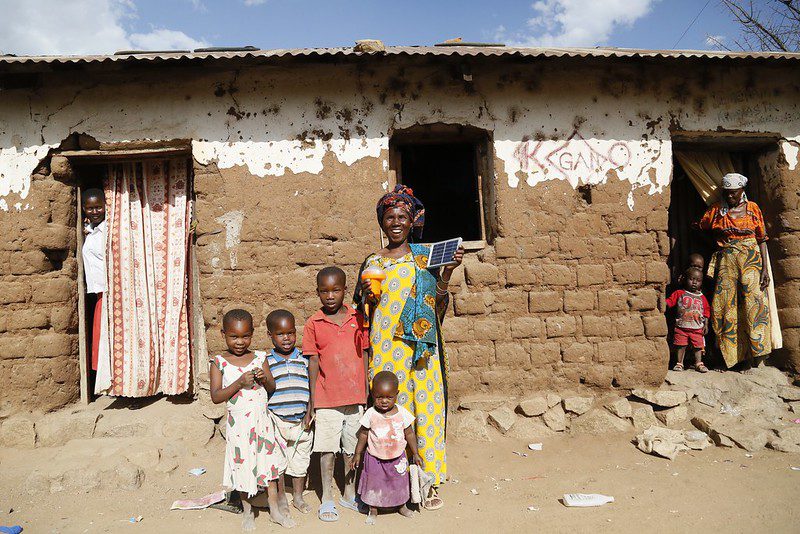
 With nearly 75% of rural Africa lacking access to electricity and only 26% of women acting as entrepreneurs, several African countries remain behind the developmental curve and bogged down in poverty. Lack of light and decreased business-building based on gender and status stall improvement in nearly every facet of life. Therefore, access to electricity and increased female entrepreneurial activity could be pivotal in overcoming poverty. The nonprofit organization Solar Sister empowers women to conquer economic, healthcare and education challenges in developing nations by encouraging female entrepreneurship related to increasing electricity availability.
What Is Solar Sister?
Founded in 2011, Solar Sister is a women-led empowerment movement aimed at encouraging female innovation and entrepreneurship through solar technology. The organization trains and equips participants with the necessary skills to create and distribute clean energy solutions that help combat community problems. The overarching goal is to increase electricity access in the world’s most impoverished places. According one successful Solar Sister, “to progress, first you need light.”
Like most business ventures, many Solar Sisters report that their businesses are built largely on trust and willingness to “take risks.” Solar Sister empowers women by focusing intently on its founder and CEO Katherine Lucey’s motto that everyone deserves access to clean, affordable energy. By employing women’s personal knowledge about their peers’ and villages’ needs, the organization is quickly approaching Lucey’s goal by creating specialized clean energy solutions and promoting female entrepreneurship.
Hilaria’s Story
Hilaria Paschal, one of Solar Sister’s first entrepreneurs in Tanzania, began her journey with clean energy in 2013. She is a farmer, basket weaver, businesswoman, wife and mother of three. Paschal’s husband kick-started her company with minor capital, but she has managed the operation since. She purchased only 12 lights at her business’s conception, yet managed to sell 25 products in her first month. Since 2013, Paschal has sold nearly 400 products that now power more than 2,000 homes. She attributes her success to her specialized knowledge of her village’s needs and to her immense creativity.
In 2015, Paschal formed Mshikamano, a group of basket weaving women ready to learn more about clean energy, entrepreneurship and the possibility of becoming a Solar Sister. Mshikamano translates to “solidarity” in Swahili, a perfect depiction of Solar Sister’s mission and Paschal’s work.
For her outstanding performance in the Solar Sister Program, Paschal was named the 2017 Women Entrepreneur of the Year by the International Network on Gender and Sustainable Energy (ENERGIA). She was granted the opportunity to travel to New York, where she accepted her prize and was invited to speak at the Sustainable Energy for All Forum.
But Solar Sister’s praise and recognition does not end with Paschal. In 2015, former president Bill Clinton visited Solar Sister’s site in Karatu, Tanzania as a part of the Clinton Global Initiative Commitment to Action. His visit resulted in higher publicity for the organization and its entrepreneurial opportunities for women.
Solar Sister’s Impact
To date, Solar Sister has launched operations in Nigeria, Kenya, Tanzania and Uganda, where its 4,000 entrepreneurs have collectively reached more than 1.5 million people and broadened electricity access in some of the world’s most energy-poor countries. Solar Sister products include clean cooking stoves, regular solar lanterns and even solar-powered cell phone chargers, all of which can improve several facets of life and surpass the abilities of simple light.
In an effort to explain just how beneficial affordable, clean energy can be in developing countries, Santa Clara University’s Miller Center for Social Entrepreneurship conducted a 2017 study entitled, “Turning on the Lights: Transcending Energy Poverty Through the Power of Women Entrepreneurs.” The study concluded that Solar Sister provides much more than light to communities and opportunities for female entrepreneurs, as newly prosperous populations also experience an enhanced quality of healthcare and education. Women in particular are reaping the benefits of increased household incomes, greater respect in the workplace and higher economic statuses.
Empowering Women Helps Entire Communities
In addition, Solar Sister’s solar technology improves health and safety. Solar lanterns do not create the negative health effects that kerosene exposure causes, nor do they pose a fire hazard. Additionally, health clinics and hospitals can use solar lanterns to extend their services and increase their efficiency during night hours. In terms of education, 90% of parents believe their children have improved academically since obtaining increased access to light. This progress is partially due to children having more time to study at night, but mostly because kerosene savings can now be put toward education. Other benefits of solar power include eliminating the travel time required to acquire kerosene, which can now be used to work longer hours and increase household incomes. Higher incomes create more purchasing power and more opportunities for advancement which stimulates local, national and global economies. Overall, Solar Sister empowers women in Africa to live safer, financially secure lifestyles.
To follow the Solar Sister program and its progress, visit solarsister.org or search #IAmSolarSister on social media.
– Natalie Clark
Photo: Flickr

How Solar Sister Empowers Women in Africa
What Is Solar Sister?
Founded in 2011, Solar Sister is a women-led empowerment movement aimed at encouraging female innovation and entrepreneurship through solar technology. The organization trains and equips participants with the necessary skills to create and distribute clean energy solutions that help combat community problems. The overarching goal is to increase electricity access in the world’s most impoverished places. According one successful Solar Sister, “to progress, first you need light.”
Like most business ventures, many Solar Sisters report that their businesses are built largely on trust and willingness to “take risks.” Solar Sister empowers women by focusing intently on its founder and CEO Katherine Lucey’s motto that everyone deserves access to clean, affordable energy. By employing women’s personal knowledge about their peers’ and villages’ needs, the organization is quickly approaching Lucey’s goal by creating specialized clean energy solutions and promoting female entrepreneurship.
Hilaria’s Story
Hilaria Paschal, one of Solar Sister’s first entrepreneurs in Tanzania, began her journey with clean energy in 2013. She is a farmer, basket weaver, businesswoman, wife and mother of three. Paschal’s husband kick-started her company with minor capital, but she has managed the operation since. She purchased only 12 lights at her business’s conception, yet managed to sell 25 products in her first month. Since 2013, Paschal has sold nearly 400 products that now power more than 2,000 homes. She attributes her success to her specialized knowledge of her village’s needs and to her immense creativity.
In 2015, Paschal formed Mshikamano, a group of basket weaving women ready to learn more about clean energy, entrepreneurship and the possibility of becoming a Solar Sister. Mshikamano translates to “solidarity” in Swahili, a perfect depiction of Solar Sister’s mission and Paschal’s work.
For her outstanding performance in the Solar Sister Program, Paschal was named the 2017 Women Entrepreneur of the Year by the International Network on Gender and Sustainable Energy (ENERGIA). She was granted the opportunity to travel to New York, where she accepted her prize and was invited to speak at the Sustainable Energy for All Forum.
But Solar Sister’s praise and recognition does not end with Paschal. In 2015, former president Bill Clinton visited Solar Sister’s site in Karatu, Tanzania as a part of the Clinton Global Initiative Commitment to Action. His visit resulted in higher publicity for the organization and its entrepreneurial opportunities for women.
Solar Sister’s Impact
To date, Solar Sister has launched operations in Nigeria, Kenya, Tanzania and Uganda, where its 4,000 entrepreneurs have collectively reached more than 1.5 million people and broadened electricity access in some of the world’s most energy-poor countries. Solar Sister products include clean cooking stoves, regular solar lanterns and even solar-powered cell phone chargers, all of which can improve several facets of life and surpass the abilities of simple light.
In an effort to explain just how beneficial affordable, clean energy can be in developing countries, Santa Clara University’s Miller Center for Social Entrepreneurship conducted a 2017 study entitled, “Turning on the Lights: Transcending Energy Poverty Through the Power of Women Entrepreneurs.” The study concluded that Solar Sister provides much more than light to communities and opportunities for female entrepreneurs, as newly prosperous populations also experience an enhanced quality of healthcare and education. Women in particular are reaping the benefits of increased household incomes, greater respect in the workplace and higher economic statuses.
Empowering Women Helps Entire Communities
In addition, Solar Sister’s solar technology improves health and safety. Solar lanterns do not create the negative health effects that kerosene exposure causes, nor do they pose a fire hazard. Additionally, health clinics and hospitals can use solar lanterns to extend their services and increase their efficiency during night hours. In terms of education, 90% of parents believe their children have improved academically since obtaining increased access to light. This progress is partially due to children having more time to study at night, but mostly because kerosene savings can now be put toward education. Other benefits of solar power include eliminating the travel time required to acquire kerosene, which can now be used to work longer hours and increase household incomes. Higher incomes create more purchasing power and more opportunities for advancement which stimulates local, national and global economies. Overall, Solar Sister empowers women in Africa to live safer, financially secure lifestyles.
To follow the Solar Sister program and its progress, visit solarsister.org or search #IAmSolarSister on social media.
– Natalie Clark
Photo: Flickr
Efforts in Poverty Eradication in Morocco
Within a decade, the Moroccan government was able to lower the country’s poverty rate to 9%, previously 16.2%, from 2000 to 2010. According to a World Bank report, the rate decreased even more with the national poverty rate at 4.8% in 2018. In 2018, the unforeseeable natural obstructions halted the process of poverty eradication in Morocco. Nevertheless, the strides that some have made in poverty eradication in Morocco serve as examples of the importance of investing in foreign aid. Here are five ways Morocco has successfully helped its citizens with poverty reduction.
Progressive Taxing and Better-Targeted Public Spending
Despite adopting a new constitution in 2011 that granted universal public services, such as free education and healthcare, Morocco still faced some adversities. For one, the Moroccan government was not able to meet the needs of its surging population. The state budget disproportionately benefited cities with larger populations. As a result, it left rural areas with resource shortages. To efficiently reallocate public spending, the country set aside funds for local-level organizations such as NGOs.
NGOs are single-issue driven and avoid any political alliance. NGOs target anything from the distribution of resources, such as water and electricity, to literacy campaigns for their communities. A Carnegie Endowment for International Peace publication concluded that “[d]espite NGOs’ limited resources, case studies have shown that their actions have made a real difference in the lives of people at the local level.” The World Bank study predicts that social spending will increase with the 2020 Budget Law that is under development.
Access to Education
When accessible, education encourages free and critical thinking. ChildFund International believes that knowledge breaks the cycle of poverty because education fosters the power to dream of a better future. Additionally, it purports that education presents employment opportunities. Upon state independence, Moroccan policymakers prioritized free education. A 2019 article estimated that Morocco spent about 5.26% of GDP on education which is “considerably higher than the world average.”
Slowed Down Population Growth
A lower population growth rate means more sustainable resource allocations. Morocco is able to meet demands for resources, such as food and housing, with slow population growth. The Carnegie Endowment report claims that “access to education and fewer opportunities in the labor market delayed the average age of marriage… and slowed down population growth.”
Moroccan citizens are waiting longer to start families, which is allowing them the time to enable economic prosperity as well. By securing their financial stability first, parents are guaranteeing desirable circumstances for raising future children and wealth to inherit. The research also supports that “inheritance is an important channel through which some people in Morocco have moved out of poverty.” Generational wealth gives future generations a financial head-start when they begin to participate in the economy.
Investing in Infrastructure
In decentralizing government spending, Morocco made accomplishments in basic infrastructure programs. These programs tackled the drinking water supply, electrical networks and road systems. For example, the program known as PAGER increased access to drinking water for rural areas by 29.4% in 2009.
The program PAGER has worked to reduce health risks in communities so that there is less strain on healthcare resources. Additionally, the program has removed the responsibility of girls having to carry clean water home from distant drinking wells. Other advances in rural electrification have led to readily available information. Meanwhile, new road constructions make it easier to reach schools and jobs located outside of small towns.
Controlling Inflation
The World Bank estimated that inflation in Morocco had a Consumer Price Index (CPI) of about 0.6% in 2019. Forecasts estimate that inflation will only reach 1.7% in 2021, which is relatively low for neighboring countries. In addition, the World Bank attributes the low inflation rate to “sound monetary policy and ample supply of fresh food.”
Low inflation is important for keeping prices for goods competitive in the world market. Competitive prices are attractive to countries seeking affordable exports and tourists. Additionally, contained inflation protects the income of Moroccans as citizens will not have to pay inflated prices for everyday goods.
Although the country’s hardships are still ongoing, there are many efforts towards poverty eradication in Morocco. Morocco’s efforts prove the efficiency of state intervention when combined with smaller local governments and respond accordingly to the demands of the most vulnerable.
– Lizt Garcia
Photo: Flickr
5 Facts About the Effects of Pollution in Developing Countries
5 Facts About the Negative Effects of Pollution in Developing Countries
To combat the adverse effects of air pollution in developing countries, the world needs more government involvement and partnership regarding the issue. In order for developing countries to adequately reduce emissions, developed nations need to cooperate and enforce standards of air quality to promote health. These efforts will require intense dedication but are necessary to help protect the lives of nearly everyone on Earth.
– Aiden Farr
Photo: Flickr
Tackling Macedonia’s Housing Crisis
Macedonia’s housing crisis requires swift attention. In 2018, about 21.9% of the country’s population was living below the poverty line. With a population of 2,082,957 in 2018, more than 456,000 people living in Macedonia were experiencing poverty that year. Furthermore, Macedonia saw an unemployment rate of 17.76% in 2019, a rate which is more than double the national average of 7.04%. The collapse of state-run housing development organizations in Macedonia since its independence has led to about 15% of Macedonians living in “illegally constructed buildings.” This means that roughly 320,000 people living in Macedonia lack access to adequate housing.
Invisible Homeless
The unauthorized housing that many people in Macedonia must live in bars thousands from access to important social systems and tools. Since Macedonians require an official home address to obtain a legal ID, the state effectively renders many of them nonexistent. This prevents these people from utilizing such essential services as insurance, social safety nets and immunization services.
Macedonia’s housing crisis is also a health crisis. Without adequate housing, hundreds of thousands of Macedonians are at risk of injury and disease due to hazardous living conditions. In 2018, fewer than a third of Macedonians had thermal insulation systems in their places of residence. Inadequate heating and insulation in buildings have forced thousands of people living in Macedonia to use homemade fires to keep warm since they cannot afford the expensive heating bills otherwise necessary to heat their homes. In the capital city of Skopje, roughly “two-thirds of households use firewood as their primary source of heating,” according to the Financial Times. Without proper air circulation, this can lead to severe chronic health conditions such as heart and lung disease due to inhalation of the hazardous particles which such fires produce.
Habitat for Humanity and Roma SOS
While Macedonia’s housing crisis is a daunting problem, some are doing significant work to improve housing in impoverished Macedonian communities. Despite being an attractive country for foreign investment due to its low tax rates and free economic zones, Macedonia still has one of the lowest foreign investment rates among European countries. This can make it harder for the government to provide solutions.
A Macedonian-based organization called Roma SOS is working to improve the living conditions of those experiencing the most need in Macedonia. The organization is currently working with Habitat for Humanity to provide impoverished Macedonians with zero-interest loans for legalizing and renovating their homes. While Habitat for Humanity provides the funding for these loans, Roma SOS helps residents in navigating the legal process of receiving approval for their loans.
Since 2004, Habitat for Humanity has worked to improve affordable housing for the people of Macedonia, and in 2019 it served 4,245 individuals “through market development.” Habitat for Humanity has further worked to provide individuals in Macedonia with housing that is not only affordable but also energy efficient. Since beginning this project in 2010, it has worked to restructure more than 60 buildings to improve energy efficiency, which has saved Macedonia more than 7,910 MWh of energy usage annually. The loans that Habitat for Humanity provides are essential for giving impoverished people in Macedonia access to better housing. With these loans, Habitat for Humanity has made heating safer and more affordable for more than 1,000 families living in Macedonia.
On the Path to EU Membership
Macedonia’s government also appears to be taking steps towards increased funding for improved housing. Macedonia has recently signed a deal with Greece and is currently on its way to becoming a member of the E.U. By joining the E.U., Macedonia would see an increase in foreign investment and would be able to apply for crisis aid packages to help improve housing in its impoverished communities.
The country’s housing situation may look bleak, but there is significant work occurring to address Macedonia’s housing crisis by improving the country’s economic situation. Several organizations, both outside of Macedonia and within it, are providing poor Macedonian populations access to safe, legal housing. With Macedonia moving towards E.U. membership and its accompanying economic support, there is hope for thousands of people in Macedonia whose living conditions formerly seemed hopeless.
– Marshall Kirk
Photo: Pixabay
Improving Healthcare in Macedonia
Healthcare in Macedonia utilizes a mixture of a public and private healthcare system. All residents are eligible to receive free state-funded healthcare and have the option of receiving private healthcare for treatments that the public system does not cover. Public healthcare in Macedonia often comes with long wait times and although public hospitals have basic medical supplies, they do not have specialized treatments. For these specialized treatments, residents typically seek private treatment where they must pay out of pocket or buy private insurance on top of their free healthcare.
Improvements in Overall Health
North Macedonia did not become a part of NATO until 2019, and still has not received admission into the E.U. As a result, its healthcare system has developed slower than member countries. Despite this, North Macedonia has shown growth in overall health. The introduction of private healthcare allowed residents to seek a wider range of treatments and cut down wait times. Life expectancy has grown from 71.7 years in 1991 to 75.1 years in 2010. However, this is still lower than the E.U.’s average life expectancy which is 80.2. Although life expectancy has grown, North Macedonia’s infant mortality rate is still above average.
North Macedonia reached a European record of 14.3 deaths per 1,000 live births in 2015. To compare, the average mortality rate in Europe for 2015 was 5.2 deaths per 1,000 live births. The high infant mortality rate is likely the result of outdated equipment at public health facilities and a shortage of qualified health workers. Only 6.5% of North Macedonia’s GDP goes towards healthcare, and therefore healthcare in Macedonia is often reliant on outside donations. These conditions have caused health workers to leave the Macedonian healthcare system in search of better working conditions. The health ministry has worked to purchase new equipment as well as increase the amount of qualified staff in public hospitals by hiring more workers. Today, the infant mortality rate in North Macedonia is 10.102 deaths per 1,000 births. This is an improvement, and hopefully, with continued programs, the numbers will continue to decrease. Organizations such as Project HOPE and WHO have already made a direct impact on Macedonia’s healthcare system.
Organizations Combating Infant Mortality
Project HOPE has donated over $80 million worth of medicines, medical supplies and medical equipment to hospitals throughout North Macedonia since 2007. Starting in 2017, most of these donations went to hospitals specializing in infant care. Project HOPE also provides training for healthcare workers so they can adapt to the updated equipment. The current drop in the infant mortality rate is due to these donations that allow hospitals to buy updated equipment and retain healthcare workers through training. There is only one hospital in North Macedonia that accepts low birth-rate and premature babies, University Clinical Center at Mother Theresa. Therefore, Project HOPE’s donation has greatly lessened the burden on this hospital to care for infants. Since Project HOPE implemented this program, the number of deliveries at Mother Theresa has increased by 40%.
WHO has also assisted North Macedonia in developing a new 2020 healthcare plan for infants and mothers. This plan would link healthcare facilities in the country and classify them by level of service to ensure everyone is receiving the appropriate care. It should also improve transportation between hospitals to increase the continuity of care between locations. This shared communication and learning between healthcare facilities is imperative since there are only nine hospitals in Macedonia for 2.08 million people and seven of those hospitals are in the country’s capital, Skopje. Increasing transportation and communication will ensure that those living outside of the capital are receiving quality healthcare. Slowly but surely with these new policies in place, North Macedonia’s infant mortality rate will continue to drop.
– Rae Brozovich
Photo: Flickr
3 Powerful Social Movements in Argentina
There is a vibrant culture of using social movements in Argentina to achieve political change. In recent years, Argentines have created community movements that push change related to hunger, sanitation, gender equality, same-sex rights, psychosocial and emotional treatment reform and much more. Notorious social movements throughout the country’s history of political and economic hardship have led to transformative policies around poverty, inequity and inequality. Here are three notable social movements in Argentina that have fostered attention to human rights and political reform.
Mothers of The Plaza de Mayo and Demilitarization
Between 1976 and 1983, Argentina experienced a period referred to as the “dirty war,” which resulted from a highly-militarized junta ruling under President Jorge Rafael Videla. This militarized dictatorship imposed extreme violence, regular kidnappings and killings of Argentinian citizens. On 30 April 1977, 14 mothers of disappeared children took to the Plaza de Mayo, located directly outside the presidential palace, to protest both the mystery behind their children’s disappearances and state violence. These 14 mothers inspired Argentines with their bravery, encouraging many to speak up about personal sufferings at the hands of the standing government. Eventually, oppositional parties, leading labor groups and other community leaders overthrew this militarized system. Democracy returned in 1983 under elected President Raúl Alfonsín — a long-term result of the heroism of The Mothers of Plaza de Mayo.
The Piquetero Movement
The 2001 Piquetero social movement in Argentina brought destructive neoliberal policies to an end. The neoliberal ideals of President De La Rúa threatened the rights of many Argentines suffering from systemic injustices. Many working-class Argentines lost jobs without governmental support, which rippled to affect local neighborhood living standards. Neoliberal policies perpetuated poor living conditions, unemployment and governmental neglect of basic human rights. Many Argentines had to demonstrate for their own lives.
Neoliberal policy oppressed the primary voices involved in this social movement in Argentina. These groups included the unemployed, labor unions and even middle-class workers. As the Piquetero protests broke out in December 2001, economic minister Domingo Cavallo and President De La Rúa both chose to resign. This allowed local communities to band together with newfound power. Solidarity, equality and equity of need-based opportunity were cultivated across classes, communities and neighborhoods, resulting in permanent, unionized local powers. In 2003, the president-elect of Argentina, Néstor Kirchner, rejected Argentina’s former neoliberal economic system. Still, he brought little reform to systematized social and economic issues within the country.
The Evita Movement
Named after former Argentine first lady Eva Perón, the Evita movement responded to vestigial aggressions of neoliberal economics. Eva Perón championed multiple labor and feminist movements during her husband’s 1946 presidency. Now, Perón is a popular culture idol within the country. Her values are the face of this social movement in Argentina, which fights for the redistribution of wealth and access to human rights.
The movement started in 2003 in support of President Kirchner’s plans for economic and social reform. Although President Kirchner did not reform systemic issues of oppression, the Evita movement is committed to addressing systemic poverty that resulted from Argentina’s debilitating period of neoliberalism. Inspired by Eva Perón’s ideals, the Evita movement works to redistribute wealth and power to people burdened by systemic violence.
Argentina is rich with a history of powerful unions, leaders and communities. With courage, the country has achieved full governmental renewal multiple times and worked to empower oppressed voices. The Argentinian population provides inspiration for social and political change across the globe.
– Lilia Wilson
Photo: Pixabay
7 Facts About Healthcare in Uzbekistan
7 Facts About Healthcare in Uzbekistan
Project Hope
Uzbekistan has not accomplished everything on its own. Many charities have worked with Uzbekistan, such as Project Hope. In 1999, Project Hope established its first office in Uzbekistan, with a focus on reducing child and maternal mortality rates, through the Child Survival Program and Healthy Family Program. It created initiatives, as well as opportunities for sexual education for the new mothers. Since then, under the Global Fund to Fight AIDS, Project Hope has focused on creating opportunities for AIDS-focused healthcare and education.
Uzbekistan has made progress in healthcare from the time of its independence, but it still has a long way to go. As Uzbekistan’s government continues to implement reforms heavily focusing on rural areas, it will most likely continue on its upward trajectory and create a health system that is beneficial to all of its citizens. As healthcare grows, poverty will decrease. Currently, Uzbekistan’s most poor are in rural areas, the areas with the least access to healthcare, as well as the lowest levels of sanitation. If Uzbekistan continues making reforms, rural areas will receive more healthcare, decreasing the disadvantage of living there, and therefore increasing the quality of life for Uzbekistan’s poor.
– Seona Maskara
Photo: Flickr
Providing Cataract Surgery to People in Poverty
Of the five senses, vision is arguably the most important. People perceive 80% of impressions through sight. Vision helps people determine if a situation is dangerous, or helps them find a familiar face in a crowd. Without vision, life becomes more difficult to navigate. Cataracts are a natural, age-related disease that all people will experience if they live long enough. In developed countries, it is easy for people to access care to remove cataracts; however, the process is much more difficult in underdeveloped countries. Here is some information about cataracts and the groups providing cataract surgery to people in extreme poverty, specifically in the country of Nigeria.
What are Cataracts?
Inside a person’s eye is a lens. The lens is located behind the iris or the colored part of the eye. Light travels through the pupil—the dark hole in the center of the iris—and the lens focuses it onto the retina, which sends the image to the brain. The lens is normally clear, but cataracts cause it to become cloudy and opaque so that light can not penetrate through the lens as well. This obstruction causes the vision to become blurry and dark.
Who Do Cataracts Affect?
According to the World Health Organization, at least 2.2 billion people currently experience vision impairment or blindness. Of those individuals, 65.2 million experience blindness from cataracts and 52.6 million have vision impairment from cataracts. About 99% of people with cataracts live in developing countries.
Although aging is the most common cause of cataracts, several factors speed up the process. When people work outdoors and are consistently in the sun, their eyes have exposure to UV light rays which are incredibly harmful and aid in cataract production.
Agricultural jobs make up 54% of the workforce in Africa, meaning many people are outdoors for long periods of time. About 600,000 Africans experience blindness each year due to cataracts. Yet, of the entire African population, only about 0.0005% get cataract surgery. In comparison, 7.5% of Americans aged 65 or older undergo cataract surgery each year. However, with limited ophthalmologists and expensive medical fees, the people of Sub-Saharan Africa, including those in Nigeria, lack access to this otherwise commonly performed surgery. Fortunately, several institutions are providing cataract surgery to people in extreme poverty.
See International
The more developed a cataract becomes, the harder it is for affected individuals to see, work and take care of themselves. One organization, SEE International, provides “essential and transformative eye care and surgery around the world,” through programs connecting volunteers and medical professionals to the people who need their services most. Nigeria is one of the top 10 most populated countries in the world but has limited access to eye care specialists. There is only one eye doctor available per million people in urban areas. In rural areas, which encompass 70% of the population, the ratio is even lower. SEE hosts several clinics a year in Port Harcourt to provide free eye care, including cataract surgery.
Vision Care
Vision Care is a program based out of South Korea that brings free cataract surgery to Lagos, Nigeria to help eliminate avoidable blindness. Even with limited access to eye care providers, however, patients stated the financial cost was the biggest obstacle to receiving this surgery. Vision Care gives the gift of cataract surgery to people in extreme poverty. By eradicating the need to provide payment, Vision Care has helped many people regain their sight and quality of life. On top of performing cataract surgeries, the program has also worked on educating eye care professionals in Lagos to help those doctors perform more comprehensive and upscale services.
The International Agency for the Prevention of Blindness (IAPB)
The International Agency for the Prevention of Blindness (IAPB) is the leading alliance fighting global blindness through advocacy, partnerships and knowledge. With programs like World Sight Day, the IAPB aims to ensure universal access to quality eye care by providing cataract surgery to people in extreme poverty and treating other eye diseases like glaucoma and macular degeneration. The IAPB Africa branch recognizes the alarming shortage of eye health professionals: with the general shortage of health care workers, 57 countries are in crisis, with 36 of those located in Africa. In 2014, the IAPB developed a 10-year plan to achieve universal coverage in all Sub-Saharan countries with goals to have “the right number [of eye health professionals] in the right place at the right time.”
These noble organizations are providing cataract surgery to people in extreme poverty, which, in turn, does more for these individuals than restore vision: every dollar that goes toward improving sight produced a four-fold return in developing countries. As eye care takes higher priority in developing countries, the economic and social benefits will enable millions to live higher-quality lives.
– Tawney Smith
Photo: Flickr
8 Facts About Homelessness in Timor-Leste
Timor-Leste, formerly known as East Timor, is a small nation located in the expansive seas of Southeast Asia. As one of the youngest countries in the world today, it holds its fair share of successes and problems. Homelessness in Timor-Leste is one of these problems, which is an issue common in many countries.
Homelessness in Timor-Leste is unique due to the several social, historical and political factors contributing to housing insecurity in this country. Though organizations such as UNICEF and United Nations Transitional Administration in East Timor (UNTAET) have implemented efforts to combat this quandary, much work still remains in order to eradicate homelessness. Listed below are eight facts about homelessness in Timor-Leste.
8 Facts About Homelessness in Timor-Leste
As shown these facts show, the housing predicament in Timor-Leste is extremely complex and difficult to resolve quickly. While the Timorese government and various humanitarian organizations have made multiple commendable efforts to combat homelessness in the country, the issue requires more work.
The displacement of many individuals from their original homes has caused countless land and property disputes. Resolving these issues requires a sophisticated legal framework. Moreover, many displaced individuals lack secure work opportunities as well as access to basic health and social services.
While the displaced individuals remain strong and resilient through these times, additional legal, social and infrastructural changes must occur to provide long-term solutions to homelessness in Timor-Leste. Nevertheless, throughout the past 10 years, this country has made promising improvements in living standards for its citizens.
– Vanna Figueroa
Photo: Flickr
3 Countries Where the Marist Brothers Help Children
Saint Marcellin Champagnat formed the Institute of the Marist Brothers in 1817 with the mission of helping poor and marginalized children around the world. The community of Marist Brothers has now grown to include almost 3,000 members. In 2007, in the spirit of Champagnat’s vision, the Congregation of the Marist Brothers of the Schools established the Marist International Solidarity Foundation (FMSI) in Rome. Its mission is to provide quality care and education for all children. Today, the foundation directly improves the lives of more than 650,000 youth around the world. It does so through its presence in educational, social and youth centers. Three of FMSI’s important mission projects are in Ghana, Haiti and Lebanon.
Ghana: Marist Junior High School
With a fast-growing youth population, experts claim that Ghana has a unique opportunity to utilize its “demographic dividend” as a positive force for its society and economy. Without a strong educational system, however, the growing demographic could exacerbate the country’s poverty. Problems in the Ghanaian educational system, especially in rural settings, include shortages of qualified teachers, adequate teaching spaces and school materials. Additionally, literacy and learning standards are low. Educational institutions struggle to provide quality, inclusive teaching across gender and socioeconomic disparities. Thousands of children drop out of school because their families cannot afford the economic burden.
Fortunately, the Marist Brothers have been quietly contributing to the betterment of Ghanaian education. In 1998, the Marist Junior High School emerged in Sabin-Akrofrom. In this rural area, families cannot afford the transportation costs to send their children to city schools. Since its establishment, the Marist Junior High School has taught more than a thousand students who would have not received schooling otherwise. Its students meet high academic standards, and the facility is now prominent for its effective, inclusive and quality education for children living in remote areas of Ghana.
Haiti: the Collège Alexandre Dumas
In Haiti, thousands of children do not receive an adequate education because families cannot afford to make such financial sacrifices. Because of this, child labor is widespread in Haiti. As of 2019, more than 34% of children between the age of five and 14 were in the labor force. Child labor drastically reduces children’s opportunities to go to school. The government is unable to enforce a minimum age requirement for its workers or prohibit the use of children for dangerous work. Children left at orphanages also often work in hard domestic work.
The Marist Brothers have taken action to advocate for child rights and reduce child labor in the region of Latiboliere. The mission of the Collège Alexandre Dumas secondary school is to improve the lives of children who are vulnerable to exploitation. After successful negotiations with children’s families, the Marist Brothers are now able to host 100 boys and girls per year. In addition to providing basic schooling, this program offers nutritional meals, medical care, and recreational activities like sports and arts. These activities contribute to the Haitian children’s academic, emotional and social advancements. Overall, the school reduces the labor exploitation of minors by educating their families on the importance of schooling.
Lebanon: the Fratelli Project
Lebanon also faces the issue of widespread child labor, which impedes youth access to school. Immigrant children, whose parents experience exclusion from the Lebanese labor market, are especially vulnerable to labor trafficking. They can receive less pay and employers do not require identification papers. However, Lebanese families living in the poorest areas of the country face similar problems to those of immigrant families. Thus, Lebanese child labor is also on the rise. This cycle forces children to become the only source of income for many poor families who cannot afford to lose their support by sending them to school. Consequently, even the children enrolled in an educational institution have poor levels of attendance when due to seasonal labor.
The Marist Brothers’ school, Les Frères, has been helping children in Lebanon since before the Lebanese civil war. Now, in cooperation with the La Salle Brothers, the Marist brothers in Lebanon have introduced a new educational project called Fratelli. The Fratelli project supports hundreds of Lebanese and refugee children who have fallen behind in school. It incorporates socio-academic and vocational training to help them reintegrate into the Lebanese education system. FMSI provides funds to buy school materials, pay activity costs and finance the enlargement of buildings to make Les Frères accessible to more children.
Ghana, Haiti, and Lebanon are just three of the 81 countries around the world where the Marist Brothers have improved children’s lives. By protecting the world’s children, the Marist Brothers are effectively protecting the world’s future.
– Margherita Bassi
Photo: Flickr