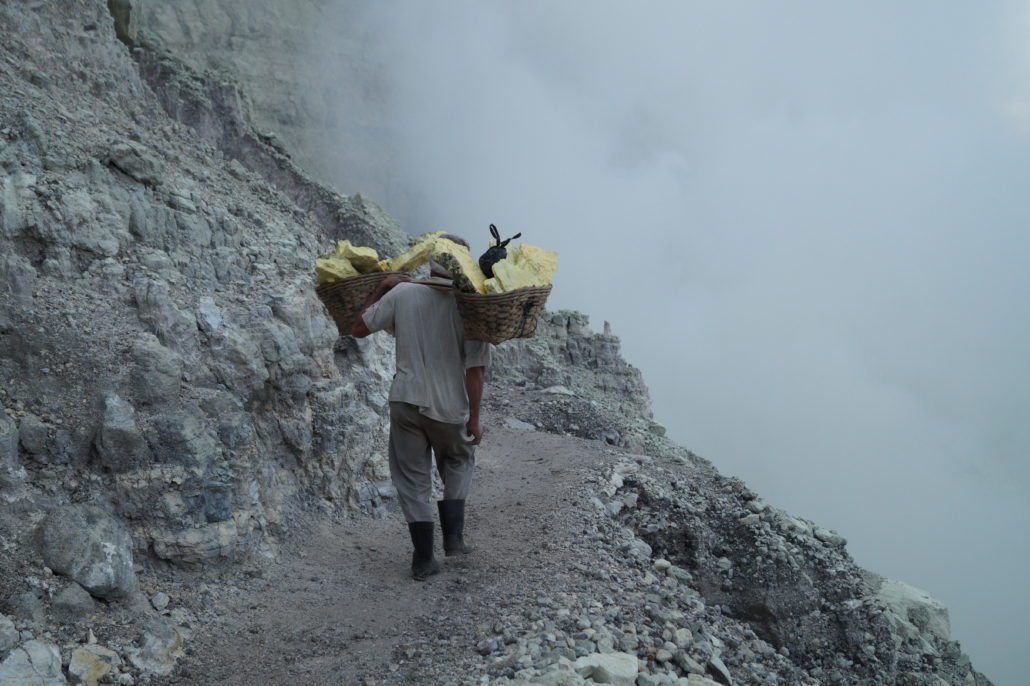
In Indonesia, 9,000 feet above sea level, on the Kawah Ijen volcano crater, one can see two kinds of people: sulfur miners suffering backbreaking labor in toxic conditions, and tourists wealthy enough to afford gas masks and enjoy the rugged beauty of the landscape.
Background
The miners are locals of the region. They trek up the steep cliffs, carrying 80 kilograms of sulfur per trip for compensation of about 7 cents per kilogram. PT Candi Ngrimi employs them and processes the sulfur into powder, slabs and granules for sale to manufacturing companies. In particular, sugar processing companies use sulfur to refine and whiten sugar crystals.
Despite working next to the most acidic lake in the world and within the toxic fumes of the volcano, the workers have virtually no equipment to protect themselves from hazards. Most wear only a thin piece of cloth over their nose and mouth.
Unlike the miners, who have been active since 1954, the tourists at Kawah Ijen are a new addition to the volcano. East Java was rather obscure until 2010. Then, Abdullah Azwar Anas became regent of the Banyuwangi Regency (the city in which the volcano is located). Upon his election, Azwar developed fervent promotions for tourism, and now millions of people visit Banyuwangi yearly.
Benefits of Tourism
The economic impact of tourism is immense for many countries around the world. For instance, Maldives has shifted from a least developed to a developing country largely because of tourism, which is the dominant economic sector for that country.
Tourism is a growing economic force for Indonesia, too, as it accounts for 5.2% of GDP and 3.7% of total employment. Tourists at Kawah Ijen create the potential for public and private sector cooperation. This relationship could build infrastructure to support tourism, ultimately increasing employment and income.
Tourist attractions like the Kawah Ijen crater rely on the environmental and cultural health of the area. Thus, the governments and corporations in Banyuwangi have the motivation to preserve these aspects. Although there may be increased infrastructure development in the area, it is unlikely that there will be large-scale changes that would alter the natural and cultural beauty of Banyuwangi.
Consequences of Tourism
The primary concern of tourism at Kawah Ijen is that the sulfur miners become an attraction, much like the alluring blue fire, yellow sulfur and acidic lake of the volcano’s crater. Tourists reflect this concern by taking selfies with miners who are about to begin their trek back to base for their daily $5. Despite their popularity, the miners have not seen any monetary rewards during Banyuwangi’s tourism boom, barring small fees for photographs. Their wages remain as they have for decades.
Tourists at Kawah Ijen are not an inherently bad thing, of course. However, the sulfur miners are a big reason that the volcano is a tourist attraction at all, yet they continue to live in poverty. It is an extreme example of exploitation without compensation.
So popular is the hardship of the sulfur miners’ lives that they are documented on a database of “dark tourism.” Dark tourism, according to the website, is “travel to sites that are in some way connected to death or disaster.” Kawah Ijen received a 10/10 on its “dark-o-meter” rating, alongside memorials to the Hiroshima bombing and the Rwandan genocide.
How to Ensure Positive Development
There are ways that tourism can theoretically provide a positive experience for host communities. These ways not only avoid voyeurism but seek to alleviate some of the challenges host communities experience.
One example of this is voluntourism, which melds volunteer service work with tourism. Tourists could plant trees resistant to sea-level rise on the coast of East Java. They could help build a road to make the miners’ travels easier. Voluntourism, however, is a potentially deleterious activity that can strip local communities of their agency. If implemented at Kawah Ijen, officials would have to monitor voluntourism with extreme caution and attention to detail.
Another example is pro-poor tourism, which aims to create a net benefit for impoverished communities in host countries. This often takes the form of governments or private companies training impoverished populations to take part in the tourist industry, perhaps as a travel guide or an education specialist.
Because of tourism’s growing economic importance in Banyuwangi, tourists themselves have indirect political power in the region. Considering this, tourists at Kawah Ijen have an opportunity to become activists. If they demanded that miners received just compensation for their work, the regency or PT Cambri Ngimri may oblige. This is called justice tourism, and although it may seem idealistic, it could produce a serious change in places like Kawah Ijen, if it were done correctly.
Sublime photos of Kawah Ijen’s sulfur mines and blue fire continue to circulate on the internet. It is clear that the volcano’s popularity is not dwindling. Governments and companies, then, should try and discover ways to make tourism socially sustainable. This practice is necessary not just in Indonesia, but in any place that is worth visiting and celebrating.
– Christopher Orion Bresnahan
Photo: Flickr

Decreasing Hunger in Uzbekistan
In the past, hunger in Uzbekistan showed staggering numbers. However, these rates have decreased exponentially since the early 2000s. Within the past 20 years, hunger rates peaked in 2002, where 19.8% of the population either could not afford or access a sufficient amount of nourishment necessary for survival.
The Connection Between Poverty and Hunger
Poverty drives hunger in Uzbekistan. For example, many people could not afford bread in 2005 due to the inflated price, but the rates have dropped by 14.5% since then. Moreover, many people did not even make sufficient wages to purchase a bag of flour each week to provide for their families.
Reducing Undernourishment
Globally, 805 million people experienced undernourishment in 2014. Of that number, 1.7 million lived in Uzbekistan. While these numbers may seem disheartening, there has been a turn for the better. From 2016 to 2017, there was a 0% increase in hunger rates in Uzbekistan. While there was not a reduction in hunger during that time, a 0% increase is still a victory showing that Uzbekistan is on the path to creating a country without hunger.
With these numbers in mind, it is important to highlight just how much progress there has been. Within the country, hunger in Uzbekistan decreased to 6.3% by 2017, which was the lowest it had been since 2000.
Many volunteers and organizations, such as Action Against Hunger, have provided aid to people in Uzbekistan including those that violence displaced in 2010. Action Against Hunger’s actions have directly affected the rates of undernourishment in the country. Here are some of the ways Action Against Hunger influenced the hunger rate in Uzbekistan.
3 Ways Action Against Hunger has Decreased Hunger in Uzbekistan
Hunger and malnutrition can come from many places but mostly stems from insecurity within the economy, poverty and job instability. With help, Uzbekistan should be able to eradicate these problems and increase food security. The fight to end hunger in Uzbekistan continues, but the numbers show that change surely is possible.
– Natalie Belford
Photo: UN Multimedia
Top 5 Humanitarian Role Models for Children
Parents always want the best for their children, but in an increasingly overwhelming world, it can be hard to stay positive. As a society, we need to actively work harder to inspire future generations to protect our planet and its people. Thankfully, there are many amazing role models out there that can motivate children to get involved in making the world a better place.
Top 5 Role Models for Children
There are many fantastic role models worldwide that demonstrate how crucial nonprofit organizations are in improving people’s standards of living worldwide. Yet, perhaps the most important role models are the parents at home. Teach children about the real impact of charity work and get them involved in both local and global humanitarian organizations. As children grow older, they will start to venture off on their own charity projects, ensuring a brighter and equal future.
– Karin Filipova
Photo: Flickr
Family Legacy Combats Child Poverty in Zambia
What Is Family Legacy?
Family Legacy is a nonprofit organization based in Irving, Texas that seeks improvement in both of those areas for the most affected children of Lusaka, Zambia. In a variety of ways, the organization aims to reduce child poverty in Zambia by ensuring that these children have the opportunity to attend school. There, they get one hot meal every day and extra food to take home when they have good attendance. “This makes the parents more likely to let the kids go to school, and not be forced to work,” a Family Legacy volunteer said.
What Is Being Done to Fight Child Poverty in Zambia?
Family Legacy has four programs to meet its goal of alleviating child poverty in Zambia. The first, Legacy Academy, focuses on the Academics pillar, one of the organization’s four pillars of care. This main school program ensures that the children it serves receive primary and secondary education with all the necessary materials. The second program, Tree of Life, focuses on the physical and emotional pillars. Tree of Life is a residential community that provides children who have been through physical or emotional trauma with a safe place to live while they attend school. The third program, Excel Beyond, also focuses on the academics pillar. This program is designed to support the high school graduates of Legacy Academy while they build the foundation of a successful career. Finally, Camp Life represents Family Legacy’s spiritual pillar. The week-long experience seeks to bring hope and emotional growth to the Academy students.
Family Legacy’s success can be attributed to its three-tier approach, combining education, nourishment and the inclusion of benefits to the families of these children in need. The organization’s programs saw a ninth grade completion rate that was 18% higher than the national average last year. In addition, it has 156 students currently pursuing higher education. To help with curbing hunger in Zambia, Family Legacy distributes 4 million meals annually.
What Can We Do to Help?
Family Legacy’s progress is achieved via activities in multiple parts of the globe. In Dallas, volunteers pack meals, distribute clothes, gather supplies and find sponsors. Sponsorships are programs in which a family or individual provides the financial means for a child in Lusaka to attend school and receive meals and extra food. In Lusaka, volunteers make up the summer staff of Camp Life, participate in medical internships, assist with the graduation ceremonies of Tree of Life and Legacy Academy and participate in activities with the other Tree of Life children. Beginning to get involved in the fight against global poverty seems like a daunting task, but Family Legacy makes it easier than ever to fight child poverty in Zambia.
– Carolina Larracilla
Photo: Wikimedia Commons
The Africa Mental Health Research and Training Foundation
The need for physical necessities such as medical care and food security often overshadows discussions of mental health care in developing countries. However, stress, trauma, violence and poverty exacerbate the need for sufficient mental health services. This makes a lack of these resources even more problematic. The Africa Mental Health Research and Training Foundation is working to fill this unmet need.
The Africa Mental Health Research and Training Foundation (AMHRTF)
Professor of Psychiatry David Ndetei founded AMHRTF in 2004. In addition to teaching at the University of Nairobi, Ndetei has written more than 250 journal articles and six books on mental health. This NGO is based in Nairobi, Kenya. It aims to provide affordable and accessible mental health care to Kenyans who might ordinarily struggle to access services. The organization’s network of researchers and mental health professionals tackle a range of mental health concerns, including suicide prevention, substance abuse and PTSD. In addition to providing clinical services, AMHRTF conducts research to inform public policy and enact innovative, larger-scale projects to provide Kenyans with mental health care regardless of income level.
Services
Resources for mental health care in developing countries, like Kenya, are notoriously scarce. In higher-income countries, 5% of total health expenditures correspond to mental health services. In contrast, in lower-income countries, the expenditure is just 0.5%. However, deficits in mental health services have harsh fiscal consequences for nations already struggling with poverty. Low and middle-income countries lose approximately $870 billion each year, compensating for the effects of untreated mental health disorders, such as productivity loss.
One of the organization’s primary functions is providing Kenyans with affordable counseling services. Clients can book appointments with a network of mental health professionals for individual, couple, group and family therapy. These professionals provide services for anxiety, depression, family violence, personality disorders and PTSD. In addition, AMHRTF offers workshops and presentations to educate other companies and organizations.
Larger Projects
One of the primary challenges of providing mental health care in developing countries is a low concentration of professionals. As of 2016, there were a mere 100 psychiatrists in Kenya. Rural populations outside of Nairobi are especially underserved, with only one psychiatrist per 1 million Kenyans.
AMHRTF has facilitated other innovative, evidence-based solutions to broaden the reach of their organization. To combat a lack of accessible care, AMHRTF has partnered with the Columbia University Global Mental Health Program to form the TEAM initiative. Additionally, the innovative 2015 initiative was awarded nearly $1 million CAD in aid from the Canadian government. This bridges the influence of traditional healers with modern mental health car. Moreover, it works within preexisting structures as a way of reaching rural and underserved patients through trusted community leaders. Many Kenyans turn to traditional healers for help in times of distress. A referral program allows healers to identify and direct individuals to professional care.
Final Thoughts
Developing nations have a pressing demand for mental health services. However, these countries rarely have the resources to deliver sufficient care. To meet this demand, the Africa Mental Health Research and Training Foundation provides affordable mental health services for those in need, conducts research and initiates innovative projects that maximize Kenyans’ existing resources.
– Stefanie Grodman
Photo: Flickr
Severe Land Degradation in Malawi
Malawi, a small country located in southern Africa, is heavily experiencing the negative effects of deforestation: severe land degradation. If the country cannot find a successful way to fix its watersheds, it could become water scarce.
Malawi has a population of over 18 million people. Poverty affects a large percentage of Malawi’s population. Agriculture is the main source of income for most households in Malawi, making up more than one-third of the country’s $7 billion GDP and 90% of its exports. Over 80% of the population in Malawi lives in more rural areas, while around 11 million of those people partake in smallholder farming.
While agriculture is the main contributor to Malawi’s GDP, the majority of the land in Malawi is not suitable for farming. Because of this viability issue, the country is experiencing mass deforestation. Smallholder communities, therefore, push into the marginal land to survive. Other than expanding agriculture, Malawi forests are suffering from high demand for charcoal. In March 2017, the Malawi army went to major forests in the country to stop people from cutting down the trees for charcoal production, which was contributing to the land degradation that was contaminating the Shire River, the country’s main water source.
Due to these actions and others, cities in Malawi are experiencing deforestation at alarming rates. For example, between 2001 and 2019, a mere two regions were responsible for over 50% of Malawi’s deforestation. Nhata Bay lost 64.3-kilo hectares of forest, equivalent to about 158,889 acres; Mzimba lost 25.8-kilo hectares of forest, equivalent to about 63,753 acres. Over the last 40 years, over half of Malawi’s forests have been cut down, and because of that, nearly 80% of the total land area in Malawi has experienced degradation.
How is Land Degradation Hurting Malawi?
Here are some ways that severe land degradation and watershed degradation affect the communities in Malawi:
Efforts to Help
The Malawi Watershed Services Improvement Project (MWASIP), which the Ministry of Agriculture Irrigation and Water Development (MoAIWD) implemented, aims to fix the watershed crisis and the severe land degradation issue through three different components:
The proposed project costs $160 million. On June 19, 2020, The World Bank Board of Executive Directors approved $157 million for the MWASIP. The World Bank press release noted a few specific things that the $157 million will go towards. It will use the available $45 million dedicated to increasing water infrastructure to create 10 small multipurpose dams; 20 rainwater harvesting structures; 10 small irrigation schemes to increase access to water for productive use; create over 2,500 construction jobs; provide $40 million in livelihood support through community grant programs.
– Sophie Dan
Photo: Flickr
The COVID-19 Impact on Cambodian Art & Culture
Worldwide, COVID-19 has impacted many countries and peoples’ daily lives. While not all countries have been affected in the same manner due to their respective population demographics, economies, etc. — places with a contained outbreak are far from lucky. As of the beginning of July 2020, Cambodia has had 141 confirmed cases of the new virus and zero deaths; possessing one of the world’s most desirable records for disease containment. However, citizens canceled many gatherings and traditions due to the constant spread of the new virus, in order to stave off the increasing numbers of infected. In a country filled with culture and art, postponing annual festivals poses a significant threat to society — both from an emotional and economic standpoint. As a result, many long-standing art troupes are facing closures and this, in turn, is negatively affecting the Cambodian art industry.
A Brief History
In the past, Cambodia faced a difficult battle with its culture. The country underwent a prolonged civil war and genocidal regime, forcing many traditional forms of Cambodian culture to the brink of vanishing. In addition to the political stress on the art industry, many artists faced financial struggles and gave up their passions in return for a stable outcome. Although the Cambodian arts encountered numerous obstacles, certain traditions have outlasted these struggles. Albeit, the impact of COVID-19 stands to be the most difficult obstacle for these troupes yet.
Kok Thlok Association of Artists
One of the most popular forms of Cambodian art is through traditional shadow puppet plays. Kok Thlok Association of Artists is a group of artists that includes a majority of French nationals performing this art form. Since March of 2019, this troupe has been entertaining the public by putting on shadow puppet plays (also known as a Sbek Touch) and Yike (a Cambodian art form of Khmer musical theatre). They perform these traditional art forms to showcase and instill their culture into the younger generation and earn income for the artists. With theatre being their primary source of income and the new virus spreading, no performances occur, which in turn prevents these artists from earning their wages.
A Drastic Decrease in Income
Soon after the discovery of Cambodia’s first COVID-19 case in January of 2020, the government ordered the temporary shutdown of places such as schools, museums and cinemas. The government canceled public events, including art performances and heavily encouraged people to refrain from gathering in crowds. As a result, the Kok Thlok Association of Artists was unable to perform and gain income. With this drastic decrease in income, these artists are finding it difficult to feed themselves and pay for expenses like rent. Even in these severe circumstances, however, the association is still committed to preserving the art form.
Siem Reap’s Phare Cambodian Circus
In addition to collecting revenue from Cambodian residents, many art performances have a large following of tourists. Due to the new virus, tourism has halted — which has consequently impacted many other industries and companies as well. The Siem Reap’s Phare Cambodian circus is popular for its ability to combine the Cambodian art of storytelling effectively and artistically with dance, music and other forms of performing arts; the circus is a very popular tourist attraction. With almost no tourist arrivals, establishments like the Phare circus have been deeply affected. The effects of COVID-19 will have a long-lasting impact on the economy and the tourism industry, meaning that entertainers and artists will remain in this situation for some time.
With most of the artists’ primary and part-time jobs lost, many participants are attempting to stay above the poverty line by moving to cheaper areas and by selling goods. In addition to their dire circumstances, there is the aforementioned cultural battle in Cambodia which leaves local residents unable or unwilling to provide monetary support. Apart from monetary issues, these performances helped artists from challenging backgrounds to put aside their problems and focus on the art form. Now, with their primary outlet of expression gone, many artists are facing both financial and emotional problems.
An Adaptive Look to the Future
While these artists are managing to barely stay afloat, many theatres are unable to do so. The long-standing Sovanna Phum Theatre — a shadow puppet theatre that blends puppetry with traditional Khmer dance — closed down in May 2020. However, the ministry provides alternate ways for these artists to make money, e.g. through media outlets and other online platforms. In fact, The Sovanna Phum Theatre relocated to the School of Fine Arts. Although their performances are online and difficult for the performers to adjust to — the government has provided them with a temporary solution. It is unknown how long this solution will last, but the Cambodian artists hope for the best and pray that COVID-19 does not hurt their chances of performing in the future.
– Aditi Prasad
Photo: Wikimedia Commons
6 Facts about Homelessness in Yemen
Before conflict escalated in Yemen, many considered the country the poorest in the Middle East and North African region. Poverty affected half the population, about 29 million people, before the crisis. Today, poverty impacts 71% to 78% of the population. The Yemen Crisis has led to increased homelessness and internally displaced persons. In addition, more than 3.6 million people lived in displacement at the end of 2019. Below are six facts about homelessness in Yemen.
6 Facts about Homelessness in Yemen
Yemen is in desperate need of aid to provide its people with essentials. Additionally, the COVID-19 pandemic and conflict in Yemen continue to push Yemeni people into extreme poverty and homelessness. The U.S. and international organizations must come up with finances to help Yemen’s dire situation. Without the support of the global community, Yemenis will go to sleep hungry, thirsty and in unsuitable living conditions.
– Mia Mendez
Photo: Flickr
Tourists at Kawah Ijen Crater
In Indonesia, 9,000 feet above sea level, on the Kawah Ijen volcano crater, one can see two kinds of people: sulfur miners suffering backbreaking labor in toxic conditions, and tourists wealthy enough to afford gas masks and enjoy the rugged beauty of the landscape.
Background
The miners are locals of the region. They trek up the steep cliffs, carrying 80 kilograms of sulfur per trip for compensation of about 7 cents per kilogram. PT Candi Ngrimi employs them and processes the sulfur into powder, slabs and granules for sale to manufacturing companies. In particular, sugar processing companies use sulfur to refine and whiten sugar crystals.
Despite working next to the most acidic lake in the world and within the toxic fumes of the volcano, the workers have virtually no equipment to protect themselves from hazards. Most wear only a thin piece of cloth over their nose and mouth.
Unlike the miners, who have been active since 1954, the tourists at Kawah Ijen are a new addition to the volcano. East Java was rather obscure until 2010. Then, Abdullah Azwar Anas became regent of the Banyuwangi Regency (the city in which the volcano is located). Upon his election, Azwar developed fervent promotions for tourism, and now millions of people visit Banyuwangi yearly.
Benefits of Tourism
The economic impact of tourism is immense for many countries around the world. For instance, Maldives has shifted from a least developed to a developing country largely because of tourism, which is the dominant economic sector for that country.
Tourism is a growing economic force for Indonesia, too, as it accounts for 5.2% of GDP and 3.7% of total employment. Tourists at Kawah Ijen create the potential for public and private sector cooperation. This relationship could build infrastructure to support tourism, ultimately increasing employment and income.
Tourist attractions like the Kawah Ijen crater rely on the environmental and cultural health of the area. Thus, the governments and corporations in Banyuwangi have the motivation to preserve these aspects. Although there may be increased infrastructure development in the area, it is unlikely that there will be large-scale changes that would alter the natural and cultural beauty of Banyuwangi.
Consequences of Tourism
The primary concern of tourism at Kawah Ijen is that the sulfur miners become an attraction, much like the alluring blue fire, yellow sulfur and acidic lake of the volcano’s crater. Tourists reflect this concern by taking selfies with miners who are about to begin their trek back to base for their daily $5. Despite their popularity, the miners have not seen any monetary rewards during Banyuwangi’s tourism boom, barring small fees for photographs. Their wages remain as they have for decades.
Tourists at Kawah Ijen are not an inherently bad thing, of course. However, the sulfur miners are a big reason that the volcano is a tourist attraction at all, yet they continue to live in poverty. It is an extreme example of exploitation without compensation.
So popular is the hardship of the sulfur miners’ lives that they are documented on a database of “dark tourism.” Dark tourism, according to the website, is “travel to sites that are in some way connected to death or disaster.” Kawah Ijen received a 10/10 on its “dark-o-meter” rating, alongside memorials to the Hiroshima bombing and the Rwandan genocide.
How to Ensure Positive Development
There are ways that tourism can theoretically provide a positive experience for host communities. These ways not only avoid voyeurism but seek to alleviate some of the challenges host communities experience.
One example of this is voluntourism, which melds volunteer service work with tourism. Tourists could plant trees resistant to sea-level rise on the coast of East Java. They could help build a road to make the miners’ travels easier. Voluntourism, however, is a potentially deleterious activity that can strip local communities of their agency. If implemented at Kawah Ijen, officials would have to monitor voluntourism with extreme caution and attention to detail.
Another example is pro-poor tourism, which aims to create a net benefit for impoverished communities in host countries. This often takes the form of governments or private companies training impoverished populations to take part in the tourist industry, perhaps as a travel guide or an education specialist.
Because of tourism’s growing economic importance in Banyuwangi, tourists themselves have indirect political power in the region. Considering this, tourists at Kawah Ijen have an opportunity to become activists. If they demanded that miners received just compensation for their work, the regency or PT Cambri Ngimri may oblige. This is called justice tourism, and although it may seem idealistic, it could produce a serious change in places like Kawah Ijen, if it were done correctly.
Sublime photos of Kawah Ijen’s sulfur mines and blue fire continue to circulate on the internet. It is clear that the volcano’s popularity is not dwindling. Governments and companies, then, should try and discover ways to make tourism socially sustainable. This practice is necessary not just in Indonesia, but in any place that is worth visiting and celebrating.
– Christopher Orion Bresnahan
Photo: Flickr
Countering Hunger in Estonia
Estonia is a country located in Northern Europe, directly below Finland. Throughout the 1980s, it was under the illegal control of the U.S.S.R., but Estonia officially declared its independence on August 20, 1991. However, the country had been heavily dependent on the U.S.S.R., which was the source of 92% of Estonia’s national trade. This made the path to independence long and arduous for the small country. Despite the challenges of gaining economic independence, the citizens of Estonia remained persistent and diligent. Their successful bid for independence marks the end of one hurdle and the beginning of another. Countering hunger in Estonia is a challenge in which the nation continues to make significant strides forward.
Incredible Decline in Hunger Since the 1990s
After declaring independence, Estonians had to stand in long lines for many hours, just to buy food. In 2000, 5.6% of the population was undernourished. In 2019, this percentage was reduced to 2.9%, according to the Global Hunger Index (GHI).
The Estonian Food Bank and the European Aid Fund have been working together with local governments in countering hunger in Estonia. They have provided food for those in need of it since 2015 with roughly 25,000 people aided each year. In 2016, the Estonian Food Bank and the Stockholm Environment Institute Tallinn Centre created the “Consume food wisely!” campaign. Its goal is to reduce food waste while also spreading awareness about the issue. In a concerted effort, large stores and restaurants also supported the campaign.
The Estonian Animal Breeding Association set forth a project named “Implementation of cattle breeding and feeding measures in Georgian dairy farms”. The main aim of the project; to increase the efficiency of dairy farms. Lasting from 2016 to 2017, the project focused on teaching farmers how to properly cultivate cattle and operate husbandry technologies. Estonia’s agricultural productivity was €9,465, in 2016. Continuing this trend, in 2018 the agricultural productivity had reached €15,812.
Decreased Child Mortality Rate
Children are the most vulnerable group when it comes to death caused by hunger. In 2000, the amount of under five-year-old child deaths was at 1.1%. Moreover, this number shrunk to 0.3%, by 2019.
When it comes to malnutrition in children, weight and height are efficient indicators. In 2000, underweight children accounted for 2.4%, according to the GHI. After much fluctuation, the number remained at 2.4%, in 2019. Furthermore, children with stunted height accounted for 3.6%, in 2000 and this number dropped to 3.4% by 2019.
Based on information from the OECD, 16% of the population of Estonia lives in relative income poverty. If the country’s population had to forgo three months of their income, 40% would be at risk for slipping into poverty. When looking at households, 18% use up to 40% of their income on housing, which leaves little left for food, after additional costs.
Progress Continues with Estonia’s Economy
Estonia’s economy has been progressing exceedingly well since it gained its independence from the U.S.S.R. With the help of innovative government projects and outside funds, the people have taken many great steps toward countering hunger in Estonia. The nation is one of just 17 countries who have a GHI score under five — out of the 117 total qualifying countries. Estonia is a shining example of what inquisitive thinking, research and aid can do to improve a once starving nation.
– Emma Green
Photo: Pixbay
#WhereIsMyName Fights for Women’s Rights in Afghanistan
Afghanistan is a conservative and religious country where the existence of mistreatment of women still exists. In October 2011, an article published by Oxfam pointed out that the women who lived under the Taliban regime were not allowed to work outside their homes and were forced to wear a burqa. Women’s rights in Afghanistan suffer under these policies. However, as an act of resistance, Afghan women started an online campaign in 2017, titled #WhereIsMyName. The focus of this campaign is for women in Afghanistan to have the right to publicly reveal their names. These women want their names recognized. Despite facing repercussions for their mobilization, some Afghan women are still campaigning for their rights and the free use their names through the slogan “Where’s My Name”.
The Campaign Begins
The campaign started three years ago when Laleh Osmany realized that she was fed up with women being denied what she thought was a basic right — the right to publicly use their names. Shortly after Ms. Osmany started her campaign, Afghan celebrities began supporting it, including singer and music producer Farhad Darya and singer-songwriter Aryana Sayeed.
In July 2020, demand has resurfaced yet again. This time, the right to have mothers’ names listed on their children’s documents was the key issue. For years, women’s rights activists demanded their names mentioned in official documents, including their children’s birth certificates. Similar to Afghan identification, birth certificates only carry the father’s name and even on a woman’s wedding card, her name does not appear. Only the woman’s father and future husband’s names appear. Moreover, the woman’s name also does not appear on her grave. This led the activist Wida Saghari, a single parent, to speak out and denounce her difficulties in obtaining custody of her child’s identity documents.
Progress Ensues
Due to the efforts of these activist women, many more people recognize the campaign, #WhereIsMyName, and its imposition is now much greater in Afghanistan. It is quite a common occurrence for family members in Afghanistan to coerce women into hiding their names from non-family members. The use of a woman’s name in public is an offense, per Taliban law. #WhereIsMyName recently made a big stride forward in its cause. The right of women to use their names is being studied to amend the Population Registration Law. This will allow women to issue their names on identification cards and birth certificates.
Campaign members have explained that they intend to identify issues before the Afghan government and enact rights to protect women. They also stressed that the movement worries that only 38% of women possess Tazkera, the country’s main identity document. Since the start of the campaign, organizations such as the Revolutionary Association of Women joined the cause by declaring their opposition to the current state of women’s rights in Afghanistan.
Challenges & Continued Progress
Although Osmany welcomes an amendment, she says that the country is very conservative and male-dominated. It is due to these circumstances, that many women would still face challenges in society, even if the law passes. One of these challenges is the gender-based violence seen in the country as 87% of women experience some type of violence.
Mobilizing #WhereIsMyName is an advancement for women’s rights in Afghanistan. The campaign enables women and creates at the very least, a space for opportunities for women’s rights advancement. This is a critical step in achieving gender equality in a conservative country.
– Juliet Quintero
Photo: Pixbay