• Link to X
  • Link to Facebook
  • Link to Instagram
  • Link to TikTok
  • Link to Youtube
  • About
    • About Us
      • President
      • Board of Directors
      • Board of Advisors
      • Financials
      • Our Methodology
      • Success Tracker
      • Contact
  • Act Now
    • 30 Ways to Help
      • Email Congress
      • Call Congress
      • Volunteer
      • Courses & Certificates
      • Be a Donor
    • Internships
      • In-Office Internships
      • Remote Internships
    • Legislation
      • Politics 101
  • The Blog
  • The Podcast
  • Magazine
  • Donate
  • Click to open the search input field Click to open the search input field Search
  • Menu Menu

Tag Archive for: Poverty In Yemen

Posts

Global Poverty, Hunger

Poverty in Yemen: An Exploration of Why the Country is So Poor

Poverty in Yemen : Why the Country Is So Poor?
Poverty in Yemen holds one of the highest rates in the Arab world. Half of the population lives on less than two dollars per day.

The main reason for poverty in Yemen is a lack of basic resources, such as water, healthcare and education. Rural and remote areas make it physically, intellectually, economically and socially isolated from rest of the region.

Beyond this, Yemen faces may other problems as well. Most of the population does not have access to clean water and proper sanitation. Ten million people–nearly half of the population–go without enough food to eat. Child malnutrition rates are the highest in the world. Half of the children under the age of five are stunted. Girls often get married before the age of 15 and never receive a formal education. Illiteracy among women is currently at 49 percent. Yemen ranks 140th out of 182 countries on the United Nations Development Programme Human Development Index.


Exploring Leading Causes of Poverty in Yemen


The poverty crisis is related to the violence and chronic hunger in Yemen. An 18-month civil war in Yemen has killed 10,000 people. It pushed the country toward a famine and increased the poverty in Yemen. Eighty percent of the population requires humanitarian assistance.

The civil war has made conditions difficult for economic growth. There are two internal conflicts in the country. The southern conflict is between the government and extremist religious groups called the Houthis. The north of Yemen faces a conflict between the government and Al Qaeda. This conflict has lasted for more than 10 years.

Government corruption and nepotism is also widespread, and government officials only elect relatives or those who are going to pay bribes. A lack of jobs even among graduates has forced young adults to the streets, leading to even more widespread poverty in Yemen.

Furthermore, the country’s infrastructure is very inadequate, and only 15 percent of the rural population is covered by the national electric grid. Transportation is expensive and the poor road networks obstruct travel.

The Gulf crisis led to the massive return of migrant workers who do not have an income or prospects of employment, further exasperating poverty rates in Yemen.

The United Nations World Food Programme delivers hope by working to fight poverty in Yemen. The organization reaches six million Yemenis with lifesaving food, meals for school children and sustainability projects such as rainwater conservation and irrigation. Ending poverty in Yemen will require the government to take responsibility of its citizens at the end of the civil war.

– Aishwarya Bansal

Photo: Flickr

June 23, 2017
https://borgenproject.org/wp-content/uploads/borgen-project-logo.svg 0 0 Borgen Project https://borgenproject.org/wp-content/uploads/borgen-project-logo.svg Borgen Project2017-06-23 07:30:592024-12-13 17:58:09Poverty in Yemen: An Exploration of Why the Country is So Poor
Children, Development, Education, Global Poverty

The Youth of Yemen Promote Peace

The Youth of Yemen Promoting Peace

Yemen has been through a whole lot in the past few years. While political unrest has plagued the nation for years, in the recent months, the country has been dealing with ongoing airstrikes.

“Some days it’s calm, and some days it’s not. It’s so unpredictable. Right now, we’re on day four with no electricity. When it does come on, it will only be one for an hour,” Hana reports. At 26-year-old, Hana is a youth assistant project manager for the Foundation for Peace project.

The project was founded in 2012 by the Cooperative for Assistance and Relief Everywhere (CARE), with the goal of teaching members of the community to effectively prevent and resolve conflicts. They focus on women and youth that typically do not have the opportunity to be influential or participate in dialogue.

So far, 560 youth, women, and local community leaders have received training. In addition, CARE has provided 15 water tanks for poor neighborhoods.

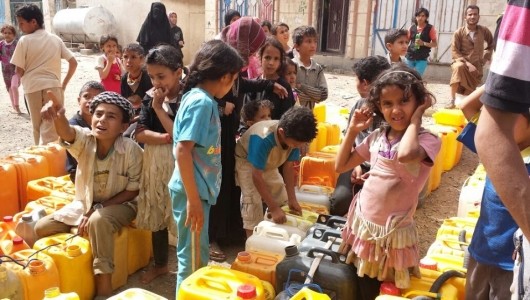
Many people in the country do not have nearby access to water sources and have to walk for miles every day. The limited amount of water sometimes results in clashes within communities.

In the past, wealthy business owners and merchants have paid for trucks to bring water to the poor. However, the trucks wasted a lot of water since they did not offer an effective method of collection. To rectify this inefficiency, the water tanks that CARE installed are permanent. They allow for people to obtain water with ease and less conflict.

Airstrikes and a naval blockade, however, have been preventing essential supplies, such as fuel and food, from reaching Yemen. Because of the lack of fuel, prices have soared and the cost to ride the bus has doubled. Service has also become undependable and people have switched to riding bikes for transportation.

The closure of many Yemeni schools poses another issue. Yemen has a very large population of young people and the majority of them are unemployed and out of school. This leaves them susceptible to recruitment into dangerous militant groups.

Yet, Yemen’s youth are finding ways to stay out of trouble and bring about dramatic change. For example, they initiate groups that spread awareness about issues like women’s rights. Women are fighting for the right to ride bicycles, which is traditionally not allowed in Yemen.

They turn destroyed buildings and windows into art and paint messages of peace all over their cities. Young people are passionate about promoting peace and developing their nation.

The United Nations Development Program gives out a yearly National Award for the Best Innovative Small Business Plan to Yemeni youth. Young people are able to submit smart business ideas for a chance to make their ideas into an entrepreneurship opportunity.

The goal of the award is to kick start the motivation and genius of Yemen’s youth, as well as generate new opportunities for employment. With the award, young people start their own businesses to contribute to their community and the nation’s developing economy.

The youth’s ability to take their lives and future into their own hands also grants them a hearty amount of satisfaction and self-esteem. There are five winners chosen who each are given $20,000 and support from the UNDP while executing their idea.

At the moment, Yemen receives funding from organizations like CARE. But even without aid in the future, the youth hope to keep inspiring progress and peace.

– Lillian Sickler

Sources: CARE, Yemen Innovation And Creativity Award, The Globalist
Photo: Care

July 9, 2015
https://borgenproject.org/wp-content/uploads/borgen-project-logo.svg 0 0 Borgen Project https://borgenproject.org/wp-content/uploads/borgen-project-logo.svg Borgen Project2015-07-09 10:25:302024-05-24 23:48:54The Youth of Yemen Promote Peace
Food & Hunger, Global Poverty, Politics and Political Attention, Water

5 Facts about Poverty in Yemen

Poverty in Yemen
As one of the poorest countries in the Middle East, Yemen is currently faced with some of the most extreme poverty issues in the world. There are several issues that are unique to Yemen that contribute to this magnitude of poverty, issues that are on track to only get worse unless direct action is taken to mitigate these circumstances. If basic problems, such as lack of access to water, are not properly addressed, other matters, such as sub-par literacy rates, will continue to plague the region and exacerbate poverty in Yemen.


Top 5 Facts about Poverty in Yemen


1. Yemen’s population stands at 25.4 million and approximately 54% of those people live in poverty.  In other words, 54% of the population survives on fewer than 2 dollars per day.

2. Approximately 45% of the population is malnourished.

3. Life expectancy in Yemen is 64 years old, 14 years younger than the average life expectancy in the United States.

4. Major infectious diseases plaguing the country include Bacterial diarrhea, Typhoid fever, Dengue fever and Malaria, all of which are preventable, curable and in some cases largely unheard of anymore in the western world.

5. There is less than 1 physician for every 1,000 people in Yemen.


Major Causes Behind Poverty in Yemen Today


  • The dire water shortage: The use of the word ‘dire’ cannot be stressed enough. According to Maplecroft, a global risk analysis organization, Yemen is ranked as the seventh most water-stressed country on the planet. Even though there is a water shortage in Yemen, approximately 90% of the country’s water is put towards its largely ineffective agricultural practices. In Yemen’s capital city, Sana’a, tap water is only available once every four days for its 2 million people. Even worse, in Taiz, a major city in the south, tap water is only available every 20 days. It is estimated that in 10 years, Sana’a will literally run out of water for its citizens.
  • On the brink of famine: In mid-2012, several major humanitarian relief organizations issued a warning that 44% of the population’s food needs are not currently being adequately met. Five million of these malnourished Yemeni citizens require emergency aid and immediate action. The warning cited a surge in food and fuel prices and political instability as the cause behind the number of malnourished people doubling since 2009. Though there is food available in some cases, many Yemenis cannot afford to buy nourishment because they have been displaced from their homes due to conflict.
  • Lingering political instability: Like most of the Middle East, Yemen felt the effects of the Arab Spring in 2011. The initial uprising was centered on protesting high unemployment, economic conditions and government corruption, which included the then president’s plan to alter the constitution to allow the direct transfer of power to his son. Al-Qaeda also has a presence in the region, which further contributes to political instability. For these reasons and many others, the attempt to reach stability within the government and the region is an ongoing process. After significant fighting and the displacement of hundreds of thousands of citizens, a new president was placed in power after running uncontested in an election. The new president is responsible for overseeing the drafting and implementation of a new constitution and further presidential and parliamentary elections in 2014.

– Colleen Eckvahl


Sources: BBC: Yemen’s President cedes power, BBC: Yemen on brink of food crisis, Green Profit, Maplecroft, The World Bank


December 11, 2013
https://borgenproject.org/wp-content/uploads/borgen-project-logo.svg 0 0 Borgen Project https://borgenproject.org/wp-content/uploads/borgen-project-logo.svg Borgen Project2013-12-11 09:00:582018-01-11 14:34:255 Facts about Poverty in Yemen
Page 5 of 512345

Get Smarter

  • Global Poverty 101
  • Global Poverty… The Good News
  • Global Poverty & U.S. Jobs
  • Global Poverty and National Security
  • Innovative Solutions to Poverty
  • Global Poverty & Aid FAQ’s
Search Search

Take Action

  • Call Congress
  • Email Congress
  • Donate
  • 30 Ways to Help
  • Volunteer Ops
  • Internships
  • Courses & Certificates
  • The Podcast
Borgen Project

“The Borgen Project is an incredible nonprofit organization that is addressing poverty and hunger and working towards ending them.”

-The Huffington Post

Inside The Borgen Project

  • Contact
  • About
  • Financials
  • President
  • Board of Directors
  • Board of Advisors

International Links

  • UK Email Parliament
  • UK Donate
  • Canada Email Parliament

Get Smarter

  • Global Poverty 101
  • Global Poverty… The Good News
  • Global Poverty & U.S. Jobs
  • Global Poverty and National Security
  • Innovative Solutions to Poverty
  • Global Poverty & Aid FAQ’s

Ways to Help

  • Call Congress
  • Email Congress
  • Donate
  • 30 Ways to Help
  • Volunteer Ops
  • Internships
  • Courses & Certificates
  • The Podcast
Scroll to top Scroll to top Scroll to top