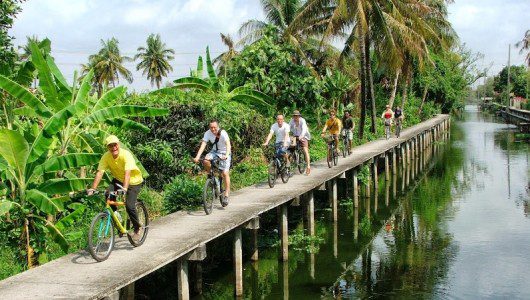
For two bicycle tour companies, biking in Bangkok is more than a tour. These two extraordinary companies not only give excellent guided tours of the hidden gems of this city, but also have significant impacts on the poverty in and around Bangkok.
Bangkok, the coastal capital of Thailand has two seasons, covers 606 sq miles, and 18 million residents, and approximately 1.5 million slum dwellers. There are over 400 Buddhist temples and thousands of other tourist attractions including the Royal Palace and the famous Khaosan Road. One could spend a lifetime discovering new parts of Bangkok. As a tourist with limited time, the best way to see the real Bangkok is to pound the pavement with locals.
The first bicycle tour company is Co van Kessel. Mr. van Kessel, a Dutch ex-patriot, started the tour company over 30 years ago. Frustrated with the image of Bangkok as a city of uninhibited urban sprawl, grid-lock traffic and suffocating pollution, Mr. van Kessel started a bicycle tour company to change this image. His was the first bicycle tour company in Bangkok and has been working towards making Bangkok a cyclist-friendly city ever since.
In addition to being an entrepreneur, Co van Kessel bike tour company is also generous with their time and money. They often donate money to local charity organizations. Additionally, every year they donate bicycles that are unfit for tours but still in good working condition to villages in the north of Thailand. The bicycles serve the villagers as their primary form of transportation thereby allowing them to pursue livelihoods otherwise unavailable.
The second, Recreational Bangkok Biking (RBB), is also run by a Dutch ex-patriot, Andre Breuer. RBB offers several different tours each with their own extraordinary sights. They offer a variety of walking, biking, rickshaw, boat and combination tours throughout the city. Their goal is to give tourists a chance to see what Thai life is really all about—colorful markets full of sounds and smells that make your whole body tingle, daily life along the canals that wind through the city, and stretches of green space one could hardly imagine existed when limited to main tourist areas.
What makes this company stand out is not only the high quality of the tours but also the social commitment Mr. Breuer insists on. His employees are local, mostly low-class Thais. The employees start out as bicycle mechanics and learn English through interacting with foreigners—two skills that are extremely valuable to enhancing their living standards. The restaurants, food stands, boat drivers, and bicycle repair establishments are locals, mostly slum dwellers. Mr. Breuer also uses his influence and business network to help fund a local orphanage, the Mercy Center, and a kindergarten. (Mercy Center is located in the largest slum in Bangkok, Khlong Toey and serves as an orphanage and rehabilitation center for those with AIDS.) Tourists have the option of stopping at the school and talking to the children, who learn English from their frequent interactions.
It is easy to get sucked into the tourist traps in Bangkok. Everyone wants to take you for a ride. Let yourself be taken by Recreational Bangkok Biking or Co van Kessel and you will not regret it!
– Katherine Zobre
Sources: Co Van Kessel , The Mercy Center
Photo: Google Plus

Biking in Bangkok is More Than a Tour
For two bicycle tour companies, biking in Bangkok is more than a tour. These two extraordinary companies not only give excellent guided tours of the hidden gems of this city, but also have significant impacts on the poverty in and around Bangkok.
Bangkok, the coastal capital of Thailand has two seasons, covers 606 sq miles, and 18 million residents, and approximately 1.5 million slum dwellers. There are over 400 Buddhist temples and thousands of other tourist attractions including the Royal Palace and the famous Khaosan Road. One could spend a lifetime discovering new parts of Bangkok. As a tourist with limited time, the best way to see the real Bangkok is to pound the pavement with locals.
The first bicycle tour company is Co van Kessel. Mr. van Kessel, a Dutch ex-patriot, started the tour company over 30 years ago. Frustrated with the image of Bangkok as a city of uninhibited urban sprawl, grid-lock traffic and suffocating pollution, Mr. van Kessel started a bicycle tour company to change this image. His was the first bicycle tour company in Bangkok and has been working towards making Bangkok a cyclist-friendly city ever since.
In addition to being an entrepreneur, Co van Kessel bike tour company is also generous with their time and money. They often donate money to local charity organizations. Additionally, every year they donate bicycles that are unfit for tours but still in good working condition to villages in the north of Thailand. The bicycles serve the villagers as their primary form of transportation thereby allowing them to pursue livelihoods otherwise unavailable.
The second, Recreational Bangkok Biking (RBB), is also run by a Dutch ex-patriot, Andre Breuer. RBB offers several different tours each with their own extraordinary sights. They offer a variety of walking, biking, rickshaw, boat and combination tours throughout the city. Their goal is to give tourists a chance to see what Thai life is really all about—colorful markets full of sounds and smells that make your whole body tingle, daily life along the canals that wind through the city, and stretches of green space one could hardly imagine existed when limited to main tourist areas.
What makes this company stand out is not only the high quality of the tours but also the social commitment Mr. Breuer insists on. His employees are local, mostly low-class Thais. The employees start out as bicycle mechanics and learn English through interacting with foreigners—two skills that are extremely valuable to enhancing their living standards. The restaurants, food stands, boat drivers, and bicycle repair establishments are locals, mostly slum dwellers. Mr. Breuer also uses his influence and business network to help fund a local orphanage, the Mercy Center, and a kindergarten. (Mercy Center is located in the largest slum in Bangkok, Khlong Toey and serves as an orphanage and rehabilitation center for those with AIDS.) Tourists have the option of stopping at the school and talking to the children, who learn English from their frequent interactions.
It is easy to get sucked into the tourist traps in Bangkok. Everyone wants to take you for a ride. Let yourself be taken by Recreational Bangkok Biking or Co van Kessel and you will not regret it!
– Katherine Zobre
Sources: Co Van Kessel , The Mercy Center
Photo: Google Plus
Fawzia Koofi Running in 2014 Election to be Afghanistan’s First Female President
Whether you identify as a feminist or not, no one can deny the courage of Fawzia Koofi, as she is running for the presidency in Afghanistan during the 2014 elections. President Karzai is set to reach his limit of two five-year terms in office and if Koofi succeeds, she will be Afghanistan’s first female president. As of now, Koofi chairs parliament’s women and human rights committee.
There is no doubt that Fawzia Koofi embodies the feminist movement and sends a clear message to the world; Afghanistan is progressing, despite the Taliban’s best efforts of terrifying women into suppression and out of politics. Seeing as Afghanistan was once known as the worst place in the world to be a woman, Koofi has managed to incite dramatic change in Afghanistan’s political climate.
After years of conflict, this potential change in leadership has restored faith in many of Afghanistan’s people. Afghanistan’s first female president would serve as a representation of endless opportunity and positive forward motion for the country’s youth. Koofi has said herself that there is a strong desire for change among young people and women throughout Afghanistan. Koofi emphasizes this in her new book, “Letters to my Daughters”.
“Being a woman in politics in Afghanistan and a woman who stands for what she believes in, there is always risk”, Koofi stated. Fawzia Koofi is well aware of the danger she is putting herself in, as her own father was a politician who was killed by assassination. However, she is determined, stating that “…change is possible; it’s just a matter of some political and moral support from our international friends.”
This leads to the question of how this political shift would impact the United States, particularly in the realm of national security. Koofi herself has asked that the United States continue its support for Afghan women’s rights, even after the withdrawal of troops in 2014. Her concern is that gains made for women’s rights in Afghanistan will be eradicated if the new president enters into reconciliation talks with conservatives, including Taliban insurgents. There is great concern among women in Afghanistan, as this settlement could lead to the Taliban sharing in power. Koofi sees this threat even now, stating that “Talibanisation is a process, people within government are already promoting Taliban ideology and Taliban thinking”.
Rebekah Russo
Source:Al Arabiya News
Can Genetically Modified Food End World Hunger?
Between smartphones, social media, electric cars, and other advances in electronics, technology is a rapidly growing industry. Usually, these advances are pretty well-accepted by the public as they can help increase efficiency, expand creativity, and even reduce our global footprint. What if there was a technology that could potentially end world hunger? Would it be readily embraced?
Genetically modified food has been available for decades and gives farmers the ability to produce more food in less time. Last year, over 17.3 million farmers opted to plant genetically modified food. Over 90% of those farmers were in developing nations that needed any extra food they could get. By 2050, the global population is expected to jump to a staggering 9 billion from the current 6 billion. Many people believe that standard food production methods aren’t enough to satisfy those 9 billion hungry mouths.
Genetically modified food is one area of technology that some people strongly oppose. Because so many people are against agriculture technology of this sort, the political and legal hoops that farmers must jump through to gain approval to plant and sell the products are intense and even hostile. And sometimes unnecessary. Alison Van Eenennaam, UC Davis animal genomics and biotechnology specialist, says “we and our livestock have consumed billions of meals and there hasn’t been one documented case of the [genetically modified] nature of the material consumed causing safety or health problems.” She also claims that in a world where the priority should be placed on feeding its ever growing population, the “absolutely precautionary, prohibitively expensive, time-consuming, uncertain regulatory approach to [genetically modified] plants and animals” is preventing the world from achieving that very goal.
– Katie Brockman
Source: Beef Magazine
Photo: Huffington Post
Room to Read: Helping Educate Children
Room to Read is a non-profit organization started by John J. Wood in 1999. He got the idea for the organization when he visited a school in Nepal one year during a vacation. There were 450 students at the school, yet there were no children’s books. The library only a had a few books that were inaccessible to the students. The following year, Wood quit his job at Microsoft and returned to Nepal with 3,000 books to build a functioning library for the children. This was how Room to Read began.
Wood believes that simply coming into a country, building a library or school, and then leaving does not completely fix the problem. Instead, he says that prolonged community involvement is key. Finding local librarians and teachers to encourage students to read and learn will create a ripple effect. It creates jobs for native citizens and gives kids an education. Everyone is more invested in the outcome that way because they are actively involved in the solution, and results will last longer than if they simply received a gift from someone in a foreign country.
He also encourages more affluent students and families to participate in raising money for Room to Read through ‘sponsored silence’ programs and Read-a-thons. So far, Room to Read is established in 10 countries and will have helped 10 million kids by 2015. Other accomplishments include building 15,000 libraries and 1,600 schools, publishing 850 original children’s books, and enrolling 20,000 girls in a special girl’s education program.
– Katie Brockman
Source New York Times
Photo: Room to Read
Greater Investment Required For Universal Energy Access
4 million lives are lost each year to household air pollution. This means that annually, a population roughly the size of Los Angeles dies as a consequence of traditional cooking methods still practiced by poverty stricken families of the global south. In an attempt to raise awareness of the need for the adequate power grids necessary to ameliorate the toxic effects of indoor air pollution, policymakers are calling for increased funding towards universal energy access.
Researchers at the International Institute for Applied Systems Analysis (IIASA) in Austria recently published a study showing that an annual investment of between 65 to 86 billion dollars a year for the next 17 years would allow for universal energy access. Why is universal energy access the solution to indoor air pollution? In order to reduce fatalities by up to 1.8 million by 2030, clean combusting cooking fuels and electric ovens must be made available –via greater energy investment – to poverty stricken areas.
Regarding universal energy access, IIASA researcher Dr. Shonali Pachauri remarked that, “The scale of investment required is small from a global perspective, though it will require additional financing for nations that are least likely to have access to sources of finances.”
Ingenious forecasting models generated from the study show that an investment of 750 to 1000 billion dollars over the next 20 years – or 3 to 4% of current energy investments – would facilitate universal energy access. Furthermore, through these investments, a policy of fuel subsidies, new stoves, and improved access to electricity would all serve to dramatically reduce the casualties of indoor air pollution.
By enacting a policy of universal energy access now, future generations of poverty stricken families can enjoy the safety of cooking without the carcinogenic side effects of indoor air pollution. Dr. Pachauri optimistically notes that achieving this goal will result in signicant health benefits.
–Brian Turner
Source: Science Daily
Photo: Building A Smarter Planet
Cassava Beer Enables Economic Development in Ghana
When people think about Africa, breathtaking savannas teaming with migratory wildlife is generally the first thought that comes to mind. What doesn’t come to mind, however, is a robust micro-brewing industry that utilizes the fermentation properties of the locally sourced cassava plant. In an attempt to challenge previously held notions regarding beer brewing in Africa, production of Impala brand cassava beer is helping to usher in new economic opportunities for Ghanaian farmers.
Thanks to the investment of brewer SABMiller, Impala beer – brewed from the cassava plant – was recently launched in Ghana. How does cassava beer help economic development in Africa? Until recently, cassava farming had been dismissed as an economic failure due to the high costs associated with transferring and processing the root-like product.
Enter innovative DATCO engineers and their ingenious development of a mobile cassava processing unit that enables cassava harvesting to be economically feasible. So for those rural cassava farmers previously hampered by transportation constraints, the new processing units and subsequent production of cassava beer will help to bolster demand for their crops, leading to greater economic gains.
In regards to SABMiller’s investment in cassava beer and the economic benefits to local farmers, Accra Brewery Director Adjoba Kyiamah noted that though more than 70% of Ghanaian farms, most of which grow cassava, are 3 hectares or smaller, there is a current annual surplus of around 40%.
The economic possibilities that stem from both the production and sales of Impala brand cassava beer are nothing less that astonishing, and underpins the business sustainability currently lacking from many developing countries. Remarked SABMiller Director Mark Bowman, “The idea here then is to try and create a win-win proposition, where we have a strong group of farmers contracted to producing grains for us of whatever form.”
–Brian Turner
Source: How we Made it in Africa
Photo: Hanna Clark Steinman
Isabel Dos Santos Africa’s First Female Billionaire
Isabel Dos Santos, the daughter of Angolan president Jose Eduardo Dos Santos, is Africa’s first female billionaire. Dos Santos is an Angolan investor, and according to Forbes, she has become the Africa’s wealthiest female, reaching a net worth of more than a billion USD. She ranks in at 736 richest person in the world overall and thirty-first in Africa.
The president’s daughter works to keep her prowess as a businesswoman separated from the political field. However, she has received sharp criticism as to how she acquired her wealth. President Dos Santos has been accused of enriching his family at the expense of normal Angolans- a country where a majority of the population lives on $2 a day. Problems come into play here because it is nearly impossible to trace the sources of her funds. There is a complete lack of transparency and many of her business transactions are approved and transferred by her father.
Dos Santos has invested in several publicly traded companies in Portugal as well as Angola. She has significant shares in a cable TV firm, as well as assets in at least one Angolan bank. Although, exactly how she got the funds remains unknown.
Dos Santos commands the biggest percentage of shares in Zon Multimedia, which is the largest cable TV operator in Portugal. She also holds 19.5% holding at Banco BPI- one of Portugal’s largest publicly traded banks. In Angola, Dos Santos sits on the board of Banco BIC and is reported to own as much as a 25% stake in the bank.
Angola has emerged from a civil war and developed into one of Africa’s largest economic contributors. This economic growth, however, has not come without problems. Angola has been criticized for its dramatically unequal society, ranking 148th of 187 countries on the U.N Human Development Index. Additionally, they have ranked 157th of 176 countries on Transparency International’s Corruption Perceptions Index.
– Caitlin Zusy
Source Forbes, Guardian
Are U.S. Farmers Hurt by Food Aid Reform?
Are US farmers hurt by food aid reform? The short answer: No.
President Obama’s proposal to allow the food aid supplied by the United States to be purchased more locally has obvious benefits: less travel time and expense to feed those in the greatest danger, bolstering local economies, investing in local agriculture to create a sustainable supply, and the potential of feeding 2-4 million more people.
These are obvious benefits unless you are an American farmer, packer or shipper, the three main interested parties (other than the millions of hungry around the world). These minders are not without questions of their own.
For example, one might wonder how purchasing a larger percentage of the food aid from non-US farmers is reconciled with USAID’s mission of expanding external markets for US goods?
The food crises require immediate response. According to the World Food Program, hunger kills more people than AIDs, Malaria, and TB combined. Preventable deaths per year due to malnutrition are measured in the millions. A shipment from the United States can take many weeks — time the vulnerable simply do not have. Purchasing local produce reduces the time from farm to mouth by 11-14 weeks and feeds an extra 2-4 million people.
Preventing deaths by malnutrition and all the suffering, humiliation, and diseases that go along with it allows for medium and long-term development. Medium to long-term development expands peace and US markets of goods, services, travel and tourism.
How, one may also wonder, do American farmers benefit when their jobs are outsourced and market share displaced?
US farm exports are worth around $145 billion. The US government spends $1 billion on food aid programs—a “drop in the market” compared to the enormous figure of US farm exports. Even an economist from the American Farm Bureau Federation admits, “Our concern is less about decreasing an important revenue stream for U.S. agriculture. It’s more about the loss of a sense of pride.” Despite the minimal impact, the reform proposal includes $25 million to ease the transition of US farmers affected.
Are US farmers hurt by food aid reform? With no significant job losses and no significant market share loss, US farmers’ pride cannot justify denying food to 4 million hungry people deserving of the same dignity and opportunities as them.
– Katherine Zobre
Sources: USAID, The Economist, World Food Program, Reuters
Personal Banking to End Poverty
2.5 billion people around the world, many of whom live in extreme poverty, are excluded from the formal financial system. Consequently, this exclusion results in the use of risky and expensive financial alternatives that slow individual and macro-level economic development. In the past, microcredit schemes have been used to solve the problem. Recently, a more holistic understanding of financial inclusion is emerging that focuses on savings, credit, financial literacy, and access to services. However, as these new systems take root, debate can be heard in regards to how the systems should be implemented, who the stakeholders will be, and how to ensure that this new financial ecosystem will function in the long-term.
These issues were addressed in early April at a Guardian conference where Banking on Change outlined the future of the financial ecosystem in developing countries. Banking on Change is a partnership between Plan UK, CARE International UK and Barclays that hopes to help around 400,000 people in 11 countries by developing access to basic financial services. The organization has used savings-led community finance groups in poor communities to help people save, build up assets, access loans from the community “pot”, develop financial literacy and eventually link into formal services. The scheme showed that due to erratic incomes, poor people have a high demand for savings accounts and products in contrast to credit lines and accounts.
Living conditions and finances aside, Ashok Vaswani, Barclays’ CEO for retail and business banking in the UK, Europe and Africa, believes that all people are the same. “People’s hopes and aspirations don’t vary too much,” he said. “We all have them, and people who live in much worse conditions than us have hopes and aspirations that are not very different to ours. They want to send their children to school. They want more for their children, just like we do. People with limited means still have the desire to move up, to put something away.” The difference is that people living in poverty do not have sufficient means to even start a savings account. Vaswani also believes that the money that potential customers save annually, about $58 multiplied by the 2.5 billion people living in financial exclusion, could be much more powerful if linked into the formal financial system rather than stashed under people’s beds.
Aside from defining the customer’s needs, financial literacy is important to the development of the financial ecosystem as well. Governments should do more in educating citizens, especially the youth, about their finances, commented Michaela Kelly, head of Plan’s Programme Delivery Unit.
As the demand for personal banking increases, the needs of potential customers will need to be assessed accordingly. While many view various forms of credit building important, savings accounts and related programs are just as important to the beginning of a financial ecosystem in developing countries. With the implementation of a financial system, both individual and macro-level, economic development will flourish and raise billions of people out of poverty.
– Kira Maixner
Source: The Guardian
Photo: Business Fights Poverty
Tracking Chinese Aid to Africa
Amidst a flurry of excitement and criticism, AidData released their latest project: a dataset tracking Chinese aid to Africa. This user-friendly free dataset has sparked debate among policy, practitioner, and academic circles.
The data compiles China’s official and unofficial projects between 2000-2011. During this time-period, China committed to 1,673 projects amounting to US$ 75.4 billion. For reference, the US committed US$ 90 billion over the same time-period.
In policy, critics point to the definitions of aid used by AidData in tracking Chinese aid to Africa. Under the OECD classification of aid, China has only invested US$ 1.1 billion over the decade. Academics and practitioners share concerns over the validity of the data and media analysis data collection method. Among the critics are Professor of international development at Johns Hopkins University, Deborah Brautigam, Duncan Green of Oxfam, and Andy Norton of Overseas Development Institute. Brautigam cites her research as having vastly different numbers resulting in reordering of the top recipients.
AidData responded to the critiques by stating that the dataset is a public good and practitioners should make their own conclusions about the policy implications. To the criticism that the data is incorrect and controversial method too risky, AidData responded that “media reports, though imperfect, are often the best means available to track Chinese development finance” citing Brautigam’s own critique as evidence. AidData stresses that the data is a work in progress relying on efforts from many organizations, individuals and experts to find and correct mistakes.
– Katherine Zobre
Sources: China AidData , Japan Times , Devex Impact , AidData Rejoinder to Rubbery Numbers,
Photo: The ChinAfrica Project