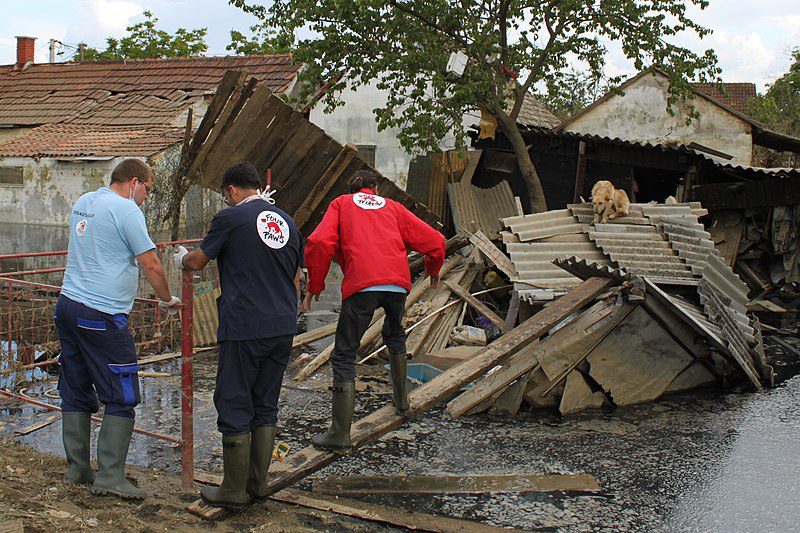
The number of natural catastrophes surpassed the 1,000 mark in 2015 for the first time, according to the United Nations Development Plan (UNDP). The UNDP estimates the total cost from those disasters to be over $90 billion. Only 30 percent of this amount had insurance. Disaster risk insurance benefits places that experience natural disasters because it helps combat them.
Many expect that the frequency of these disasters will grow as populations continue to increase and weather patterns remain unpredictable. Moreover, disaster and development strongly link together which takes away key investment. The poor are more susceptible to disasters due to their inability to uproot their lives and the overcrowded conditions in which they often live.
Between 1991 and 2010, the Overseas Development Institute found that approximately 81 percent of the deaths that disasters caused were people in a lower-middle or low-income status. Ninety-three percent of these deaths came from developing countries.
The Disaster Risk Financing and Insurance (DRFI) Program
Established by the World Bank in 2010, the DRFI program seeks to provide funding and skills to help developing countries establish financial protection strategies. This program seeks to assist national and local governments, as well as businesses, homeowners, agricultural producers and the low-income population altogether. This program implements protection strategies with the goal in mind for the affected country to continue its development strategies while recovering from natural disasters.
How it Works
In 2018, the World Bank issued disaster risk insurance to Mexico, Peru, Columbia and Chile. These four countries are located along the western end of the Pacific Rim, a ring of seismic activity that surrounds the Pacific Ocean. Due to location, these countries are susceptible to damaging earthquakes.
The disaster risk insurance came in the form of a catastrophe bond of $1.36 billion split between the four countries for coverage against earthquakes. The World Bank stepped in to oversee the creation of the bonds and help the countries find investors. Once the World Bank secured investors, many of which were large insurance companies or hedge funds, investors receive a premium for the coverage as payment. Should a big enough earthquake hit one or more of the member countries within the designated time frame of three years, an investor would pay a predetermined portion of the principal of the bond to the affected country.
The African Risk Capacity Insurance Limited
An example of disaster risk insurance outside the operations of the World Bank is the African Risk Capacity. The African Risk Capacity includes countries across Africa and development partners support it. Each member pays into a pool of funding which then goes to countries that do not receive a predetermined quota of rainfall. Within two to four weeks of the rainfall season coming to an end, money goes to the affected countries to help their citizens.
In September 2019, the organization issued a payout of $738,835 to the government of the Republic of Côte d’Ivoire after it suffered through a severe drought. The drought affected an estimated 400,000, but the payout will reportedly help up to 32,496 individuals across 6,500 households through a cash transfer program. The CEO of African Risk Capacity, Dolika Banda, stated that the payout is to target women and female-headed households directly because of the disproportionate effect disasters have on women.
Since 2014, the African Risk Capacity Agency has received $73 million in premiums for a total coverage of $553 million toward the protection of 55 million people across the member states.
Disaster Risk Insurance Benefits
While not suitable for preventing damage, disaster risk insurance benefits exist. Insurance can provide greater economic stability and help prevent deaths in the aftermath of disasters. In these times, communities often suffer from a resource shortage that easily accessible capital can assist.
Governments have limited debt because the investments their countries use to rebuild comes from the outside. Disaster risk insurance also provides incentives for risk reduction efforts by offering lower premiums.
While these financing efforts are not a catch-all solution to the damaging effects of natural disasters, they can be a critical tool to help prevent developing countries from regressing.
– Scott Boyce
Photo: Wikimedia Commons

5 Facts About Sex Education in India
5 Facts About Sex Education in India
This biggest barrier toward sex education in India will probably be cultural norms against talking about sex. These norms are heavily ingrained in Indian society. However, India is making small but important steps to provide more comprehensive sex education.
– Emily Joy Oomen
Photo: Flickr
Disaster Risk Insurance Benefits
The number of natural catastrophes surpassed the 1,000 mark in 2015 for the first time, according to the United Nations Development Plan (UNDP). The UNDP estimates the total cost from those disasters to be over $90 billion. Only 30 percent of this amount had insurance. Disaster risk insurance benefits places that experience natural disasters because it helps combat them.
Many expect that the frequency of these disasters will grow as populations continue to increase and weather patterns remain unpredictable. Moreover, disaster and development strongly link together which takes away key investment. The poor are more susceptible to disasters due to their inability to uproot their lives and the overcrowded conditions in which they often live.
Between 1991 and 2010, the Overseas Development Institute found that approximately 81 percent of the deaths that disasters caused were people in a lower-middle or low-income status. Ninety-three percent of these deaths came from developing countries.
The Disaster Risk Financing and Insurance (DRFI) Program
Established by the World Bank in 2010, the DRFI program seeks to provide funding and skills to help developing countries establish financial protection strategies. This program seeks to assist national and local governments, as well as businesses, homeowners, agricultural producers and the low-income population altogether. This program implements protection strategies with the goal in mind for the affected country to continue its development strategies while recovering from natural disasters.
How it Works
In 2018, the World Bank issued disaster risk insurance to Mexico, Peru, Columbia and Chile. These four countries are located along the western end of the Pacific Rim, a ring of seismic activity that surrounds the Pacific Ocean. Due to location, these countries are susceptible to damaging earthquakes.
The disaster risk insurance came in the form of a catastrophe bond of $1.36 billion split between the four countries for coverage against earthquakes. The World Bank stepped in to oversee the creation of the bonds and help the countries find investors. Once the World Bank secured investors, many of which were large insurance companies or hedge funds, investors receive a premium for the coverage as payment. Should a big enough earthquake hit one or more of the member countries within the designated time frame of three years, an investor would pay a predetermined portion of the principal of the bond to the affected country.
The African Risk Capacity Insurance Limited
An example of disaster risk insurance outside the operations of the World Bank is the African Risk Capacity. The African Risk Capacity includes countries across Africa and development partners support it. Each member pays into a pool of funding which then goes to countries that do not receive a predetermined quota of rainfall. Within two to four weeks of the rainfall season coming to an end, money goes to the affected countries to help their citizens.
In September 2019, the organization issued a payout of $738,835 to the government of the Republic of Côte d’Ivoire after it suffered through a severe drought. The drought affected an estimated 400,000, but the payout will reportedly help up to 32,496 individuals across 6,500 households through a cash transfer program. The CEO of African Risk Capacity, Dolika Banda, stated that the payout is to target women and female-headed households directly because of the disproportionate effect disasters have on women.
Since 2014, the African Risk Capacity Agency has received $73 million in premiums for a total coverage of $553 million toward the protection of 55 million people across the member states.
Disaster Risk Insurance Benefits
While not suitable for preventing damage, disaster risk insurance benefits exist. Insurance can provide greater economic stability and help prevent deaths in the aftermath of disasters. In these times, communities often suffer from a resource shortage that easily accessible capital can assist.
Governments have limited debt because the investments their countries use to rebuild comes from the outside. Disaster risk insurance also provides incentives for risk reduction efforts by offering lower premiums.
While these financing efforts are not a catch-all solution to the damaging effects of natural disasters, they can be a critical tool to help prevent developing countries from regressing.
– Scott Boyce
Photo: Wikimedia Commons
5 Millennial Celebrities Fighting Poverty
The term “millennial” is one that has garnered some negative attention in the past decade in that many associate the generation with adjectives like “lazy” or “entitled.” While there are people of all dispositions and work ethics in every generation, the following is a list of five millennial celebrities fighting global poverty and challenging stereotypes about their age group.
5 Millennial Celebrities Fighting Global Poverty
These five millennial celebrities are breaking down negative stereotypes about their generation and serve as inspiring role models for the world when it comes to reducing global poverty. These celebrities’ efforts and generosity are changing the lives of countless impoverished people around the world for the better.
– Hannah White
Photo: Flickr
Saving Kidnapped Children in India
The Hidden Industry
Child trafficking is a common problem around the world. It is an industry with 20.9 million victims around the world ranging from the ages of 1 to 18. Victims are most likely to come from poor families, particularly if they are living in an abusive home situation. Captors may lure victims into captivity with the false promises of school or work. Fifty percent of all people who suffer kidnapping and trafficking are children. Two out of three kidnapped children are girls.
In India, reports determine that 90,000 children go missing every year. The most common reason for child trafficking is that people see children as cheap sources of labor. As a result, kidnappers may tear them from their families so they never hear from them again. In these cases, the family may or may not know what is actually happening to the child. Children may also experience kidnapping for other reasons.
For many years, Indian authorities turned a blind eye to this problem. Since India did not consider child labor a crime, it had no reason to stop those who wished to exploit children for labor. However, in 2007, the remains of 17 women and children were found in a sewer beneath the suburb of Noida in Delhi. Authorities arrested the two men responsible, but civilians accused the officers of incompetence and began protesting against police negligence. Since authorities were no longer able to ignore the problem, they had no choice but to find a solution.
Technology Saves Children
Today, Indian police are saving kidnapped children in India with facial-recognition technology. The technology entered into widespread use on April 6, 2018, after India’s High Court ruled the test run of the software successful. In 2018, authorities used facial-recognition software to find nearly 3,000 missing children and reunite them with their families. Some people raise concerns that the widespread use of facial-recognition technology could be a breach of privacy. However, the National Commission for the Protection of Child Rights points out that finding and returning missing children to their families is worth it.
The Future
Child trafficking has been a problem around the world for a long time. Child trafficking has affected India more than most countries, and this is primarily due to the high number of poor families. Fortunately, facial recognition is saving kidnapped children in India. This practice is still in its infancy, but the results look promising so far.
– Cassie Parvaz
Photo: Flickr
Oil Find and Economic Growth in Guyana
Guyana discovered oil off its coast in 2015 and is on the brink of major economic growth. According to the International Monetary Fund (IMF), the projected economic growth in Guyana for 2020 is 86 percent. The projected growth rate is high for 2020 due to ExxonMobil’s oil find in the Caribbean Sea in 2015, which brought hope for change to poor Guyanese. For 2019, GDP growth was 4.4 percent, almost double from the previous year, and the 86 percent projected growth by the IMF shows an increased interest in the development of Guyana. Oil production in 2020 and in the future could bring economic growth in Guyana and add thousands of jobs.
A Potential Future in Oil
Guyana found an estimated 3.2 billion barrels of oil off its coast, with oil production beginning in late December 2019. More than 1,700 Exxon employees are working on extracting oil from Stabroek Block, the oil reservoir, and transporting oil to the Liza Destiny, a storage and offloading vessel. About 50 percent of the 1,700 workers are Guyanese. Exxon expects to produce 120,000 barrels of oil a day in 2020 and estimates 750,000 barrels a day by 2025. The 2025 estimated production would position the South American country in the top 30 countries for oil production. The 750,000 barrels a day estimate would be more oil than India produced daily in 2018. This is one reason for the IMF’s projection of a high growth rate for Guyana, as oil could transform the economy.
Uses of Future Revenue
Oil production in 2020 is exciting Guyanese about the possibilities of changing the country and its people. President David Granger commented, “Every Guyanese will benefit from petroleum production. No one will be left behind.” Guyana’s GDP per capita is about $8,100, which ranks among the lowest in the world. With oil now in production, there is potential to improve its lagging infrastructure and low income. Guyana only has about 500 miles of paved roads, yet almost 2,000 miles of unpaved roads. The President stated that oil could transform the developing country and improve life for hundreds of thousands of Guyanese.
Guyana’s government expects oil revenue of $300 million in 2020 and $5 billion for 2025. This could further enhance economic growth in Guyana and bring the possibility of distributing the money to lagging sectors. In 2019, the government spent $2 billion in its infrastructure. This included constructing or upgrading roads, bridges, highway lights and drains. The East Coast of Demerara Road Widening Project affects more than 100,000 of Guyana’s 777,000 population. Guyana approved about $500 million for the project that focuses on upgrading roadways along the coast. Most of the population resides near the coast and along the Demerara River. Guyana could not only use oil revenue to further develop Guyana but also to add jobs, as the ExxonMobil operation is already showing.
The Impact of Guyanese Oil Revenue
There is steady economic growth in Guyana, as one can witness from its GDP rising from 2.1 percent in 2018 to 4.4 percent in 2019. The IMF’s projected 86 percent growth rate for Guyana in 2020 expresses big expectations for the South American country. Although Guyana’s potential future wealth is good news, the developing country will need support in transforming its newfound wealth into positive change for its people. Every poor country that strikes oil does not always manage natural resources well, yet with the right tools and guidance, Guyana could reduce its 35 percent poverty rate by adding jobs and transforming into a developed economy.
– Lucas Schmidt
Photo: Wikipedia Commons
10 Facts About Girls’ Education in Macedonia
The Republic of North Macedonia, commonly referred to as Macedonia, is a republic in the Balkan Peninsula. After the country’s independence from Yugoslavia in 1991, Macedonia had a tumultuous relationship with Greece. Macedonia became a U.N. member in 1993, and in 1995, Greece and Macedonia agreed to ease tensions in their relationship. After Macedonia’s 29 years of existence as a nation, girls’ education in Macedonia is coming into the spotlight as part of the country’s initiative to improve its education system. Here are 10 facts about girls’ education in Macedonia.
10 Facts About Girls’ Education in Macedonia
While there is certainly room for improvement in girls’ education in Macedonia, it is clear that the Macedonian government is taking steps toward improving education. Girls’ education in Macedonia is not a singular issue of gender discrimination. Rather, it is a diverse issue that has its roots in socio-economic backgrounds and race of the girls in Macedonia. With the help of international groups such as OECD and UNICEF, the Macedonian government is improving the education of girls.
– YongJin Yi
Photo: Flickr
Indonesia Ends Child Marriage
The Problem
In Indonesia, the general consensus is that if a girl has any association with a boy to whom she is not related, they marry as soon as possible. The assumption is that any heterosexual relationship can and will lead to sex and pregnancy. Girls are often pressured into marriage at a young age.
The New Movement and Its Implications
Indonesia’s 1974 Marriage Law permits girls as young as age 16 to get married. However, under Indonesia’s 2002 child protection law, anyone under the age of 18 is considered a child. These competing laws create a situation where girls still marry young despite legally being children.
The Future for Indonesia
Child marriage remains a problem in Indonesia even as the world enters a new decade. Girls feel pressured to marry young and may not wait until the legal age to do so. Therefore, the country still needs to work to change the attitudes of its citizens. However, if Indonesia ends child marriage by raising the minimum age required to marry, maybe it will help encourage these girls to stay in school.
– Cassie Parvaz
Photo: Wikimedia Commons
Digital Cash Transfers in Cote d’Ivoire
The Rise of Mobile Money in Cote d’Ivoire
From 2012 to 2018, the number of active mobile money users grew from less than 1 million to more than 9 million. Of note, the number of mobile cellular subscribers increased from 18.1 million to 33.81 million during the same time frame. With a population of less than 28 million, it is evident how popular the use of technology is becoming in the country. Ivorians have adapted to using mobile money for several reasons:
How the Cash Transfer Program Works
According to the World Bank, the program operates as follows: “(i) a targeting system for cash transfers; (ii) a social protection household registry; (iii) a cash transfer payment system using digital mobile money technology; and (iv) management information system and capacity-building.”
For the actual transferring of money, the government of Cote d’Ivoire has partnered with the digital financial service organization, Orange. The Account of the Ministry of Social Protection sends a wire transfer to Orange. Then, it creates e-money and puts it into the digital accounts of the intended recipients. The recipients can then access and use their money electronically or cash-out.
Initial Constraints of the Program
Successes of the Program
Peer-to-peer and community-oriented training focus on increasing knowledge surrounding the operation of devices and building awareness about security best practices with accounts. Those without a proper state-issued ID have been informed on how to obtain one. In addition, exemptions have been provided which allow beneficiaries to designate a trusted transfer recipient within the household or community. This led to 100 percent of beneficiaries receiving their payments in 2018.
By going digital, administrative and transactional costs are limited. As of April 2019, 300,000 poor individuals have benefitted from the program, more than half of whom are women. Additionally, as of the same date, 720,000 individuals have been registered with the social program’s registry. This expands the number of potential future social program beneficiaries.
Overall, the implementation of cash transfers in Cote d’Ivoire is an excellent example of how technology can assist those who are most financially vulnerable and most disconnected from the rest of society.
– Scott Boyce
Photo: Flickr
How Droughts in Zimbabwe Affect the Hunger Crisis
Temperatures in southern Africa are notable for their fluctuation which commonly causes climate disasters. These disasters are particularly devastating to Zimbabwe’s rural population of approximately 16 million people and its substantial community of farmers. The country’s landscape has suffered significant damage from unprecedented weather, particularly droughts. Efforts to scale up governmental assistance have skyrocketed since January 2019, which has accounted for much of the rise in the price of basic commodities. Below is a brief history of droughts in Zimbabwe, the many implications that they cause and the solutions that different aid efforts have come to.
History of Drought
Zimbabwe has a long history of droughts, which have cumulatively caused an increase in poverty. On a regional scale, droughts often result in crop failure, loss of livestock and wildlife and power outages. A report from the World Food Programme indicates that as of 2019, an estimated 2.3 million people suffered from poverty as a result of the country’s worst hunger crisis thus far. Citizens turn to government officials to assist in food shortages, and while weather within the region is a determining factor in food production, it is mostly up to different organizations to provide varied forms of food security.
The country’s worst drought happened in 1992, which many consider the most destructive one Zimbabwe faced in the 20th century. Water shortages forced the shutdown of many industries and schools. Due to poor harvests that year, regions across southern Africa faced a short-term supply in their food reserves. Zimbabwe’s food shortages caused a ripple effect, with aggravated food production compromising foods like corn to countries like Mozambique, which relied on Zimbabwe’s exports. Due to low rainfall, communal area farmers did not have any suitable locations for food production.
Solutions and Aid
Shortly after the regional drought, the humanitarian agency Cooperative for Assistance and Relief Everywhere (CARE) worked with Zimbabwe in order to build developmental programs that would increase accessibility to clean water and food. Programs that pilot cleaner VIP latrines, reinforce sexual and reproductive health and develop financial advocacy should increase household income, alleviate food insecurity and improve better access to markets.
In 2016, Zimbabwe declared a drought disaster as an estimated five million people faced food shortages. Shifts in weather patterns were a direct result of El Nino and La Nina, which refer to the periodic changes in sea temperatures in the Pacific Ocean.
The International Rescue Committee works to alleviate many of the economic struggles in Zimbabwe. Started in 2008 after a devastating cholera outbreak, the organization provides support to those afflicted by natural disasters. It will extend its strategy action plan to 2020, continuing to transfer direct cash transfers to low-income households, provide vouchers to farmers, assist in getting more food for livestock, deliver medical and emergency supplies, drill deeper wells and rehabilitate water plants.
The World Food Programme also plans to assist up to two million people in 2020. By March 2020, predictions determine that nearly 59 percent of rural households—5.5 million people—will be food insecure or in poverty. An estimated $173 million is necessary to allocate support to these regions. Many are saying that the hunger crisis will peak during the first three months of 2020, which is elevating the level of urgency for funding.
Recent Drought
Zimbabwe experienced another drought in December 2019, which ignited the worst hunger crisis the country has faced in nearly a decade. It has entered a “Phase 3” food crisis, which is just two steps below large-scale famine. Predictions estimate that this will extend into 2020, as poor macro-economy and germination rates continually affect crop production. In November 2019, farmers received only 55 percent of normal rainfall. Livestock losses have reached 2.2 million people in urban areas and 5.5 million in rural ones. An emergency operation is underway by the World Food Programme in order to assist the 7.7 million people who plunged into hunger. Partnerships with UNICEF and the Food and Agricultural Organization of the United Nations (FAO) are leading to more international efforts for resilience programs.
Implications of Drought
These droughts carry many logistical implications, leading to economic struggles as inflation rates go up, farmers undergo crop failure and food supplies grow scarce. Clean water, medical supplies and nourishing foods have become inaccessible and render much of the population food insecure and poverty-stricken.
Droughts in Zimbabwe hold many implications for the country’s current hunger crisis. Varying aid efforts are slowly pushing the region to a progressive standpoint. The limitations of food security, when it comes to natural hazards like droughts, illustrate a need to offer more aid to regions stricken by climate disasters. Efforts to mobilize aid in southern African are essential to curbing economic decline and creating sustainable communities.
– Brittany Adames
Photo: Flickr
Empowering 50 million women
Women face many barriers when it comes to entering the workplace, especially in developing countries. Societal norms in developing countries often prevent girls and women from pursuing an education. When women do not have an education, they cannot enter the labor force as easily and help cultivate the economy. This cultural practice hinders a developing country’s ability to procure economic growth and reduce poverty rates. The Women’s Global Development and Prosperity Initiative is empowering 50 million women.
The Women’s Global Development and Prosperity Initiative
The Women’s Global Development and Prosperity Initiative (W-GDP) is an initiative committed to delivering tangible results concerning women in developing countries. The three pillars of the initiative are: women prospering in the workforce, women succeeding as entrepreneurs and enabling women in the economy. It has been proven that when women have economic empowerment, there is a multiplier effect throughout the region. They invest more in their families and communities, which then promotes economic growth.
United States President Donald Trump established the W-GDP Initiative in February 2019 as the first total government movement to promote the economic empowerment of women across the globe. Funding for the initiative began in July 2019.
14 W-GDP Projects
This introduced 14 new projects and around 200 private-public partnerships from across more than 20 countries. The partnerships consist of foreign governments, multilateral donors, non-government organizations, the private sector and universities. These partnerships will allow the W-GDP to influence more than 100,000 women. The 14 projects are throughout developing countries.
In Papua New Guinea, Cardno Emerging Markets leads its partners in working to grow 40 enterprises led by women. It also plans to reform any discriminatory laws in the region that affect some 50,000 businesswomen. In Indonesia, Cargill and its partners are working together to increase the salaries for 2,000 enterprises led by women.
In the Philippines, UPS and its partners are increasing the salaries of 3,800 women and are working to remove obstacles that block full economic participation. In Chile, Brazil, Peru, Mexico and Colombia, big-name companies such as Citi and Google have formed a partnership within the private sector in order to provide efficient training for some 8,700 women.
In Liberia, Zambia, Tanzania, Ethiopia and Mozambique, Landesa and its private sector partners work to change any laws that limit women’s property rights. In Côte d’Ivoire, the International Rescue Committee and partners work to give job training to around 750 women in the solar energy industry.
In Benin, the Management Sciences for Health and its partners work together to reintegrate more than 170 female victims of gender-based violence into the workforce. This is going to happen via entrepreneurship and employment opportunities.
Ivanka Trump and the U.S. Agency for International Development Administrator (USAID), Mark Green, are going to run the initiative. Green strongly supports investing in women. He will oversee that the resources of the U.S. government will go towards helping women as much as possible.
The Future
By 2025, the W-GDP wishes to help in empowering 50 million women in the developing world. The plan is to achieve this through a new fund, private-public partnerships and U.S. government activities. The W-GDP will focus its resources on these five main points.
With these ambitious objectives, empowering 50 million women will be observable. It is propitious that in the coming years, women living in developing countries will enjoy abundant access to the economic sector.
– Nyssa Jordan
Photo: Wikimedia Commons