Information and stories on social activism.

Eva Mendes and Half the Sky

In late 2012, the Public Broadcasting Service (PBS) created a documentary about women living in developing countries called Half the Sky. This documentary examines the lives of many women in third world countries who have suffered through rape, prostitution, slavery, violent marriages, and other forms of oppression. By interviewing numerous women, Half the Sky is able to construct a common bond that promotes a sense of connectivity for all women and all humanity. Eva Mendes is one of the celebrities participating in this eye-opening project.

While the documentary takes the viewer to many different parts of the world, like Cambodia and Vietnam, Eva travels to Sierra Leone to talk to women about empowerment and to raise awareness of violence against females.

The film advocates women in leadership roles who advocate for women victims of rape and physical abuse. In one instance, a woman, who was abducted at the age of 13 and forced into prostitution, now provides shelter and counseling for girls who escaped from similar situations. Eva Mendes also had the opportunity to interview a particularly inspirational woman who had the courage to press charges against the men who raped her.

Half the Sky focuses on how women are fighting back against gender-based violence and paints a relatively optimistic future. Although in some societies female violence is still the norm, many women are attempting to create and implement the concept of women’s rights. It may be a long battle in some countries, but, as Eva Mendes notes, even small progress is worth celebrating.

It is easy for some documentaries to merely show story after story about women who have suffered from violence; Half the Sky is a different kind of documentary. It shows the viewer that even in the midst of discrimination and struggle, these women are able to overcome their past experiences and emerge ready and eager to help other women. These women refuse to be silent and submissive. That is something that every gender and nationality can relate to.

– Mary Penn

Source: policymic
Video: You Tube

Instagram to Fight World HungerOne of the most common types of pictures posted on Instagram is food.  We love to share what we cook, what we eat, and what we enjoy. One charity has decided to capitalize on the idea of sharing pictures of your food.  Food Share Filter, a new app, is the first supportive Instagram filter. The idea is to use Instagram to fight world hunger. The app was created by DDB Spain and all money raised goes to support a Salvadoran charity called Manos Unidas.
Manos Unidas is a non-profit organization working with the Association of the Catholic Church in Spain. The charity works to promote development in the third world. They focus on working to eradicate the structural causes of hunger, disease, and underdevelopment such as injustice, prejudice, and inequality.  Geographically, Manos Unidas works in Africa, Asia, American, and Oceania to assist in development causes there.

The filter can be downloaded from the Apple Store or Google Play store. Once downloaded, anytime a user post a picture of food, they can add the filter #FoodShareFilter.  This immediately adds the message, “This picture helps millions of people not to suffer hunger.”  It is an easy way to raise awareness in posting photos that would normally be posted.

The #FoodShareFilter is available in both English and Spanish and costs$0.99 in the Apple Store and $1.16 in Google Play.  The app was launched late last week and all proceeds from the purchase of the app go directly to the charity.  Check it out and download the app to start raising awareness on world hunger!

– Amanda Kloeppel

Source: WkBW Eyewitness News
Photo: Goodnet

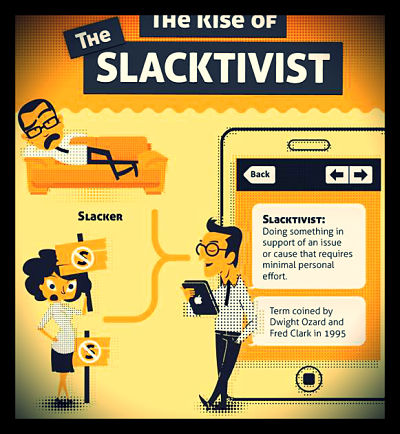
3 Ways That Slacktivism Promotes Social Change
The cynicism implied in the word slacktivism, which describes a lazy form of activism requiring little commitment of the participant and having almost no effect on policy and social issues, has been pushed to the forefront of public discourse lately. A recent phenomenon, this social-media led, tech-savy means of expressing one’s support for causes such as gay rights or ending modern slavery has been felt through the relatively safe confines of Facebook, Twitter, and university assembly quads. But does the slacktivist form of activism work better than the more traditional methods involving protests, writing congressional leaders, and fundraising? Yes and no, as the following describes three ways that slacktivism promotes social change.

1. It raises awareness – One of the more obvious ways that slacktivism promotes social change is through its exposure to social issues to huge audiences that were once limited by geographic location and means of communication. For those Facebook and Twitter users that have vast amounts of friends and followers, the switching of one’s profile picture to a red equal sign, for example, will no doubt generate questions by others who are curious as to why so many of their friends are changing their profiles on a given day. Through the vehicle of social media, a single individual is able to reach huge numbers of people with simply the click of a mouse and can raise awareness of a social issue almost instantaneously.

2. It allows everyone to participate – Unlike the traditional forms of activism that require a certain amount of interpersonal skills and economic commitments, slacktivism promotes social change by allowing everyone to participate in the movement. The current economic situation non-withstanding; most university students eager to participate have – at best – meager financial resources available to help fund an organization. By limiting the barriers of entry and participation in causes committed to social change, everyone who simply marks their hand with a red x feels that they are helping to fight slavery worldwide.

3. It leads to high-risk activism – Street protests, donor fundraising, and political volunteerism referred to as “high-risk” forms of activism are still instrumental tools of effecting social change. However, for those individuals who have had little to no experience in the traditional forms of activism, slacktivism helps people take the first steps towards larger civic engagement and global awareness. Individuals changing their profile picture on Facebook today may be serving as a board member for multi-national non-profits tomorrow, as slacktivism promotes social change in its ability to allow everyone to get their feet wet as a social media activist. And by combining the huge influence of social media along with good old fashioned congressional letter writing and fundraising, The Borgen Project has positioned itself to utilize the best of both worlds.

Brian Turner

Source: CNN
Photo: Trendhunter

Dadaab Stories: By the People, For the People
A story is best told by someone who was there. Whereas many documentaries as made by directors and producers passionate about the cause they are filming for, there is a difference between an outsider shooting their subjects, and the subjects shooting themselves.

The organization FilmAid had initially begun to screen videos and films at refugee camps. These films were mostly educational, providing those living in refugee camps with important safety and health information. They also showed films for purely entertainment purposes in order to help lighten the mood and spirit at the camps. In 2011, however, the organization’s branch in Dadaab, the world’s biggest refugee camp in Somalia, began a special project entitled “Dadaab Stories” where it began to train the refugees to work the cameras themselves and have the chance to tell their stories from their perspective.

Dadaab was built in the 1990s to house 90,000 refugees. Today, it is the home to over 500,000 refugees. Describing life in a refugee camp is difficult; insiders know more and have been around longer than an outside film crew.

Ryan Jones, an American videographer who joined FilmAid’s project in 2011, said that the part of the appeal of the program that it strays from the usual model of “an American film crew coming into a camp and spending a short period of time there and shooting some kind of 90-minute doc we hope to get into Sundance.”

Refugees have made various videos such as an emergency response video regarding a cholera outbreak, a safety video for rape awareness, the camp’s orientation film, a music video for the local group Dadaab All Stars, and documentation of actress Scarlett Johansson’s visit.

In October of 2011, however, a kidnapping incident involving Doctors Without Borders created intense restrictions and security issues which prevented the FilmAid team from coming back to Somalia. Since then, the refugees have been trying to manage posting videos and have begun to make their camp-wide newspaper The Refugee available online.

This project has not only taught the refugees a new and unique skill they would otherwise not have the chance to learn, but it gives them a creative outlet to truly show the world what life in a refugee camp is like. They may not be making feature length films or Sundance-worthy documentaries, but their progress and work are so valuable that it could never be put into a simple award category.

– Deena Dulgerian

Source: Co.EXIST

Matt Damon Toilet Strike

Dear Toilet,

It’s not you. It’s us.

Sincerely,

Matt Damon

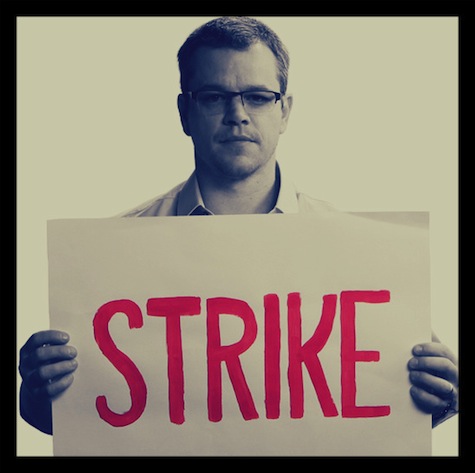
Matt Damon broke up with his toilet…well at least until everyone has access to clean water and sanitation. The Oscar-winning actor and co-founder of Water.org announced his toilet strike in a comedic video.

The video is a staged press conference with prominent comedians. It highlights society’s ignorance of the world water crisis and the underappreciation of toilets. 780 million people lack access to clean water.

Damon mentions how the toilet has saved more lives than any other invention, yet 2.5 billion people lack access to toilets or basic sanitation.  More people own cell phones than toilets. The “Matt Damon Toilet Strike” is designed to be less about him and more about people who lack the luxury of clean sanitation.

U.N. Deputy Secretary-General Jan Eliasson released a statement that the world water crisis is something people “don’t like to talk about.” The United Nations aims to double the number of people with toilets by 2015.

The organization’s long-term plan is to “eliminate the practice of open defecation” by 2025.  This practice makes unsanitary water the number one killer of people worldwide.  In fact, children under the age of five are most likely to die from diarrhea-related diseases.

Water.org traded the traditional public service announcement model in hopes of creating a viral frenzy.

“If Sarah Silverman and I can generate millions of views on YouTube for something ridiculous, then we should be able to do better for one of the most important and solvable issues of our time,” Damon said.

The nonprofit has “been toying with [the idea of comedic videos] for a couple of years.”  Damon and the rest of Water.org believe viral videos can “generate new levels of awareness and participation in the cause.”

The announcement video is the first of 12 videos. The strike campaign’s other videos include: Damon breaking up with his toilet, other celebrities joining the strike, and John Elerick fighting to outdo Damon.  The video was filmed for free at YouTube’s L.A. studios as YouTube works to educate nonprofits about best practices for video campaigns.

Jessica Mason, YouTube spokeswoman, understands that views should not be the main concern for non-profits. “We want to help nonprofits raise awareness and turn that awareness into action.”

Water.org will continue using social media to further awarness.  The website features extensive social media integration.  It asks visitors to “lend” their social media accounts and allow Water.org to publish automatically until World Toilet Day on November 9, 2013.

For more information, visit strikewithme.org or tweet questions with #strikewithme.

Whitney M. Wyszynski

Source: Strike With Me

“As a girl, I am always being told that things happen because of fate, but it’s the things I do, not luck that determine my fate,” says Sikha, a young girl from the slums of Kolkata and one of the children featured in “The Revolutionary Optimists,” a documentary following several children living in the slums of Kolkata and making a difference.

Salim is an eleven year old boy who lives in a community that has no water. Every morning at 4:30, he has to go to a neighboring slum to collect water for his family. By mapping their community and collecting data, he is leading a team of child activists to persuade the government to provide their community with a water tap. Priyanka is a sixteen year old girl who teaches and leads a dance troupe as a means of fighting tradition and the pressure to enter into arranged marriage and to keep girls in school. These children and others featured in the film are the child activists of Prayasam.

Founded by Ashoka Fellow Amlan Ganguly, Prayasam is an organization that doesn’t work to rescue children; rather the organization empowers them to become “agents of change.” The philosophy is to reach out to these children who live in dire circumstances but believe that they decide their own fates. Prayasam works with six child advisors and more than thirty children as core members who take the lead in spearheading projects that address social issues within their communities.

Through methods from street theater to data collection, the children have managed to organize education campaigns, first aid training, and vaccination drives for polio, and turn garbage dumps into playing grounds. Fueled by child-led activism, the work of Prayasam and its child activists has had a considerable effect on health, hygiene, and sanitation in their neighborhoods having decreased cases of malaria and diarrhea.

Inspired by the film, the BAVC Producer’s Institute for New Technologies developed a project called Map Your World based on Salim’s mapping of his own communities. The technology would allow other child activists to map their community, track and collect data on health issues, and improve health in their communities using cell phones.

“The Revolutionary Optimists” was the recipient of the Hilton Lightstay Sustainability Award this year from Sundance and is set to officially open in New York on March 29 with other cities to follow.

– Rafael Panlilio

Source: Ashoka, Prayasam, Revolutionary Optimists, Telegraph India