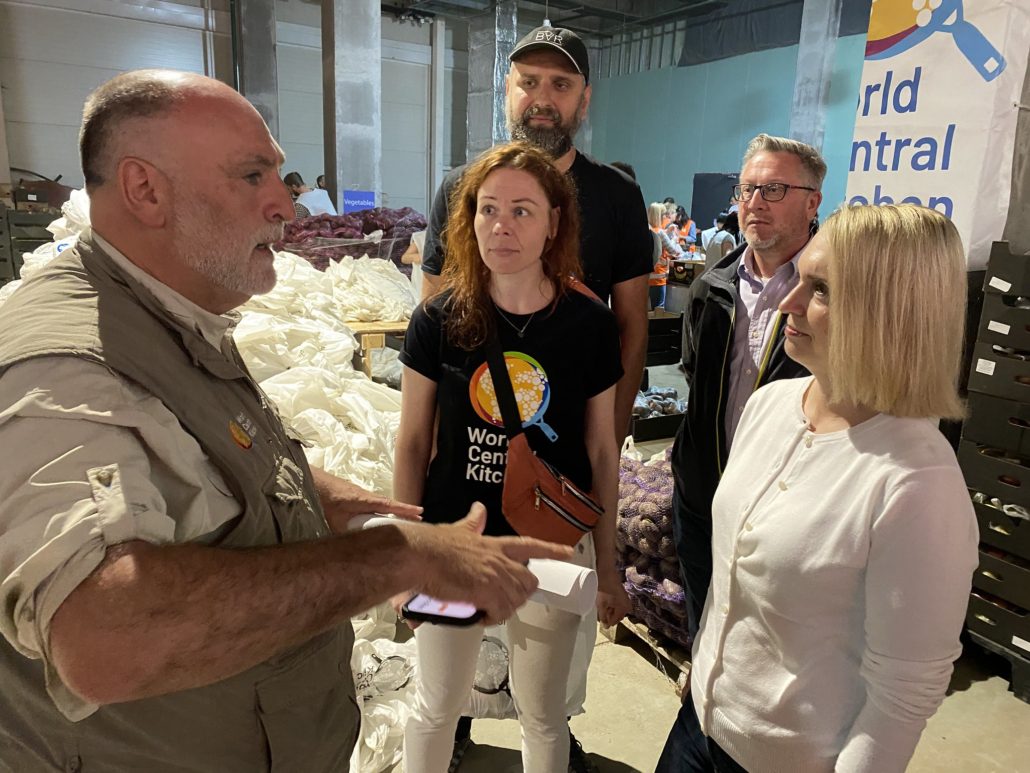
 The war in Ukraine has posed a significant threat to the region’s food supplies as ports and bridges have been under attack, limiting exports of Ukrainian grains to the rest of Europe. On June 6, 2023, the Kakhovka hydroelectric dam exploded, flooding one of the world’s largest reservoirs and displacing 190,000 people from the Mykolaiv region in Ukraine. Flooding destroyed entire villages and ravaged miles of crops.
This reservoir is known as “Europe’s breadbasket,” and according to The New York Times, it irrigates millions of acres of farmland. Its catastrophic flooding puts food for millions at risk. More than 5 million Ukrainians are already internally displaced, with an additional 8 million seeking refuge outside of Ukraine. Today, one-third of families in Ukraine are food insecure. Here is some information about World Central Kitchen’s work in Ukraine to feed Ukrainian families.
About World Central Kitchen’s Work in Ukraine
Since 2011, World Central Kitchen (WCK) has worked on the front lines of humanitarian crises, feeding those cut off from a stable food source. Since the onset of the war in Ukraine, WCK has cooked and delivered 235 million meals to refugees in seven other countries and people still in Ukraine.
On the same day the dam exploded, World Central Kitchen in Ukraine set up sites for evacuees. Volunteer teams from the Mykolaiv and Kherson regions arrived at Pryozerne, a village that was underwater. WCK teams used inflatable boats to transport the supplies to reach families stuck without food or drinking water.
How the World Central Kitchen Works
The goal of WCK is to provide hot, locally sourced meals for those with nothing to eat. First Food Fighters respond immediately to disasters where the need is greatest and then partner with local restaurants to affect long-term change. Its approach has come to include meal kits and bags of groceries.
In an interview on “The Late Night Show,” founder of World Central Kitchen Jose Andres, recipient of the 2018 Humanitarian of the Year by the James Beard Culinary Foundation, said of his decision to act: “I think I got tired of sitting in the comfort of my home and seeing that actually big problems had really simple solutions.”
In 2010, Andres went to Haiti to cook for victims of a devastating earthquake. He noticed inefficiencies in existing crisis response systems. Emergency provisions did not arrive soon enough nor stay long enough. To remain community-driven and sustainable, World Central Kitchen partners with local restaurants and chefs. José Andres formed a cooking school École des Chefs alongside a Haitian chef to permanently improve access to quality food in Haiti. Since then, WCK has spearheaded infrastructure that increases food stability in hard-hit regions.
Chefs for Ukraine
Chefs for Ukraine is a branch of WCK. It runs the largest food relief network in Ukraine, with sites in Kyiv, Kramatorsk, Kharkiv and Lviv, among others, despite active missile strikes. In a #ChefsforUkraine interview, a Food Fighter explains, “There is an urgent need for World Central Kitchen. Food is a big contribution because people in the 21st Century are dying of hunger.”
In Kramatorsk, at the end of a train line, World Central Kitchen in Ukraine opened an aid site within hours of Russia’s first attack. As more residential areas are targeted, Chefs for Ukraine sites feed refugees – mostly women, children and seniors. Currently, thousands of Food Fighters run more than 9,000 sites in Ukraine.
Ripple Effect
The impact of giving food and water to those hungry and thirsty is world-changing. José Andres believes WCK is an investment in the people, in democracy and in global interconnectedness. A video for #ChefsforUkraine in 2022 announced 100 million meals served in Ukraine. Andres, in the video, describes how World Central Kitchen’s work in Ukraine is helping fight for “a country of liberty, a country of freedom, and a country that for centuries has been feeding not only Ukraine but has been feeding the world.” Food changes individual lives and, in doing so, changes the world.
– Caroline Crider
Photo: Flickr

Child Poverty in Luxembourg: The Unexpected Crisis
The Current Child Poverty Situation in Luxembourg
Luxembourg boasts of having the highest average wage in the European Union (EU), but the cost of living is also proportionally high, leading to a higher poverty rate. Even with a relatively high income, a child living in Luxembourg may still experience financial struggles due to the country’s high living standards. In this situation, a child could potentially live in relative poverty.
The risk of poverty for children in Luxembourg is currently around 24.2%. Luxembourg also has a child deprivation rate of 8%. Around one in four children in Luxembourg does not have access to new clothes, an internet connection or the opportunity to participate in leisure activities. Findings determined that Luxembourg children who are the age of 18 and under are three times more likely to experience poverty than people over the age of 65.
One reason for the high rate of child poverty in Luxembourg is the inequality the country experiences. Households with single parents suffer higher taxation rates than families with two parents. One-fourth of single parents also use more than 40% of their income just to pay their rent. Being a single parent is one of the highest poverty risks in Luxembourg.
Children in low-income households in Luxembourg face reduced chances of acquiring an education, suffer more often from health problems and frequently experience psychological and social issues, as well as developmental delays. These children encounter limitations in almost all areas of life.
Poverty in Luxembourg is also generational. Children born into impoverished families tend to remain in poverty throughout their lives. Children born to parents addicted to drugs or alcohol often experience medical problems and require more medical care than the average child. However, their parents are typically unable to afford the medical care that they require.
Solutions
In 2021, the European Union launched the European Child Guarantee. The EU required all of its member countries to submit their Child Guarantee National Action Plans, including Luxembourg. Luxembourg’s plan focused on fighting child poverty in Luxembourg by providing education, health care services and housing for children living in poverty. It offers financial assistance to help cover the costs of childcare and education for children aged 0-12. Additionally, there are national mental health services available specifically for children.
Looking Ahead
By offering financial assistance for childcare and education and establishing dedicated mental health services for children, Luxembourg is making positive strides toward improving its young population’s well-being and future prospects. However, there are still challenges to overcome. But with such proactive measures in place, there is hope for a brighter future for children living in poverty in the country.
– Marisa Del Vecchio
Photo: Flickr
Understanding the Complex Outcomes of El Salvador’s Gang Crackdown
Over the past year, El Salvador has undergone a significant transformation from being known as the homicide capital of the world. The country was once plagued by the MS-13 and 18th Street gangs, whose activities forced residents to abide by their rules. Homicides and extortion payments to these gangs were common for decades. However, in March 2022, after a two-day spike of more than 70 killings, President Nayib Bukele declared a state of emergency. As a part of El Salvador’s effort to combat gang violence, a drastic measure was taken to temporarily suspend certain constitutional rights. The aim of this measure was to permanently remove gang members from communities. More than 66,000 individuals were imprisoned by the government during the crackdown on gangs. El Salvador has the world’s highest incarceration rate globally, with approximately 1% of its population behind bars.
Impact on Community
Since El Salvador’s gang crackdown, the gangs that controlled cities for years have almost entirely disappeared. Since the removal of the MS-13 and 18th Street gang members, individuals no longer have to pay regular extortion payments or tolls. These payments exacerbated poverty in gang-controlled territories. Although poverty has decreased by about 20% in the past decade, 30% of Salvadorans live under the poverty line.
Criminal activity has decreased significantly. The crackdown has disrupted the operations and networks of gangs and even dismantled some of their structures. Several gang leaders and members have been arrested or killed, and this has significantly impacted the frequency of criminal activities. Public safety has increased greatly since the start of El Salvador’s gang crackdown. People feel much safer walking the streets, businesses can operate without constraints from gangs and communities have regained some sense of security. The nation has not had a homicide at the national level for more than one year.
El Salvador’s successful crackdown on gang violence has inspired neighboring countries, including Honduras, which also grapples with significant gang-related issues. El Salvador’s achievements serve as inspiration for these countries to take similar decisive measures to combat gang violence.
Human Rights Concerns
Although El Salvador’s crackdown was extremely effective in removing gang members from communities, it is important to acknowledge that during this process, the police also arrested a considerable number of innocent individuals. While there have been efforts to release those wrongly imprisoned, many believe that there are still thousands of unjustly convicted people. The suspension of constitutional rights calls for concern because those convicted do not have the right to a trial. This situation highlights the need for a balanced approach to addressing gang violence while safeguarding the human rights of all individuals.
Expanding Education Opportunities
Gang presence has had a major negative impact on El Salvador’s education system. The poor education system is a major driver of the country’s high poverty rate. Only 11% of Salvadorans have received more than 13 years of education. Within the prison system, more than 90% of those incarcerated did not finish high school, reflecting the limited access to education opportunities in El Salvador.
In order to increase the youth population’s access to education, the Bukele government has introduced CUBOS, or “Urban Centers for Welfare and Opportunities,” in impoverished communities. The goal of these centers is to provide young people with a space where they have academic support and access to technology and other resources.
Additionally, the Education Quality Improvement Project aims to improve lower secondary and upper secondary education rates in the public school system as well as expand access to education.
The El Salvadoran government and international organizations are working together to create a long-term strategy to increase the national education rate, which could also decrease the high poverty rate.
– Surya Patil
Photo: Flickr
The Reasons Homelessness in Monaco Does Not Exist
Monaco immediately brings to mind extravagant casinos, roaring race cars and lavish yachts. This impression is a correctly informed one as the GDP per capita in the nation is $234,317, making it one of the wealthiest countries in the world. With almost 68% of the population consisting of foreigners taking up residence in the country, and ethnic Monegasques generally being very wealthy, the absence of data about homelessness in Monaco is not surprising; homelessness simply does not exist. However, the reasons for this fact are much more nuanced than “everyone is rich.” An analysis of the Principalities’ institutions, economy and culture, provides useful insight into how the nation effectively removed homelessness from its society.
The Government
The Grimaldi dynasty has ruled the Principality of Monaco, a constitutional monarchy, since 1914. Additionally, it has a unicameral legislature with 24 seats and a judicial branch with seven members. Elections for the legislature undergo calculation through both simple majority and proportional representation, creating a fair and equitable system. Any Monegasque citizen over the age of 18 can vote in elections.
The prince and his government are adamant about providing a strong social safety net for the country’s citizens and residents. These services include rent-controlled housing, free apartments for those who need them and health care. Access to these services depends on one’s status with the government. Naturally, Monegasque nationals receive top priority to all of the government services. Additionally, the state provides benefits, such as health care, to non-citizen residents.
The Economy
Monaco’s economy centers on service. Tourism and banking are the biggest industries in the nation, creating the $7.6 billion RGDP that the country had in 2015. The state takes a very pro-business approach toward its development. The government’s website states that modernizing business law and incentivizing firms to relocate to the principality will create a high level of economic activity within the country and its surrounding region, which has been true. This strategy is coupled with the relatively simple process of acquiring residency, which strongly influences investment in the principality. Further, all a person needs is proof of accommodation and proof of self-sufficiency to become a resident, making it, bureaucratically speaking, a fairly simple process to obtain the status.
Culture
Despite the government’s accommodations, the citizenship process is a long and difficult one. With citizenship comes many benefits such as guaranteed health care, efficient rent-controlled housing, a promise of education and a plethora of other services so, naturally, the government is not handing it out to anyone who asks. The easiest way to gain citizenship is to be born from Monegasque parents. If not, individuals must live in Monaco for at least 10 years before they can even be considered for the application, and if approved, they must relinquish all other citizenship.
The rigorous path to residency and naturalization reveals an important cultural phenomenon when thinking about the lack of homelessness in Monaco. Due to the high standards of citizenship and the long history between the people and the state, Monegasques have formed a strong national identity. Further, this relationship has created a sense of camaraderie and responsibility from person to person, person to state and state to person. This nation-building process makes the elimination of homelessness possible, as institutions and society work in conjunction to maintain a standard of living for everyone within the ingroup.
While Monaco is the land of the super-wealthy, the reason for the lack of homelessness is a nuanced discussion. Through the country’s effective institutions and tight-knit community, it has been able to eliminate homelessness within its borders by utilizing a strong social safety net.
– Eduardo Gonzalez del Valle
Photo: Pexels
5 Youth Organizations Operating in South Africa
The following is a list of five youth organizations in South Africa remedying the current low voting turnout and high unemployment rates.
5 Youth Organizations in South Africa
These five youth organizations in South Africa are making a positive impact on the community and increasing the chances of young people finding employment. As the country continues to heal from the effects of apartheid, these organizations are promoting inclusivity and a more liberal society.
– Christian Vince
Photo: Flickr
Mental Health in Burkina Faso
The State of Mental Health in Burkina Faso
Due to the trauma of witnessing ongoing conflict, displacement or living in perpetual hunger, many Burkinabes suffer psychologically. Unfortunately, low mental health awareness breeds stigma and ignorance.
As of 2021, the government has not yet provided any human or financial resources for the mental health policy they passed in 2020. Mental health remains a largely unexplored subject in Burkina Faso as only 2% of the country’s research output deals with it. The Mental Health Atlas shows that Burkina Faso only has 103 mental health professionals, indicating a significant lack of expertise in this area.
Additionally, internal conflict has affected more than 600 health facilities and shut down 211, some of which provided crucial mental health services. This makes it more difficult to access psychological support, especially in remote areas.
Children are deeply affected by poverty and poor mental health in Burkina Faso. The conflict has pushed more than 1 million children out of classes, making them more vulnerable to psychological harm and causing many behavioral anomalies. This is exacerbated by the prevalence of violence in many economically stressed homes, which almost half of the 360 child participants in a 2016 study had experienced. Violence contributes to depression, trauma and low self-esteem.
On the Frontlines of Improving Burkinabes’ Mental Health
The Mental Health Atlas observed a 112-time increase in the number of community-based mental health services per 100,000 people between 2014 and 2020, suggesting that many citizens are seeking help, even if not through hospitalization.
Abroad, USAID and the EU have pledged $175 million (in 2021) and €25.5 million (in 2023) in humanitarian aid to Burkina Faso, respectively. Much of this is dedicated to human rights, food security and health care, and often funds local efforts to improve Burkinabes’ quality of life.
USAID and the EU have yet to dedicate funds to mental health initiatives in particular. However, improving living conditions and reducing violence preemptively protects Burkinabes against the trauma that contributes to many of their psychological struggles.
In particular, USAID provided furniture to 20 schools in Tatao and 30 in Fada, Gayeri and Matiacoali. This enabled the schools to accommodate more than 5,000 displaced children, creating a routine and sense of childhood amidst extreme turbulence.
Leyla Ismayilova, a University of Chicago researcher, is similarly on the frontlines of improving child mental health outcomes. Her 2017 study revealed that family counseling improved parent–child relationships and decreased symptoms of depression, trauma and low self-esteem in participating children. This suggests that culturally sensitive, relationship-driven mental health interventions have significant potential.
Looking Ahead
Burkina Faso is facing significant challenges in addressing mental health issues. Despite limited resources and expertise, there has been a noticeable rise in community-based mental health services, indicating an increase in awareness and willingness to seek help. Aid from organizations such as USAID and the EU has had a positive impact, improving living conditions and providing stability for displaced children. The work of researchers like Leyla Ismayilova offers hope for culturally sensitive interventions that can effectively enhance mental health outcomes for Burkinabes.
– Faye Crawford
Photo: Flickr
The Athlete Helping Australian Women and Indigenous Peoples
At the 2000 Olympics, Cathy Freeman ran once more around the track, after winning gold in the Women’s 400 m, draped in the Australian and Aboriginal flags — a historic moment for both Indigenous and non-Indigenous Australians. Cathy Freeman’s legacy is a notable and influential athletic career, breaking barriers for Australian women and Indigenous peoples. Since retiring in 2003, her inspiring work as an Aboriginal athlete has continued through her philanthropic endeavors to help Australian women and those in the Indigenous community.
Freeman’s Inspiring Athletic Career
Cathy Freeman’s athletic portfolio exhibits numerous outstanding performances in track and field. She has won multiple World Championships, gold and silver Olympic medals and four Commonwealth Games gold medals. In recognition of these performances, she earned the titles Young Australian of the Year (1990) and Australian of the Year (1998), is forever inducted into the Sport Australia Hall of Fame and wears the Medal of the Order of Australia (OAM).
Advocating for Indigenous Peoples
Post-athletic career, Cathy Freeman dedicates her efforts to the education of Aboriginal and Torres Strait Islander children. Her foundation, the Community Spirit Foundation, established in 2007, aims “to support children and their families recognize the power of education in achieving their dreams.” When the foundation began “more than 90% of Year 7 students living in Palm Island could not read or write at the minimum national standard, truancy rates were as high as 55% and less than 10% of students graduated high school.”
The foundation plays a key role in the lives of thousands of Indigenous children across four remote First Nation communities. In collaboration with local leaders, the foundation provides a suite of education programs for students at each grade level. These programs build confidence, teach goal-setting, increase resilience through education and provide positive role models appropriate to each community context.
Since its inception, the foundation has been integral to improving access to education, inspiring a newfound sense of confidence as figures consistently reveal annual increases in year 12 graduation across all four partner communities. Of note, between 2017 to 2018 there was a 50% jump in Year 12 graduations. Furthermore, the organization is regarded highly as a recipient of the St. George Foundation Inspire Grant (2020), an investment in support of bridging the education gap in Indigenous communities.
In addition, for several years, Cathy was an ambassador of the Australian Indigenous Education Foundation, as well as for the Victorian children’s charity, Cottage by the Sea.
Freeman’s Legacy Continues
For more than a decade, the Community Spirit Foundation has extended its reach in providing access to quality, sustainable educational opportunities in rural Indigenous communities. In 2021, UNICEF Australia partnered with the Foundation, empowering Freeman’s vision and passion to “implement community-led, long-term partnerships with Indigenous communities, employing local people and working in a sustainable way.” The partnership bases efforts in the Aboriginal community of Woorabinda, where young people (under the age of 20) make up almost half the population and work to create sustainable educational and life opportunities.
Cathy Freeman continues breaking barriers for Australian Women and Indigenous peoples. As her work continues in her community, recognition of women in athletics and Indigenous communities expands to greater heights, creating opportunities in education, work and life.
– Emmalyn Meyer
Photo: Wikipedia Commons
The Chaiim Foundation: A Hope for Women Survivors of Trafficking
Human trafficking is a grave issue that affects millions of women worldwide. It involves the illegal trade of women for various purposes, including forced labor, sexual exploitation and slavery. This crime thrives on the vulnerability of women, often targeting those from marginalized backgrounds or communities. Trafficked women experience unimaginable abuse and violation of their basic human rights. In 2020, India’s government identified 5,156 trafficking victims. In 2022, the figures increased to 6,622, accounting for kidnapping and drugging.
The fight against trafficking requires a multi-faceted approach that includes raising awareness, strengthening laws and law enforcement, providing support to survivors and addressing the root causes of this crime.
Multiple organizations are working to save the victims from the harsh realities of trafficking and provide them with a safe and secure future. One such organization is the Chaiim Foundation, which focuses on helping survivors to reintegrate into society.
About The Chaiim Foundation
Chaiim is a non-governmental organization located in Mumbai, India that aims to improve the lives of women who have survived human trafficking. Founded in 2013, the organization has been supporting victims who have experienced exploitation due to gender, caste and religious differences. Chaiim provides education and training programs to help survivors join leadership roles within its organization.
Women who have been rescued from vulnerable situations such as prostitution and human trafficking receive the opportunity to improve their prospects through education, vocational training, housing, life skills and other means. Chaiim offers weekly life skills classes to monitor survivors’ progress in dealing with mental trauma, while vocational training courses in areas such as sewing and beauty care are tailored to individual interests and the needs of the local job market.
Living circumstances have deprived many girls of educational opportunities. The Chaiim Foundation steps in to change this, providing access to subjects like math, English and computer skills, paving the way for higher education in the future. Presently, the foundation’s life skills and education program benefits 132 women survivors.
The Chaiim Foundation’s Clothing Business
Humanitarian is a sustainable clothing business that the Chaiim Foundation established in July 2013. It aims to directly support women survivors by providing education, health care, vocational training and housing. The venture provides employment opportunities for women who have escaped human trafficking. Customers can submit their designs and inquiries to the team, who will then provide a production plan with cost and time estimates. Once the plan reaches finalization, the manufacturing team begins cutting and sewing the product before packaging it for shipping.
Other Initiatives to Help Women Survivors
The foundation hosts awareness programs, seminars and workshops to promote the work and efforts of volunteers and women survivors. It also facilitates victims’ reintegration into society, helping them start anew with fresh opportunities and goals. Additionally, it is working on a new venture called “Daag,” which aims to create reusable sanitary pads. This project seeks to promote job opportunities and improve the health of women living in rural areas.
Looking Ahead
In India, efforts to combat women’s trafficking focus on investigations. However, rural women continue to encounter difficulties in this area. Thankfully, organizations like the Chaiim Foundation exist to assist survivors by providing essential support in the form of education, health care, legal aid and housing. These resources help to create a brighter future for those affected by this heinous crime.
– Gurjot Kaur
Photo: Flickr
World Central Kitchen’s Work in Ukraine
This reservoir is known as “Europe’s breadbasket,” and according to The New York Times, it irrigates millions of acres of farmland. Its catastrophic flooding puts food for millions at risk. More than 5 million Ukrainians are already internally displaced, with an additional 8 million seeking refuge outside of Ukraine. Today, one-third of families in Ukraine are food insecure. Here is some information about World Central Kitchen’s work in Ukraine to feed Ukrainian families.
About World Central Kitchen’s Work in Ukraine
Since 2011, World Central Kitchen (WCK) has worked on the front lines of humanitarian crises, feeding those cut off from a stable food source. Since the onset of the war in Ukraine, WCK has cooked and delivered 235 million meals to refugees in seven other countries and people still in Ukraine.
On the same day the dam exploded, World Central Kitchen in Ukraine set up sites for evacuees. Volunteer teams from the Mykolaiv and Kherson regions arrived at Pryozerne, a village that was underwater. WCK teams used inflatable boats to transport the supplies to reach families stuck without food or drinking water.
How the World Central Kitchen Works
The goal of WCK is to provide hot, locally sourced meals for those with nothing to eat. First Food Fighters respond immediately to disasters where the need is greatest and then partner with local restaurants to affect long-term change. Its approach has come to include meal kits and bags of groceries.
In an interview on “The Late Night Show,” founder of World Central Kitchen Jose Andres, recipient of the 2018 Humanitarian of the Year by the James Beard Culinary Foundation, said of his decision to act: “I think I got tired of sitting in the comfort of my home and seeing that actually big problems had really simple solutions.”
In 2010, Andres went to Haiti to cook for victims of a devastating earthquake. He noticed inefficiencies in existing crisis response systems. Emergency provisions did not arrive soon enough nor stay long enough. To remain community-driven and sustainable, World Central Kitchen partners with local restaurants and chefs. José Andres formed a cooking school École des Chefs alongside a Haitian chef to permanently improve access to quality food in Haiti. Since then, WCK has spearheaded infrastructure that increases food stability in hard-hit regions.
Chefs for Ukraine
Chefs for Ukraine is a branch of WCK. It runs the largest food relief network in Ukraine, with sites in Kyiv, Kramatorsk, Kharkiv and Lviv, among others, despite active missile strikes. In a #ChefsforUkraine interview, a Food Fighter explains, “There is an urgent need for World Central Kitchen. Food is a big contribution because people in the 21st Century are dying of hunger.”
In Kramatorsk, at the end of a train line, World Central Kitchen in Ukraine opened an aid site within hours of Russia’s first attack. As more residential areas are targeted, Chefs for Ukraine sites feed refugees – mostly women, children and seniors. Currently, thousands of Food Fighters run more than 9,000 sites in Ukraine.
Ripple Effect
The impact of giving food and water to those hungry and thirsty is world-changing. José Andres believes WCK is an investment in the people, in democracy and in global interconnectedness. A video for #ChefsforUkraine in 2022 announced 100 million meals served in Ukraine. Andres, in the video, describes how World Central Kitchen’s work in Ukraine is helping fight for “a country of liberty, a country of freedom, and a country that for centuries has been feeding not only Ukraine but has been feeding the world.” Food changes individual lives and, in doing so, changes the world.
– Caroline Crider
Photo: Flickr
Affordable and Efficient Green Hydrogen Technology in Africa
In terms of definition, for hydrogen to qualify as green, it must come from renewable energy sources, unlike black/brown and blue/gray hydrogen, which come from nonrenewable sources, coal and methane respectively. According to the United Nations (U.N.), hydrogen’s power generation source can either be renewable or nonrenewable. In this case, the focus here is on renewable energy for green hydrogen production, capable of storing excess energy generated during peak cycles.
The Impact of Green Hydrogen Fuel
The use of green hydrogen fuel prevents the heating of the atmosphere, reducing the impacts of environmental shocks in African cities and communities. Solar power, wind power, geothermal and biomass are among the domestic resources utilized for green hydrogen production, all of which are renewable energy sources.
Green hydrogen technology can provide significant support to the 600 million Africans without accessible electricity, aligning with the global movement toward more sustainable economies. Many investments into green hydrogen technology have propelled this to become a wider market in Africa as it is an ambitious development with much potential. The International Energy Agency suggests Africa could become a global hub for green hydrogen production due to its abundance of wind and solar energy.
The Just Energy Transition Partnership
Since November 2021, South Africa has been collaborating with France, Germany, the U.S. and the U.K. in its decarbonization efforts through the Just Energy Transition Partnership. This initiative aims to enable South Africa’s economy to achieve its low carbon emission goals while also generating green jobs. The initial phase of funding involves a commitment of $8.5 billion to facilitate the shift away from fossil fuels and to promote investments in green hydrogen and electric vehicles, as reported by the European Commission.
In a speech about the partnership, President Biden acknowledges South Africa as the “largest emitter in Africa,” mainly due to its heavy reliance on coal for power. However, the partnership’s funding aims to assist vulnerable communities, including coal miners, women and youth, as noted by Ursula von der Leyen, President of the European Commission. Researchers have analyzed the potential impact of green hydrogen technology on Africa’s job market. The United Nations Framework Convention on Climate Change (UNFCCC) predicts that the GDP of six African countries involved in the Africa Green Hydrogen Alliance (Egypt, Morocco, Kenya, South Africa, Mauritania and Namibia) could increase through market exports and domestic demand for “green hydrogen related products.” The Alliance’s study confirms Africa’s significant potential to embrace local communities in the adoption of green, clean energy sources, creating millions of jobs and fostering a climate-resilient economy.
In 2021, a new project was announced in Namibia, a country that offers significant potential in domestic and international markets for affordable green hydrogen. This project involves a $9.4 billion hydrogen initiative, scheduled to commence in 2026, that reinforces the commitment to producing low-cost hydrogen.
A Look Ahead
The groundwork for many upcoming projects for green hydrogen technology requires financial support due to Africa’s economic viability. Collaborative work has been continuously communicated throughout many nations in an effort to reform policy-making within the energy sector, allowing for economic developments that protect energy security and reduce poverty in African communities.
–Lucy Cosme Vera
Photo: Flickr
USAID and Partners’ Humanitarian Response in Sudan
A humanitarian crisis has erupted in Sudan as a result of widespread destruction and fighting. This is exacerbating the already-present effects of widespread poverty and almost 20% unemployment in 2022. A June 2023 report from USAID has identified and mapped multiple poverty-related crisis categories that must be addressed by a humanitarian response in Sudan. Notably, these are water scarcity and agricultural-nutritional crises. USAID is partnering with organizations such as OCHA, UNFPA and the World Food Program (WFP) to provide the Sudanese with desperately needed resources and aid.
Water Scarcity in Sudan
According to USAID, multiple regions in Sudan such as Khartoum, Gedaref, North and South Kordofan and all of the Darfur region are experiencing water scarcity. Water scarcity doesn’t only affect access to drinking water, but also diminishes a population’s ability to implement adequate sanitation and hygiene practices, putting the public health of thousands of impoverished Sudanese at risk. Sudan also ranks among the most climate-insecure countries in the world, at risk of desertification and extreme heat. Consequently, the Norwegian Refugee Council has emphasized that heat strokes and other sun-related health issues are rampant in areas bordering South Sudan.
To combat this, USAID is providing humanitarian efforts in Sudan. The U.N. High Commission for Refugees has helped almost 700,000 Sudanese refugees since 2022 to obtain drinking water, and the International Medical Corps has outfitted hundreds of families in Sudan with sanitation kits this year. The International Organization for Migration is contributing $25 million to USAID and the Bureau for Humanitarian Assistance to implement WASH projects in Sudan. Moreover, the WASH (water, sanitation, and hygiene) and shelter projects receive further support with an additional three million dollars from the UN High Council for Refugees. The U.N. Population Fund also contributes another three million dollars to USAID’s response plan for public health implementations in Blue and White Nile, Gedaref, Khartoum, and areas of Darfur and Kordofan.
Agricultural Crises
War and climate change have strained farmers and livestock herders across Darfur and Northern Sudan, as well as Kassala, Gedaref and Sennar in the east. Sudan’s livestock industry brought in $143 million in export revenue in 2022, and the World Bank estimates almost half the Sudanese population work in the agricultural industry. This highlights the crucial role of humanitarian response in supporting agribusiness and safeguarding a significant portion of the population from factors leading to poverty, such as unemployment and malnutrition. OCHA’s 2023 response plan outlines the need for $500 million in food security and livelihood aid to assist 75% of the nearly 20 million affected Sudanese. The plan is to source the funding from the Sudan Humanitarian Fund and donations to partner organizations like UNICEF.
Food and Nutrition: Crisis & Solutions
Food insecurity is a pressing issue in multiple regions of Sudan, particularly in South and West Kordofan, Kassala in the east, and across central-northwest Darfur. The problem has been ongoing since 2022 but has worsened due to the conflict. According to an IPC report, out of the total Sudanese population of more than 46 million, only 18.6 million people were food secure in 2022. Without international intervention, expectations lean toward a further deterioration of the situation in 2023.
Despite the ongoing dangers, the World Food Program responded in May 2023 by resuming nutritional assistance programs in the country, while contributing more than $140 million in cash transfers. As a result, WFP and BHA have been able to provide more than 800,000 people with thousands of metric tonnes of sorghum grain since mid-May 2023. On top of this, UNICEF has provided citizens in Wad Madani and Khartoum with critical aid such as Ready-To-Use Therapeutic Food and truckloads of health and nutrition supplies.
USAID and its partners plan to work diligently to expand the humanitarian response in Sudan throughout 2023 and onward.
– Finneas Sensiba
Photo: Pixabay