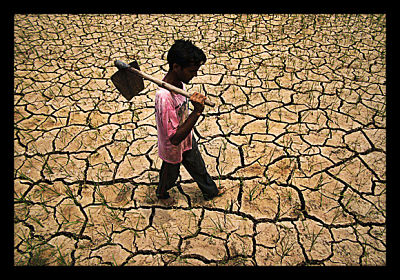
The individuals and families of developing nations that have contributed little to climate change will nonetheless experience its greatest hardships. The World Bank warns that Earth’s rising temperature is undermining economic development in poor countries. Droughts, floods, heatwaves, rising sea levels, and powerful storms will cause severe devastation in areas that are already poor or were coming out of poverty. Within just two decades, climate change is expected to cause food shortages in these same areas.
An increase of at least 2°C, the limit set by scientists that marks a catastrophic and irreversible change to the climate, is inevitable if current trends continue. Although some refuse to regard climate change as anything other than a future problem, many parts of the world are already experiencing extreme challenges due to rising temperatures.
Jim Yong Kim, president of the World Bank, warns that: “The scientists tell us that if the world warms by 2°C—warming which may be reached in 20 to 30 years—that will cause widespread food shortages, unprecedented heatwaves, and more intense cyclones.”
In Southeast Asia, catastrophic events such as the floods in Pakistan in 2010, which affected the lives of 20 million people, could become the norm, while changes to the monsoon season could be detrimental to Indian farmers. In Sub-Saharan Africa, researchers found that food security will be a major challenge, accompanied by dangers from droughts, flooding, and shifts in rainfall. It is predicted that farmers of this region will lose 40-80% of current farmland used primarily for growing their most stable crop: maize.
The World Bank plans to increase funding to countries currently without the capabilities to adapt to the consequences of climate change. Its aid has doubled from $2.3 billion in 2011 to $4.6 billion last year. An additional $7 billion a year is used to help poor countries cut their greenhouse gas emissions and work towards an environmentally sustainable economy. The bank is calling for rich countries to increase their efforts in cutting current greenhouse gas emissions. The need to avoid 2°C of warming is being emphasized, which scientists say is possible if countries cut their emissions in the near future.
According to Kim, “At the World Bank Group, we are concerned that unless the world takes bold action now, a disastrously warming planet threatens to put prosperity out of reach of millions and roll back decades of development…in response, we are stepping up our mitigation, adaptation, and disaster risk management work, and will increasingly look at our business through a ‘climate lens’.”
– Ali Warlich
Source: The Guardian, World Bank, Huffington Post
Photo: Business Insider

Food Crisis in the Central African Republic
The Central African Republic is now facing a food crisis nearly four months after a coup overthrew the government and proclaimed the leader of the Seleka rebel coalition, Michel Djotodia, as president. More than 60,000 people are suffering from severe food shortages, and 200,000 have been forced to flee their homes due to instability in the region.
Food shortages are nothing new for the country, as last year the United Nations claimed that upwards of 800,000 people, nearly 20% of the country’s population, experienced some level of food crisis. However, the current shortages have the potential to be much more severe as the fighting has severely impacted the country’s agriculture, with many families losing food stocks, seeds, and livestock.
Due to the new government administration, and ongoing political turmoil following the coup, access for humanitarian agencies throughout the country has been restricted, especially in some of the hardest-hit rural areas. Yet before this can change, security throughout the country must improve. This lack of security has further led to the closing of health centers and schools due to safety concerns. Nearly a million children are out of school as a result of these closures, and a significant percentage of those have missed nearly a full school year due to the ongoing conflict.
Funding for humanitarian work is an ongoing issue. Current donations account for only about 43% of the $125 million in aid that the UN estimates are needed in the Central African Republic. The Archbishop of Bangui, Dieudonné Nzapalainga, said, “The current humanitarian crisis is the worst in the country’s history. It is urgent that the international community provides funds quickly to help and to save lives. The world can’t turn a blind eye on the crisis here. The country is bordered by six of the most fragile African nations—there is a high risk of destabilization throughout Central Africa.”
– David Wilson
Sources: WFP, The Examiner, Action Against America
Revolution in Chiapas: An Unstoppable Force
When thinking about poverty and hard times, it’s important to remember that no matter how bad one might think they have it, there are always people around the world who have it worse. One group of people who have to deal with extreme poverty and repression are the indigenous populations in Mexico and Central America.
Many indigenous people are from the state of Chiapas, which contains the largest population of indigenous people and is also the poorest region of the country. For the poorest state to have the most indigenous people is far from a coincidence. They seek to preserve their traditional ways of life and are often discriminated against by their own nation. Battles between the indigenous population and the Mexican state have gone on for decades and unfortunately continue today.
The Zapatista movement (an armed revolutionary group based in Chiapas) began in 1994 and has been in a declared war against the “Mexican state” ever since. During this time, the North American Free Trade Agreement (NAFTA) was signed between Mexico, the United States, and Canada, which ended up taking many jobs away from local farmers in Mexico while throwing millions into poverty. It also revoked Article 27 of the Mexican constitution which granted land rights to the indigenous. After the article was revoked, these indigenous people were driven off their lands by the government.
While the Chiapas have taken steps to improve the lives of the indigenous population and maintain their fundamental rights, more still needs to be done. A big step forward took place in 2009 when the state adopted the Chiapas-UN Agenda. The deal put a strong focus on improving health and education while also dealing with poverty and the environment. The state amended its constitution in the process. While each president promises to lend a helping to these communities, too often they fall short.
One looks at the indigenous people and it will become obvious that their ideology has never died and the people will always reach for their goal of demolishing deprivation and injustice within Chiapas. Their continued revolutionary ways set an example for the rest of the world that corruption, poverty, injustice, and environmental devastation will not be tolerated as the underdog will continue to push forward until justice is served.
– Taylor Rae Schaefer
Sources: Occupy News Network, United Development Programme
Photo: LibCom
Climate Change and the World’s Poor
The individuals and families of developing nations that have contributed little to climate change will nonetheless experience its greatest hardships. The World Bank warns that Earth’s rising temperature is undermining economic development in poor countries. Droughts, floods, heatwaves, rising sea levels, and powerful storms will cause severe devastation in areas that are already poor or were coming out of poverty. Within just two decades, climate change is expected to cause food shortages in these same areas.
An increase of at least 2°C, the limit set by scientists that marks a catastrophic and irreversible change to the climate, is inevitable if current trends continue. Although some refuse to regard climate change as anything other than a future problem, many parts of the world are already experiencing extreme challenges due to rising temperatures.
Jim Yong Kim, president of the World Bank, warns that: “The scientists tell us that if the world warms by 2°C—warming which may be reached in 20 to 30 years—that will cause widespread food shortages, unprecedented heatwaves, and more intense cyclones.”
In Southeast Asia, catastrophic events such as the floods in Pakistan in 2010, which affected the lives of 20 million people, could become the norm, while changes to the monsoon season could be detrimental to Indian farmers. In Sub-Saharan Africa, researchers found that food security will be a major challenge, accompanied by dangers from droughts, flooding, and shifts in rainfall. It is predicted that farmers of this region will lose 40-80% of current farmland used primarily for growing their most stable crop: maize.
The World Bank plans to increase funding to countries currently without the capabilities to adapt to the consequences of climate change. Its aid has doubled from $2.3 billion in 2011 to $4.6 billion last year. An additional $7 billion a year is used to help poor countries cut their greenhouse gas emissions and work towards an environmentally sustainable economy. The bank is calling for rich countries to increase their efforts in cutting current greenhouse gas emissions. The need to avoid 2°C of warming is being emphasized, which scientists say is possible if countries cut their emissions in the near future.
According to Kim, “At the World Bank Group, we are concerned that unless the world takes bold action now, a disastrously warming planet threatens to put prosperity out of reach of millions and roll back decades of development…in response, we are stepping up our mitigation, adaptation, and disaster risk management work, and will increasingly look at our business through a ‘climate lens’.”
– Ali Warlich
Source: The Guardian, World Bank, Huffington Post
Photo: Business Insider
Marketplace for Nutritious Foods in Kenya and Mozambique
Over 925 million people are currently undernourished worldwide, and 3.5 million children under the age of five die from malnourishment every year. The problem is especially prevalent in Eastern Africa, where 23 million children will grow up stunted and likely permanently impaired. Most diets in these areas consist of simple grains and very few fruits and vegetables which contain key nutrients that are needed for proper mental and physical growth.
In the past, poverty alleviation efforts have been focused on increasing the quantity of food produced by farmers, rather than quality. But recently, more attention has been paid to what kinds of foods are reaching those in poverty, and how the crops can help them not just survive, but actually improve their quality of life. The Global Alliance for Improved Nutrition (GAIN) has created a unique plan for making nutritious foods a possibility for farmers to grow, and for consumers to buy.
The Marketplace for Nutritious Foods, which was started up with a $2.1 million grant from USAID, is up and running in both Kenya and Mozambique, with plans to go to Tanzania as well. The Marketplace works by searching for businesses that can provide affordable nutritious foods upon receipt of help from the organization in the form of funding for seeds, technical assistance, business support and networking opportunities. After receiving numerous applications, GAIN selectively chooses organizations that fit the program and gives them everything they need to get nutritious foods to the consumers. The final product, which is anything from dairy products to sweet potatoes, is fully nutritious and reaches the local markets at an affordable price for the public to consume.
As a result, the public is not only given more access to nutritious foods, but the farmers also gain an opportunity for income. The Marketplace provides the incentive farmers need to produce the healthy foods necessary for the population to thrive.
– Emma McKay
Sources: USAID
Push and Pull Strategy in East Africa
The UN Food and Agriculture Organization reports that a quarter of the under-nourished global population lives in sub-Saharan Africa. Many of these people are small-scale farmers, so most methods to increase their productivity would lead to massive gains in the fight against global hunger.
The ‘Push-Pull’ strategy is a technique that utilizes intercropping to increase yields by improving soil quality and protecting against pests. The concept is simple. Two of the primary threats to crops in sub-Saharan Africa are stemborers and Striga weeds. Stemborers are a type of moth that lay their eggs inside the stems of crop plants. This pest has been known to destroy up to 80% of small farmers’ crop yields. The other main concern for farmers in the region is the Striga weed. This weed is parasitic and stunts crop growth, which can mean a loss of 30-100% of yields.
The combination of these two threats alone can lead to $7 billion annually in damages from lost crops. Rather, though, than turn to expensive pesticides and herbicides to neutralize these threats, ‘Push-Pull’ focuses on more sustainable methods. In order to reduce damage from stemborers, repellant plants are interspersed within the primary crop. One such example is the plant desmodium, the presence of which discourages stemborers from the crop. Additionally, a plant that attracts the pests, such as Napier grass, is planted in a border around the field. Thus, the stemborers are simultaneously repelled from the actual crop while being attracted to the border. Along with serving to deter stemborers, desmodium also has the added benefit of producing a substance that interferes with the germination of Striga seeds, effectively eliminating this weed from crop fields.
Benefits of the ‘Push-Pull’ technique go beyond those of just natural pesticide and herbicide. Desmodium, being a cover crop, can be plowed back into the soil after harvest, raising the nutrient content of the soil. Meanwhile, Napier grass can serve as a feed crop for livestock as well as assisting in erosion control via its root system.
To date, more than 50,000 East African farmers have implemented the ‘Push-Pull’ system. Remarkably, this change has resulted in triple-the-average maize yields of previous practices. ICIPE plans to expand the practice throughout sub-Saharan Africa, educating and training farmers to take advantage of this revolutionary technique.
– David Wilson
Sources: Push-Pull, Food Security, Christian Science Monitor
Photo: Flickr
AMREF USA’s Pledge for a Healthy Africa
African Medical and Research Foundation USA seeks to improve the health standards of all African nations, one community at a time. Founded in 1957, AMREF looks to improve the quality of life for African communities and eradicate public health problems.
AMREF understands local health systems are essential in developing quality, sustainable health standards. AMREF has trained many African locals to return to their communities in order to improve health conditions. The organization educates volunteers and on the symptoms and treatment of diseases to prevent diseases from spreading further and decrease the number of citizens infected. AMREF has trained over 10,000 health workers in over 40 African nations.
AMREF estimates that a million more health workers need to be properly trained and educated to meet the United Nation’s Millenium Development Goals for improved public health. As the fight for better health conditions in Africa continues, educating and training citizens may be the solution for healthier African communities and improved health standards.
– William Norris
Sources: AMREF USA, All Africa
Photo: Flickr
Digital Divide Data: Incubator of Human Capitol
Once identifying and recruiting qualified youth, they are trained and employed with a fair wage and offered scholarships to attend university. DDD alumni eventually move on to high-skilled positions where they earn four times the average regional wage. Not only are these individuals able to escape poverty, but also they are equipped with the resources to send family members to school while raising their household’s standard of living.
DDD has data management locations in Cambodia, Laos, Kenya, with sales and client support in the United States. The workers are connected to the world market and trained to produce the outstanding quality of work and meet client requirements. Since 2001, DDD has pioneered the ‘Impact Sourcing model’, which works with young people in countries with untapped talent and ambition. They are given employment opportunities that would otherwise be out of reach, creating better and more secure futures. Through this Impact Sourcing model, clients are provided with quality services, while lives are changed.
The world is taking notice of the work DDD is doing and the organization was ranked at #25 in The Global Journal’s Top 100 NGOs for 2013. 450 organizations were evaluated on three criteria: impact, innovation and sustainability. DDD was recognized as an “Incubator of Human Capital” which combines the mission of an NGO and the profitability and sustainability of a business enterprise. The Global Journal ranking falls alongside additional recognition by international media and opinion-makers.
The mission of DDD has made them a more responsive partner to clients such as Stanford University, Ancestry.com, and Benetech. Their Impact Sourcing model has been recognized by Boeing, Cisco Systems, Microsoft, and the United Nations Development Programs, among others. Donor support from individuals and institutions makes it possible for DDD to provide training and educational scholarships to their staff. To donate to the cause of DDD, visit: https://npo1.networkforgood.
– Ali Warlich
Sources: DDD, The Global Journal
Photo: Flickr
Global Cycle Solutions
It first opened in Tanzania in 2009 as a technology company. At the time, it was selling bicycle parts to smallholder farmers. Soon enough, the company realized that it could have an even bigger impact on communities by focusing on villages. Tanzanian villages often lacked basic amenities such as electricity and light. Understanding this, Global Cycle Solutions shifted gears to improving village life. From then on, Global Cycle Solutions became more than just a company selling technology, it became a collaborative and innovative organization designed to uplift the poor.
The enterprise works primarily in two ways. If a need can be fulfilled with existing technology than Global Cycle Solutions will build and develop a network of entrepreneurs through what they call their Rafiki Network. One product that is currently being distributed through the network is the SunKing Pro Solar Light and Phone Charger. Both the light and charger provide incredibly efficient and long-lasting power and light sources.
If a need cannot be fulfilled with pre-existing products than Global Cycle Solutions develops technology by partnering with universities, villages and other innovators. Currently, a bike-powered maize sheller, bicycle phone charge, and a multi-crop thresher are being developed by the organization for distribution.
How can you get involved with Global Cycle Solutions? One way is by contributing a micro-loan. A micro-loan of just $100 is enough to jumpstart one individual’s entrepreneurial career as well as help them begin the climb out of poverty. For a more hands-on approach, the enterprise also offers various positions on its project teams. Student opportunities to get involved can come in the form of collaboration with universities. For intern April Zhu, her involvement with Global Cycle Solutions began in the spring of 2012 with her work with the Massachusetts Institute of Technology’s D-lab. Now as a member of the product development team, April works on testing prototypes of the multi-crop thresher before the harvest season is over.
Through this highly innovative and collaborative work, Global Cycle Solutions has impacted over 3,000 families over the last two years. Now the organization aims to create a sustainable network within villages to increase the availability of technology for all. By improving the standard of living for local Tanzanian villagers, Global Cycle Solutions is bringing empowerment to all within its network.
– Grace Zhao
Sources: Global Cycle Solutions
Photo: Flickr
Malaria Tool Tracks Insecticide Resistance
The IR Mapper “consolidates reports of insecticide resistance in malaria vectors onto filterable maps to inform vector control strategies.” Collected through the cooperative efforts of Kenya Medical Research Institute (KEMRI) and the US Centers for Disease Control and Prevention (CDC), the information was brought together by Vestergaard Frandsen, a Swiss company. Lastly, the design for the interactive map came from ESRI Eastern Africa.
Today, insecticide plays a valuable role in the prevention of malaria. Spraying a house with insecticide ensures mosquito prevention within homes lasting from 3-6 months. Similarly, insecticide-treated bed nets are extremely valuable and, as the CDC found, these bed nets reduced deaths of children under 5 from all causes by roughly 20 percent.
Yet, the successes of insecticide are in danger if insecticide resistance is not combated. IR has been found in two-thirds of malaria prevalent countries. This large percentage of countries hindered by IR displays the importance of the IR Mapper.
Estimated that 26 million more new malaria cases might occur if the action doesn’t occur against IR, this interactive map will provide the needed knowledge to health-care workers on the ground.
These IR Maps provide a new means of knowing where insecticide is facing confrontation with IR strains of malaria. This new map of information allows users to “guide the deployment of insecticidal tools to ensure the right tool is used in the right place at the right time,” according to IR Mapper’s homepage.
With maps that are armed with data spanning 1954 to present with detailed information on the current susceptibility situation with the mapped pinpoint.
To gain the information necessary to fill the maps the team acquired data from scientific articles and reports and from the IR focused database IRBase.
With this information public, more policies will be constructed with better knowledge and more research will be widespread to excel the deterrence of malaria.
– Michael Carney
Sources: CDC, IR Mapper, IRIN
Photo: Flickr
Planet Aid: Saving the World One Shirt at a Time
The nonprofit organization collects and recycles used clothing and shoes in the U.S. as a way to reduce environmental impact while supporting sustainable development in impoverished communities worldwide.
Planet Aid started out as a small idea in 1997 near Boston, Massachusetts. The original setup included a mere few drop-off boxes alongside a small, rented storage unit where community members could donate clothing and shoes. Soon, however, the group’s scope began to outgrow the tiny rented space, and the organization’s creators set their sights on bigger, global aspirations.
Though its influence expanded quickly, its clear-cut aim to expand global environmental sustainability and mobilize resources to alleviate poverty remained the same. Planet Aid now owns over 18,000 clothes collection boxes throughout the United States, all featuring the same signature yellow exterior.
How does Planet Aid accomplish these goals? Firstly, by collecting and recycling used goods, Planet Aid saves valuable resources that help reduce CO2 emissions and thus alleviate global warming. Recycling clothing also saves precious landfill space.
Furthermore, Planet Aid supports development projects that help to strengthen and organize communities by promoting small enterprise development and increasing access to quality training and education. In addition, Planet Aid’s support programs meet health and nutrition needs as well, extending from HIV/AIDS care and prevention to Farmers’ Clubs to teach sustainable agriculture and work towards a more stable food source.
Today, Planet Aid recycles millions of pounds of used clothing nationwide each year. Since 1997, the group has given more than $90 million in support of more than 60 projects in 15 projects throughout the developing world.
In its “afterlife”, recycled clothing can be and important tool for solving global poverty and meeting environmental needs. If there was ever a need for proof that fashion could save the world, Planet Aid provides the evidence.
– Alexandra Bruschi
Sources: Planet Aid, Aid For Africa
Photo: Flickr