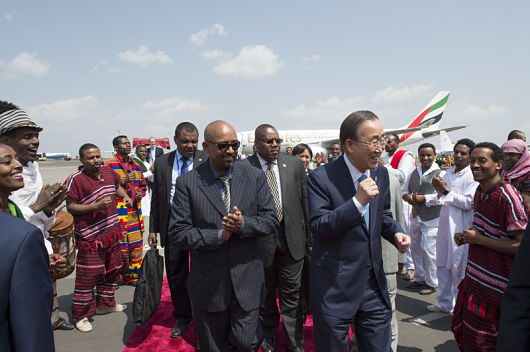
This past week, global leaders met at a four-day international conference on Financing Development in Ethiopia’s capital of Addis Ababa. True to name, the top priority on the summit’s agenda was the creation of a comprehensive financing framework for sustainable development.
This conference was the first of three summits scheduled for 2015, all of which aim to reestablish the world’s vision of sustainable prosperity and revamp the collaborative effort toward achieving this goal. Collectively, these summits will set transnational aspirations and set the global standard for sustainable development.
Conference attendees included high-level political representatives, Ministers of Finance, Foreign Affairs, and Development Cooperation, non-governmental organizations and business sector entities. The final outcome of the prolonged discussion was a document known as the Addis Ababa Action Agenda.
The Action Agenda will support the implementation of the post-2015 worldwide development agenda. Most notably, it will provide some backbone for the upcoming Sustainable Development Goals, scheduled to replace the current Millennium Development goals this September.
After intense discussion and deliberation, the 193 UN Member States were able to agree on a series of groundbreaking measures. These measures strategically aim to refurbish global finance practices and generate investments that will help tackle economic, social and environmental challenges.
Technically, the finalized agreement represents months rather than days of hard work and prolonged negotiations between countries. UN Secretary-General Ban Ki-moon is proud of this highly anticipated outcome.
He said, “The results here in Addis Ababa give us the foundation of a revitalized global partnership for sustainable development that will leave no one behind.” Indeed, the Action Agenda will help transform the upcoming SDGs from a dream into a reality, as strategized financing is key to the Goals’ success.
The agenda contains more than 100 concrete measures, addressing all sources of finance, and covering cooperation in terms of technology, science, innovation, trade and capacity building.
Specifically, the representatives agreed to establish a Technology Facilitation Mechanism at the SDG Summit in September. This will help to enhance collaboration among all relevant actors supporting the Sustainable Development Goals’ long-term implementation.
Infrastructure was another key point of focus, leading to an agreement to establish a Global Infrastructure Forum. This forum will help to identify infrastructural areas that need improvement. Additionally, it will help leaders pinpoint opportunities for investment and promote cooperation on international infrastructure projects.
In order to protect the poorest and most vulnerable global citizens, the countries adopted a new social compact that will work to establish social protection systems. To address health issues, the countries agreed to consider taxing harmful substances.
Representatives pledged their commitment to promote affordable access to credit for smaller business enterprises. They vowed to develop a global strategy for youth employment and promised to implement the International Labor Organization Global Jobs Pact within the next five years.
Leaders restated their commitment to achieve the original Millennium Development Goal target of allocating .7 percent of their countries’ gross national incomes for development assistance, and .15 percent to .2 percent for the world’s least developed countries.
In addition, the Action Agenda stresses the importance of inclusive cooperation among national tax authorities and the dangers of climate change. It calls on developed countries to achieve the goal of mobilizing $100 billion annually by 2020 to address developing countries’ most pressing needs.
By breaking down the complex financing needed to fight global poverty and promote sustainable development, the Action Agenda symbolizes a monumental step in the right direction. This pioneering financial framework will make the Sustainable Development Goals all the more achievable.
– Sarah Bernard
Sources: United Nations 1, United Nations 2, NPR, The Guardian
Photo: NPR

Can Aid Abroad Aid Detroit?
In 2013, Detroit filed for bankruptcy. The city is full of empty factories and dirty streets. Two years ago, when crossing the border from Canada back into Detroit, my family and I commented on the dramatic change in scenery that occurs when crossing this small border. On one side of the border, the streets are immaculate and bright with blues and greens, there are ongoing construction projects, and polite signs telling drivers to, “pull over and take a nap.” On the other side in Detroit, it seemed to me that almost everything was grey and brown. Many of the people crossing the street appeared to be living in poverty.
An article by economyincrisis.org comments that the city looks, “war-torn,” partially thanks to the fact that, “American automakers shipped their jobs to Canada and Mexico.” While Detroit could use economic assistance in its transportation, educational and architectural sectors, what the city really needs is jobs. Perhaps one place that these jobs could come from could be foreign aid.
USAID has lost funding since 2009. While a loss in funding is always an issue, USAID was already understaffed in 2009.
Foreign aid is shown to boost the United States’ economy and create jobs, so why is the countries aid organization losing funding?
USAID is one source of potential in the U.S. job market. If USAID were better funded, it would have the ability to create more jobs and expand in order to have locations to manage and contain those jobs. One city that could perhaps become a place of USAID expansion could be Detroit. In addition, USAID works with many partner organizations in order to help people abroad. If USAID had the economic ability to utilize these partners more often, then the partner organizations would expand as well. This leaves yet another avenue open for expansion into Detroit, or at the very least providing some of the unemployed people there with jobs.
Detroit had an unemployment rate of 24.8 percent in 2010, according to the Bureau of Labor Statistics.
While USAID expansion could in itself be at least a partial solution to the Detroit job crisis, sending more aid abroad will also be a great solution. AIPAC.org says that “by law, nearly all of U.S. assistance must be spent on American-produced items.” If the U.S. sends more aid, then it will have to open up factories in order to create projects to keep up with the increase in aid. As the aid brings greater numbers of people out of poverty, these aid products will become purchased products.
If more people abroad can afford these products from the United States, then more people will buy them. While these factories may begin as “aid” factories, they will in the end boost the American economy. The United States was once an industrial giant and Detroit was in some ways at the center of the industry.
Perhaps the solution is to return Detroit back to its roots and get the empty “war-torn” factories running again.
– Clare Holtzman
Sources: AIPA, Bureau of Labor Statistics, The Detroit News 1, The Detroit News 2, Economy In Crisis, Foreign Policy, Jalopnik
Photo: Urban Ghosts
UN Conference on Financing Development
This past week, global leaders met at a four-day international conference on Financing Development in Ethiopia’s capital of Addis Ababa. True to name, the top priority on the summit’s agenda was the creation of a comprehensive financing framework for sustainable development.
This conference was the first of three summits scheduled for 2015, all of which aim to reestablish the world’s vision of sustainable prosperity and revamp the collaborative effort toward achieving this goal. Collectively, these summits will set transnational aspirations and set the global standard for sustainable development.
Conference attendees included high-level political representatives, Ministers of Finance, Foreign Affairs, and Development Cooperation, non-governmental organizations and business sector entities. The final outcome of the prolonged discussion was a document known as the Addis Ababa Action Agenda.
The Action Agenda will support the implementation of the post-2015 worldwide development agenda. Most notably, it will provide some backbone for the upcoming Sustainable Development Goals, scheduled to replace the current Millennium Development goals this September.
After intense discussion and deliberation, the 193 UN Member States were able to agree on a series of groundbreaking measures. These measures strategically aim to refurbish global finance practices and generate investments that will help tackle economic, social and environmental challenges.
Technically, the finalized agreement represents months rather than days of hard work and prolonged negotiations between countries. UN Secretary-General Ban Ki-moon is proud of this highly anticipated outcome.
He said, “The results here in Addis Ababa give us the foundation of a revitalized global partnership for sustainable development that will leave no one behind.” Indeed, the Action Agenda will help transform the upcoming SDGs from a dream into a reality, as strategized financing is key to the Goals’ success.
The agenda contains more than 100 concrete measures, addressing all sources of finance, and covering cooperation in terms of technology, science, innovation, trade and capacity building.
Specifically, the representatives agreed to establish a Technology Facilitation Mechanism at the SDG Summit in September. This will help to enhance collaboration among all relevant actors supporting the Sustainable Development Goals’ long-term implementation.
Infrastructure was another key point of focus, leading to an agreement to establish a Global Infrastructure Forum. This forum will help to identify infrastructural areas that need improvement. Additionally, it will help leaders pinpoint opportunities for investment and promote cooperation on international infrastructure projects.
In order to protect the poorest and most vulnerable global citizens, the countries adopted a new social compact that will work to establish social protection systems. To address health issues, the countries agreed to consider taxing harmful substances.
Representatives pledged their commitment to promote affordable access to credit for smaller business enterprises. They vowed to develop a global strategy for youth employment and promised to implement the International Labor Organization Global Jobs Pact within the next five years.
Leaders restated their commitment to achieve the original Millennium Development Goal target of allocating .7 percent of their countries’ gross national incomes for development assistance, and .15 percent to .2 percent for the world’s least developed countries.
In addition, the Action Agenda stresses the importance of inclusive cooperation among national tax authorities and the dangers of climate change. It calls on developed countries to achieve the goal of mobilizing $100 billion annually by 2020 to address developing countries’ most pressing needs.
By breaking down the complex financing needed to fight global poverty and promote sustainable development, the Action Agenda symbolizes a monumental step in the right direction. This pioneering financial framework will make the Sustainable Development Goals all the more achievable.
– Sarah Bernard
Sources: United Nations 1, United Nations 2, NPR, The Guardian
Photo: NPR
Stories from America’s Poor
The Huffington Post has started exploring the lives of America’s poor in a novel way. Rather than reporting on them, it asks the poor themselves to write about their experiences. All their stories are consolidated under a page entitled “All Work and No Pay: False Promises of the American Economy” on the Huffington Post’s website. While many are from people who live under the poverty line, others are from those who earn well above it–and still struggle to make ends meet. Here are a couple of common themes in these stories:
– Radhika Singh
Sources: Huffington Post 1, Huffington Post 2
Photo: Epic Times
Top 5 Diseases that are Nearly Eradicated
For many years, life expectancy of humans was around 40 to 50 years old. Once modern medicine advanced, these numbers changed drastically. Thanks to vaccinations and better medical understanding of diseases, people all over the world can rest a little easier knowing some life-threatening diseases are now nearly eradicated.
Smallpox
Smallpox has been responsible for an estimated 300 million to 500 million deaths in the 20th century alone. This horrifying disease was characterized by small, painful bumps which appeared all over a patient’s body. Smallpox was particularly scary because it affected people of all ages. When scientist Edward Jenner noticed that individuals who had been exposed to cowpox were seemingly immune to this disease, an idea struck. Since the invention of the small pox vaccine in 1796, the world has seen a rapid decrease in the number of cases. In fact, smallpox is the only disease that is considered to be 100 percent eradicated throughout the entire world.
Polio
At its prime, polio was known to be one of the most feared diseases in the world, mainly because it primarily affected young children. It sent hundreds of thousands of children to the hospital. When Dr. Jonas Salk invented a vaccine against it, the world rejoiced. Although this vaccine has not yet been spread throughout the world, with help from organizations such as the Bill and Melinda Gates Foundation, polio is on its way out. Hopefully within the next few years, polio will have been eradicated throughout the entire world and parents will no longer have to fear for the lives of their children.
The Plague
The Black Death killed over 50 million people in Europe, accounting for about 60 percent of the population at the time. The disease was spread through infected rats and other small animals. Once infected, people were highly contagious. This disease was characterized by horrible blisters called “boobos” that would emerge and fester on an ill persons’ body. While doctors did not know how to prevent this disease at the time it has since disappeared from the world as sanitation and medical practices have become much more elaborate. While there may be one case every decade, it looks like the plague is gone for now and, hopefully, will never make another appearance.
Tetanus
Tetanus has long been considered a disease of filth, something one can catch by touching rusted metal or using an infected needle. It affects thousands of people each year and causes muscle spasms, lock-jaw and a whole host of other horrible symptoms. Nowadays, most developed nations such as the United States no longer have trouble with this disease, as children are regularly vaccinated against it. In developing nations doctors can administer emergency tetanus shots and have seen great success with this. It is imperative that doctors begin to vaccinate more patients in third world countries as these are the most at-risk individuals. Although this disease has not yet been eradicated, the number of cases has drastically dropped.
Rabies
Rabies has long haunted the big screen throughout the world, with visions of Old Yeller foaming at the mouth sending audiences to tears everywhere, but this image is a reality for many individuals who live every day surrounded by stray animals. Rabies is a virus which is contractible by almost any mammal and is characterized by over excitation, confusion, paranoia, fear of water and the tell-tale foaming at the mouth. Rabies can be transferred through a bite from an infected animal and can have devastating effects once the virus takes root. Thankfully, vaccines have been developed to prevent the disease from taking hold. Whenever an individual is bitten by an animal, it is mandatory that they get a rabies shot; these regulations have allowed doctors to monitor and significantly reduce the amount of rabies related deaths in the United States. Many other nations such as India and parts of Africa are beginning to adapt these procedures and are currently making key decisions about the lives of their stray furry friends.
Thanks to the care and dedication of many scientists and researchers, we now live in a safer and happier world. Hopefully more innovation can lead us down a path of true health and happiness.
– Sumita Tellakat
Sources: MNN, UNICEF
Photo: My NYC Doctor
UN Launches New Deal to End Global Poverty
After three days of negotiations in Addis Ababa, Ethiopia, the United Nations has established a new deal that will finance the U.N.’s new Sustainable Development Goals. Ultimately, these goals set a 2030 deadline to greatly reduce global poverty.
The negotiations in Addis Ababa involved representatives from around 200 different countries. Seventeen goals make up the new U.N. plan, which mainly includes large, overarching goals such as completely eliminating global poverty and hunger, obtaining gender equality worldwide, creating environmentally sustainable cities and ensuring everyone quality education.
These goals also come with a hefty price tag. U.N. experts estimate that the Sustainable Development Goals will cost around $3 trillion each year in order to properly finance each goal. World Bank President Jim Yong Kim also estimates that along with billions of dollars in foreign aid, these goals will require “trillions in investments.”
“This agreement is a critical step forward in building a sustainable future for all,” U.N. Secretary-General Ban Ki-moon said. “The results here in Addis Ababa give us the foundation of a revitalized global partnership for sustainable development that will leave no one behind.”
– Alexander Jones
Sources: BBC, Cheyne, Solomon
Photo: BBC
Charity Versus Chauvinism: Successful Working Methodology at BRAC
What makes this methodology different from other approaches can be found in the difference between chauvinism and charity. Chauvinistic approaches to world aid portray a very “hands-off” tactic, whereas charity clearly sets out to give direct help to those in need.
Many IGOs are now looking to out-source the BRAC method. This method utilizes a short amount of time, 24 months, and a high amount of pressure on developing communities in order to produce the greatest results.
The first step is to determine the target individuals of aid by looking at the “determinants of poverty” – little to no healthcare availability, no livelihood skills or capital, low self-esteem and illiteracy, as well as social exclusion. This is done through “participatory wealth ranking,” which directly engages the community.
Next, the individuals are provided with adequate resources and taught fundamentals through “asset grants.” Fundamentals include different livelihood skills and literacy abilities, such as being able to write his or her name for the first time.
The last tactic is monitoring. Arguably, this demonstrates the importance of such a hands-on approach and in fact is referred to as the “hand-holding” step. Progress is closely supervised. For two years the individuals receive direct assistance and have proven that these individuals are able to maintain a better quality of life over the next four years after they “graduate” the BRAC system.
While this methodology might seem a “brute force approach” concerning its direct and hands-on elements, it proves to be the most effective. BRAC is smart, efficient, and proven to work. It targets the “ultra-poor” specifically, sets goals and drives the ball home until the individuals have successfully been pulled out of poor living conditions.
– Felicia L. Warren
Sources: The Guardian
Photo: Flickr
8 Ways PMI is Fighting Malaria
The effort has been largely successful, due partly to the range of methodology. The following are all ways that PMI is seeking to address the spread of the disease.
– Em Dieckman
Sources: CGDEV, PMI 1, PMI 2, USAID
Photo: Alliance for Malaria Protection
Forest-Friendly Fashion Brands
Canopy, an NGO, commits to sustainability by targeting the marketplace to mitigate non-green practices. Canopy works with businesses, fashion brands, book publishers, magazine publishers, newspaper publishers and printers to protect the earth’s forests and fragile ecosystems.
CanopyStyle pledges to protect the earth’s ancient and endangered forests from supply chains. It’s “Fashion Loved by Forest” campaign unites prestigious clothing companies to support Canopy’s mission of eliminating environmentally destructive materials from fashion production.
Among the fashion brands devoted to reducing their ecological footprint are Inditex/Zara, Levi Strauss & Co., Quiksilver, Patagonia, Stella McCartney, prAna, Aritzia, Portico/Under the Canopy, H&M, Marks & Spencer, lululemon Athletica, EILEEN FISHER, loomstate, Stanley &Stella, ASOS and G-Star RAW.
– Lin Sabones
Sources: Canopy Planet, Canopy Style 1, Canopy Style 2, H&M, Lulu Lemon, Stella McCartney, Patagonia, Aritzia
Water Access Just a Swipe Away Thanks to New Dispensers
According to Water.org, only about half of Kenya’s 45.5 million citizens have access to safe drinking water, and access to improved sanitation services is even lower. This creates a serious health risk as waterborne diseases are easily spread, as well as an opportunity for extreme price gouging.
While Kenya may be dealing with a severe water shortage, there is no lack of waterborne illnesses in the struggling nation. Diarrhea is the second leading cause of death for children under five in Kenya, surpassed only by pneumonia, and water-related illnesses are the leading cause of hospitalizations in this age group as well. Access to safe drinking water is paramount, yet water from vendors is often no safer than water from any other source.
Despite this, some water vendors may still charge up to 50 Kenyan shillings for 20 liters of water. That’s about 50 cents per 5 gallons of often dirty water, in a nation where almost half the population is scraping by on less than $1.25 a day. But when faced with a choice between walking several miles to fill a single water jug, or paying for uncertain water in the village, many are willing to take the risk.
Grundfos’ water kiosks not only provide Kenyans with water that is guaranteed safe to drink but at a fraction of the cost. At a cost of only a single Kenyan shilling per 20 liters (less than one cent), the Grundfos water kiosk is revolutionizing water access to a number of rural Kenyan villages. Participants simply swipe their card, select the desired amount of water, and their account is charged and the water dispensed. Money can be added to water accounts at the kiosks or via smartphone.
Grundfos has recently placed their water kiosks in Kenya’s Mathare slum, their first experiment in an urbanized environment. They have yet to release a report on how their system is performing, but officials have confirmed plans to expand to Nairobi in the near future.
– Gina Lehner
Sources: PSFK, VOANews, UNICEF
Photo: Child Fund International
Renewable Energy Poised to Generate Employment in Kenya
Kenyan President Uhuru Kenyatta recently broke ground at the site of Africa’s largest wind-power project in Marsabit County, Kenya, which began construction earlier this month. The farm is part of an initiative that will see Kenya become a world leader in renewable energy generation, with a fifth of its energy set to come from the wind turbines when it becomes fully operational in 2017.
The Lake Turkana Wind Project covers 40,000 acres and will be powered by a high-intensity jet stream originating in the Indian Ocean. The farm will consist of 365 wind turbines and is expected to achieve 68% load capacity factor, making it the most energy-efficient wind power farm in the world.
The farm is one element of the Kenyan government’s goal to add 5,000 megawatts of power to its national grid over the next three years, reducing its dependence on hydro and fossil fuels. In 2012, Kenya’s Ministry of Energy announced that vast oil reserves had been discovered in the country’s Turkana region, and four major petroleum basins were being evaluated for economic feasibility. The massive Lake Turkana wind project will provide 20% of Kenya’s energy consumption when fully operational, making the country a prospective leader in renewable energy and weakening the economic argument for accessing these previously untapped fossil fuel reserves.
A government entity called Kenya Power has signed an agreement to buy the power at a fixed price over the next 20 years to guarantee that the wind power is converted into accessible electricity for the Kenyan people. According to a 2013 report published by SunnyMoney, the largest distributor of solar-powered electricity in Africa, 19% of Kenya’s population, or 34 million people, currently live without electricity. Ninety-two percent of rural Kenyan households rely on kerosene for lighting, which can cause permanent eye and lung damage, is too dim to study or perform work after dark, and is extremely expensive, costing off-the-grid families up to 25% of their monthly income.
While Chinese investors have funded many of Africa’s construction initiatives in the last decade, the $690 million Lake Turkana farm is being funded by investors in the European Union under the leadership of the African Development Bank, a development finance institution that contributes to the social progress of African countries. The project is the largest single private investment in Kenyan history.
Due to Kenya’s arid climate, economic opportunity for civilians is limited to animal husbandry and small-scale farming operations. The wind project is set to create 2,000 jobs during the construction phase and over 200 full-time jobs when fully operational. It is also likely to generate thousands more employment opportunities in the form of national power grid operations, electricity distribution and infrastructure.
“As the turbines will be at full production all of the time they will need servicing twice as often as similar units sited in Europe,” said Project Director Carlo van Waginengen in an interview with African Business Review. “As soon as the substation goes live we will be electrifying the largest towns in the area.”
Lake Turkana will also benefit Kenyans in the form of comparatively low energy costs: power from the plant will cost just 8.42 cents per kilowatt, nearly four cents lower than the average cost of electricity in the United States.
Because the power generated by the farm is green energy, the United Nations has registered Lake Turkana under a mechanism that will allow the project to generate carbon credits yielded around $4 million toward local community development. The project has been designed to allocate funding toward business development in the region as part of a 20-year plan.
The Lake Turkana Wind Program represents a long-term investment in energy production and community development in Kenya and provides a legitimate alternative to the short-term economic thought that generally motivates fossil fuel extraction. Projects like this provide opportunities for investors looking to realize returns on sustainable energy initiatives, expand access to basic necessities for local communities and improve economic climates in ways that are sustainable both to the African people and the land that they live on.
– Zach VeShancey
Sources: African Business Review, Quartz Africa, Sunny Money, OPIC, ISSUU
Photo: Quartz Africa