Being in the spotlight gives charitable celebrities the unique ability to send messages, raise money and act as major advocates for important causes around the world. In 2015, these five stars stood out for their global poverty-fighting efforts:
1) Akon
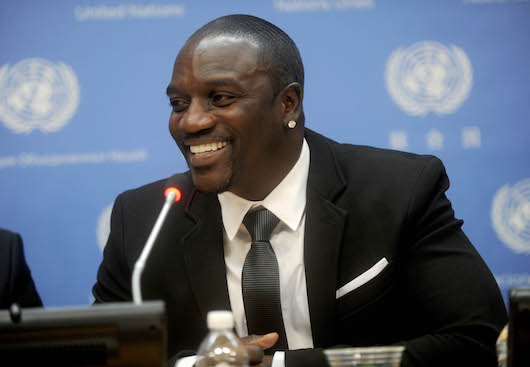 Many charitable celebrities have favorite organizations or causes and Akon’s interest in improving electrical accessibility in Africa hits close to home. Growing up in southern Senegal, Akon experienced a childhood without electricity. While Akon may have made his way to the United States, 600 million Africans still lack consistent access to energy.
In a recent interview with Devex, the American rapper stated that he felt it was time for some innovation in poverty-combating efforts: “There’s always been so many initiatives in Africa, so much money raised in Africa, but there’s never no results and it got to the point where you get tired of it […] I took it more personal than anything and I wanted to be in a position to where if I move forward on something I wanted to actually see it materialize.”
In 2013, he founded Akon Lighting Africa, along with Thione Niang and Samba Bathily, which invests in solar energy at a grassroots level in African communities. Through innovative solutions, the organization has grown and reached more countries in 2015, celebrating the inauguration of the Solektra Solar Academy, which promises bright things to come.
2) Angelina Jolie
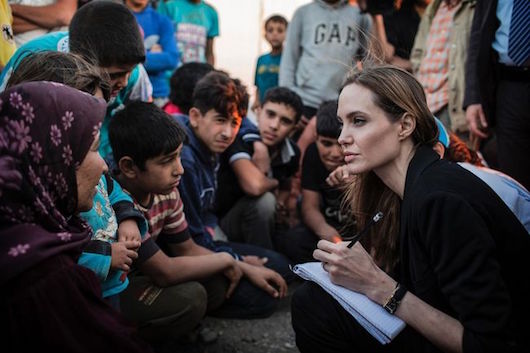 No list of famous global poverty warriors would be complete without Angelina Jolie. After years of working on global refugee issues with UNHCR, she was appointed in 2012 to the role of Special Envoy for Refugee Issues and has since extended her good work.
2015 was a big year for Jolie, who not only continued to donate her time and money to a wide variety of global charities but also brought light to many of the struggling Syrian refugees, according to the Times.
She also spent time revisiting her son Maddox’s birthplace in Cambodia and visited the two poverty-fighting organizations she helped found there: the Maddox Jolie-Pitt Foundation and the Maddox Chivan Children’s Center.
3) Matt Damon
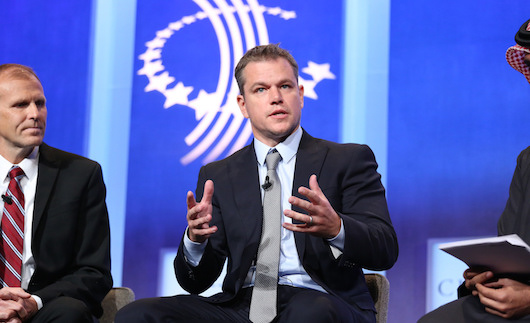 Actor Matt Damon has been working on improving access to clean water for many years. In 2006, he co-founded the H20 Africa Foundation, which later merged with WaterPartners and became Water.org, developing a more global focus.
In 2015 Damon and Water.org’s co-founder Gary White updated the public on the organization’s progress, stating in an interview for USA Today that it “surpassed its goal of reaching 2 million people with safe water and/or sanitation.”
In September 2015, Damon announced that he, along with friend Ben Affleck, will be producing a film set against the backdrop of the global water crisis entitled “Thirst.” The movie is currently in development for HBO Films.
https://www.youtube.com/watch?v=UpUWtMYqikc
4) Serena Williams
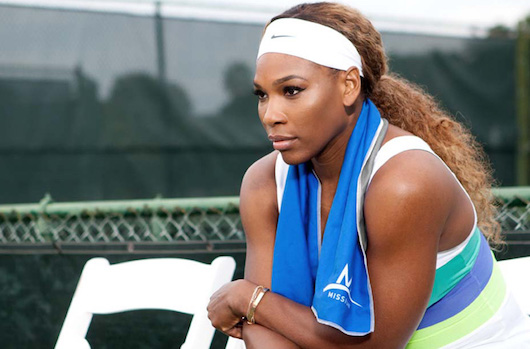 Last year, Williams expanded her already impressive portfolio of charity work by launching the 1 in 11 campaign, which focuses on helping the one in 11 children in the world who are kept out of school to get a quality education and achieve their full potentials.
Her foundation, the Serena Williams Foundation, gives large sums of money each year to a myriad of organizations, including UNICEF, Build African Schools and the Equal Justice Initiative.
A superstar on and off the tennis courts, Williams makes charity work a priority by forming partnerships with nonprofits and utilizing her global platform for good.
5) Emma Watson
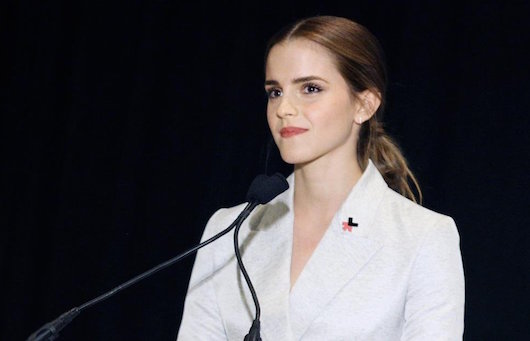 Since graduating from her role as Hermione in the Harry Potter franchise, Emma Watson has been a huge contributor to humanitarian issues around the globe.
In 2014, she was appointed by the United Nations to assume the role of Global Ambassador for Women. She has since been a huge advocate for girls’ education as a means of alleviating poverty and promoting equal rights. She has used this platform to bring attention to the HeforShe campaign, which advocates for global gender equality.
2015 saw major fundraising efforts by Ms. Watson, who auctioned off her shoes to benefit the Small Steps Project, an organization providing emergency aid to communities living in municipal garbage dumps around the world.
– Jennifer Diamond
Sources: Akon Lighting Africa 1, Akon Lighting Africa 2, Akon Lighting Africa 3, Devex, UNHCR, The Times, Journeys 4 Good, Global Health Committee, People, Water, USA Today, Variety, Serena Williams, CNBC, The Leaky Cauldron
Photo: Music.Mic, SUN, LiveScience, Mission, Global Citizen

The Life Sack: Providing Access to Improved Water Globally
The Life Sack functions as a water purifier that utilizes solar water disinfection process (SODIS) technology. UVA radiation and thermal treatment work together to kill toxic microorganisms and bacteria.
Typically, UVA radiation and thermal treatment are individually harmful to microorganisms and bacteria. The combined effect, therefore, increases the efficacy of the purification process. Moreover, the polyvinyl chloride (PVC) composition lends the Life Sack a high sunlight penetration ratio and durability.
Fashioned as a backpack, the Life Sack also ensures ease of mobility, which is especially crucial for areas without sources of water. These areas rely on individuals to travel outside of the community to supply the water that they need.
Water purification is not the only way that the Life Sack can be used.
The designers were partly inspired by how nongovernmental organizations and other charities often sent their supplies, such as grain and other food staples, in sacks. The Life Sack can thus double as a storage unit, allowing users to easily store and transfer goods other than water when needed. According to CauseTech, some nongovernmental organizations now use the Life Sack rather than “conventional food bags” to send their goods.
Since the initial launch of the Millennium Development Goals (MDGs), great improvements have been made in global access to improved sources of drinking water. From 1990 to 2015, the percentage of the global population with access to improved sources of drinking water has risen from 76 percent to 91 percent.
Further improvements are still to be made. Of the 63 million without access to clean water, most are concentrated in Sub-Saharan Africa and Southern and Southeast Asia.
A lack of access to clean water increases the propensity for water-borne diseases. Figures from WHO indicate that 760,000 children under five die of diarrheal diseases every year. More universal access to clean water would help in reducing this number.
Goal six of the United Nations’ 2015 Sustainable Development Goals (SDGs) addresses the need to “ensure access to water and sanitation for all” by 2030. Innovations like the Life Sack may support this effort toward increasing global access to improved water sources.
– Jocelyn Lim
Sources: Inhabitat, SODIS, Tuvie, The United Nations, UNICEF
Ai Weiwei’s Efforts to Raise Awareness for Refugees
Chinese artist Ai Weiwei is well-known for using his art to protest against human rights abuses committed by the Chinese government.
Ai’s concern, however, is not limited to his home country. He has lately made several efforts to support refugees and protest the conditions they find themselves living in.
On the Greek island of Lesbos, Ai recently set up a studio to highlight the plight of refugees. “The island has been the main point of entry into the EU for hundreds of thousands of refugees over the past year and the studio would produce several projects with themes related to the refugee crisis from him and his students, Ai told reporters,” said a January 2016 article in the Guardian.
Ai noted the lack of awareness of the situation and willingness to act in Europe and the rest of the world. “The border is not in Lesbos, it really [is] in our minds and in our hearts,” Ai said.
In Copenhagen, Ai closed down his exhibition in response to new laws and reforms. These laws aim to discourage refugees from seeking asylum by delaying family reunification and by allowing Danish authorities to seize refugee’s valuables. “The law has provoked international outrage, with many human rights activists criticizing the delay for family reunification as a breach of international conventions,” as reported by the Guardian.
“The way I can protest is that I can withdraw my works from that country. It is very simple, very symbolic – I cannot co-exist, I cannot stand in front of these people, and see these policies. It is a personal act, very simple; an artist trying not just to watch events but to act, and I made this decision spontaneously,” Ai told the Associated Press.
Perhaps most publicized and controversial of his recent efforts was a reenacted photo of deceased Syrian toddler Alan Kurdi. In this photo, Ai posed in the position of Kurdi’s dead body. Ai described to CNN his emotional experience of posing for the photograph: “I was standing there and I could feel my body shaking with the wind – you feel death in the wind. You are taken by some kind of emotions that you can only have when you are there. So for me to be in the same position [as Kurdi], is to suggest our condition can be so far from human concerns in today’s politics.”
Ai continued to express his frustration with the lack of action and compassion for refugees: “…you see all those politicians that are not really helping, and trying to find all kinds of excuses. To refuse and to even put these refugees in more tragic situations.”
For this effort in particular, Ai Weiwei received significant criticism. Various news publications and art critics derided the photo. For instance, a headline in the Spectator labeled it “crude, thoughtless and egoistical,” and an article in the Guardian discussed the danger of the photo having a “very real possibility of diluting a worthy cause.”
While the criticism may be valid, to expect Ai Weiwei to stop trying may be very mistaken. He plans to continue to raise awareness and support for the refugees. “As an artist, I have to relate to humanity’s struggles…I never separate these situations from my art.”
– Anton Li
Sources: CNN, The Spectator, The Guardian 1, The Guardian 2, The Guardian 3
Photo: Washington Times
Where is Mogadishu?
Considering its location, it is not surprising that Mogadishu was Somalia’s major port for centuries and has since served as the commercial and financial center of the country. Previously known as the “White Pearl of the Indian Ocean,” the city has undergone much turmoil, given its conflicts between competing warlords and various militias until 2006.
Mogadishu started to expand steadily in 2010 with the election of a new technocratic government and the start of federal control of the city. In 2013, Mogadishu’s population was estimated to be around two million people.
At present, the people of Mogadishu can look back at the past and see how far their city has come — from the days of war, when women were forced to wear niqabs and children were not allowed to play football on the streets, to present times, when women can wear modern clothes under their abayas.
2016 is a very important year for the city of Mogadishu and Somalia as a whole because of its upcoming presidential election. This is not just an ordinary presidential election because this could be the first time a woman holds the top job in the country.
Somalia’s first female presidential candidate is Fadumo Dayib, the daughter of Somali parents who was born in Kenya but grew up in Somalia and Finland. Though Fadumo did not learn to read and write until the age of 14, she managed to earn a master’s degree in health care and public health.
During the time she worked with the United Nations, she realized her passion was to do more to help Somalians.
From the perspectives of Somalians like Fadumo from the diaspora, returning to their country, Mogadishu is growing very quickly. As described by Laila Ali in the Guardian, Mogadishu is becoming like “Manhattan or Central London…new buildings and businesses are emerging from the carnage and lawlessness that pervaded the East African country for more than two decades.”
Mogadishu is rising from the dust after 23 years of conflict and is growing at a rate of 6.9 percent as the world’s second fastest growing city. Despite its horrid past, this “White Pearl of the Indian Ocean” is surely making steps in the right direction due to an improvement in its security situation and economic pursuits.
– Vanessa Awanyo
Sources: Nations Online, The Guardian 1, BBC, Fortune of Africa, The Guardian 2
Photo: Flickr
Supermarket Chain Branches Out to Customers in Kenya
Tuskys, Kenya’s second-largest retailer, recently began franchising as part of an expansion strategy to reach out and assist small businesses.
Created in the early 1980s, the family-owned supermarket has 52 stores in Kenya and seven in Uganda. Each Tuskys store tends to be located near a bus terminal in order to grant customers easy access to both groceries and public transportation.
However, the new expansion strategy allows the supermarket chain to be even closer to customers in Kenya through the use of a franchising model, which will rebrand and trade independent shops as Tuskys outlets.
“There is someone who is running a successful retail business in Kibera and all they need is a bit of support to make their business more modern, support to access a wider range of products from manufacturers and to better engage with customers,” CEO Dan Githua says. “We can give that to the retailer as a package and make some money out of it, and the retailer also gets to expand their business.”
Tuskys not only cares about their customers but also about their employees. In October 2015, the supermarket chain set aside 154 million shillings to train graduates in the business. The five-year program allowed up to 2,000 interns to partake in a six-month-long training program. After the program ended, 60 percent of the interns were guaranteed a job in the Tuskys’ workforce.
With a wide range of new interns, Tuskys was able to come up with a quick expansion strategy. Tuskys will begin with five stores as pilots, before adopting a wider franchising business model. The supermarket chain is looking to promote small businesses that are well-served with a nice space and location. After locating these entrepreneurs, Tuskys will then offer a value proposition.
The main goal of the expansion is to give small business owners what they need. Githua says, “If he doesn’t have freezers, we will give them nice freezers. If he doesn’t bake bread, we introduce Tuskys bread in the store.”
By providing Kenyan and Ugandan businesses with proper goods, the store owners and employees will benefit and more people will have access to necessary resources.
– Megan Hadley
Sources: How We Made It in Africa, Standard Media, Tuskys
Five Celebrities Who Fought Global Poverty in 2015
Being in the spotlight gives charitable celebrities the unique ability to send messages, raise money and act as major advocates for important causes around the world. In 2015, these five stars stood out for their global poverty-fighting efforts:
1) Akon
In a recent interview with Devex, the American rapper stated that he felt it was time for some innovation in poverty-combating efforts: “There’s always been so many initiatives in Africa, so much money raised in Africa, but there’s never no results and it got to the point where you get tired of it […] I took it more personal than anything and I wanted to be in a position to where if I move forward on something I wanted to actually see it materialize.”
In 2013, he founded Akon Lighting Africa, along with Thione Niang and Samba Bathily, which invests in solar energy at a grassroots level in African communities. Through innovative solutions, the organization has grown and reached more countries in 2015, celebrating the inauguration of the Solektra Solar Academy, which promises bright things to come.
2) Angelina Jolie
2015 was a big year for Jolie, who not only continued to donate her time and money to a wide variety of global charities but also brought light to many of the struggling Syrian refugees, according to the Times.
She also spent time revisiting her son Maddox’s birthplace in Cambodia and visited the two poverty-fighting organizations she helped found there: the Maddox Jolie-Pitt Foundation and the Maddox Chivan Children’s Center.
3) Matt Damon
In 2015 Damon and Water.org’s co-founder Gary White updated the public on the organization’s progress, stating in an interview for USA Today that it “surpassed its goal of reaching 2 million people with safe water and/or sanitation.”
In September 2015, Damon announced that he, along with friend Ben Affleck, will be producing a film set against the backdrop of the global water crisis entitled “Thirst.” The movie is currently in development for HBO Films.
https://www.youtube.com/watch?v=UpUWtMYqikc
4) Serena Williams
Her foundation, the Serena Williams Foundation, gives large sums of money each year to a myriad of organizations, including UNICEF, Build African Schools and the Equal Justice Initiative.
A superstar on and off the tennis courts, Williams makes charity work a priority by forming partnerships with nonprofits and utilizing her global platform for good.
5) Emma Watson
In 2014, she was appointed by the United Nations to assume the role of Global Ambassador for Women. She has since been a huge advocate for girls’ education as a means of alleviating poverty and promoting equal rights. She has used this platform to bring attention to the HeforShe campaign, which advocates for global gender equality.
2015 saw major fundraising efforts by Ms. Watson, who auctioned off her shoes to benefit the Small Steps Project, an organization providing emergency aid to communities living in municipal garbage dumps around the world.
– Jennifer Diamond
Sources: Akon Lighting Africa 1, Akon Lighting Africa 2, Akon Lighting Africa 3, Devex, UNHCR, The Times, Journeys 4 Good, Global Health Committee, People, Water, USA Today, Variety, Serena Williams, CNBC, The Leaky Cauldron
Photo: Music.Mic, SUN, LiveScience, Mission, Global Citizen
The Ford Foundation Fights Against Inequality
Two years ago, the Ford Foundation sponsored 35 different initiatives. To better focus on inequality, this has been reduced to 15 in the following seven categories:
Under Inclusive Economies are initiatives such as impact investing and economic security, while engaging government and equitable resources are listed under Civic Engagement and Government. The other five categories cover drives such as social justice storytelling, natural resources and climate change, rights of women and girls, digital rights and access and pathways to youth success.
Institution building is another key goal of the foundation. From 2016 to 2020, the Ford Foundation plans to invest $1 billion around the world to create a network of organizations against inequality. This initiative – called BUILD – is designed to magnify each institution’s impact by aligning their goals and bringing them together.
To bring the issue to the forefront and get the attention of the world’s creative leaders, on Feb. 2, 2016, the Ford Foundation announced a two-year partnership with the Cannes Film Festival through its JustFilms grants. Like BUILD, JustFilms creates a network against inequality, in this case, a network of documentarists, storytellers and independent filmmakers.
The 2016 Cannes Film Festival takes place from May 11 to May 22 and is the one of the world’s most prominent independent film festivals. In its partnership with JustFilms, Cannes Film Market will bring some of the most talented documentary makers from the global south to the event.
By bringing in filmmakers from a largely neglected region of the world, JustFilms hopes that they can connect these storytellers with the larger industry. Once connected, their stories and perspectives can spread around the globe and reach people in developed nations.
Cannes Film Market’s head of industry programming, Julie Bergeson, was grateful for the foundation’s contribution to fighting inequality. She said, “Ford has created an incredible legacy in tackling social injustice and inequality. Their efforts have lead to revealing insights and sometimes startling exposures from filmmakers around the world.”
In changing the focus of its grants, the Ford Foundation has highlighted inequality as one of the most pressing issues of the 21st century. In partnering with Cannes, they have taken a step to raise awareness by bringing forth perspectives from the developing world.
There is much more to be done but there is reason to hope. The fight to end inequality will be long but the Ford Foundation is fully committed.
– Dennis Sawyers
Sources: Ford Foundation, Nonprofit Quarterly, The Chronicle of Philanthropy 1, The Chronicle of Philanthropy 2, Variety
Photo: The Chronicle of Philanthropy
What are the Killing Fields of Cambodia?
The Khmer Rouge regime, led by Pol Pot, took over Cambodia in 1975. During its four-year rule, over one-quarter of the country’s entire population was killed in the regime’s ruthless pursuit of totalitarian control. In 1979, the Vietnamese ended the corruption by invading Cambodia and seizing power from the regime.
The largest pieces of evidence from this time in history are the remains of the killing fields of Cambodia. These were the places where those who did not cooperate were sent to work to their death. The fields exist today as a museum of sorts, with 20,000 people buried underground. The fields also hold displays, such as 8,000 human skulls placed in glass shrines.
The experiences that the Cambodian people underwent were deeply inhumane. Men, women and children were starved, worked to their death or were murdered in these fields. The fields are not just one inclusive area; there are 343 fields that have been discovered. Especially gruesome is that when it rains on the fields, bone and teeth fragments often wash up.
Cambodia coordinated with the U.N. General Assembly almost three decades after the Khmer Rouge were driven out. On Jun. 6, 2003, the Cambodian government agreed to prosecute the crimes committed during the genocide, which established the Extraordinary Chambers in the Courts of Cambodia (ECCC). Though many perpetrators had already passed away by this time, the ECCC did prosecute five men involved.
Although they hold a dark past, the killing fields of Cambodia have actually become a positive asset to the country. According to National Geographic, tourism in Cambodia has increased by 40 percent every year since 1998 as curiosity about the genocide has grown. The fields have created many tour guide jobs for hundreds of Cambodians and the large rise in tourists has helped boost the country’s economy.
When people visit this site, however, they are most importantly paying their respects to Cambodia’s history and those who have passed. The fields will continue to exist as a reminder of the horror that comes when tyranny and genocide take hold.
– Kerri Whelan
Sources: World Without Genocide, National Geographic, University of Rochester, MTVU, CyberCambodia
Photo: Reuters Media
Helping Refugees Settle in the United States
For the 500 refugees that arrive in San Antonio each year, the transition can be difficult. After fleeing violence and persecution at home, refugees face a new set of challenges when trying to settle in the United States, including language barriers, unfamiliar cultures, discrimination and unemployment. Programs helping refugees settle in the U.S. are central to facilitating a successful, new start for refugees.
Catholic Charities of the Archdiocese of San Antonio (CCOASA) offers a comprehensive program helping refugees settle and achieve economic self-sufficiency and cultural integration in San Antonio. When refugees arrive at San Antonio International Airport in central Texas, Catholic Charities volunteers are there to help.
The program begins as soon as refugees touch down. After their reception at the airport, volunteers assist refugees with housing, food, clothing and supplemental financial assistance. From there, they can receive a number of orientation courses covering topics such as American culture and laws, safety, healthcare, childcare, banking and employment.
The majority of CCOASA’s work, however, continues long after arrival. In addition to offering ESL and other courses through its Refugee Services Education Program, the organization provides ongoing case management services to identify and address each refugee’s unique obstacles to employment, community integration and cultural adjustment.
CCOASA’s Refugee Employment Services Program helps refugees join the workforce by linking them with potential employers based on specialized skills and level of employability. The organization also works to help refugees adjust to American work culture once they are employed.
For the children of refugees, the organization offers after-school tutoring and family services to help children acclimate to the American public school system. CCOASA’s School Impact Program helps 200 children per year integrate into educational life.
With support from the Department of Health and Human Services’ Office of Refugee Resettlement (ORR), CCOASA is just one of the hundreds of organizations helping refugees settle in the U.S. The office partners with private organizations in major cities across the country to take on this work.
Through ORR, refugees can also take advantage of numerous federal grants in order to buy homes, start businesses, go to college and develop careers. The office even provides opportunities for refugees to take part in sustainable community farming programs.
Helping refugees settle into a new life in the United States is challenging but, luckily, there are support systems in place to make the process easier. You can find opportunities to help in your own community here.
– Ron Minard
Sources: HHS, Borgen Project, CCAOSA, Immigration Policy
Photo: Washington Post
The Oscar-worthy Activist: Leonardo DiCaprio’s Charity Work
In 1998, when he was 24 years old, DiCaprio recognized the importance of protecting the environment and the need for building a sustainable future. He established the Leonardo DiCaprio Foundation (LDF) to contribute to this cause.
Since 2010, the LDF has donated over $30 million to fund high-impact environmental projects in more than 44 countries, according to the organization’s website. “I play fictitious characters often solving fictitious problems,” DiCaprio said in an interview with the Telegraph in January 2016. “I believe mankind has looked at climate change in the same way, as if it were a fiction. But I think we know better than that.”
DiCaprio’s unwavering commitment to the environment earned him the role of United Nations Messenger of Peace in September 2014. “[DiCaprio’s] global stardom is the perfect match for this global challenge,” said U.N. Secretary-General Ban Ki-moon at a press conference at that time.
Charity Navigator, an organization known for guiding intelligent giving, noted DiCaprio’s involvement in the National Resources Defense Council, WildAid and the World Wildlife Fund on their list of celebrities who put their star power to good use. The LDF raised over $25 million at its inaugural gala in July 2014 thanks to auctioned items from Bono and Simon de Pury, according to Vogue Magazine.
DiCaprio’s charity work extends beyond the realm of fundraising galas or speaking to world leaders. While most celebrities use Facebook, Instagram and Twitter for self-promotion, DiCaprio’s accounts are devoted to causes he cares about.
“Leonardo’s website and social media platforms are also dedicated to inspiring the public to take action on key environmental issues,” the LDF website says, regarding DiCaprio’s social media channels. “Growing in reach from just 500,000 followers in 2007 to over 25 million in 2015, Leonardo’s fans have engaged on an array of issues protecting key species — sharks in California, tigers in Asia, elephants in Africa — and calling on world leaders to address climate change.”
Leonardo DiCaprio’s ability to leverage social media for good has not gone unnoticed. Complex Magazine cited DiCaprio as one of 11 celebrities that used social media for good in 2015.
– Summer Jackson
Sources: Complex, Look to the Stars, Telegraph, UN, Vogue, Charity Navigator
Photo: Google Images
Netflix to Expand Technology Access to Africa
The rise in cell phone usage has helped connect an estimated 300 million Africans to the Internet. But widespread connectivity problems and high data bills have made on demand video services less feasible for many. It is difficult for services like Netflix to gain momentum in areas that have problems connecting to the Internet.
Another video on demand company, iRoko TV, has switched to a mobile-first platform, making its product download-only and Android driven. The company, often referred to as the Netflix of Africa, is also working on technology that can compress videos into smaller files, which will allow them to deliver data quickly to any device with broadband abilities.
“The infrastructure, generally, isn’t really here for streaming long-form content,” founder of iRoko TV, Jason Njoku, told Variety. “For millions, the data price-points are way too high to pay for content streaming.”
The amount of data required to use Netflix for one hour can cost the user $4 in developing countries, says State Salem Log. This can translate to $250 each month. However, African users are attracted to the service because video content is offered at cheaper rates than the same content shown on cable networks, State Salem Log reports. Companies are trying to stay ahead of the game, with the hopes that falling data costs and increased Internet connection speeds will create more demand for video on demand services.
Marie Lora-Mungai, co-founder and CEO of African studio Restless Media, who is involved with streaming service Buni.tv, told Variety, “Netflix might be worse equipped than local VOD providers to deal with local infrastructural challenges, in that they traditionally don’t modify their platform to adapt to the specificities of local markets.”
Netflix expanded into 130 countries this January and even shot its first original film in Ghana earlier this year.
– Kaitlyn Arford
Sources: Variety, Wired, Salem State Log, AFK Insider
Photo: Enterprise54