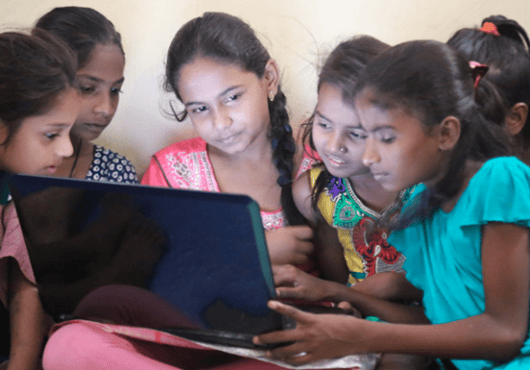
Dharavi is Asia’s largest slum and is located in the middle of Mumbai, India’s financial capital. The slum is home to nearly a million people. Within that population, teenage girls have been learning how to code in order to develop mobile applications that can help tackle different problems within their community.
Filmmaker Nawneet Ranjan founded the Dharavi Diary project, which teaches young girls in the slum to code. With this skill, the girls can then develop mobile applications that aim to combat everyday issues including “sexual harassment, access to water and education.”
Using the MIT App Inventor, online video instruction, documentary films and Powerpoint presentations, Ranjan and the Dharavi Diary project team teaches girls between the ages eight and 16, the basics of coding.
Ranjan first became involved in working with the Dharavi community after he made a film titled Dharavi Diary in 2012. The film documented issues faced by the slum’s residents.
He then set up a small computer lab in 2014, with the goal of encouraging young girls to become changemakers. The result of their involvement in the program can ultimately lead them to better education and more employment opportunities.
“A lot of girls in the neighbourhood don’t get the chance to use computers and laptops,” Ranjan told Mashable. “I showed them how technology can be used to solve problems and improve their job opportunities. I told them that these were things that they could learn on their own.”
The project experienced a setback when the slum was destroyed by a fire on Jan. 4, 2016, destroying tablets and computers as well as the homes of over 50 families in the neighborhood.
However, through a new crowd-funding campaign, Ranjan hopes to raise more resources to buy more computers, laptops, and food and clothing for the children.
One app that a group of girls developed, for example, is called Paani, which alerts residents of the slum when they collect water from the community tap. This allows members of the community to avoid waiting in long lines for the water every day.
In a country where access to clean water is a luxury, the responsibility of collecting water often falls on girls, who consequently must miss school as a result of waiting hours for the essential resource.
Another Android App, Women Fight Back, focuses on women’s safety. Its features include SMS alerts, a distress alarm and emergency calls to contacts on their phones, according to Business Insider.
“When we joined the program we decided first to look at the problems that our neighborhood and community faced, and then build apps to address them,” said Ansuja Madiwal, a 15-year-old girl, in an interview with The Hindu.
“In a small way, initiatives like this help in giving people a greater sense of participation and an awareness of the problems that they face and how they can devote resources to solving them,” said Ranjan.
– Michelle Simon

Cricket Without Boundaries Raises Awareness
Cricket Without Boundaries (CWB) is a U.K. based charity, founded in 2005. The organization is dedicated to raising awareness about the HIV/AIDs epidemic occurring in various impoverished communities.
CWB does this through integrating lessons about HIV and AIDs with cricket instruction. These cricket programs are designed to, “break down the barriers of discrimination, empower individuals and educate about HIV/AIDs prevention and testing.”
This charity is currently involved in five African countries: Botswana, Cameroon, Kenya, Rwanda and Uganda. Within these countries, CWB offers cricket coaching programs as well as comprehensive sexual education.
The organization aims to go beyond the traditional approach to understanding sexual education as a method for fighting transmitting STIs. This traditional method involves abstinence, being faithful to a single partner, condom use and testing (ABC and T). CWB includes this approach in its lessons but also understands that HIV spreads despite abstinence and faithfulness.
The charity wants to provide accurate sexual education to both genders to further protect women and girls (among the most vulnerable) from HIV. By eliminating the gender gap in sexual education, CWB has a stronger impact in these communities.
By focusing on prevention and healthy sexual relationships, the organization has successfully educated thousands of adults and children. CWB trains various coaches within these countries to create a sustainable community-level program.
The charity states that it has, “coached over 65,000 children, who will be the next generation of cricketers, passing on skills and knowledge in cricket grounds, schools and communities, both about cricket and about the disease.”
By utilizing sport to build a supportive community that educates both adults and children about HIV/AIDS, Cricket Without Boundaries provides a model of disease prevention that can be applied globally.
CWB has gained traction over the years in major news sources such as BBC and CNN. In 2014, CNN conducted interviews within one of the charity’s projects in Rwanda.
Eric Hirwa, a member of Rwanda’s national cricket team, is among the individuals interviewed who train and educate hundreds of Rwandan children each week. The most recent UNAIDS data estimated 210,000 people living with HIV in the country.
This same report estimated 85,000 children to be orphaned as a result of AIDS and 3,000 deaths due to the virus. Rwanda is just one example of the vulnerable communities CWB targets.
Funding Cricket Without Boundaries and other similar organizations can significantly improve the current state of the HIV/AIDS crisis in the developing world.
– Saroja Koneru
Photo: Flickr
UN: Helping Impoverished Women in Nepal
On April 25, 2015, an earthquake in Nepal pushed an estimated 1 million people below the poverty line. Before the disaster, the poverty prevalence in Nepal was already at 23.8 percent. The World Bank also predicted that by this year, up to 982,000 more people would be pushed into poverty, including many women in Nepal.
The U.N. Deputy Secretary-General Jan Eliasson recently visited the women in Nepal affected by the earthquakes at the Chautara U.N. multipurpose women’s center. The center provides counseling and trauma assistance, information dissemination and recovery-related activities.
“This is a very different experience for me,” Eliasson said during the visit, according to a U.N. Women article. “I met with women and young girls who despite all odds are getting on with their lives. This is a sign of resilience. It is important for them to be able to clear the rubble and rebuild their lives.”
The earthquake that hit Nepal affected agriculture, education, water and sanitation and health—crucial aspects of development. People were pushed into poverty because they lost their homes, income opportunities, personal items and livestock.
Worse, up to 70 percent of the people pushed into poverty from the earthquake live in rural hills and mountains that are already developmentally vulnerable.
During the visit, a young woman named Sita Shrestha shared her experience of a leadership training program offered by the women’s center. She told the Secretary-General that the program allowed her to fundraise, organize villagers and supply water to individual houses.
“The training and this project have changed my life,” Shrestha said at the visit, reports U.N. Women. “I want to join a humanitarian organization like the U.N. in the future.”
The U.N. multipurpose women’s center is focused on delivering sustainable services to women in Nepal. The center also now focuses on enhancing the capacity of local women’s groups to ensure equality with regard to disaster recovery, reconstruction and preparedness initiatives.
– Kerri Whelan
Photo: Flickr
What is Advocacy in Terms of Helping the Global Poor?
What is advocacy? Merriam-Webster defines an advocate as someone who “argues for or supports a cause or policy.” Other definitions paint advocates as defenders, either of a cause or of a person. Lastly, an advocate can also be defined as a promoter of another’s interests.
What is Advocacy in Terms of Global Poverty?
With almost 10 percent of the world’s population living on less that $2 a day, ignoring the global poor is like ignoring someone who is injured and cannot get to their feet.
In the case of the global poor, an advocate is one who supports, defends and promotes the human rights of those suffering in extreme poverty. A person is an advocate when they support policies that aid struggling populations stricken with hunger, disease and a lack of access to education or sanitation.
Eradicating global poverty can seem like a daunting task. Who is equipped to change the world in such a way? Notice that the definition does not say an advocate is an implicit solution to the problem. On the contrary, an advocate is someone who works to find a solution and appeals to the powers that can make a difference.
Today, being an advocate for the global poor does not require immense effort. In fact, it is as easy as sending a few emails and making a few phone calls. By contacting our representatives in Congress and showing our support for foreign aid, we can act as intermediaries for the millions who do not have the means to do so themselves.
Advocacy is more powerful in groups. By spreading awareness of the global poor and demonstrating how easy it is to support their cause, we can multiply our impact. With enough people promoting the same interests, leaders will take notice. If we do not have the power to eradicate poverty on our own, the governments of the world certainly do.
The actions of advocates have had a profound effect. Since 2011, a projected 200 million people are no longer in extreme poverty. Nevertheless, there are still millions more that are crying for help with the hope that someone will take notice and champion their cause.
– Emiliano Perez
Photo: Flickr
Indian Girls Develop Mobile Applications to Tackle Local Issues
Dharavi is Asia’s largest slum and is located in the middle of Mumbai, India’s financial capital. The slum is home to nearly a million people. Within that population, teenage girls have been learning how to code in order to develop mobile applications that can help tackle different problems within their community.
Filmmaker Nawneet Ranjan founded the Dharavi Diary project, which teaches young girls in the slum to code. With this skill, the girls can then develop mobile applications that aim to combat everyday issues including “sexual harassment, access to water and education.”
Using the MIT App Inventor, online video instruction, documentary films and Powerpoint presentations, Ranjan and the Dharavi Diary project team teaches girls between the ages eight and 16, the basics of coding.
Ranjan first became involved in working with the Dharavi community after he made a film titled Dharavi Diary in 2012. The film documented issues faced by the slum’s residents.
He then set up a small computer lab in 2014, with the goal of encouraging young girls to become changemakers. The result of their involvement in the program can ultimately lead them to better education and more employment opportunities.
“A lot of girls in the neighbourhood don’t get the chance to use computers and laptops,” Ranjan told Mashable. “I showed them how technology can be used to solve problems and improve their job opportunities. I told them that these were things that they could learn on their own.”
The project experienced a setback when the slum was destroyed by a fire on Jan. 4, 2016, destroying tablets and computers as well as the homes of over 50 families in the neighborhood.
However, through a new crowd-funding campaign, Ranjan hopes to raise more resources to buy more computers, laptops, and food and clothing for the children.
One app that a group of girls developed, for example, is called Paani, which alerts residents of the slum when they collect water from the community tap. This allows members of the community to avoid waiting in long lines for the water every day.
In a country where access to clean water is a luxury, the responsibility of collecting water often falls on girls, who consequently must miss school as a result of waiting hours for the essential resource.
Another Android App, Women Fight Back, focuses on women’s safety. Its features include SMS alerts, a distress alarm and emergency calls to contacts on their phones, according to Business Insider.
“When we joined the program we decided first to look at the problems that our neighborhood and community faced, and then build apps to address them,” said Ansuja Madiwal, a 15-year-old girl, in an interview with The Hindu.
“In a small way, initiatives like this help in giving people a greater sense of participation and an awareness of the problems that they face and how they can devote resources to solving them,” said Ranjan.
– Michelle Simon
Surprising Ways Smartphones are Helping Refugees
Smartphones can go a long way in helping refugees to stay safe, connected and assimilate into new communities.
According to research conducted by Penn State University, about 86 percent of young Syrian refugees at Zaatari Camp of Jordan own cell phones and more than half access the Internet daily.
During dangerous and long journeys, the luxury of smartphones helps ensure safety by keeping refugees connected with their family members. In addition, something as simple as taking and sharing photos helps to maintain a sense of community.
Navigation applications like Google Maps have also drastically changed the scene by helping refugees to travel without a heavy dependence on guides. When they do need to hire guides, information and reviews on social networking services including Facebook and WhatsApp ensure quality of service and prevent trafficking related crimes.
Some applications specifically target refugees and their needs. Google’s Crisis Info Hub lists travel information for those entering Europe through the island of Lesbos, with hotline Red Cross contacts and lodgings.
Gherbtna (“exile” or “loneliness” in Arabic), developed by Mojahed Akil who is himself a Syrian refugee, provides resettlement advice and guidelines. On the other side of the border, countries accommodating refugees have established similar information services such as Germany’s Refugee Welcome.
Another way that smartphone use is helping refugees is through increased accessibility to educational tools. In a situation where access to a formal education is near impossible, the Internet provides ubiquitous access to educational material.
The Guardian notes that there are “more than 80,000 education apps in Apple’s App Store, ranging from phonics to physics.”
The nonprofit organization Aiim develops education apps for refugees between the ages of 12 and 16 that are available offline, even in areas without Internet connection. The organization hopes to reach 10,000 Syrian refugees by the end of next year through pilot programs in Jordan and Lebanon.
– Haena Chu
Photo: Flickr
Perspective-Changing Films About Poverty
When you have enough money and food to be comfortable, it can be easy to be unaware of just how many people in the world are lacking in these basics. Sometimes an inspiring film can really drive this point home, with moving stories and imagery that make it shockingly clear that millions of people in the world struggle with poverty every day. These are a few of the documentaries and films about poverty that give an idea of what poverty is like, or attempt to explain the nature of poverty.
We Feed the World: This film examines the contrast between the overproduction and waste of food among the affluent and the scarcity among those who are hungry. Food production is also explored. The story is told via an interview with U.N. Special Rapporteur on the Right to Food, Jean Zigler.
Slumdog Millionaire: One of the most popular films about poverty, Slumdog Millionaire is about how an orphan growing up in poverty in Mumbai comes to be a contestant on India’s “Who Wants to be a Millionaire?” The question is, how did an uneducated orphan come to have the answers to some many of the game’s trivia questions? Moving visual imagery and dramatic storytelling bring both the reality of poverty and the hope amidst it to life.
A Place at the Table: This film, featuring actor-director Jeff Bridges, examines hunger in the U.S. The staggering statistic of 50 million Americans living in household lacking food security is given and this in the “richest country in the world,” reported Bills Moyers & Company. A Place at the Table tells us not only how many Americans are going hungry, but what tax dollars are being spent on instead. It also follows the lives of Americans living with food insecurity. Often they are people who are working full-time. Despite adding many food banks in the U.S., the problem persists.
The End of Poverty: This is another film that asks why there is so much poverty existing alongside so much wealth in the world. Directed by Philippe Diaz and narrated by Martin Sheen, the film takes the view that our current economic system is not only responsible for this situation, but perpetuates it and keeps it from truly changing. A look is taken at policies that keep rich countries rich, and poor countries poor.
Poverty, Inc.: This documentary takes a hard look at how the system of giving aid is and is not working. Although the film acknowledges the good in giving, it raises the question of what happens once money or aid is given. Are there unforeseen consequences? Sometimes aid can create dependence in a community in need. It’s important to examine the most efficient strategies for helping communities to rise above poverty and learn the tools to keep themselves out of it.
These thought-provoking documentaries and films about poverty bring new perspective to how we think about giving aid to those in poverty.
– Katherine Hamblen
Photo: Flickr
Genocide Survivors Rebuild with Banana Cooperative
Jacqueline Musabyimana is the president of the Twiyubake Banana Leaf Cooperative. Twiyubake means “to rebuild ourselves” in the Kinyarwanda language. Musabyimana is a survivor of the Rwandan genocide of 1994. Her family, like many in the area, struggled to survive in the aftermath of the humanitarian crisis.
Genocide survivors were faced with difficult circumstances, including the loss of many (mostly male) family members. However, women were determined to lift themselves out of poverty with dignity and confidence.
The Twiyubake Cooperative is made up of master banana leaf weavers and other master artisans who have been making and selling banana leaf products since 2008.
Musabyimana and other women in the area learned to make hand-woven banana leaf baskets and jewelry to supplement family incomes. In 2011, U.S.-based Songa Designs International came to their village. The for-profit “socially conscious” fashion start-up was fascinated with the merchandise weavers were making and decided to help sell them.
Musabyimana was able to buy a plot of land, build a home, as well as purchase a cow and goat — all with the money she made by selling her products through Songa.
The Songa Designs website states that the dynamic in many areas of the developing world is for women to be entirely dependent on their husbands.
However, the company seeks to change the status quo by offering opportunities to under-resourced women so that they can “achieve economic independence by using skills acquired through everyday life to make a living. Songa Designs provides jobs for these women who negotiate their own salaries and earn fair wages.”
The Twiyubake Cooperative is one of the groups that belong to Indego Africa, a group whose mission it is to empower women artisan in Africa. According to the Indego Africa website, a cooperative is “a legally recognized form of association in Rwanda that was promoted by the government after the 1994 genocide.”
Following the genocide, the Rwanda population was 70 percent female and the economy was a disaster. Women were left to rebuild the country, but most lacked education and knew nothing about business or export markets. Indego Africa helps the cooperatives develop business and become sustainable.
The Twiyubake Cooperative employs female genocide survivors as well as the wives of genocide perpetrators. All the steps involved in making products for sale in the Twiyubake artisan line are done by hand — specifically, the metal working, beading, embroidery and sewing. In addition, the natural banana leaf and other fibers are grown locally.
– Rhonda Marrone
Photo: Flickr
How Refugees Improve Countries of Resettlement
More than 1.3 million refugees sought asylum in Europe in 2015 alone, the influx demonstrating the escalating urgency of the refugee crisis. As these unprecedented numbers flow in, refugee camps have been pushed far past the limits of their capacities and countries within the European Union have struggled to negotiate sharing the burden.
Citizens of these countries fear that the refugee influx could threaten safety and job security. For those who do not find humanitarian duty reason enough to intervene, the situation leaves many wondering how refugees improve countries.
However, a number of unexpected benefits of refugees entering a country make stepping up in this humanitarian crisis potentially beneficial for both parties. Below are six ways in which refugees improve countries to which they’ve been granted resettlement.
Germany has been at the forefront of countries extending open arms to refugees–announcing that it will accept 800,000. The country also has the lowest birth rate in the world, which continues to decline at a fast pace. In order to support the aging community and state pension system, an estimated 1.5 million skilled immigrants is needed. By 2060, Hamburg’s World Economy anticipates that Germany will need two workers to support each individual in retirement. As a result, there is a significant opportunity for refugees to improve countries with declining birth rates.
The biggest receivers of refugees have also become focus areas for humanitarian aid. While often this aid is woefully insufficient, what does come can accomplish a great deal for the host nation itself. It is estimated by the United Nations that in countries like Lebanon, the multiplier effect of aid means that every U.S. dollar worth of assistance generates $0.50 for the local economy.
Companies looking to grow need skilled, young workers to take on the roles of aging European work forces. Notably, the head of Mercedes Benz, Dieter Zetsche, has expressed that refugee workers are precisely what countries like Germany and corporations like Mercedes Benz need.
Putting systems in place to allow refugees to become employed and contribute to society creates a larger tax base. This enables refugees to help improve countries by decreasing tax burden, maintaining state systems and increasing public services.
A number of potential security benefits may come with accepting refugees from the Middle East to countries like the U.S. These movements have the ability to counter the anti-U.S. propaganda that many radical groups like ISIS depend on. The migration of people and the decreased potency of propaganda could deprive radical groups of the resources and recruits that they need. In addition, the inclusivity and acceptance which comes from welcoming refugees to Western parts of the world has the potential to decrease the marginalization of Muslim and Middle Eastern people living in the West. This could be a potent tool against internal-radicalization.
Obtaining information regarding realities on the ground in areas like Syria has been a large obstacle for the U.S. and other countries involved in combating terrorism. Patrick Eddington, a former CIA intelligence officer, has described Syrian refugees in the U.S. as the most valuable source of insight regarding the realities of living in ISIS-controlled territory. Through Syrian refugees, intelligence has been obtained regarding ISIS funding, leadership and military-related inventory. Therefore, refugees improve countries combating terrorism by contributing to security and intelligence needs.
These six examples of how refugees improve countries of resettlement demonstrate the multifaceted contributions of refugee populations. By joining the formal workforce, they have the potential to offset varying degrees of the economic burden which accompanies a humanitarian crisis and influx of migrants. Intelligence contribution and the decreased marginalization of refugees also offer significant security benefits. Finally, facilitating the movement of refugees to safety can decrease the efficacy of extremist propaganda and recruitment tactics.
– Charlotte Bellomy
10 Facts About Forced Migration
The subject of forced migration, especially related to refugees, is a major topic in current news and politics across the world. Columbia University defines forced migration as “the movements of refugees and internally displaced people (those displaced by conflicts within their country of origin) as well as people displaced by natural or environmental disasters, chemical or nuclear disasters, famine, or development projects.” Below are 10 facts about forced migration:
migrated within their own countries. The UNHCR reports there are over 38 million people classified as IDPs.
Forced migration has been a major issue for quite some time now. Although countries around the world have stepped in to help refugees and other displaced individuals, these facts further prove that it will take much more to reduce these numbers.
— Saroja Koneru
Photo: U.N. Multimedia
Why Vaccines are an Economic Investment
In addition to preventing serious illnesses, vaccines are an economic investment as they have the added bonus of saving money. As fewer people get sick, this reduces the need for complex and often long-term medical treatment which allows communities to save greatly.
Research from the Johns Hopkins Bloomberg School of Public Health, in addition to other studies, has shown that the returns on vaccines are 16 times the investment; that is to say, every dollar spent on vaccines, on average, saves sixteen dollars in future medical spending.
The journal Health Affairs, which published the Johns Hopkins study, noted that when other factors are considered beyond direct medical costs, such as time not taken off from work due to illness, the return rises to as high as $44 for every dollar spent.
While the economic benefits of vaccinations are great for every country, they especially matter in poor or developing countries, where funds are often stretched thin and accessing affordable health care can be difficult if not impossible.
The World Health Organization estimates that malaria costs Sub-Saharan Africa $100 billion every year. In a region plagued by poverty, that is too much money for countries to be spending on preventable diseases.
Vaccines show that when we invest in prevention, we can make huge savings on treatment. In turn, the money that would be spent treating preventable diseases can go to other places, such as to education, poverty reduction schemes or energy programs.
Vaccines are an economic investment that not only save lives, but they also save money in so many ways, not just treatment costs.
When people are sick with a debilitating illness, not only do they spend money on treatment, they lose money when they cannot work resulting in a vicious cycle of economic hardship. Continued increased access to vaccines can help millions around the world.
– Emily Milakovic
Photo: U.N. Multimedia