• Link to X
  • Link to Facebook
  • Link to Instagram
  • Link to TikTok
  • Link to Youtube
  • About
    • About Us
      • President
      • Board of Directors
      • Board of Advisors
      • Financials
      • Our Methodology
      • Success Tracker
      • Contact
  • Act Now
    • 30 Ways to Help
      • Email Congress
      • Call Congress
      • Volunteer
      • Courses & Certificates
      • Be a Donor
    • Internships
      • In-Office Internships
      • Remote Internships
    • Legislation
      • Politics 101
  • The Blog
  • The Podcast
  • Magazine
  • Donate
  • Click to open the search input field Click to open the search input field Search
  • Menu Menu

Tag Archive for: Venezuela

Posts

Economy, Global Poverty, Politics and Political Attention

Reducing Poverty: Venezuela’s New President

reducing_poverty_Venezuela
Countless Venezuelans live in poverty, many of them living in small, run-down towns that are sprawled over the hillside around Caracas, the nation’s capital. Even though Venezuela is known for having some of the world’s largest oil deposits and massive amounts of coal, gold, iron ore, and bauxite, poverty is still a very real issue. The economy is mainly tied to global oil prices, with the oil boom in the 70’s largely benefitting the Venezuelan middle class, but the price collapse to follow caused many of the middle class to enter into poverty and worsened the lives of the already impoverished. Former President Hugo Chavez pursued political programs based on a society with equal rights and opportunities for all, as well as the sustainable integration of the rural poor population into the national economy.

Approximately 60 percent of households are living in poor conditions because of the unemployment rates being so high. Around 50 percent of the rural population is poor, compared to the 40 percent in urban areas. The National Institute of Statistics indicates that over 38 percent of the total population lives below the poverty line and 10 percent of the population lives in abject poverty. The poorest segments of the rural population include mostly Afro-Venezuelan and indigenous communities and landless households headed by women that inhabit semi-arid territories. Even though there have been strong efforts to endorse national food security, the country still imports many basic foods, like grain, milk, and meat. This makes the country extremely vulnerable to global food price inflation, so scarcities of key basic foods is very likely to become more severe in the future.

Some say Hugo Chavez’s economic reforms and expansion of social programs have helped the poor population benefit from oil money, but others say he has harmed economic performance since his rise to power in 1999. According to The Guardian, however, poverty and illiteracy levels have fallen, but violent crime and inflation have increased at the same time. Lately, oil exports have boomed, with the country’s current net oil export revenues at $60 billion, when they were only at $14.4 billion in 1999. The nation’s GDP per capita has increased from $4,105 to $10,801, but the inflation rate has also increased from 23.6 to 31.6 percent. Violence has increased as well and become a key concern for Venezuela, with murder rates doubling since 1999. Unemployment has decreased from 14.5 to 7.6 percent and as a result, poverty has dropped significantly, as well as infant mortality which was 20 per 1,000 live births in 1999 and is now only 13 per 1,000 live births.

Former Vice President Nicolas Maduro assumed presidency of Venezuela in April, 2013 after the death of Hugo Chavez, and has invited corrupt officials into the government. The country continues to face formidable challenges with its economy’s vulnerability to the fluctuations in international oil prices. They have also recently experienced sharp increases in public debt as well as major fiscal deficits. The high inflation rate, largely blamed on businesses, mixed with the falling international reserves that represent less than five months of imports are a great concern to many government officials. The international community is curious to see how Venezuela’s new president will affect what were once improving statistics in the nation.

– Kenneth W. Kliesner

Sources: BBC News, The Guardian, Rural Poverty Portal, World Bank
Photo: Efareport
April 11, 2014
https://borgenproject.org/wp-content/uploads/borgen-project-logo.svg 0 0 Borgen Project https://borgenproject.org/wp-content/uploads/borgen-project-logo.svg Borgen Project2014-04-11 10:25:092017-03-20 14:06:48Reducing Poverty: Venezuela’s New President
Global Poverty

What Is Chavismo?

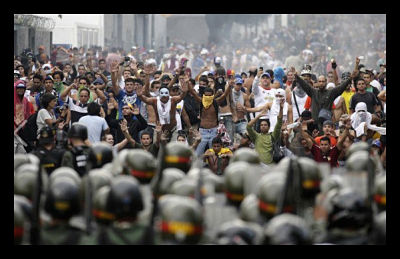
Recent protests in Venezuela have caught the attention of the entire world. Demonstrators are protesting for a myriad of different reasons, from extreme rates of inflation, to rising crime and murder rates, to allegations of corruption. Despite these different reasons, one thing remains constant: the majority of protestors are demonstrating against the government ruled by Nicolás Maduro, the successor to the late charismatic firebrand Hugo Chavez.

But what is Chavismo? What are the origins of this political movement that has swept up the Venezuelan state and has until recently, been extremely popular?

Chavismo has its origins in the beginnings of Chavez’s political career. In 1997, the Fifth Republic Movement was founded to support Chavez in the 1998 presidential elections. The Movement was named the fifth republic because at the time, Venezuela was in its fourth republic and the movement intended to renew the state of Venezuela on revolutionary policies.

A key belief of Chavismo is that the state should support social welfare programs for its citizens. For instance, Chavez often used populist rhetoric to galvanize the lower classes and the disenfranchised with promises to make their lives better. Revenue from Venezuela’s significant oil reserves were put into programs designed to reduce poverty, improve education, and establish social justice and social welfare within Venezuela.

 Some tenets of Chavismo include nationalization of industries, and a strongly anti-neoliberal stance on economic issues with an emphasis on participatory democracy. Systems of “Bolivarian missions” or misiones bolivarianas exist in order to bypass the red tape that often comes with bureaucracy and where citizens can gather to express their opinions directly and have their voices heard.

Not surprisingly for a revolutionary political movement, Chavismo strongly identifies with the historic figure of Símon Bolívar, the 19th century liberator of Latin America from Spanish colonialism. This idea is carried on today with Chavismo attempting to rally countries around the region to oppose what is seen as imperialist US policies that put capitalistic gain ahead of basic human rights.

The idea of Chavismo works well theoretically, as most populist ideologies do. But the reality of the situation is that Venezuelans are unhappy with the way the country is being governed and the direction the current brand of Chavismo led by Maduro is taking them.

Instead of listening to the demands of the people, Maduro decided to take the thuggish route and try to quell the current protests by deploying hundreds of soldiers and ordering fighter jets to make low passes over the capital of Caracas.

Maduro’s responses to the protests give full view to his insecurity. In order to maintain a tight grip on the country, he has expelled three US diplomats from the country and detained 45 people. Maduro has also attempted to regulate media coverage of the protests and threatened to revoke press credentials for CNN reporters.

Unless he listens to and responds to the needs of the people, he will be put in an increasingly insecure position within his United Socialist Party. While an overthrow of Maduro’s government and an opposition-installed government in unlikely, what is possible is Maduro being forced to step down in favor of his Vice-President, Jorge Arreaza.

– Jeff Meyer

Sources: The New York Times, The Huffington Post
Photo: Jorge Amin

March 3, 2014
https://borgenproject.org/wp-content/uploads/borgen-project-logo.svg 0 0 Borgen Project https://borgenproject.org/wp-content/uploads/borgen-project-logo.svg Borgen Project2014-03-03 15:47:242024-05-26 23:16:31What Is Chavismo?
Developing Countries, Development, Economy, Global Poverty

Venezuelan Economic Spiral

2
Eudomar Tovar is the Central Bank President in Venezuela and has taken the spotlight most recently for blaming a nation-wide blackout on sabotage. Accusations have been made that the Central Bank has been using their gold supply in a deal with Goldman Sachs and Bank of America to increase hard currency.

Tovar vehemently denies that the Central Bank is doing any sort of business with either Goldman Sachs or Bank of America. Henrique Capriles, an opposition leader, claims that Central Bank was involved in a value swap with Goldman Sachs for the equivalent of $2 billion dollars (USD) in gold ounces. Central Bank has also been accused of dealing with Bank of America to pay off debts owed to foreign governments. Tovar denied any such deals and claimed they were unofficial proposals, but did not elaborate or further explain the Bank’s position in regards to these claims.

The main problem is that Venezuela is experiencing a shortage of basic goods, and could potentially use its huge reserves of gold to procure a loan from such companies such as Goldman Sachs or Bank of America. Main Central Bank officials have complained that they are due a huge amount of hard currency from Washington, and that the red tape and delay in receiving this currency is causing inflation and product shortages.

Furthermore, a decrease in oil supply has caused tension on the dollar value, making some think that Venezuela is in desperate need of cash. The value of gold has decreased as well, putting a dent in the net worth of the country’s enormous gold reserves. As it stands, only government channels have access to the dollar due to harsh capital requirements, which often causes delays and bottlenecks day-to-day cash flow.

Leaders of the South American nation do not believe in free market capitalism and have tightly controlled the cash flow for decades. Consequently, the country falls more deeply into poverty every year, while the tyrannical government is not improving the situation.

President Maduro replaced the recently deceased President Chavez, who had a reputation for spending funds that could not be liquidated. Shortages have increased, inflation has risen to 55% and an inside Bank official claimed that Venezuela was indeed conversing with Wall Street. However, all three parties involved had no comment to offer on these claims. The economy is in a downward spiral, encouraged by the fact that stores cannot buy new inventory due to the cost of goods being higher than the retail price.

Questions are circulating about methods of intervention and whether American aid is appropriate, as well as questions regarding the depth of corruption in the Venezuelan government. Basic economics further show that public spending is good for the economy, when business have the right to compete with each other for capital gain.

The absence of a free market suggests that if Bank of America or Goldman Sachs loaned Venezuela the cash they need, it would just be reinvested into a corrupt system and exacerbate the problem. Solutions must involve correcting the dishonest practices of the government and its leaders so that the citizens will not continue to suffer, but instead thrive.

– Kaitlin Sutherby

Sources: Reuters, The Wall Street Journal: The Pope, State and Venezuela, The Wall Street Journal: Blackout
Photo: Vintage 3D

January 18, 2014
https://borgenproject.org/wp-content/uploads/borgen-project-logo.svg 0 0 Borgen Project https://borgenproject.org/wp-content/uploads/borgen-project-logo.svg Borgen Project2014-01-18 04:00:422017-01-11 12:35:54Venezuelan Economic Spiral
Economy, Food & Hunger

Inflation and Food Shortages in Venezuela

For residents of Venezuela, food and grocery shortages have become a part of daily life. Outside of many government-subsidized grocery stores, people line up before dawn hoping to purchase what they can before supplies run out. Items such as milk, meat and toilet paper are bought up quickly. The shortages have lasted for more than a year, prompting calls for President Madura to reevaluate the economic policies of his predecessor, Hugo Chavez.

Though Venezuela is one of the most oil rich nations in the world, it is struggling to mitigate inflation and keep subsidized grocers stocked with products. Many experts say that strict price controls are to blame for the country’s economic problems, while President Maduro insists that it is all part of an effort by the opposition and CIA to destabilize the government and sabotage Venezuela’s oil industry.

Asdrubal Oliveros, an economist at one of Venezuela’s leading consulting firms, told the Guardian that the current crisis is the result of several factors, which include the country’s overreliance on imports and the government price controls. Another factor is the decrease in agricultural production due to the government’s recent land expropriations. “It’s cheaper to import than it is to produce,” Oliveros said. “That’s a perverse model that kills off any productivity.”

Many economists echo Oliveros analysis, saying that the Venezuelan government is not helping the problem by fixing prices so low. When prices are set low, companies and producers are not able to make a profit—this, in turn, leads to a cessation of farming, manufacturing, and production. Originally designed to help Venezuela’s poor and working classes afford food and staples, the price-fixing program has instead led to empty shelves and long queues.

After becoming President of Venezuela, Hugo Chavez and his ministers sought to reduce the growing wealth disparity in their country. To achieve this, they implemented price controls on certain goods so as to make them cheaper for individuals and families with lower incomes. This step and increased spending on social programs, however, may be contributing to the country’s current economic crisis.

Aggravating the problem is the fact that inflation is increasing at an alarming speed. In August, 12-month interest rates rose to 45.4 percent. This is the highest since Venezuela’s hyperinflation crisis in the mid-1990s. Officials in Maduro’s government have said that they will be considering changes in the country’s economic policies in an effort to combat the rising prices and food shortages in Venezuela.

– Daniel Bonasso

Sources: The Guardian, New York Times, Wall Street Journal

October 9, 2013
https://borgenproject.org/wp-content/uploads/borgen-project-logo.svg 0 0 Borgen Project https://borgenproject.org/wp-content/uploads/borgen-project-logo.svg Borgen Project2013-10-09 20:55:002024-05-25 00:24:18Inflation and Food Shortages in Venezuela
Global Poverty, War and Violence

Venezuela’s Crime Rates Rise Due to Poverty

Crime_Venezuela_Poverty
Venezuela is a beautiful country known for its striking natural beauty and urbanized culture. Venezuela is also home to some of the world’s largest oil deposits, and houses large quantities of coal, iron, ore, bauxite, and gold. The country has experienced great wealth and prosperity as a result of its natural resources.

However, economic growth in Venezuela had disproportionately benefited some people more than others. A majority of Venezuela’s citizens live in impoverished areas and have not benefited from the oil wealth. Over 60% of the households in Venezuela are poor families, and the unemployment rate has only been increasing over the last few years. Sewage flows into the once beautiful Guaire River, which has led to its declining safety and toxicity. Streets are covered in trash, and citizens to not have enough clean water to bathe in regularly.

Venezuela has also been experiencing an increasing crime rates. Families such as the Olivero family, live in fear of the violence, for gangs and increasing violent crimes are growing in their home town of Caracas. Every night around six, the family gathers together in their home and locks the main entrance to their house. Their homes are not the most secure protection from the violence outside, for Mr. Olivero has stated to the Huffington Post that their neighbor’s roof was penetrated by a stray bullet recently.

For the Olivero family and many others, the violence does not seem to end. Venezuela’s homicide rate is the fifth highest homicide rate in the world and is 20 times higher than that of the United States. Unfortunately, RFI explains, crime within Venezuela continues as a result of the high poverty and lack of impunity, and will not come to an end until the country’s economy improves.

Venezuelan cities are also undergoing current food shortages, for store owners are unable to fill their shelves with basic goods. Anglys Bericote, a local, explains how private businesses hold on to the supplies and goods. Bericote also stated to the Huffington Post that her town has been so low on supplies, that she was unable to buy toothpaste or toilet paper for herself and her family.

Another local, Yaneth Solano, said she does not believe that the government will help the citizens of Venezuela with these current issues of violence or poverty. She believes that nothing can or will change Venezuela, for only God could help them now. As crime, food shortages, and littering continue within Venezuela, its citizens will not see improvement until the government places more focus on helping the impoverished improve their standard of living.

– Grace Elizabeth Beal

Sources: The Huffington Post, BBC, RFI

August 10, 2013
https://borgenproject.org/wp-content/uploads/borgen-project-logo.svg 0 0 Borgen Project https://borgenproject.org/wp-content/uploads/borgen-project-logo.svg Borgen Project2013-08-10 07:37:192024-05-25 00:15:37Venezuela’s Crime Rates Rise Due to Poverty
Aid Effectiveness & Reform, USAID

Death of Hugo Chavez Impacts US Aid

Death of Hugo Chavez Impacts US AidLike it or not, foreign aid usually follows the paths that are set by political relationships. U.S.-Venezuelan relations have been stressed ever since Hugo Chavez came to power, and even before then. How could the death of Hugo Chavez affect the aid relationship between the U.S. and Venezuela?

The first time that Chavez met President Obama, he gave him a copy Eduardo Galeano’s book “Las Venas Abiertas de America Latina”, a history of colonial rule over the Americas that focuses on how the United States became the colonizing power of modern age in Latin America, especially in Central America where American corporations and military interventions created the infamously titled “banana republics.” That first meeting is the perfect anecdote to represent the relationship between the two countries over the last five years. Chavez had always been extraordinarily outspoken against the United States and, because of that tense relationship, the U.S. has given very little to Venezuela with the exception of small amounts of disaster relief assistance. It is important to note that Venezuela, the founding member of OPEC, is one of the wealthiest countries in the Americas, yet nearly 32% of the country’s population lives below the poverty line.

In order to begin building a more amicable relationship, the U.S. may begin giving more to causes that aren’t related to politics and focus more on job creation and training. Providing this type of aid would not only benefit Venezuela, but it may also help build a much less tense relationship with a resource-rich country that has significant pull in international oil markets and price control. A well-executed increase in aid could end up being very beneficial for both parties as Venezuela changes leadership.

– Kevin Sullivan

Sources: The New York Times, CIA World Factbook
Photo: Biography

March 6, 2013
https://borgenproject.org/wp-content/uploads/borgen-project-logo.svg 0 0 Borgen Project https://borgenproject.org/wp-content/uploads/borgen-project-logo.svg Borgen Project2013-03-06 11:02:122024-05-24 23:43:14Death of Hugo Chavez Impacts US Aid
Page 5 of 512345

Get Smarter

  • Global Poverty 101
  • Global Poverty… The Good News
  • Global Poverty & U.S. Jobs
  • Global Poverty and National Security
  • Innovative Solutions to Poverty
  • Global Poverty & Aid FAQ’s
Search Search

Take Action

  • Call Congress
  • Email Congress
  • Donate
  • 30 Ways to Help
  • Volunteer Ops
  • Internships
  • Courses & Certificates
  • The Podcast
Borgen Project

“The Borgen Project is an incredible nonprofit organization that is addressing poverty and hunger and working towards ending them.”

-The Huffington Post

Inside The Borgen Project

  • Contact
  • About
  • Financials
  • President
  • Board of Directors
  • Board of Advisors

International Links

  • UK Email Parliament
  • UK Donate
  • Canada Email Parliament

Get Smarter

  • Global Poverty 101
  • Global Poverty… The Good News
  • Global Poverty & U.S. Jobs
  • Global Poverty and National Security
  • Innovative Solutions to Poverty
  • Global Poverty & Aid FAQ’s

Ways to Help

  • Call Congress
  • Email Congress
  • Donate
  • 30 Ways to Help
  • Volunteer Ops
  • Internships
  • Courses & Certificates
  • The Podcast
Scroll to top Scroll to top Scroll to top