In Uganda’s Kibale National Park (NP), the international nongovernmental organization (NGO), Village Enterprise, has introduced a highly successful scheme combining poverty alleviation methods with environmental conservation. In Uganda’s western regions, poverty is lower than the national average at 11.4%, though the region is one of Uganda’s most unequal, with the majority of the poor situated in rural areas. To improve the lives of those in extreme poverty and simultaneously strengthen environmental protection, a hybrid solution had to be implemented.
Kibale National Park
Kibale NP is situated in the west of Uganda. This region struggles with inequality, with a Gini coefficient of 0.33, a figure that rises to 0.39 for children, demonstrating the gulf between urban and rural populations. The national park contains 13 different primate species, including one of the largest chimpanzee populations in the world, more than 120 mammal species and 370 varieties of birds. Given the park’s immense biodiversity, local residents are dependent on its resources, often leading to confrontation between human activity and endangered wildlife.
Combining Poverty Alleviation and Conservation
Combining poverty alleviation and conservation is a challenging task, as economic development often depends on the exploitation of natural resources. Acknowledging this, Village Enterprise announced the PARKS initiative in 2021, an acronym for the Poverty Alleviation and Removal of Kibale Snares project.
The project, funded since 2024 by the Arcus Foundation and in collaboration with the Ngogo Chimpanzee Project, has two distinct but connected goals: to reduce the incidence of extreme poverty within the national park and to ensure the protection of Kibale NP’s endangered chimpanzee population.
The key to this initiative was accepting that poverty alleviation and conservation are intertwined. In areas like Kibale NP, people living in extreme poverty are forced to rely on the natural world for economic stability, often engaging in harmful practices such as the illegal harvesting of bushmeat and timber. Programs aimed at reducing these activities, or punishing those engaged in them, have often had the unintended effect of pushing the local population further into poverty.
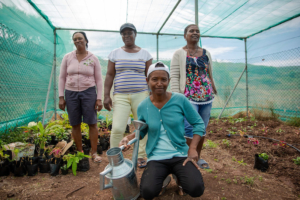
To tackle this issue, the PARKS program focuses on providing entrepreneurial training centered on local, sustainable micro-enterprises. Village Enterprise provides startup funding as well as mentorship to ensure local residents are freed from the pressure to engage in poaching and illegal logging. PARKS also encourages the formation of Business Savings Groups, allowing new business owners to pool their savings and provide a financial safety net for future entrepreneurs. Alongside this, PARKS offers additional training to selected entrepreneurs, creating “Conservation Champions” who encourage and advise others on sustainable business practices.
Results So Far
Through the PARKS initiative, Village Enterprise has provided training to more than 5,500 entrepreneurs, more than 65% of whom are women. This has led to the creation of 1,838 sustainable micro-businesses, positively impacting the lives of more than 20,000 people within the national park. These businesses include retail shops, small-scale agricultural projects, tailoring, cobbling, beekeeping, agroforestry and innovative solutions such as energy-efficient stoves for everyday cooking.
These businesses have reduced dependence on poaching and have helped families afford school fees and improve nutrition. On the conservation side, 90 Conservation Champions have been trained, providing further instruction to members of their local communities. Since the project’s implementation, Kibale NP has observed a significant reduction in illegal human activity within the park. As of April 2025, anti-poaching patrols funded directly by the PARKS project have led to the removal of 445 illegal snares, in addition to the more than 800 snares removed under the project as a whole.
Opportunities for Further Implementation
The benefits of the PARKS project extend beyond the boundaries of Kibale NP. It is an exemplary model of how to combine poverty alleviation and conservation, not only within Uganda, where human-animal conflict is common in several national parks, but also globally.
By encouraging a healthy entrepreneurial ecosystem alongside environmental protection, the project contributes directly to several United Nations Sustainable Development Goals (SDGs): goal 1 (No Poverty), goal 2 (Zero Hunger), goal 12 (Responsible Consumption and Production) and goal 15 (Life on Land). Indirectly, the scheme also addresses goal 5 (Gender Equality) through its focus on empowering women.
– Henry Weiser
Henry is based in Cornwall, UK and focuses on Technology and Politics for The Borgen Project.
Photo: Flickr