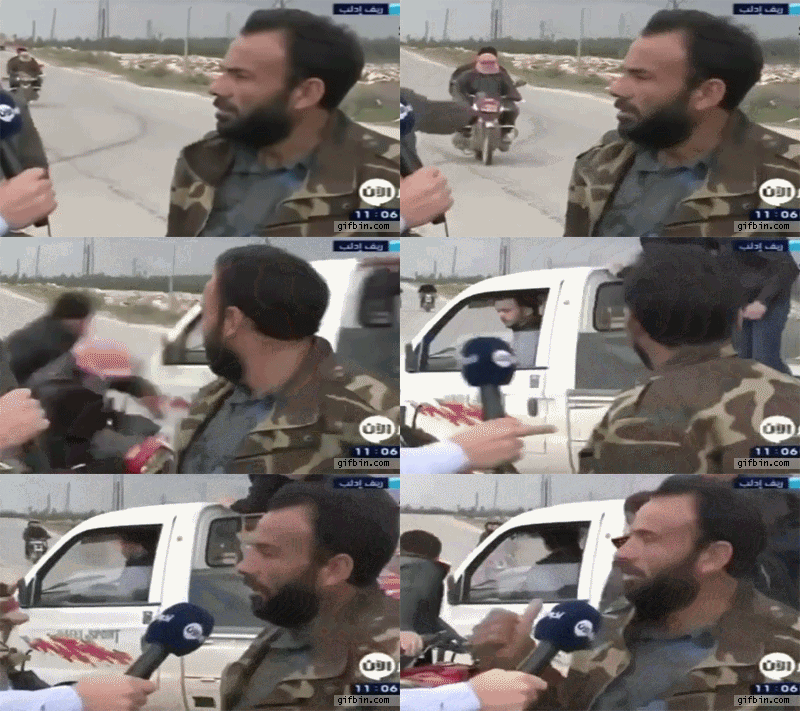
Raging since early 2011, the civil war in Syria has left many wondering who will obtain the reins of power in the war torn nation. Will the rebel forces topple Bashar al-Assad’s regime, creating a power vacuum? Or will Assad maintain control?
These questions lie at the heart of what policymakers consider when sending aid to rebel forces who have managed to continue their three year war against the Assad regime with minimal support from the West.
One of the questions that has been most pertinent to American policymakers is who exactly are the rebels and to what extent are there Islamist extremists in their ranks.
Politifact points out politicians on both sides of the aisle, advocating both for and against aid to the Syrian rebels, who use questionable sources to justify the numbers of radical or moderate elements among the rebel forces.
For example, Senator John McCain has been a vocal proponent of aid to the rebels and has stated that close to 70 percent of the rebels are still moderate. When pressed on his certainty of where the rebels stand, McCain simply stated he visited the war torn country and through his visit, gained an understanding as to the leanings of the rebel forces.
Others such as IHS Jane’s, a British intelligence analysis agency, have estimated the radical element composes half of the 100,000 opposition fighters. Their conclusion is based off interviews and intelligence estimates that are extremely difficult to confirm.
Many have turned to social media to examine the political leanings of the rebels.
Caerus, a strategy firm that examines Syrian governance for government clients, examines major internet platforms such as YouTube to glean data about the rebels. They claim through examining social media, very reliable data can be constructed giving a better understanding of the ideological makeup of opposition fighters.
For example, the Free Syrian Army has a hefty YouTube footprint of over seven YouTube channels. Other rebel groups are active Facebook and Twitter users, posting propaganda sympathetic to their cause.
Unfortunately, David Kilcullen, CEO of Caerus, as well as many government officials have concluded that moderate opposition forces are losing influence to radical Islamist sects within the rebel forces.
The perception of Islamist elements among the rebels gaining ground has led some officials to suggest that Assad staying in power would be the best outcome for the protracted civil war. The Christian Science Monitor quotes Ryan Crocker, a former U.S. ambassador to Damascus, predicting Assad’s eventual victory in Syria.
He states, “And do we really want the alternative–a major country in the heart of the Arab world in the hands of Al-Qaeda?”
The different factions of moderates versus Islamist hardliners have contributed to the propagation of the Assad regime. Their incoordination among each other has prevented a cohesive strategy from forming against Assad. And the radicalization of many forces has blocked the flow of foreign aid from countries unwilling to potentially support Al-Qaeda linked forces.
While many officials are now leaning toward the continuation of the Assad regime as the best outcome for the war, others have argued that the brutal tactics perpetrated by the regime was the main cause for their radicalization in the first place, and the failure by the west to adequately fund the rebel forces have led them toward radical ideals in an attempt to secure funding from wealthy Arab nations.
Now close to three years old, the Syrian conflict shows no signs of letting up and rebel groups no closer to toppling the Assad regime.
– Zack Lindberg
Sources: NPR, The Christian Science Monitor, Politifact
Photo: Giphy.com

IFC Invests in Fluidic Energy Climate-Smart Batteries
Energy is tantamount to the development of poor nations. Several sectors rely on energy — from lighting schools and hospitals, powering farms, manufacturing facilities, maintaining water sanitation plants to keeping emerging businesses afloat. Mobile telecommunications has become a fundamental part of successful business — especially, the business of global development.
IFC, the private sector arm of the World Bank Group, plans to invest $7 million to the clean energy company, Fluidic Energy, which is a company for the research and development of new climate-smart batteries that power cellular phone networks in developing countries. The rechargeable energy sources are promised to be a solution that is both cost-effective and power-efficient. As the technology will reduce costs of powering mobile networks in rural areas, the battery is also a cleaner alternative to diesel generators and lead-acid batteries. In result, it is less damaging to the environment for it leaves a smaller carbon footprint.
The technology is currently used in Indonesia and other South East Asian countries. The hope is that the technology will branch out into the rest of Asia and South America. Fluidic Energy, the Arizona-based company, is a fine example of private businesses working in tandem with The World Bank Group for the common goal of global development.
Providing sustainable energy to telecommunications is a development that is promised to open new frontiers in other sectors where sustainable energy can be a progressive alternative.
– Malika Gumpangkum
Sources: IFCPressRoom, thegef
Photo: Panos
From NFL Cheerleading to Active Duty
For one former NFL cheerleader turned U.S. Army first lieutenant, 2014 has a lot to live up to.
Rachel Washburn, 25, closed 2013 as a Philadelphia Eagle’s “Hometown Hero,” an honor she was nominated for by her father, Lon, a former Army and Air Force pilot himself.
The honor does not seem out of place for the accomplished Washburn, her passion for public service is evident in many of her life choices since an early age.
Over the years and the many moves she endured as the child of a military member, Washburn gained respect for her father’s profession and felt drawn to an Army career.
Without a place to call “hometown,” Washburn followed an interest in history to the city of Philadelphia for her college years. She attended Drexel University with the assistance of a Reserve Officers’ Training Corps (ROTC) scholarship, solidifying her future military commitment.
With a childhood of gymnastics behind her, in 2007, then college sophomore, Washburn auditioned to be an NFL cheerleader for her adopted hometown’s Philadelphia Eagles.
Despite never having attended a single cheer class, she was selected on her first tryout and cheered until 2010.
Between games, Washburn eagerly participated in Eagle supported, local VA hospital visits, as well as what she calls one of the greatest honors of her life, a USO tour to Iraq.
Following college graduation, Washburn enlisted in the military and wasted no time developing a decorated career. Her honors include, the Bronze Star Medal, the Army Commendation Medal and the Combat, Airborne and Air Assault Badges.
These honors have been truly earned; during her first tour in Afghanistan, Washburn helped deliver a baby during a snow storm. The only medical assistance she had access to, was via radio.
Washburn recently returned from her second tour in Afghanistan as part of the Army’s new Cultural Support Program.
This program placed Washburn in an integral position, attempting to locate and communicate with civilian women and children. This mission she found particularly fulfilling as it enabled her and her fellow military members to give a “voice” to those often unheard due to cultural gaps most operations can have difficulty bypassing.
The Cultural Support Program also required frequent mental toughness training, in which military personnel are encouraged to develop their mental “happy place.”
Washburn had little difficulty in finding hers between the white lines of the Lincoln Financial Field, on her first cheerleading experience back in 2007.
Happy to be “home” for the holidays and honored by her Philadelphia Eagles, in 2014 Washburn will return to her current station at Fort Stewart Ga., where she is serving as a platoon leader and considering re-enlisting for yet another tour of overseas service.
– Zoë Dean
Sources: CNN, Philadelphia Eagles
Photo: Lazy Girls
Who are the Syrian Rebels?
Raging since early 2011, the civil war in Syria has left many wondering who will obtain the reins of power in the war torn nation. Will the rebel forces topple Bashar al-Assad’s regime, creating a power vacuum? Or will Assad maintain control?
These questions lie at the heart of what policymakers consider when sending aid to rebel forces who have managed to continue their three year war against the Assad regime with minimal support from the West.
One of the questions that has been most pertinent to American policymakers is who exactly are the rebels and to what extent are there Islamist extremists in their ranks.
Politifact points out politicians on both sides of the aisle, advocating both for and against aid to the Syrian rebels, who use questionable sources to justify the numbers of radical or moderate elements among the rebel forces.
For example, Senator John McCain has been a vocal proponent of aid to the rebels and has stated that close to 70 percent of the rebels are still moderate. When pressed on his certainty of where the rebels stand, McCain simply stated he visited the war torn country and through his visit, gained an understanding as to the leanings of the rebel forces.
Others such as IHS Jane’s, a British intelligence analysis agency, have estimated the radical element composes half of the 100,000 opposition fighters. Their conclusion is based off interviews and intelligence estimates that are extremely difficult to confirm.
Many have turned to social media to examine the political leanings of the rebels.
Caerus, a strategy firm that examines Syrian governance for government clients, examines major internet platforms such as YouTube to glean data about the rebels. They claim through examining social media, very reliable data can be constructed giving a better understanding of the ideological makeup of opposition fighters.
For example, the Free Syrian Army has a hefty YouTube footprint of over seven YouTube channels. Other rebel groups are active Facebook and Twitter users, posting propaganda sympathetic to their cause.
Unfortunately, David Kilcullen, CEO of Caerus, as well as many government officials have concluded that moderate opposition forces are losing influence to radical Islamist sects within the rebel forces.
The perception of Islamist elements among the rebels gaining ground has led some officials to suggest that Assad staying in power would be the best outcome for the protracted civil war. The Christian Science Monitor quotes Ryan Crocker, a former U.S. ambassador to Damascus, predicting Assad’s eventual victory in Syria.
He states, “And do we really want the alternative–a major country in the heart of the Arab world in the hands of Al-Qaeda?”
The different factions of moderates versus Islamist hardliners have contributed to the propagation of the Assad regime. Their incoordination among each other has prevented a cohesive strategy from forming against Assad. And the radicalization of many forces has blocked the flow of foreign aid from countries unwilling to potentially support Al-Qaeda linked forces.
While many officials are now leaning toward the continuation of the Assad regime as the best outcome for the war, others have argued that the brutal tactics perpetrated by the regime was the main cause for their radicalization in the first place, and the failure by the west to adequately fund the rebel forces have led them toward radical ideals in an attempt to secure funding from wealthy Arab nations.
Now close to three years old, the Syrian conflict shows no signs of letting up and rebel groups no closer to toppling the Assad regime.
– Zack Lindberg
Sources: NPR, The Christian Science Monitor, Politifact
Photo: Giphy.com
Telecommute Internships at The Borgen Project
Are you seeking real world experience working as part of a news content team? Looking to build skills working as a journalist, writer, editor, or public relations/visual editor? Are you an independent self-starter? Does working from your personal computer appeal to you? Would you like to research, advocate, and produce content for a cause that is aiming to end global poverty?
If you said yes to the questions above, you may be a good fit for an telecommute internship with The Borgen Project. The Borgen Project is an innovative humanitarian organization downsizing global poverty located in Seattle, Washington. The Borgen Project volunteer network extends to 190 cities, and includes celebrities, political leaders, and a growing number of passionate individuals.
Currently, there are four open telecommute internship positions for The Borgen Project: Journalist, Writer, Editor, and PR/Visual Editor.
The time commitments for the internships vary depending on internship type. While The Borgen Project requires a 12-week program for journalists and writers, editors and PR/visual editors are required to spend 260 hours in total, and 15 hours each week.
Access to a computer is vital, as you will be communicating back and forth with supervisors at Seattle Headquarters, and fellow team members across the nation. Attendance to The Borgen Project national conference call from 5pm-6pm PST every Monday is also required.
Content workload varies depending on the internship type. Writers must complete 4 blog posts/magazine articles each week, journalist write 3 in-depth articles each week, PR/visual editors find, tint, and resize images to meet website criteria, and editors edit and approve articles submitted by content team writers. While each internship fills a certain role for The Borgen Project, all interns must spend 2-3 days assisting with fundraising, share Borgen Project articles and news via social media, meet deadlines, and effectively communicate with supervisors.
Interns are given the freedom to choose their own schedule within the required time commitment guidelines. The first week of the internship entails an online training curriculum that clearly lays out your role, what is expected of you, and eliminates any ambiguity about what you should be doing. Supervisors are supportive and can respond to any questions you have regarding fundraising, article content, article style, deadlines etc.
Additionally, interns have the opportunity to meet each other (people from all walks of life), network, and work within a community that extends across the nation. Internet and social media allow us to extend the values and mission of The Borgen Project across many networks.
View telecommute internship openings.
– Laura Reinacher
Sources: The Borgen Project
Photo: Smallbiz Technology
Cost Comparison: Bitcoins
Officials across the nation are expressing concern over the latest technology on the internet: virtual currency.
Bitcoins are the one of the most common recognized digital currencies available on the web today. Disguised behind encrypted computer programs, the coins are becoming harder to find since their introduction in 2008. Once a user discovers a coin, they are able to store it in an online account.
The currency and any individual using it are untraceable and are garnering attention from authorities worldwide. Users of the currency remain anonymous through the use of identification numbers. Once a user knows the identification of another user, funds may be transferred to the receiver’s digital “wallet.” There are currently no restrictions on the types of products that may be purchased.
Investigations over the past few weeks have revealed the use of the currency to obtain illegal items including guns and drugs. But representatives of the Bitcoin Foundation argue that the currency is also being used for good.
The foundation currently operates as a self-governing institution that has been declared impenetrable by its creators. They maintain that the organization was founded in order to provide individuals with the ability to utilize their finances away from political oversight and other forms of outside influence.
Despite recent focus on illegal transactions using the currency, Bitcoins are also used for everyday purchases such as plane tickets and groceries. Currently, each coin is worth an estimated $1000 and is accepted at over 200 online retailers. Despite their worth, the number of coins available is severally limited.
Only 21 million coins were created and nearly 11 million have been found so far. If the remaining 10 million coins are found and retain a worth of at least $1000, then at least $10 billion of free money continues to await discovery. The potential impact on world poverty is startling.
The remaining Bitcoins could provide nearly 90 percent of UNICEF’s yearly budget ($11.7 billion.) It could cover the costs of both the World Food Programme ($4 billion) and the United Nation’s Development Programme ($5 billion.)
At its current rate, a third of the $30 billion annual windfall to end world hunger could also be paid.
– Jasmine D. Smith
Sources: ABC News, Huffington Post, Bitcoin Foundation
Honduras Political Troubles
A contentious election in Honduras gave ruling party candidate Juan Orlando Hernandez 34 percent of the vote in the “eight-party race”, allowing him to claim an early victory with 80 percent of the total vote counted. Former President Manuel Zelaya’s wife, Xiomara Castro, has contested the election results. Fraud has been argued as a possible reason for Juan Hernandez’s victory.
Honduras has a long history fraught with violent overthrows and fraud filled elections, with Xiomara Castro’s husband being ousted in a coup in 2009. The coup was in response to Manuel Zelaya attempted referendum on the nations constitution, with brought the ire of many political groups in the nation.
Honduras, according to the New York Times, is one of Latin America’s “poorest and most unequal countries” with a fraught social structure that may not “withstand a new bout of political uncertainty” following the election. This looks like it may be the case.
These two major candidates are both claiming victory in the nation of 7.9 million, arguing they represent the populist mentality in the nation. Xiomara Castro respresents those liberals disillusioned in the post-coup. Hernandez represents the right wing, arguing for a strong military police to help quell the violence and consolidate the government’s power over the lawless nation. Castro posted on her twitter following the election results that she “will defend the will of the people as it was expressed at the polls.”
Perhaps the nation is behind Xiomara Castro. Manuel Zelaya ousted in 2009 led many “teachers, feminists, and young people” to violently protest. The media in Honduras promoted the “changing of the guard”, a huge contrast to what many in the streets felt.
Manuel Zelaya left-leaning beliefs were in deep contrast to the “business and political groups” whose right winged views were deeply ingrained into the nation.
In response to the coup, new political parties formed. The Freedom and Re-foundation was born out of this aggression. Current presidential candidate Xiomara Castro has become the political party’s leader. The organization functions through it’s combination of leftist leaning groups, from intellectuals, gay right activist, and “former liberals who defected” from “centre-right” Liberal Party following the coup.
The real victim of the political instability are not the political parties, but rather the nation itself. In the wake of Manuel Zelaya’s coup, the annual GDP growth for has “been only 3.5 percent” compared to the average GDP growth of “5.7 percent.” Economic inequality has been growing since 2010, with Honduras now having the “most in-equal distribution of income in Latin America” with “100 percent of all income gains” going to the “top 10 percent of Hondurans.”
Average Honduran citizens have been struggling, and the political situation following the election may worsen it. Protests have already begun in retaliation to Hernandez’s claimed victory.
– Joseph Abay
Sources: USA Today, CNN, Al Jazeera, CBS News, BBC, New York Times, Al Jazeera
Namibia’s Fish Supply Threatened by Oil and Gas
When oil and gas reserves are believed to exist in a particular region, companies in the oil and gas industry conduct what is known as a seismic survey to locate and estimate the size of underground oil and gas reserves. The results of such seismic surveys are often used by oil and gas companies to determine the viability of additional investments into oil and gas exploration.
The end result of seismic surveys is a seismic image, which is produced by generating, recording and analyzing seismic waves that travel through the Earth. A potential problem with seismic surveys, however, is explosives are sometimes involved in the process. Explosives or vibrating plates may generate the seismic waves and a line or grid of geophones, electronic receivers designed to pick up seismic vibrations, records the waves. In lieu of explosives, companies have at their disposal several additional techniques capable of producing seismic waves.
Oil and gas exploration has recently begun on Namibian waters. The production of oil and gas would certainly help boost the Namibian economy, which currently boasts a gross domestic product of $13.7 billion and a poverty rate of 28.7 percent, according to the World Bank. But this potential economy booster also comes with a hefty price tag.
While it is unclear what method is being used to generate the seismic waves on Namibia’s waters, that is, explosives, vibrating plates or other available methods, the seismic surveys have led to a massive depletion of tuna output from 1,800 tons in 2012 to approximately 650 tons in 2013. Both numbers are far from the output in 2011, which was 4,000 tons.
The reduction in the tuna supply is one that Namibia can ill afford. The country is already experiencing a food crisis due to drought. Almost one-third of the country’s population, in all of Namibia’s thirteen regions, face moderate to high levels of food insecurity after rainfall in southern Africa declined for the second straight year. The substantial level of loss to the tuna supply also threatens to damage Namibia’s economy to the extent that it relies on the tuna supply as a source of income.
In response to this crisis, a government task force, commissioned to assess the effects of seismic surveys on the fishing industry, recently recommended that the seismic surveys should be done outside the tuna fishing season, according to All Africa. The task force proposed that research should be conducted on the distance from the tuna migratory route and areas where most fishing takes place to determine which seismic surveys can be conducted to avoid interference with fishing. According to the commission’s findings thus far, efforts should be made to delay seismic surveys between February and March, during which 70 percent of the catch is made, to between May and September.
– Cavarrio Carter
Sources: All Africa, Encyclopedia Britannica, Lonestar Geophysical Surveys, World Bank, Al Jazeera, Southern Times Africa
Three Music Festivals That Give To Financial Aid
Every year, thousands of music festivals take place around the world. Perhaps inspired in part by George Harrison’s 1971 arena benefit show, “The Concert for Bangladesh,” a multi-artist concert that raised money for East Pakistani refugees following the Bhola Cyclone, festivals now incorporate special activities that contribute to poverty relief in surprising ways. Here is a list of threee music festivals from around the country that play good music while contributing to relief organizations.
1. Firefly hosted by Red Frog Events
A relatively new music festival, Firefly began in 2011 and takes place every year in Dover, DE. Located “among lush wooded landscapes,” Firefly brings in notable alternative and popular artists such as Yeasayer, Lupe Fiasco, and Bassnectar. Unlike other festivals, Firefly offers a TOMS booth which allows festival attendees to purchase a pair of TOMS shoes and have them customized by an artist. As with other TOMS programs, including eyeware, for every pair of shoes sold TOMS will donate another as part of its One For One Movement.
2. Bonnaroo
Located in Tennessee on a 700 acre stretch of land, Bonnaroo celebrate camping, music, and global awareness. One section of their festival is dedicated to “Planet Roo,” an area dedicated to a “variety of nonprofit organizations committed to protecting our resources, promoting healthy lifestyles and making the world a better place,” states their website. Although unrelated to global aid, Bonnaroo has also asked buyers to donate an additional $1 when they purchase their tickets. The proceeds go toward an on-site solar array and other eco-projects.
3. Lollapalooza
Chicago hosts this behemoth of a festival that began in 1991 by Jane’s Addiction front man, Perry Farrell. Over a three-day time period, the festival showcases popular and up and coming artists to over 225,000 fans. In addition to the concerts, Lollapalooza also offers informational booths dedicated to non-profit organizations, including One, a global grassroots advocacy organization, “dedicated to fighting extreme poverty, preventable disease and hunger around the world.” Alongside One is Oxfam, another global organization that seeks to correct the inequity created by poverty, hunger and injustice.
– Emily Bajet
Sources: Lollapalooza, Lollapalooza Billboard, Rolling Stone, Fast Company
Typhoon Haiyan: Addressing Mistakes and Oversights
Natural disasters occur every year. Their existence is virtually a law of nature and unfortunately, the loss of life is often a consequence of these devastating events. But despite the certainty in the occurrence of natural disasters, there are things that can be done to mitigate and minimize the effects of these storms. These preparation efforts, when properly implemented, can help substantially reduce the effects of natural disasters.
The Philippines sees about 20 tropical storms each year, which would lead most to believe that the country should have a sophisticated storm preparation plans considering the constant threat to its residents. However, over 10,000 lives were lost in the wake of Typhoon Haiyan. This high death toll indicates that there was likely much that could have been done to prevent the substantial loss of life caused by Typhoon Haiyan. Indeed, there were several things that should have been done differently in preparation for the storm.
1. Inaccurate Early Warning System
While Typhoon Haiyan may have been larger and stronger than most storms that typically hit the Philippines, the danger the storm presented could have been substantially decreased by the presence of a more accurate early warning system. According to University World News, the typhoon came in three hours earlier than warnings suggested and had a storm surge of six meters, which was unexpected. However, the slower development of typhoons, as compared to other rapidly forming natural disasters such as tsunamis, provides for much better preparation than what was provided during Typhoon Haiyan.
2. Underestimating the Storm’s Severity
While early estimates placed the storm surge at six meters, Typhoon Haiyan’s storm surge reached 55 feet, meaning the deadliest element of the typhoon was underestimated. So although hundreds of thousands of people evacuated, they apparently failed to evacuate far enough inland, likely relying on the underestimated storm surge.
Additionally, many residents are believed to have had an inadequate understanding of the meaning of storm surge, which likely also contributed to the failure to evacuate farther inland. According to the secretary of the Department of Social Welfare and Development in the Philippines, people were preparing for the usual wind and rain of a typhoon, a misunderstanding that turned out to be catastrophic. Government officials should learn from these mistakes and develop a better method of disseminating information on the effects of typhoons in a simple and easy-to-understand format.
3. Misplaced Focus of Government Officials
In addition to the inaccurate early warning system and residents’ failure to fully grasp the severity of the storm, there are also indications that government officials may have been distracted by a senate hearing which involved the corruption of government officials, which took much needed focus away from storm preparedness efforts. The hearing apparently involved the misappropriation of more than $228 million from tax and government funds by government officials.
This focus on politics is believed by some pundits to have contributed to the neglect of disaster risk reduction, such as evacuating people who lived on low-lying, urbanized, coastal areas of islands, areas which were considered to be under threat by several initial reports.
– Cavarrio Carter
Sources: University World News, USA Today, Christian Science Monitor, International Business Times
United Nations Treaty Collection
To promote international progress and security, the United Nations creates a series of treaties among nations. The United Nations Treaty Collection (UNTC) is an online database providing full texts of United Nations Treaty Series, League of Nations Treaty Series and multilateral treaties filed by the Secretary-General of the U.N. (SGUN) and its latest status.
The database offers access to over 200,000 bilateral and multilateral treaties filed by the Secretariat. They are recorded in their authentic languages, along with translations into English and French. More than 550 major multilateral instruments cover a wide range of issues that catch global attention, such as human rights, disarmament, commodities, refugees, environment and crimes.
The UNTC offers multiple search criteria so that people can reach treaties by searching participants, subject terms, registration number, date of adoption or keywords.
Apart from treaties, the UNTC publishes information about annual treaty events organized by the Treaty Section of the U.N. The SGUN invites heads of states and governments to attend the event and identifies a series of treaties to be the focus of the event every September. The treaty events aim to advocate universal participation in the multilateral treaties deposited with the SGUN, raise global awareness of international challenges and encourage active engagement of member states in their resolution within the international legal framework.
Treaty training information is also available on the UNTC website. The U.N. hosts annual regional training seminars and workshops on treaty law and domestic implementation of treaty obligations in different countries. The U.N. currently offers member states technical assistance in connection with a range of legal matters. Such assistance includes providing advice, expertise, research, analysis and training.
– Liying Qian
Sources: Learn Stuff, United Nations Treaty Collection, Utrecht University Library
Photo: Wikipedia