• Link to X
  • Link to Facebook
  • Link to Instagram
  • Link to TikTok
  • Link to Youtube
  • About
    • About Us
      • President
      • Board of Directors
      • Board of Advisors
      • Financials
      • Our Methodology
      • Success Tracker
      • Contact
  • Act Now
    • 30 Ways to Help
      • Email Congress
      • Call Congress
      • Volunteer
      • Courses & Certificates
      • Be a Donor
    • Internships
      • In-Office Internships
      • Remote Internships
    • Legislation
      • Politics 101
  • The Blog
  • The Podcast
  • Magazine
  • Donate
  • Click to open the search input field Click to open the search input field Search
  • Menu Menu

Archive for category: Volunteer

Food & Hunger, Global Poverty, Hunger, Volunteer

Golden Temple in India Feeds 100,000 Per Day

Golden Temple in India Feeds 100,000 People Per Day
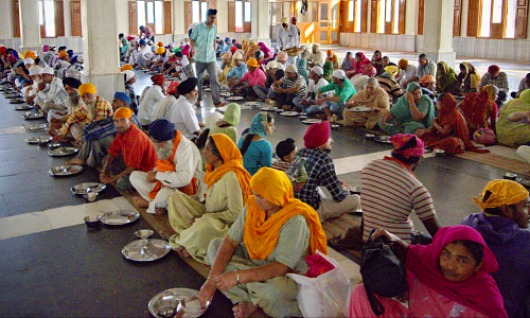
Every year, thousands of tourists line up to see the Taj Mahal in India, which is the most popular tourist destination in the country. In Amritsar, India, a Golden Temple serves 100,000 meals to the hungry every day, which is more people than the Taj Mahal attracts in a day.

The Sikhs believe the langar is a symbol of equality and not just a place for people to come eat for free. The kitchen needs an extensive number of ingredients each day, including 12,000 kilos of flour and 13,000 kilos of lentils. Most of the food is paid for up to two years in advance through donations.

At the langar, everyone gets a free hot meal regardless of their socioeconomic status or their religion. There are 450 people running the kitchen with the help of hundreds of volunteers. Over 300,000 plates, spoons and bowls are washed each day.

“There are only three things in our religion,” says a Sikh volunteer from California. “Chant the name of God, sing religious hymns and volunteer. I work as long as my legs allow me to stand.”

About 15 percent of the people in India are undernourished and 194 million people are hungry. This means a quarter of the undernourished people in the world belong to India. Also, India’s population is one of the fastest-growing populations in the world; it will one day become the most populous country.

More than 3,000 children in India die every day from illnesses related to poor nutrition. Hunger in India remains an alarming issue due to rising food prices and available agricultural land. While food grain production is increasing, it hasn’t been sufficient enough to feed the entire population.

Volunteering goes beyond the Golden Temple: donations from around the world help reduce hunger for thousands of people in India. Akshaya Patra, an NGO in India, feeds 1.4 million schoolchildren every day.

India hosts a large number of mega kitchens that feed people all over the country. Despite the rapidly growing population, the percentage of people who are undernourished and hungry is declining.

– Donald Gering

Sources: Al Jazeera, Good News Network, India Food Banking, India Times, Social Progress Imperative, UNDP, WFP
Photo: SkitHub

August 19, 2015
https://borgenproject.org/wp-content/uploads/borgen-project-logo.svg 0 0 Borgen Project https://borgenproject.org/wp-content/uploads/borgen-project-logo.svg Borgen Project2015-08-19 01:30:442024-05-27 09:27:31Golden Temple in India Feeds 100,000 Per Day
Activism, Charity, Global Poverty, Human Rights, Volunteer

The Body Shop Foundation

Body Shop Foundation
Human rights, the environment and animal protection are all causes that The Body Shop Foundation advocates for.

This charitable company works closely with The Body Shop International, a company that sells beauty and makeup products, making many of The Body Shop products an option to donate to charity.

Since 1989, the foundation has been funding and giving money to different projects around the world that focus on working for a social and environmental change.

Besides The Body Shop beauty products, they create various fundraising activities that allow them to manage their three different grant programs: animal protection, environmental protection and human rights.

In the 2011 values report of The Body Shop International, BSI, the foundation’s money, during the years 2009 and 2010, was spent in Asia Pacific, Europe, the Americas and Africa Global.

For this foundation, the natural environment means everything, and fighting to preserve and protect the animals and the environment is an important aspect to conserve the planet. Some of the animal and environment protection organizations that The foundation has supported are PAMS, the World Cetacean Alliance, the Orangutan Foundation and Wateraid, among others.

In the human rights area, The foundation has the belief that all basic rights should be given to everyone. The foundation supports organizations that fight for these means and give a voice to those who do not have one. Some of the human rights organizations that the foundation has supported are Cybersmile, Kaibosh, Changing Faces, Compassionate Hearts and Children on the Edge.

According to the 2014 impact report of the foundation, wildlife conservation, animal welfare, climate change, domestic violence, disability, poverty, child protection, access to water, recycling, forest conservation and water conservation were some of the funded issues by the foundation.

As another option, the foundation also provides volunteer opportunities in the areas of London and Littlehampton as another charitable method to advocate for the humanitarian causes they support.

The Body Shop’s 2015 fundraising product is called “Soft Hands Kind Heart.” The product is a hand cream sold in every The Body Shop store worldwide, and every purchase becomes a donation to the foundation.

For every “Soft Hands Kind Heart” cream sold, The Shop will donate £1.50 (US$2.33) to the foundation, helping it with the creation and success of its charitable programs. This beauty and makeup company is making a difference that contributes with the betterment of the world through charitable activities and fundraising projects.

The BSI, working hand in hand with the foundation, is an example of a company that provides and sells quality products to its customers at the same time as it provides donations to the organization. In tandem, it is also able to support and advocate for their three focuses: human rights, environmental protection and animal protection.

– Diana Fernanda Leon

Sources: The Body Shop Foundation 1, The Body Shop Foundation 2, The Body Shop Foundation 3, The Body Shop Foundation 4, The Body Shop Foundation 5, The Body Shop USA
Photo: The Body Shop Foundation

July 19, 2015
https://borgenproject.org/wp-content/uploads/borgen-project-logo.svg 0 0 Borgen Project https://borgenproject.org/wp-content/uploads/borgen-project-logo.svg Borgen Project2015-07-19 14:34:002020-07-09 21:12:25The Body Shop Foundation
Aid, Global Poverty, Volunteer

5 Reasons to Join the Peace Corps

Peace Corps
Founded by President Kennedy in 1961, the Peace Corps has enabled thousands of Americans to serve abroad. If you’re thinking about a commitment to the Peace Corps, here are five reasons to sign up.

To Help Others

Peace Corps volunteers are driven by the need to serve others. They are typically placed abroad for commitments of 27 months, during which volunteers assist in local development projects.

These projects may deal with issues of food security, global health or gender equality. Volunteers partner with NGOs to ensure measurable results in the communities that they serve.

For example, one of the organization’s global health initiatives is the Stomping Out Malaria program. The initiative seeks to halt the spread of malaria through Africa. Volunteers partner with organizations like Malaria No More to support those who are endangered by the deadly but preventable disease.

To See the World

The mission of the organization is to promote world peace and friendship. Volunteers serve as citizen diplomats abroad and encourage international cooperation. For those who want to see the world, the organization offers a unique opportunity to live and work abroad.

Its volunteers spend several months overseas. Almost 150 countries have received volunteers to date and there are 64 countries that partner with the organization today.

Applicants can select up to three preferred locations and work sectors. It is also possible to select a “wherever I am needed” option that places volunteers in a location that would benefit the most from a Peace Corps placement.

After 27 months of service, volunteers are also given an $8,755 stipend (before taxes). This money can be used for travel once the period of service has ended.

To Grow as a Person

Volunteers gain many different skills during their time of service. This can be useful for both personal and career development.

The organization opens new doors to other cultures that would be difficult to experience otherwise. For example, the organization provides instruction in a wide variety of languages.

This is also a great way to build a career. Volunteers learn leadership and teamwork, which are invaluable in almost every professional setting. Employers value cultural awareness and the ability to adapt to difficult situations.

For those looking to start a career in international development, the Peace Corps can be a great way to gain experience and make connections abroad.

To Help Defer Student Loans

Most Peace Corps volunteers are college graduates, which means a lot of volunteers will have some student loan debt. Those who serve in the Peace Corps are still solely responsible for these loans. However, they may qualify for a deferment on federal loans while serving in the Peace Corps.

Additionally, students with Perkins loans may qualify for a partial cancellation of these loans, depending on the length of their Peace Corps service as well as other considerations.

To Join a Growing Network of Returned Volunteers

The benefits of joining the Peace Corps don’t end after 27 months. Returning volunteers join a network of over 200,000 people who have completed their service.

This network can be used to keep in touch, meet other volunteers or assist with reintegration back home. Returned volunteers who are looking for a job will find the network helpful as well.

– Kevin McLaughlin

Sources: Peace Corps 1, Peace Corps 2, Humanitarian Jobs
Photo: MIIS Communications

July 17, 2015
https://borgenproject.org/wp-content/uploads/borgen-project-logo.svg 0 0 Borgen Project https://borgenproject.org/wp-content/uploads/borgen-project-logo.svg Borgen Project2015-07-17 11:12:172024-12-13 17:51:465 Reasons to Join the Peace Corps
Aid, Global Poverty, Volunteer

How to Become an International Aid Worker

How_to_Become_an_International_Aid_Worker
Thinking of becoming an international aid worker? Concerned about world issues like human rights, sustainability, agriculture, industrial development and natural disasters? Want to help people around the globe who need healthcare, housing, sanitation, education and relief from natural disasters?

Thousands of people with such noble ideals and ambitions are at work in developing countries. Their paths to working abroad were probably quite varied and more horizontal than vertical for a number of years before they headed overseas. Here is some other essential information to consider before planning a career as an international aid, development or humanitarian worker.

The first step is earning a degree. Like any other job, it should be in a field of strong interest that builds knowledge and develops talents and skills. The subjects most relevant to international aid work are sociology, social policy, human rights, languages, economics, sanitation and logistics. Workers with degrees in medicine, nursing, healthcare and water engineering are currently in high demand.

After earning a degree (in fact, more importantly than having a degree), one must acquire relevant experience. In reality, it is the most viable entry path to these highly competitive jobs. Because it is a catch 22—needing experience to acquire a job but needing a job to acquire experience—many beginners start as volunteers or interns in charities, nonprofits, and volunteer or nongovernmental organizations. Obviously, self-funding is necessary at this stage.

These experiences provide the training needed to move up because most organizations do not have the funding to provide extensive training programs. However, Oxfam International and the United Nations are two organizations that do provide structured internships and graduate development programs.

Once some experience has been acquired, next steps vary greatly. It is necessary to be open to changing career paths, as development needs change. Some typical work activities at this phase include hands-on project management, conducting needs assessments and organizing fundraising.

It may be that an advanced degree or some short courses will provide the necessary skills to progressing on the path to a desired position. For example, engineers, health care workers and disaster relief workers require advanced degrees and special skills. The same is true for people in microfinance and logistics. It is equally necessary to change organizations often in a horizontal or zigzag path in order to gain varied and relevant experiences.

After 10 to 15 years, it becomes possible to work in a higher level capacity. In this phase, consulting, general leadership development, policy and strategy development, or budget control are some of the possible responsibilities. These positions, whether domestic or international, are highly competitive, but they usually allow longer commitments and require less mobility.

No matter the degree, skills or experiences needed to become an international aid worker, it is also essential to begin with certain personality traits. These characteristics include: willingness to work more than 40 hours a week on a somewhat unpredictable schedule, ability to communicate with a variety of people, capacity to work under pressure and willingness to travel and live in basic conditions.

Working in the international aid field has its ups and downs like any other field. However, the entry and career paths are very different. International aid workers are among the most intelligent, skilled, resourceful and hardworking people in the world. They also have the satisfaction of knowing that the world is a better place because of the work that they do.

– Janet Quinn

Sources: All About Careers 1, Prospects 1, All About Careers 2, Prospects 2, All About Careers 3, Prospects 3, Humanitarian Jobs
Photo: One

July 9, 2015
https://borgenproject.org/wp-content/uploads/borgen-project-logo.svg 0 0 Borgen Project https://borgenproject.org/wp-content/uploads/borgen-project-logo.svg Borgen Project2015-07-09 09:43:122024-05-27 09:25:12How to Become an International Aid Worker
Global Poverty, Philanthropy, Volunteer

5 Corporate Philanthropy Programs that Target Poverty

corporate_philanthropy

Corporations have a variety of ways to contribute to poverty relief. Methods include matching employee donations, promoting employee volunteerism, providing donations in kind and simply providing grants to or partnering with charitable organizations. Some even partner with governmental institutions such as the United States Agency for International Development in hybrid public/private aid ventures.

Corporations disperse funds to a plethora of good causes, but some have a particular focus on poverty reduction, development and public health initiatives internationally. Among the most generous corporations that support poverty-reduction programs are Chevron, Johnson and Johnson, Microsoft, JP Morgan Chase and General Electric.

In 2013, Chevron donated $274.3 million, or 0.6% of its pretax profits to charitable organizations. The company has an employee donation matching program that covers up to $10,000 per year and $3,000 for retirees. Being a highly globalized corporation, Chevron sponsors a variety of international development programs, such as the Niger Delta Partnership Initiative Foundation, which provides livelihood training to residents of the Niger Delta. Last year, Chevron pledged an additional $40 million to the program.

Johnson and Johnson donated $966.3 million in 2012 in cash and goods, a full 7% of its profits that year. Johnson and Johnson has a particularly robust corporate philanthropy program, doubling employee donations to eligible nonprofits. They also have a particular focus on global health issues. For example, the company partnered with the United Nations, the World Bank and the World Health Organization to support the U.N.’s Health Four+ Initiative, providing health care and obstetric training to populations in low-resource settings in Tanzania and Ethiopia.

While Microsoft’s philanthropic activities are often associated with the co-founder Bill Gates’ Foundation, the company itself has a very generous donor program that provided $948.6 million worth of in-kind donations and $112.2 million in cash donations in 2014. Microsoft’s corporate philanthropy does not have a particular focus on poverty reduction, however, they provide technology and software to about 86,000 nonprofit organizations globally.

JP Morgan Chase donates to several different kinds of philanthropic causes, contributing $210.9 million in 2013. On top of their donations, the company also provides capital for impact investment funds, supporting a wide variety of international economic development ventures. The company partnered with the Bill and Melinda Gates Foundation to create one such project, the Global Health Investment Fund, which invests in the development of medical technologies that target diseases such as malaria and tuberculosis, which disproportionately affect the developing world. Another fund that JP Morgan Chase supports is the African Agricultural Capital Fund, which invests in agribusiness in East Africa, targeting small holder farms and rural economies.

General Electric is particularly committed to corporate philanthropy, having been the first company to introduce an employee donation matching program, which now supports up to a generous $50,000 per year. In 2013, the $154.8 million that GE donated went to initiatives such as its Developing Health Globally Program, which sponsors medical training and technological assistance in Rwanda, Ghana, Uganda, Myanmar and Indonesia.

Most large corporations have fairly long-standing traditions of giving back to their communities and supporting international development through corporate philanthropy programs. Corporations typically donate anywhere from 1% to 5% of their annual profits to such programs, sometimes even partnering with government agencies such as the United Stated Agency for International Development. However, it is worth noting that state solutions to poverty reduction continue to have the greatest funding potential. For example, Official Development Assistance in the United States alone amounted to about $30 billion in 2013, or 0.18% of the budget, many billions of dollars more than the top 10 corporate donors combined that year. While corporate donations are essential to the fight against poverty, official state aid could, if properly harnessed, represent the greatest solution to poverty worldwide.

– Derek Marion

Sources: Double the Donation, Chevron, Johnson and Johnson, Microsoft, JP Morgan Chase, GE, OECD
Photo: Ventures

July 7, 2015
https://borgenproject.org/wp-content/uploads/borgen-project-logo.svg 0 0 Borgen Project https://borgenproject.org/wp-content/uploads/borgen-project-logo.svg Borgen Project2015-07-07 06:52:292024-12-13 17:51:365 Corporate Philanthropy Programs that Target Poverty
Advocacy, Global Poverty, Volunteer

The Impact of “Clicktivism”

Clicktivism
In the digital age, it is easier than ever to voice one’s support for a cause or raise awareness about a particular issue, all it takes is the click of a button.

In the wake of the recent devastating earthquake in Nepal, Facebook gave users the option to donate to the International Medical Corps’ relief efforts. According to a Facebook post by CEO Mark Zuckerberg, over $10 million was raised by the Facebook community — in just two days.

Social media provides a platform to quickly support a cause without exerting much — if any — personal effort. This phenomenon has been labeled as “clicktivism,” or “slacktivism,” and has been widely criticized for creating an impression of support, rather than actually accomplishing anything for the cause.

Many critics point out that clicktivism satisfies the urge to respond to an issue, thus reducing eagerness to take further action.

However, according to a study conducted by Georgetown University’s Center for Social Impact Communication and Ogilvy Public Relations Worldwide, the truth is quite the contrary. Researchers found that Americans who promote causes using social media by creating posts, joining a group on Facebook or taking other similar actions, actually participate more in offline activist efforts than non-social media promoters.

“The presumption was that these individuals were replacing more ‘meaningful’ actions with simple clicks and shares. But what we found is that they’re actually supplementing—not replacing— actions like donating, volunteering and planning events,” Senior Associate Dean and Executive Director of the Center for Social Impact Communication Denise Keyes was quoted in the research report.

The study showed that so-called clicktivists are over four times as likely than non-social media promoters to encourage others to contact political representatives about an issue, twice as likely to volunteer time to a cause, more than twice as likely to participate in an event or a walk and just as likely to donate money.

It is unlikely that every user who donated to relief efforts in Nepal dedicated himself or herself to volunteering and staying informed about progress in the nation. But whether or not clicktivists take action offline, sharing a post inherently increases visibility and raises awareness, regardless of the amount of effort (or lack thereof) exerted by the “sharer” or “retweeter.” It is possible that a certain user does not accomplish anything further after pressing “share,” but that user’s friend might be scrolling through their newsfeed and be inspired to do more. Although using a hashtag and retweeting a human rights organization does not necessarily equate to action, the importance of such actions in rallying support for global issues cannot be diminished.

It is not a new concept to use whatever tools necessary to mobilize supporters of a cause. Activism is a spectrum comprised of many levels of involvement and dedication. Whether it be signing a petition or putting money in a donation box while purchasing groceries, lower levels of commitment exist and have existed, regardless of their portrayal on the Internet.

Clicktivists should remember that while their online actions are definitely helpful, it should not suffice or constitute full-fledged activism. Therefore, clicktivists should push themselves to stay committed to issues that pique their interest. That is not to say that they should stop sharing, liking and retweeting. The benefits of those actions are immeasurable.

– Arin Kerstein

Sources: Daily O, Facebook, Daily O, Georgetown University, Daily O
Photo: Invisible Children

June 27, 2015
https://borgenproject.org/wp-content/uploads/borgen-project-logo.svg 0 0 Borgen Project https://borgenproject.org/wp-content/uploads/borgen-project-logo.svg Borgen Project2015-06-27 08:00:122024-12-13 17:51:34The Impact of “Clicktivism”
Activism, Advocacy, Philanthropy, Volunteer

What Does it Mean to Be Philanthropic?

What-is-Philanthropic
What does it mean to be Philanthropic? Philanthropy is a noun that the Oxford English Dictionary defines as the “love of mankind” and “the disposition or active effort to promote the happiness and well being of others.” In our current society, the word philanthropic tends to be an interchangeable term with entrepreneurial. As those who are seen as philanthropic tend to be those individuals who are financially involved with an organization promoting effort to help those in need.

This current view on philanthropy by society is harmful in the way that it seems to prevent, or even stigmatize, philanthropic efforts on the small scale. These small-scale efforts can be seen as insignificant and unrealistic by a public assuming that only grandiose donations from entrepreneurial individuals can make a difference, which is a major factor for why many people do not get involved with social problems.

Philanthropy at its core is having a love for humanity, and there are many ways for people to become involved. Individual efforts over long periods of time can be as effective, if not more so, as a grand one-time financial gesture. While an entrepreneurial spirit can help with the sustainability of a philanthropic organization, they should not rely solely on financial gain. This would defeat the purpose of trying to make positive change.

Other than participating financially, volunteering time and effort to a philanthropic cause can make a difference in helping create positive change.

So as philanthropy exists to benefit others, it should be no surprise that participating in these efforts can help create a personal benefit and fulfillment within the individual. In recent studies regarding volunteer work and its physical benefits, the results showed a 22 percent reduction in mortality of the volunteer work participants. It has been proven that when an individual is involved with the helping of their fellow man, the reward center in the brain that produces the neurotransmitter dopamine creates a feeling of fulfillment and greater happiness, or a “helper’s high.” In addition, there are many other benefits to an individual volunteering within philanthropic organizations, such as better pain management and lower blood pressure.

To be philanthropic is to express love for all of mankind and to help in any way. While the majority of individuals choose to participate financially, it is important to realize that not all philanthropic ventures need this. Choosing to volunteer can help these philanthropic organizations continue to make a positive change within our society.

– Alysha Biemolt

Sources: Oxford English Dictionary, Inc., Huffington Post
Photo: Blake Rubin

June 27, 2015
https://borgenproject.org/wp-content/uploads/borgen-project-logo.svg 0 0 Borgen Project https://borgenproject.org/wp-content/uploads/borgen-project-logo.svg Borgen Project2015-06-27 01:58:352024-12-13 17:51:36What Does it Mean to Be Philanthropic?
Activism, Advocacy, Volunteer

Five Places to Volunteer this Holiday Season

volunteer_this_holiday_season
Many people think that they can’t help others if they don’t have money to donate, yet there are many other ways to give back to those in need. Most organizations would be grateful for a pair of helping hands if you have a little time to spare this holiday season. At a time when many people are caught up in the commercial aspect of the holidays, giving back to others can be a very fulfilling and rewarding experience. Here are five international organizations where you can volunteer this holiday season.

1. Stop Hunger Now

Stop Hunger Now is an international relief organization that provides food packages with over 23 essential nutrients to those in need. The organization has helped provide food and aid to people in 65 different countries. Stop Hunger has over 25 meal packaging locations across the U.S. where anyone is welcome to go and volunteer. You can also arrange a meal packaging drive in your local community where Stop Hunger Now will travel to you. The group makes meal packaging a fun activity and encourages teamwork between volunteers to raise production goals.

2. Heifer International

Hiefer has helped bring over 20.1 million families out of hunger and poverty through the use of animals, water purification, women’s empowerment and sustainable farming. The organization’s unique donation system allows donors to fund life-saving projects as well as partial and complete animal donations (mainly cows, goats, sheep, llamas and bees). These animals can help provide a community with valuable resources so they can learn to feed themselves.

In addition, Hiefer offers a multitude of volunteering experiences that range from simply getting the word out about the cause to working on one of Heifer’s animal farms. For those who want to stay local, volunteers can conduct fundraising campaigns like the Read to Feed drive, which promotes a love of reading in children as well as community service. Volunteers can also help advocate Heifer International at local and national events or even travel to one of Heifer’s U.S. farms where they can chose from a variety of volunteer programs lasting from several hours to five days long. You can even sign up to stay and work on the farm for several months if you aren’t quite ready to leave.

3. Oxfam International

Oxfam has established development programs in over 90 countries which work to improve human rights, food security, healthcare and education. The organization allows volunteers to work towards global human rights and poverty-elimination at the local level. Volunteers have the opportunity to join the organization’s Action Corps, a group of trained grassroots advocates that work together locally to gain support for life-saving policies, defend human rights and help communities across the world to overcome hunger and climate change. Action Corps members primarily work as advocates at local events, as event organizers and as leaders. Oxfam’s volunteer program has received great feedback, helping many to develop valuable leadership skills and standout in the job market.

If you aren’t looking to make the commitment to the Action Corps program, Oxfam also looks for volunteers to represent the group at concerts and festivals as well as local events such as farmers markets.

4. Habitat for Humanity

Habitat for Humanity strives to provide safe, affordable housing for low-income families throughout the world. The organization prides itself on an open door policy which brings people together from all walks of life. Habitat has local branches throughout all 50 states, making it easy and convenient for volunteers. Individuals can volunteer at their local branch or even participate in an international Global Village volunteer trip. Volunteers work as a team to build and repair houses for those in need and they can devote as little as one day since there are no time requirements to help out. Volunteering at Habitat helps individuals build skills, meet other like-minded people, while providing a rewarding experience to those involved.

5. Mercy Corps

Similar to Heifer International, Mercy Corps offers many charitable gift ideas that go to those living in poverty. This includes donations of livestock, clean water systems, solar power, vaccinations and education for women and children. Mercy Corps’ gift site makes it easy and fun to give rewarding and charitable gifts- a unique idea for this holiday season!

Mercy Corps Action Center volunteers are able to use their people skills by speaking at events and managing information tables for the organization. In addition, the organization’s MicroMentor system connects business mentors, volunteers and entrepreneurs.

Volunteering at one of these organizations is a great way to give back this holiday season. Though, don’t forget that these groups need help throughout the rest of the year as well.

– Meagan Douches

Sources: Habitat For Humanity, Heifer International, Mercy Corps, Oxfam, Stop Hunger Now
Photo: Wikipedia

December 9, 2014
https://borgenproject.org/wp-content/uploads/borgen-project-logo.svg 0 0 Borgen Project https://borgenproject.org/wp-content/uploads/borgen-project-logo.svg Borgen Project2014-12-09 04:00:102024-06-07 04:44:46Five Places to Volunteer this Holiday Season
Global Poverty, Volunteer, War and Violence

MAG America: Improving Post-War Zones

People know that war leaves scars, on bodies, minds, families and homes. Those affected live with the destruction, adapting to the best of their ability, and attempt to go on with their lives. While international support in the wake of conflict is great, little thought is given to the scars left behind in war zones.

When peace is brokered, troops leave behind bullets, elaborately packaged, carefully hidden explosives and yet-to-be-detonated fireworks of the military grade variety. Farmers fear working their fields. The building of roads, schools and water lines is halted indefinitely. Economic recovery is nearly impossible, at least until the threats are eliminated.

The Mines Advisory Group, or the MAG, has tasked itself with removing such lingering threats. Since 1989, MAG America employees have provided extensive training to volunteers living in post-war zones. Teams clear landmines and explosive weapons that did not go off when fired, and remove abandoned weapons, strategizing to prevent their proliferation.

To protect communities where mine contamination and weapons surpluses remain, the MAG offers programs that teach people how to recognize threats, what areas to avoid and emergency procedures. The MAG employs 2,400 people in Africa, the Middle East and Southeast Asia.

The 2,400 individuals make up about 90 percent of the MAG staff. Most are from severely underprivileged communities. Not only do these individuals benefit from the steady salary, they additionally receive professional training as mine destruction specialists, educators, community liaison specialists and medics.

The MAG is currently working to secure military storage in El Salvador, where access to small arms has fueled the second highest homicide rate in the world. Land clearing operations in Lebanon are ongoing, as they are in Iraq. The organization is aiding seven nations in Africa and four nations in Southeast Asia.

Manchester is home to the MAG’s international operations, while MAG America is based in Washington, D.C. More volunteers and staffers are needed, but the MAG recommends three ways to join its cause: become a “team driver” by building your own awareness, a “medic” by raising awareness in your community or a “virtual deminer” by fundraising or donating.

– Olivia Kostreva

Sources: MAG 1, MAG 2, MAG 3, MAG 4, Idealist
Sources: MAG

August 26, 2014
https://borgenproject.org/wp-content/uploads/borgen-project-logo.svg 0 0 Borgen Project https://borgenproject.org/wp-content/uploads/borgen-project-logo.svg Borgen Project2014-08-26 12:00:532024-05-27 09:21:31MAG America: Improving Post-War Zones
Activism, Development, Economy, Global Poverty, Nonprofit Organizations and NGOs, Poverty Reduction, Volunteer

Bankers Without Borders

Bankers without Borders started with 100 volunteers but, in the past five years, has grown to include 16,000 business professionals, academics and students coming from over 170 countries, working to increase the impact and sustainability of poverty reduction projects. So far, BwB has used its consulting and coaching to help more than 1,000 projects in 38 countries.

BwB was founded in 2008 by the Grameen Foundation, the original banking organization working through microfinance. Its motive for creating BwB was to expand its services to gain coverage in areas not originally reached by Grameen Bank.

The company reaches out by partnering with other organizations, including nonprofits, Fortune 500 companies or poverty-focused social enterprises. The experts work for free, and the Grameen Foundation likes to refer to them as “Skillanthropists;” rather than donating money, the workers are donating their skills, time and knowledge.

The volunteers’ involvement ranges from sparing a few hours a week at the comfort of their desks at work or home, to living and working in the field for weeks or months at a time. The wide range of skills and commitment BwB requires makes it possible for many people of different skill sets to make an impact through the company.

BwB’s volunteers are involved in a wide variety of fields. These include financial consultants, legal professionals, translators, researchers, a marketing staff and even a Human Resource Reserve Corps to address human capital related issues for nonprofit partners abroad.

From an economic standpoint, BwB continues to prove useful. For every dollar spent creating a BwB project, an average of $10 in skill and time has been donated by its pro bono staff, adding up to over $10 million worth of skilled work.

The volunteers work not to create temporary relief for recipients, but rather to implement a sustainable solution for clients to have successful, profit-making businesses.

BwB has formed many useful partnerships over its five years of operation, notably with J.P. Morgan, Mastercard, Google, Bloomberg, John Hopkins University and the Washington Center. As of August 5, BwB has added Wells Fargo to its arsenal of partnership companies, as well.

From the quickly-expanding volunteer base to the quantitative economic data to the qualitative success stories shared on BwB’s website, it is clear that the Grameen Foundation’s extended project has proven successful.

– Courtney Prentice

Sources: Triple Pundit, Bankers Without Borders, Grameen Foundation, Grameen-Jameel
Photo: HW Production

August 25, 2014
https://borgenproject.org/wp-content/uploads/borgen-project-logo.svg 0 0 Borgen Project https://borgenproject.org/wp-content/uploads/borgen-project-logo.svg Borgen Project2014-08-25 16:33:272024-05-27 09:21:20Bankers Without Borders
Page 5 of 7«‹34567›»

Get Smarter

  • Global Poverty 101
  • Global Poverty… The Good News
  • Global Poverty & U.S. Jobs
  • Global Poverty and National Security
  • Innovative Solutions to Poverty
  • Global Poverty & Aid FAQ’s
Search Search

Take Action

  • Call Congress
  • Email Congress
  • Donate
  • 30 Ways to Help
  • Volunteer Ops
  • Internships
  • Courses & Certificates
  • The Podcast
Borgen Project

“The Borgen Project is an incredible nonprofit organization that is addressing poverty and hunger and working towards ending them.”

-The Huffington Post

Inside The Borgen Project

  • Contact
  • About
  • Financials
  • President
  • Board of Directors
  • Board of Advisors

International Links

  • UK Email Parliament
  • UK Donate
  • Canada Email Parliament

Get Smarter

  • Global Poverty 101
  • Global Poverty… The Good News
  • Global Poverty & U.S. Jobs
  • Global Poverty and National Security
  • Innovative Solutions to Poverty
  • Global Poverty & Aid FAQ’s

Ways to Help

  • Call Congress
  • Email Congress
  • Donate
  • 30 Ways to Help
  • Volunteer Ops
  • Internships
  • Courses & Certificates
  • The Podcast
Scroll to top Scroll to top Scroll to top