 Sub-Saharan Africa continues to face high rates of education exclusion. Across the region, nearly 34 million children do not attend school due to inadequate funding, geographical distance and lack of educational staff. Children living in impoverished areas often have treacherous commutes to school and may experience teacher absenteeism upon arrival. Other children cannot attend school because they must work to support their family or tend to their livestock and land. Trees of Life is working to address the issues limiting access to education.
Education Challenges in Zimbabwe
In countries like Zimbabwe, the problem is pronounced. Most children in Zimbabwe receive primary education but only 49% of high-school-aged Zimbabweans attend secondary school. Furthermore, economic challenges have tightened funding for public and boarding schools, causing a steep increase in the cost of attendance. As a result, communities have taken to creating make-shift alternative schools run by locals to save on expenses. These schools remain unregistered in order to avoid fees and therefore do not undergo government inspections.
These challenges, however, are not unique to Zimbabwe. There is an urgent need to improve access to education in many communities throughout Sub-Saharan Africa. Experts have suggested that the implementation of technology into educational services may be a more cost-effective route than building physical infrastructure. Additionally, much of the population has access to basic smartphones or mobile devices. In fact, Sub-Saharan Africa is the world’s fastest-growing region in terms of smartphone adoption, estimating an addition of 167 million subscribers by 2025.
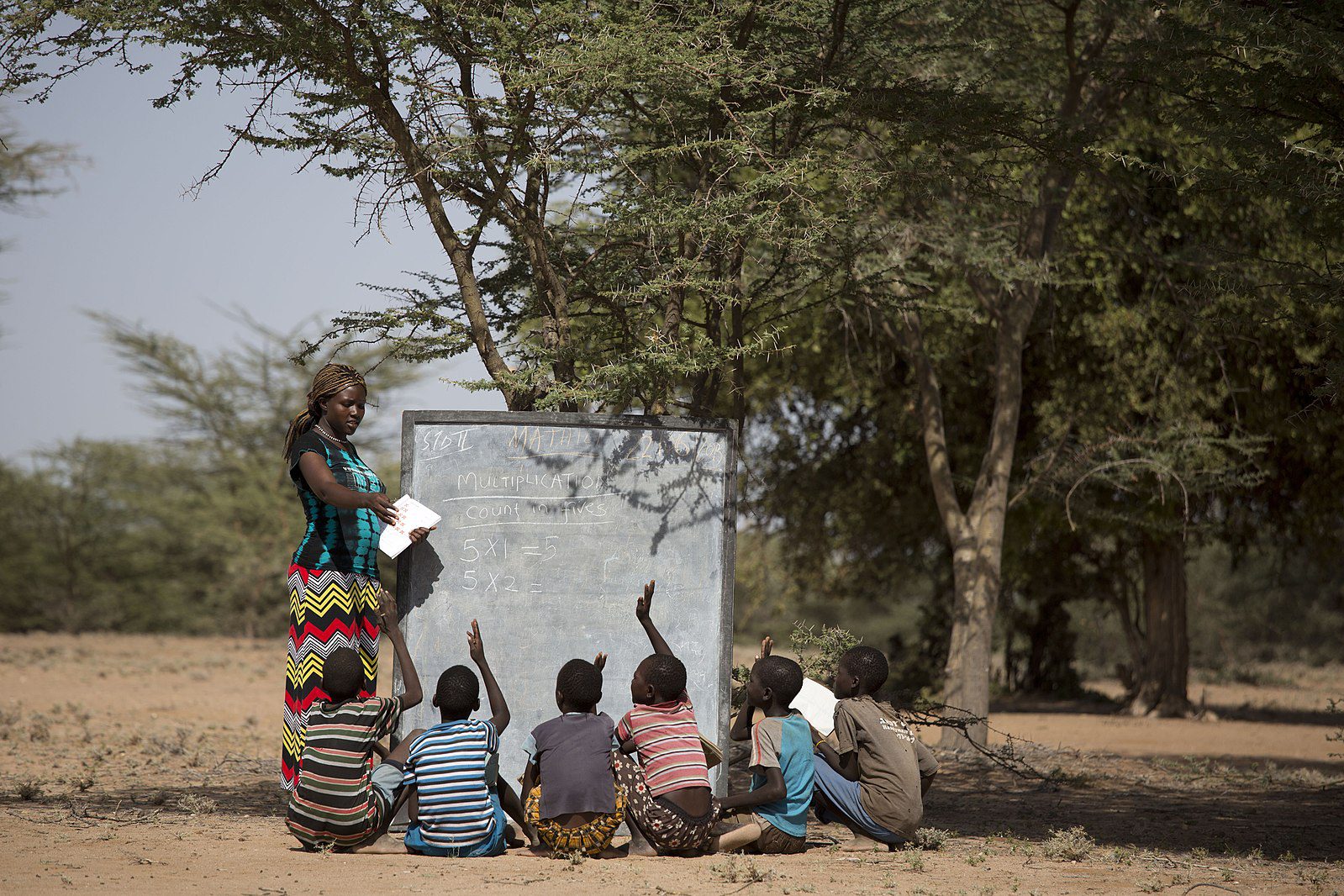
However, inconsistent and expensive data coverage as well as limited electricity for charging limits internet connectivity for many devices. Zimbabwean AI expert and entrepreneur, William Sachiti, has recently taken up this challenge with an idea for improving access not only to the internet but also to educational tools in rural areas. The project is entitled Trees of Knowledge, which reflects the common practice of gathering under the shade of a tree for class.
Technological Solutions
The Trees of Knowledge technology allows a tree or other landmark to broadcast a Wi-Fi signal. Any device within a 100-meter radius can connect to the network and access a pre-loaded server of educational content. The signal is produced by a micro-computer molded into the tree to protect it from damage. The module is powered by a small rechargeable battery that can run for several years without maintenance. The system also includes a solar-powered charging station that users can plug their devices into.
Any content can be uploaded to the educational server, but Sachiti hopes to eventually transition toward including lessons from local educators, making the content specific to each region. This would allow teachers to work with each country’s department of education to ensure that the curriculum is appropriate.
Trees of Knowledge has the potential to improve educational opportunities for rural and excluded communities. This highly integrated solution could mitigate long commutes to school, which can span from five to 1o kilometers. The system provides access to educational content as well as guidance for those unfamiliar with these new resources. As an open-source technology with no patents or intellectual property regulations, the logistics behind Trees of Knowledge are available to be shared and replicated. Since its publication in 2019, several large NGOs in Africa have picked up the idea.
Future Steps
The concept behind Trees of Knowledge is highly adaptable and can be applied to other uses. Similar technologies have recently been implemented by some national parks and nature preserves, who are using interactive digital programs to teach visitors about the ecology of an area. In rural communities, this technology could provide tutorials on first-aid skills, health and hygiene. On remote trails or routes, it may be used to offer critical safety information and orientation.
By removing the obstacles of cost, data coverage and power consumption, Trees of Knowledge is a highly sustainable idea aligned with the goal of minimizing climate change and habitat destruction. This new technology can provide a variety of educational resources by seamlessly integrating into the environment, yet leaving it unchanged.
– Sylvie Antal
Photo: Wikimedia

Planting Trees of Knowledge: A Way to Make Education Accessible
Education Challenges in Zimbabwe
In countries like Zimbabwe, the problem is pronounced. Most children in Zimbabwe receive primary education but only 49% of high-school-aged Zimbabweans attend secondary school. Furthermore, economic challenges have tightened funding for public and boarding schools, causing a steep increase in the cost of attendance. As a result, communities have taken to creating make-shift alternative schools run by locals to save on expenses. These schools remain unregistered in order to avoid fees and therefore do not undergo government inspections.
These challenges, however, are not unique to Zimbabwe. There is an urgent need to improve access to education in many communities throughout Sub-Saharan Africa. Experts have suggested that the implementation of technology into educational services may be a more cost-effective route than building physical infrastructure. Additionally, much of the population has access to basic smartphones or mobile devices. In fact, Sub-Saharan Africa is the world’s fastest-growing region in terms of smartphone adoption, estimating an addition of 167 million subscribers by 2025.
However, inconsistent and expensive data coverage as well as limited electricity for charging limits internet connectivity for many devices. Zimbabwean AI expert and entrepreneur, William Sachiti, has recently taken up this challenge with an idea for improving access not only to the internet but also to educational tools in rural areas. The project is entitled Trees of Knowledge, which reflects the common practice of gathering under the shade of a tree for class.
Technological Solutions
The Trees of Knowledge technology allows a tree or other landmark to broadcast a Wi-Fi signal. Any device within a 100-meter radius can connect to the network and access a pre-loaded server of educational content. The signal is produced by a micro-computer molded into the tree to protect it from damage. The module is powered by a small rechargeable battery that can run for several years without maintenance. The system also includes a solar-powered charging station that users can plug their devices into.
Any content can be uploaded to the educational server, but Sachiti hopes to eventually transition toward including lessons from local educators, making the content specific to each region. This would allow teachers to work with each country’s department of education to ensure that the curriculum is appropriate.
Trees of Knowledge has the potential to improve educational opportunities for rural and excluded communities. This highly integrated solution could mitigate long commutes to school, which can span from five to 1o kilometers. The system provides access to educational content as well as guidance for those unfamiliar with these new resources. As an open-source technology with no patents or intellectual property regulations, the logistics behind Trees of Knowledge are available to be shared and replicated. Since its publication in 2019, several large NGOs in Africa have picked up the idea.
Future Steps
The concept behind Trees of Knowledge is highly adaptable and can be applied to other uses. Similar technologies have recently been implemented by some national parks and nature preserves, who are using interactive digital programs to teach visitors about the ecology of an area. In rural communities, this technology could provide tutorials on first-aid skills, health and hygiene. On remote trails or routes, it may be used to offer critical safety information and orientation.
By removing the obstacles of cost, data coverage and power consumption, Trees of Knowledge is a highly sustainable idea aligned with the goal of minimizing climate change and habitat destruction. This new technology can provide a variety of educational resources by seamlessly integrating into the environment, yet leaving it unchanged.
– Sylvie Antal
Photo: Wikimedia
5 Facts about Hunger in the Bahamas
The Bahamas also face frequent natural disasters such as hurricanes which further aggravate the issue. The recent outbreak of COVID-19 has also left many Bahamians without access to food. Furthermore, these disasters also increase the price and decrease the availability of food in the country. Here are five facts about hunger in the Bahamas.
5 Facts About Hunger in the Bahamas
Change is needed and coming into the food production system in the Bahamas. With improved access for citizens to independently produce more food, the Bahamas will have less obesity, greater academic accomplishments, improved economy, and better quality of life for its citizens. Organizations such as Hands for Hunger are at the forefront of this change. These changes will allow the Bahamas to be known to the world as more than just a beautiful vacation spot.
– Allison Caso
Photo: Flickr
6 Facts about Hunger in the Russian Federation
6 Facts About Hunger in the Russian Federation
At the turn of the century, the Russian Federation modernized the economy and opened the doors for businesses to thrive. After the collapse of the Soviet Union, the Russian Federation faced financial peril but rapidly improved its economy from a GDP of $259 billion in 2000 to $1.65 trillion in 2018. The country recovered quickly, considering the collapse of the previous government, and the standard of living subsequently improved for the Russian people. The Russian Federation effectively addressed the problem of hunger and halved the poverty rate. Although the country still faces health issues stemming from obesity and a lack of fresh produce, the past two decades are a success story in the fight against hunger in the Russian Federation.
– Noah Kleinert
Photo: CIA.gov
5 Facts about Poverty in Uzbekistan
Situated between Kazakhstan and Turkmenistan sits the culturally rich and beautiful country of Uzbekistan. With thriving cities and lush mountainsides, Uzbekistan’s environment makes for blossoming communities. However, the country and communities within it have drastically changed within the last two decades. The Uzbekistan government has successfully lowered poverty rates, decreased unemployment rates and increased education, although these instances rarely make headlines. Here are five facts to know about poverty in Uzbekistan.
5 Facts About Poverty in Uzbekistan
Looking Ahead
With a continuous decrease in poverty rates and an increase in educational and sanitation infrastructure, Uzbekistan has made large strides to improve the lives of its citizens. Poverty in Uzbekistan has dramatically shifted over the last two decades. Unemployment rates have dropped, neonatal mortality rates have decreased by more than half and resources such as education and clean water are becoming more accessible to all communities. With progress like this, Uzbekistan is on its way to great improvement.
– Hannah Kaufman
Photo: Flickr
SongAid Streams Away Hunger
What Is SongAid?
SongAid is a project that works with major music streaming sites to donate profits made from streaming to the WhyHunger Rapid Response Fund. On May 29, 2020, SongAid released its first playlist. The playlist included a variety of artists from Wilco to Galatic. Listeners can find the SongAid playlists, curated by diverse groups of celebrities, on major music streaming platforms like Apple Music, Spotify, Amazon Music and Youtube Music. SongAid releases new music every Friday. Every time someone streams a SongAid song or playlist, the proceeds go directly to WhyHunger. Additionally, SongAid will host virtual gaming, music and artists events throughout the summer to promote its partnership with WhyHunger.
What is WhyHunger?
WhyHunger is a global nonprofit organization started by artists Harry Chapin and Bill Ayres in 1975. The musician and DJ started the organization to provide global access to safe, nutritious food. Several strategies of operation guide the organization. These strategies include empowering and supporting grassroots movements, advocating for social justice and uplifting community voices. Additionally the organization also focuses on protecting the right to adequate food and promoting agro-ecology. WhyHunger has raised $13 million through initiatives like Artists Against Hunger & Poverty, where artists band together to raise funds to support the various components of WhyHunger, such as the Global Movement Program, the Find Food Database and the WhyHunger Hotline.
Through its Global Movement Program, WhyHunger supports international movements for greater access to food, land and water. They have supported the World March of Women, La Via Campesina International and the World Forum of Fisher Peoples. Between 2012 and 2017, the organization raised $1.2 million to support more than 100,000 small farmers in 68 countries.
COVID-19, Poverty and Food Insecurity
Organizations like WhyHunger worked to reduce food insecurity and poverty around the world before the COVID-19 pandemic. However, individuals and organizations such as those brought together through SongAid have begun to recognize that the work WhyHunger does is even more crucial during this pandemic. The pandemic has disrupted the global food supply chain by forcing countries to close their borders. Additionally, restricting exports and keeping workers at home also affect the food supply chain.
Estimates show that half a billion people will fall into poverty as a result of disruptions to the global economy. Additionally, food prices continue to rise due to panic buying and increased demand. For example, the cost of wheat has increased by 15% and the value of rice by 12% around the globe. Moreover, less than 20% of already low-income countries do not have systematic support to provide aid to citizens that are facing exacerbated hunger and poverty.
Despite the seemingly hopelessness situation, coalitions like SongAid are fighting to help people around the world get access to the food and resources they need in spite of the global pandemic.
– Tiara Wilson
Photo: Pixabay
5 Facts About Homelessness in Fiji
Many know Fiji for its beautiful beaches and luxury resorts, but it remains a developing country that deals with poverty. In fact, 31% of its population lives below the poverty line and struggles on a weekly basis to meet their needs. This article will look into homelessness in Fiji, what are some of its causes and why this is such a prevalent issue today. Here are five facts about homelessness in Fiji.
5 Facts About Homelessness in Fiji
Solutions
Although these facts about homelessness in Fiji show that it will not dissipate overnight, some are implementing small measures to help those living on the streets. Since the coronavirus has happened, Fiji has been in lockdown like the rest of the world. One such family has taken it upon itself to continue its mission to feed the homeless. A 12-year-old boy named Junior, his parents and a small team of individuals call themselves MISSION-1. Even before lockdown, MISSION-1 would come to the streets of Suva every Sunday and provide food and hot beverages to the homeless. Despite lockdown and the risk of arrest, this team has continued to provide for those who others often forget.
Australia has also stepped up since Cyclone Harold devastated the Fiji Islands and has sent tents, kitchen supplies, hygiene items, containers for water as well as shelter kits. This is Australia’s way of giving back and thanking Fiji for its support during the Australian bushfires. With continued help, hope exists that Fiji’s homeless community will begin to decline.
– Stacey Krzych
Photo: Flickr
Cryptocurrency in Africa: The Future of a Continent’s Economy
Why Cryptocurrency is So Popular in Africa
In April 2019, Google Trends data showed that Nigeria had the world’s most searches for Bitcoin. Also in 2019, South Africa has the highest volume of cryptocurrency ownership compared to internet users. It was found that 10.7% of internet users in South Africa owned Bitcoin compared to the worldwide average of 5.5%.
In 2020, despite the global economic uncertainties, COVID-19 brought by businesses closing and people not working, Bitcoin trading has continued to increase in Africa. In May 2020, Nigeria had the highest trading volume in one week at $7.2 million, its third-best P2P trading week. Kenya was second with another record week by trading $1.6 million. South Africa came in third exchanging $1.1 million in a week.
Cryptocurrency in Africa mainly gained wide popularity because of high inflation rates across the continent. In 2018, South Sudan saw rates of 83.5% compared to the previous year. Other countries like Nigeria, Ghana and Zimbabwe, who printed $100 trillion notes worth only $40 in 2015, also experienced double-digit inflation rates. These hyperinflation rates had many citizens doubting the economic services of their central banks and governments.
Benefits of Cryptocurrency
In an effort to protect their money from the economic turmoil in their country, Africans started transitioning to Bitcoin. Since companies like Bitcoin have no single domain, the money inside the company is not affected by a single country’s inflation rate, which allows the citizens of African countries to protect their money from a failing economy. As a result, trust for these cryptocurrency companies builds.
Cryptocurrency in African also gives its people the ability to make cross-border payments. Some African countries have a history of fraud which had caused problems with international money transfers. In Nigeria, PayPal banned citizens from receiving money from other nations because of the country’s problems with fraud. However, cryptocurrency allows these citizens to transfer and receive money from anywhere around the world without the high fees that other money transfer companies usually have.
Cryptocurrency companies are blockchain technology that stores public records in a decentralized system. This also makes it impossible to alter transactions and assets. Many African countries use this new technology, through companies like Bitcoin, to elevate their status. They also use this technology to continue pushing their economy up to a level playing field with other nations. In 2019, Kenya and Nigeria announced plans to work more closely with these companies. These countries hope that by regulating cryptocurrency companies and their technology, the governments can begin bringing its people out of immense poverty and start becoming a greater global power.
– George Hashemi
Photo: Flickr
Ndlovu Youth Choir Works to Educate and Lift Spirits Through Song
The Mission of the Group
Dutch physician Dr. Hugo Tempelman established the Ndlovu Care Group in 1994, aiming to deliver proper childcare, healthcare, education, and community development for all in the local community. Dr. Tempelman later co-founded the Youth Choir in 2009, with Ralf Schmitt as co-founder and musical director. It started primarily as an after-school extracurricular opportunity and transformed into a professional, internationally-recognized choir group. The choir has continued to greatly influence the lives of its members, emphasizing that everyone has the capacity to accomplish whatever they put their mind to regardless of level of education, birthplace, or background. The choir’s positive impact has stretched around the globe. South Africa has one of the worst education systems in the world, but the choir is working to change that in a unique way. The Ndlovu Youth Choir has been working to stretch its impact to children in the most need, providing them with a safe space to both develop their musical talents while also developing strong friendships with their fellow choir members. The goal of the Ndlovu Youth Choir is to “…strive to nurture values such as self-discipline, self-confidence, tolerance, respect and leadership in our choristers.”
International Exposure
The official website of the choir “…promises to deliver an experience of infectious joy, a toe-tapping and energetic South African music…” including “…Afro-Pop classics [and] traditional South African music and original compositions irresistibly combined with mesmerizing choreography.” They have been successful in sharing such “infectious joy.” In 2018, they released a cover of Ed Sheeran’s pop hit “Shape of You” and instantly went viral. Its fame escalated upon auditioning for Season 14 of the reality TV show America’s Got Talent (AGT) and, ultimately, becoming finalists. From performing originals like “My African Dream” for their audition and doing covers of songs like Whitney Houston’s “Higher Love,” the group has consistently delivered performances that caught the attention of a wide range of audiences, from the New York Times to Billboard. Its performance in the show landed it a 2019 record deal offer with AGT judge Simon Cowell and his company Sony Music.
Spreading Awareness
The Youth Choir recently released a song titled “We’ve Got This,” hoping to raise awareness about how to prevent the spread of the COVID-19 pandemic. The choir sings the original in both their native language of isiZulu and English and offers useful advice about how to stay safe in the midst of this pandemic. They gleefully sing, “Don’t touch your face. Wash your hands.”
In addition to producing the song, the choir also choreographed its own dance for viewers to follow along with. Its music video was filled with bright South African cultural attire and even brighter smiles. Its song ends on a positive note, with the choir singing, “Don’t panic. Don’t spread rumors. We will beat corona.”
It may be surprising to discover that it took the choir and its managing team less than a day to complete production. Even though the choreography is original and complex and the effort to coordinate production seemingly more time-consuming, the choir has been quick and dedicated to combating COVID-19 through their music. According to Ndlovu Youth Choir’s co-founder and director Ralf Schmitt, misinformation regarding COVID-19 was prevalent in their local community. In producing “We’ve Got This,” the choir was able to spread positivity while relaying accurate advice about how to stay safest and healthiest during these challenging times.
– Aprile Bertomo
Photo: Flickr
6 Facts on How Spectrum is Keeping the World Connected During COVID-19
6 Facts on How Spectrum is Keeping the World Connected
To keep up with supply and demand, Spectrum saw keeping the world connected as the only option. They felt a personal responsibility to use their commodity and to give back. It will continue to try and meet its goal of ensuring all people worldwide are able to access the broadband and complete whatever they may need to do with ease. Many COVID-19 updates are available online. The more people online means more people can access the same communication method for pandemic updates. This keeps as many people as possible aware and informed. Spectrum keeping the world connected is to keep the world safe and informed.
– Kimberly Elsey
Photo: Flickr
Desalination in Micronesia Could Alleviate Water Scarcity
Hardships and the Importance of a Stable Water Supply
In 2016, the region experienced one of the worst droughts in Micronesian history. An emergency response coordinator at the International Organization for Migration explained that the drought’s impacts went beyond just providing drinking water. In early 2020, some preparatory schools in Weno were forced to close because wells were drying up.
Furthermore, because agriculture employs almost half of the nation’s labor force and produces 60% of food supply, groundwater supply is critical. In the past, severe droughts have led local farms, which are the backbone of the economy, to be shut down.
A Promising Solution
Since problems of national drought and water insecurity in the country continue to resurface, many understand that there must be a restructuring of the Micronesian water infrastructure. Fortunately, the islands’ seafront location is leading many to suggest the potential of desalination in Micronesia. This process makes ocean water drinkable and has the potential to meet Micronesia’s needs. The Marshall Islands, one of the five states in Micronesia, recently completed a desalination project that purifies 1,600 cubic meters of seawater a day. Partially funded by the Asian Development Bank, the project has been revolutionary for the Marshall Islands’ water independence. Beyond the South Pacific, nations around the world have caught on to the capabilities of desalination, from Saudi Arabia and Oman to China and India. Plants operate in more than 100 countries, and many areas, like Dubai, have been able to shift to almost 100% desalination.
The Role of Renewable of Energy
Not only does desalination in Micronesia give islands the autonomy to have a stable water supply, but the desalination plants typically encourage the growth of renewable energy, like solar panels. This is partially a result of the fact that most modern desalination plants are powered through solar energy. When government funding is available to introduce solar energy, a presence for renewables is better established in the economy and further investment is more likely. The new plants in the Marshall Islands are solar-powered and have catalyzed the development of solar street lights estimated to significantly reduce energy consumption. These plants also provide reliable drinking water to 3000 Micronesians.
While poverty and child mortality rates have steadily dropped in the region in the last decades, Micronesia cannot continue to improve on this progress without access to a stable water supply. Fortunately, the development of infrastructure to encourage desalination in Micronesia alongside current plants in the Marshall Islands and Vanuatu is a groundbreaking step in this effort for nationwide water security.
– Jack Berexa
Photo: Flickr