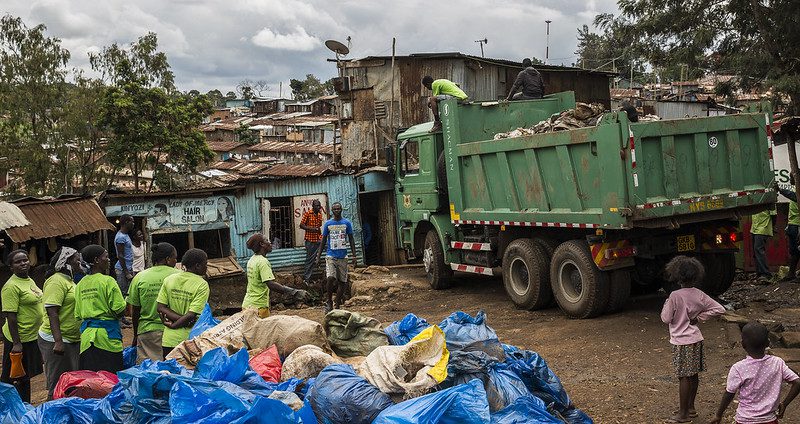
Kenya’s National Hygiene Program (otherwise known as Kazi Mtaani) aims to help the hundreds of thousands of Kenyans who lost jobs due to the COVID-19 pandemic. Implemented in April 2020, the program intends to support the individuals and households that are struggling to find work as a result of the restrictions and other issues that the pandemic created.
Impact of COVID-19 in Kenya
Kenya has a population of 51.39 million people and a rapidly growing urban population, which is increasing by about 4.3% every year. As Kenya urbanizes at a quick pace, formal housing in urban areas of the country struggles to keep up with high demand. About 60% of urban households in Kenya live in a “slum,” because informal housing remains the only option for most people.
COVID-19 hit these poor households in Kenya hard, causing over 300,000 Kenyans to lose their jobs. In Kibera, a county in Nairobi and one of the biggest slums in Africa, a survey found that 90% of low-income residents said that they had lost their family income due to COVID-19.
What Is the National Hygiene Program?
The National Hygiene Program is an extended public works project that emerged as a response to Kenya’s growing unemployed population. The goal of the program is to employ young individuals from informal settlements whose former employment has been disrupted by the pandemic. The program also aims to focus on projects that create cleaner, safer communities during the pandemic.
People must meet a few requirements to be accepted into this program. One requirement is that individuals have to be over 18 years old and under 35 years old because the program’s target audience is Kenyan youth. However, there is some leeway in communities that COVID-19 restrictions hit hardest and where youths are less willing to work. Aside from age, other requirements include the possession of a valid Identification Card, registration with Mpesa — a mobile money transferring service — and a verifiable telephone number.
Phase I
The first phase of the National Hygiene Program acted as a pilot, lasting from April 2020 through June 2020 and employing over 26,000 people. Eight counties that restrictions hit the hardest were the first to implement the program. These counties include Nairobi, Mombasa, Kiambu, Nakuru, Kisumu, Kilifi, Kwale and Mandera. In these areas, many people lost their daily wages, and businesses suffered because people could not afford to buy goods anymore.
Across these eight counties, the program targeted 29 settlements. The program paid workers about $1.03 per day, and they worked 22 days per month. In Phase I, the employees completed tasks like street cleaning, access path clearing, fumigation, disinfection, garbage collection, bush clearing and drainage cleaning.
Phase II
The second phase of the National Hygiene Program began in July 2020 and will run for six and a half months. The program has enrolled 270,000 workers and targets 1,200 informal settlements. Instead of employing workers for 22 days a month like in the first phase, the program’s 11-day rotation period will provide work for as many households as possible. Each worker has a daily wage of $0.78, and supervisors have a daily wage of $0.87.
In Phase II, workers will complete tasks like upgrading public sanitation facilities, creating or paving walkways, constructing community gardens and parks and repairing public buildings like offices and nursery schools.
As the National Hygiene Program continues, it hopes to cover all 47 counties in Kenya through later phases of the program. The program will allow Kenyans to escape unemployment while improving their communities, providing refuge from the destructive effects of COVID-19.
– Sophie Dan
Photo: Flickr

10 Facts about Healthcare in New Zealand
New Zealand is a small island country situated just southeast of Australia. Its healthcare system is known as one of the best in the world. While there are still improvements to be made, the government of New Zealand has worked to make healthcare affordable and accessible. Here are ten facts about healthcare in New Zealand.
10 Facts About Healthcare in New Zealand
New Zealand has a very effective healthcare system that is able to treat many diseases. However healthcare in New Zealand can still be improved, the most pressing issue to address being inequality. Moving forward, it is imperative that the government of New Zealand continue to support universal healthcare and expand its availability to everyone living in the country.
– Sadat Tashin
Photo: Flickr
Internal Conflict and Water Insecurity in South Sudan
South Sudan has been in a civil war since December 2013. As a result, millions uproot themselves and thousands die. Essential resources are scarce, particularly for the most vulnerable people. Specifically, water insecurity in South Sudan is a major crisis within the country. Moreover, this water insecurity permeates both the lack of drinking water and essential water for sanitation.
The South Sudanese Conflict
South Sudan’s people are currently engaged in a civil war between the government (led by President Salva Kiir) and the opposition rebels — led by former Vice President Riek Machar. The country splits along ethnic lines, which primarily determine where support lies. That is to say, the president is supported by the Dinka and the former vice president’s opposition forces, supported by the Nuer.
The conflict results in major displacement, creating internally displaced persons (IDPs) and casualties throughout the country. Due to this displacement, regular access to living resources and basic services, such as healthcare and education, have been greatly diminished. Of the displaced persons, it is estimated that 40% are adults and 60% are children.
A consequence of the conflict: 7.2 million people require humanitarian assistance. Furthermore, 3.7 million people displaced — 383,000 people have died and 1.8 million children are unable to attend school.
Does the Conflict Affect Access to Resources like Water?
In short, yes. The continued violence and inability to secure stable conditions with access to utilities like clean water and sanitation have caused a major water insecurity crisis in South Sudan. The water crisis specifically presents major issues for civilian populations, including a lack of water for infectious disease prevention.
USAID outlines the extent of limited access to water in South Sudan, as a result of the conflict. The organization estimates that only about 34% of people in rural areas have access to water. Given that 84% of the nation lives in rural areas, this statistic quite alarming. Additionally, 90% of those living in poverty reside in rural areas with the aforementioned, limited (or lack of) access to water. This affects vulnerable populations like IDPs, women and children. Furthermore, it hinders their ability to ensure basic health needs like hydration and prevention of infectious diseases like cholera, hepatitis E and Guinea worm disease (GWD).
Weaponizing Water
Infrastructure specifically used for water access systems has been a major resource that the warring parties target in attempts to harm the opposition forces, both military and civilian. To destroy their enemies’ access to water is to debilitate their ability to recover. Equally important, targeting water sources puts severe pressure on the civilians whom an adversary protects. Women in South Sudan particularly feel the effects of this strategy as it can take days to get to a safe source of drinking water. Women are the primary “water fetchers,” but the journey to water sources leaves them extremely vulnerable to death by starvation or thirst (during these on-foot trips). Worse still is the fact that women traveling into rural areas amid the country’s conflict puts them at risk of being killed or assaulted.
Water Insecurity, Nutrition and Disease Prevention
South Sudan’s resource security crises reveal how internal conflicts within countries do not just affect the warring parties or military; they affect civilians, infrastructure and public health alike. Water insecurity in South Sudan, especially, is one of the many resource insecurity crises that should remain a priority of USAID. The crisis shares an intimate connection to nutrition and disease prevention; addressing it will likely have multiple benefits for the citizens of South Sudan.
– Kiahna Stephens
Photo: Flickr
Updates on SDG Goal 1 in Afghanistan
What are the SDGs?
The Sustainable Development Goals (SDGs) are an agenda for global change, put together by the leaders of 193 nations and slated to span 15 years, from 2015 to 2030. A broad look at the SDGs can be broken down into three primary goals:
1. End Extreme Poverty
2. Fight Inequality and Injustice
3. Protect Our Planet
What the SDGs Mean For Afghanistan
The Millennium Development Goals — a similar set of precursor goals, intended for the years 2000 to 2015 — set the previous stage for success within Afghanistan. Despite the country’s continuous challenge in creating better lives for its citizens, Afghanistan made much progress during these years. For example, the first 15 years of the millennia saw a change in the mortality rate of Afghan children; in 2001, 25% of Afghans would die before age five, while today that number is down to 10%. Although this statistic is still alarming when compared to those of the developed world, it constitutes a significant improvement. Fast-forwarding to 2015, the compiling of the SDGs took place at the United Nations General Assembly. There, Chief Executive Abdullah Adulla — GoIRA, represented Afghanistan and committed to pursuing the SDGs within his nation.
Since October 2015, upon the approval of the Afghan Minister’s cabinet, the Ministry of Economy has taken the responsibility of keeping track of Afghanistan’s progress and reports regarding the SDGs. The cabinet is currently working on nationalizing the agenda and extending consultations to those with an international stake in Afghanistan reaching its SDG targets.
Progress So Far
Specific updates on SDG Goal 1 in Afghanistan or updates in ending extreme poverty mostly concern planning, rather than actual action. Extreme poverty describes those living on less than $1.25 per day. While 42% of Afghans are below the poverty line (meaning they live on less than $1.90 per day), it is unclear what portion of this statistic is made up of those suffering in “extreme” poverty. Regardless, a great deal of preparation has been made in efforts to achieve SDG Goal 1 in Afghanistan; e.g., 111 national targets and 178 indicators are set for the country.
Recommendations and reports concerning the SDGs are on the minds of Afghan leaders. Aligning Afghanistan’s National Priority Programs with the United Nations SDGs is complete and communications and advocacy strategies are drawn up and approved by the SDGs Executive Committee. In addition, the Targets Prioritization Guideline has been finalized and shared with the relevant authorities.
A Final Outlook: Positive Trends
On a more humanitarian level, the Sustainable Development Report shows updates on SDG Goal 1 in Afghanistan as somewhat bleak. “Major challenges remain” still characterizes most of the assessment of the nation’s progress. However, this does not mean that a great deal of improvement has not already taken place. In terms of hunger issues, the prevalence of starving children in Afghanistan has dropped, as has the prevalence of obesity. The general health and wellness trajectory also seems promising — with maternal mortality rates and new HIV rates in particular, dropping significantly.
Overall, while updates on SDG Goal 1 in Afghanistan may on the surface be merely organizationally based — the nation is making a great deal of important progress towards the end goal. By 2030, the country’s outlook might well be much more promising.
– Ava Roberts
Photo: Flickr
Homelessness in Benin
5 Facts About Homelessness in Benin
Rapid population growth may increase homelessness in Benin. There is also little economic stability to prepare for it. Although there has been economic growth, there are severe geographic inequities within the country. Fifty-one percent of employment depends on agricultural exports, which shows a lack of economic diversification. As a result, millions of people have no sustenance or financial means whenever trade opportunities or agricultural pursuits are unsuccessful. There is rapid population growth, averaging about 3.5% every year, and the economy is not strong enough to provide for the increasing number of births.
Existing housing is deteriorating. Also, a lack of financial resources makes it difficult for the majority to purchase or build new homes. Many of the existing houses need to be renovated since they were built over 30 years ago. Furthermore, low-lying houses can become flooded during the rainy season, causing more damage to already declining houses. With a fast-growing population and an extremely low minimum wage at $67, an average person cannot afford a high cost of building materials. Even if someone can afford to purchase land, the cost of building a tiny house may be insurmountable. Extended family members often live together because of a lack of capital. Consequently, living conditions are grossly inadequate, and overcrowding is common as many relatives live together. Issues with housing affordability may be an attribute of homelessness in Benin.
Urban development has caused homelessness in Benin. The government has attempted to focus on urban development, hoping to stir economic activity and investment. However, this has come at an expense to Beninese citizens. In the past year, over 120 homes were bulldozed in the district of Xwlacodji. Many of the residents had lived there for generations, yet had never received an official deed granting them property ownership. They were never notified of the plans to bulldoze their homes and belongings. Now, most are homeless and sleep outside or in public buildings. Despite the government’s motivations, many were left homeless.
The government is trying to reconcile its urban development with aid to its poorest citizens. The government has renewed efforts to stimulate growth and reduce inequality in the country. Although this mission has harmed the Beninese with its demolition of local homes, there are upsides to its developmental and aid plans. These benefits include providing universal healthcare, offering cash grants to those working in the national interest, aiding those with disabilities and refinancing grants to areas of geographic disadvantage. Furthermore, Benin’s president, Patrice Talon, has committed to building 20,000 housing units that the government will provide to its citizens at a subsidized cost. With the poorest 20% of the population living in severe poverty, these reforms will enable the homeless to find economic opportunities and necessary social services.
The Republic of Benin has struggled with its rate of poverty in recent years. Its economy depends mostly on its agricultural exports, which is problematic for growth and development. President Talon has proven to be aggressive in his attempts to bring financial opportunities to the Beninese. These factors, among others, have perpetuated homelessness in Benin. However, there are reasons to be hopeful for the future. Talon seeks to bring new government aid and social services to the poorest 20% of the population. With new cash advances and subsidized housing, hopefully, homelessness in Benin will soon be a thing of the past.
– Eliza Cochran
Photo: Flickr
5 Facts about Poverty in Guyana
5 Facts about Poverty in Guyana
Although data shows that the moderate poverty rate (people living on $2 per day) had slightly declined, poverty in Guyana continues to cripple the country in vital areas, leaving much to be done to improve the situation. In spite of the country’s natural resources, Guyana does not meet its economic potential. To alleviate the long-term implications of poverty, it is imperative that poverty in Guyana continues to be a focal point of international aid and developmental endeavors.
– Oumaima Jaayfer
Photo: Flickr
5 Facts About Homelessness in Armenia
Though there is little data on homelessness in Armenia, existing research indicates that it is a serious problem affecting many Armenians. Homelessness is apparent across the country, especially in the capital city of Yerevan. However, more research is necessary to fully understand the gravity of homelessness in Armenia and how the COVID-19 pandemic has impacted it. Here are five facts about homelessness in Armenia.
5 Facts About Homelessness in Armenia
Solutions
There are several organizations working to combat homelessness in Armenia. The Armenian Relief and Development Association has worked to create temporary shelters for homeless families and individuals. Similarly, the Armenia Fund’s Gyumri Housing Project works to secure housing for families in Gyumri, Armenia’s second-largest city. The project works to purchase and furnish apartments and give them to families experiencing homelessness or housing insecurity.
Those who are homeless in Armenia suffer from a lack of shelters and other forms of relief, but they also suffer from invisibility. Uncounted and under-researched, they are largely unseen by the international community. Relief organizations provide crucial support, but more is necessary to make the suffering of Armenia’s homeless quantifiable and visible. What the world cannot see, count and understand, it cannot fix.
– Sophia Gardner
Photo: Flickr
4 Facts About Updates on SDG Goal 3 in El Salvador
El Salvador is the smallest country in Central America, with a population of about 6.3 million people. Compared to every country around the globe participating in the United Nations’ Sustainable Development Goals program, El Salvador ranks relatively high. The Sustainable Development Goals, or SDGs, are 17 goals that the United Nations established in order to create a better world for citizens around the globe. All 17 goals interconnect to ensure that the goals fully account for all persons worldwide. The U.N. gives each country a numerical score out of 100 that evaluates how close it is to achieving all 17 SDGs. El Salvador has a score of 69.62 and ranks 77th out of 193 countries. Specifically, there have been many updates on SDG Goal 3 in El Salvador.
Goal 3 focuses on good health and well-being. This goal in El Salvador is increasingly important due to the ongoing COVID-19 pandemic. Prior to the pandemic, the U.N. had been seeing great strides in improving the health and well-being of people worldwide. SDG Goal 3 primarily focuses on reducing maternal mortality rates, providing universal care and ending epidemics with high mortality rates. Here are four updates on SDG Goal 3 in El Salvador.
4 Updates on SDG Goal 3 in El Salvador
The SDGs are an effective way of providing step-by-step approaches for different countries to provide the best health and safety for their citizens, and El Salvador is no exception. The country has been working consistently to improve the health and well-being of its citizens. Though there are some areas in need of improvement, these updates on SDG 3 in El Salvador make it clear why the country ranks relatively high in comparison to others. With time and further assistance, El Salvador can fully attain SDG Goal 3.
– Alondra Belford
Photo: Flickr
Kenya’s National Hygiene Program Addresses Unemployment Amid COVID-19
Kenya’s National Hygiene Program (otherwise known as Kazi Mtaani) aims to help the hundreds of thousands of Kenyans who lost jobs due to the COVID-19 pandemic. Implemented in April 2020, the program intends to support the individuals and households that are struggling to find work as a result of the restrictions and other issues that the pandemic created.
Impact of COVID-19 in Kenya
Kenya has a population of 51.39 million people and a rapidly growing urban population, which is increasing by about 4.3% every year. As Kenya urbanizes at a quick pace, formal housing in urban areas of the country struggles to keep up with high demand. About 60% of urban households in Kenya live in a “slum,” because informal housing remains the only option for most people.
COVID-19 hit these poor households in Kenya hard, causing over 300,000 Kenyans to lose their jobs. In Kibera, a county in Nairobi and one of the biggest slums in Africa, a survey found that 90% of low-income residents said that they had lost their family income due to COVID-19.
What Is the National Hygiene Program?
The National Hygiene Program is an extended public works project that emerged as a response to Kenya’s growing unemployed population. The goal of the program is to employ young individuals from informal settlements whose former employment has been disrupted by the pandemic. The program also aims to focus on projects that create cleaner, safer communities during the pandemic.
People must meet a few requirements to be accepted into this program. One requirement is that individuals have to be over 18 years old and under 35 years old because the program’s target audience is Kenyan youth. However, there is some leeway in communities that COVID-19 restrictions hit hardest and where youths are less willing to work. Aside from age, other requirements include the possession of a valid Identification Card, registration with Mpesa — a mobile money transferring service — and a verifiable telephone number.
Phase I
The first phase of the National Hygiene Program acted as a pilot, lasting from April 2020 through June 2020 and employing over 26,000 people. Eight counties that restrictions hit the hardest were the first to implement the program. These counties include Nairobi, Mombasa, Kiambu, Nakuru, Kisumu, Kilifi, Kwale and Mandera. In these areas, many people lost their daily wages, and businesses suffered because people could not afford to buy goods anymore.
Across these eight counties, the program targeted 29 settlements. The program paid workers about $1.03 per day, and they worked 22 days per month. In Phase I, the employees completed tasks like street cleaning, access path clearing, fumigation, disinfection, garbage collection, bush clearing and drainage cleaning.
Phase II
The second phase of the National Hygiene Program began in July 2020 and will run for six and a half months. The program has enrolled 270,000 workers and targets 1,200 informal settlements. Instead of employing workers for 22 days a month like in the first phase, the program’s 11-day rotation period will provide work for as many households as possible. Each worker has a daily wage of $0.78, and supervisors have a daily wage of $0.87.
In Phase II, workers will complete tasks like upgrading public sanitation facilities, creating or paving walkways, constructing community gardens and parks and repairing public buildings like offices and nursery schools.
As the National Hygiene Program continues, it hopes to cover all 47 counties in Kenya through later phases of the program. The program will allow Kenyans to escape unemployment while improving their communities, providing refuge from the destructive effects of COVID-19.
– Sophie Dan
Photo: Flickr
How Chlorhexidine Reduces Neonatal Mortality
Although the neonatal mortality rate across the globe has been consistently decreasing, neonatal death is still common in many regions. According to the World Health Organization (WHO), annual infant deaths were at an all-time low of 4.1 million deaths in 2017, decreasing from 8.8 million in 1990. However, the death rate in Africa is over six times higher than it is in Europe, illustrating a severe disparity. As such, there is still much more that people can do to lower neonatal mortality rates. One potential solution is chlorhexidine, which reduces neonatal mortality.
How Chlorhexidine Reduces Neonatal Mortality
To combat mortality rates, Save the Children and governments in Nepal and Nigeria have implemented chlorhexidine, an antiseptic found in mouthwash. When used to clean the umbilical cord as soon as possible after birth, chlorhexidine reduces neonatal mortality by preventing infection in newborns, which is among the top drivers of neonatal deaths across the globe. Save the Children and pharmaceutical company GlaxoSmithKline (GSK) partnered to create a chlorhexidine gel to distribute in wrapped pouches. Save the Children noted that this gel “was developed to be suitable for use in high temperatures, useful in sub-Saharan Africa and [South] Asia where the risk of newborn infections is high and temperatures are hot.”
Chlorhexidine gel has become wildly popular in Nepal, where USAID created the Chlorhexidine “Navi” Care Program to distribute chlorhexidine gel. In Nepal, around half of deliveries happen at home, making newborns even more exposed to infection if they are not delivered in a clean environment. In fact, a large majority of deaths in Nepal occur within the first month of life. Moreover, infections cause half of those deaths. In Nepal, chlorhexidine has reduced neonatal mortality by 24% and decreased the rate of infections in newborns by 68%. The Chlorhexidine “Navi” Care program’s objective aims to distribute chlorhexidine gel to all 75 districts of Nepal.
The Lifesaving Effects of Chlorhexidine
Nepal is not the only country to see chlorhexidine reduce neonatal mortality rates. Nigeria, one of the most populous countries in Africa, has also seen success. Its neonatal mortality rate has dropped from 48 deaths per 1,000 births in 2003 to 37 deaths per 1,000 live births in 2013. According to many estimates, infections cause at least one-third of newborn mortalities in Nigeria. In March 2016, Nigeria created a plan to scale-up the use of chlorhexidine to lower neonatal mortality rates. If this program succeeds, it will save 55,000 infants. Although this scaling up program started slowly, the Nigerian government has committed to continuing the use of chlorhexidine to prevent infection and fatalities. To do so, it has a plan in place to help local governments achieve their goals.
Across the globe, there are large imbalances in neonatal mortality rates. Countries like Pakistan, Afghanistan and Somalia have a much higher neonatal death rate than countries such as Australia, Canada or China. In developing countries where poverty rates are higher, neonatal death skyrockets due to a lack of resources. This simple, cheap and over-the-counter chlorhexidine gel is saving lives across the globe. As chlorhexidine becomes even more accessible to every community, it is hopeful that neonatal deaths will continue to decrease.
– Hannah Kaufman
Photo: Flickr
3 Organizations Combating Sweatshop Labor
National Labor Committee
The National Labor Committee is an organization committed to educating consumers about the horrors of the fashion industry by posting articles on its website. It also provides resources to help consumers trace where popular brands manufacture their garments. As mentioned previously, the enhanced scrutiny by consumers has forced various brands to disclose where and how their garments are being made, leading to increased transparency of their business practices. “The fashion industry needs to recognize that it’s up to corporations to fix these issues,” says Lawrence. The National Labor Committee is doing just that by highlighting the human rights issue of sweatshop labor through articles.
Fair Labor Association
The Fair Labor Association (FLA) seeks to end sweatshop labor on a similar scale by holding companies accountable for the manufacturing of their products through educational resources. However, this organization is unique in that it partners with universities and companies across the country to train workers and encourage schools to buy ethically made products. Many schools like Princeton and Arizona State University are FLA partners, and the FLA’s reach has only expanded since starting in 1999. Organizations like the FLA have increased awareness of the fast fashion industry, leading to a rise in sustainable fashion. Furthermore, many students across the country have started to campaign for ethically made apparel and furniture for their universities.
United Students Against Sweatshops
Also focusing on the trend of outreach, this organization—also known as SAS—encourages students across the US to take action to end sweatshop labor by creating clubs on their campuses. United Students Against Sweatshops partners with the WRC to ensure that suppliers are meeting regulations and using transparency in their manufacturing processes. Over 250 schools across the U.S. and Canada have SAS branches on campus, which further spreads this company’s reach.
The common trend of these organizations combating sweatshop labor is their national scale and specific focus on the biggest consumers of fashion goods: young adults and college students. By spreading awareness about the hazards of sweatshop labor against the trend of increasing outsourced labor, consumers are becoming more informed of how their spending habits can exacerbate poverty and abuse in developing countries throughout Asia and Africa. These organizations are paving the way for developed countries like the US to end sweatshop labor by exposing the harmful conditions endured by sweatshop workers. Encouraging universities and companies to negotiate with large corporations to improve working conditions is a major step in the right direction towards eliminating fast fashion and alleviating global poverty.
– Xenia Gonikberg
Photo: Flickr