Projects to Improve Infrastructure in Guinea-Bissau
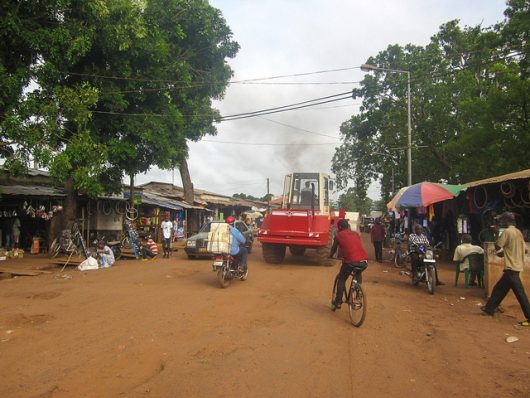
Since the early 1980s, one of Guinea-Bissau‘s main goals has been to develop and improve its fundamental facilities and services. Some of the needs for successful infrastructure in Guinea-Bissau include improvements to:
- Transportation
- Electricity Access
- Telecommunications
Transportation
With 2,734 miles of roads in Guinea-Bissau, only 10 percent are paved. This has attracted foreign aid in the form of sealing the main road to the northern border and constructing a major bridge at Joao Landin.
Guinea-Bissau has many rivers that can be accessed for coastal shipping, but the water transport needs major improvement. Bissau is the main port, and there have been plans for a European Union-sponsored deep-water port that will specialize in minerals and link to Guinea by rail.
Since the elimination of the privatized national airline, Guinea-Bissau has had to rely on foreign-owned carriers. The Guina-Bissau civil war that lasted from June 7, 1998, to May 10, 1999, severely disrupted flights and the main airport reopened in July 1999. In 2000, the country had about 29 airports but only three with paved runways.
Electricity
Guinea-Bissau has one of the lowest electrification rates in Africa. This rate indicates the number of people with electricity access as a percentage of the total population. Electricity is not accessible to a large part of the population, mostly due to corruption and inefficiency. The country is completely dependent on petroleum products, despite its own high energy potential, especially in hydroelectric power.
Telecommunications
The government of Guinea-Bissau announced its intention to liberalize the telecom industry, extend telecommunications to the whole country and introduce a cellular network. The internet access for the network would be provided by the U.S. Agency for International Development (USAID). In 1997, there were 8,000 telephones in the country, and in 2000, there was one internet service provider with about 1,500 internet users. As of July 2016, less than 1 per 100 people in Guinea-Bissau had a fixed phone line, but more than 70 percent of people had a mobile cell phone. The country now has five internet service providers and about 66,000 internet users.
Rehabilitation Projects
The World Bank conducted various projects to improve the infrastructure of Guinea-Bissau. The goal of its Social and Infrastructure Relief Project (SIRP) was to improve job opportunities and financial status for low-income workers through the support of activities with high social and economic benefits. The bank committed $15 million to the project.
Results for the SIRP in Guinea Bissau were satisfactory. There continues to be a need for assistance in the development of more detailed procedures and in fully implementing the introduction of the accounting system.
The purpose of the bank’s Multi-Sector Infrastructure Rehabilitation Project (MIRP) was to improve the access to power, water and road infrastructure services. The World Bank committed $5 million to the project, but the results were not as successful as the SIRP.
Initially, the program leadership expected the private sector to participate and contribute to the energy and water sectors. However, the willingness of the private sector to get involved in a volatile political environment was overestimated and unrealistic. Additionally, there was an imbalance of supervision between project groups.
With continued efforts to improve the infrastructure in Guinea-Bissau, the country is headed for advancement and progress.
– Julia Lee
Photo: Flickr
