• Link to X
  • Link to Facebook
  • Link to Instagram
  • Link to TikTok
  • Link to Youtube
  • About
    • About Us
      • President
      • Board of Directors
      • Board of Advisors
      • Financials
      • Our Methodology
      • Success Tracker
      • Contact
  • Act Now
    • 30 Ways to Help
      • Email Congress
      • Call Congress
      • Volunteer
      • Courses & Certificates
      • Be a Donor
    • Internships
      • In-Office Internships
      • Remote Internships
    • Legislation
      • Politics 101
  • The Blog
  • The Podcast
  • Magazine
  • Donate
  • Click to open the search input field Click to open the search input field Search
  • Menu Menu

Tag Archive for: Donations

Posts

Aid, Aid Effectiveness & Reform, Charity, Global Poverty

5 Reasons to Donate Money, Not Stuff

Donate money, not stuffIn the midst of global tragedies, many charitable people decide to send old junk or underused resources to foreigners in need. Here are five reasons why one should donate money, not stuff if one wants to solve global hunger.

  1. “Junk” is a logistical nightmare for volunteers. The people brave enough to enter disaster sites must provide emergency care to people in immediate need. They lack the necessary time to sort, transport and store cheap diapers or old sweaters sent in by well-meaning folks. Yahoo Finance reports an incident where, in the aftermath of Hurricane Katrina, a benefactor sent thousands of pounds of cheese to New Orleans. The trouble was that no working refrigerator could hold such a gift. Lots of material goods appeal to a customer’s wants… they’re not so effective in situations of dire need.
  2. Material donations can wreck a nation’s economy. Kathleen Tierney, the director of a Natural Hazards Center in Colorado, notes how economic problems occur in recovering nations when supply outstrips demand. “If you want to see economic recovery, you don’t want to send so many supplies that you create a situation where people can’t survive in a business sense,” said Tierney. Ultimately, the best use of aid is to help a country until they can take care of themselves. It’s difficult to make one’s living selling T-shirts if a global superpower dropped off millions of shirts for one’s potential customers to wear for free.
  3. Local groups know what resources they need. The Central Texas Food Bank, the largest provider of emergency food distributions in the country, was shut down by flooding during 2017’s Hurricane Harvey. The group’s president, Derrick Chubbs, supports monetary donations instead of material aid. He reasons that relief groups in a disaster area know exactly what they need for certain situations. They only lack the funds to acquire the most helpful tools for the job. The chance to clean one’s house and accomplish a moral good is tempting for a lot of do-gooders. But one can achieve similar results by selling old junk to a consignment store (like Goodwill or Half-Priced Books) and donating the proceeds to a respected charity. With one additional step in giving aid, the effectiveness of a donation multiplies.
  4. “Stuff” is a short-term solution to a long-term problem. The media focuses on the immediate aftermath of a tragedy but often loses interest by the time victims have to return to their homes. Groups like the Salvation Army understand that maintaining emergency shelters and rebuilding destroyed sites takes a long time. This is why nonprofits want people to donate money, not stuff. Not only do charities know what to spend cash on, but they know how to divide that cash to ensure a complete job. Such relief groups cannot fix a community with a stuffed animal sent from across the country.
  5. It’s more effective to call/email your representative. So how can someone help if they feel they lack the money to keep themselves afloat? One free solution would be to contact your representative and ask that your government contribute aid to a country or region in need. The Center for Global Development reports that the U.S. donates only 1 percent of its budget towards International Affairs, which includes disaster relief. Not only can this amount be increased through advocacy, but concerned citizens can ask their representatives to support revenue-neutral bills to solve global problems. Anyone interested in this surprisingly easy path to advocacy should explore The Borgen Project’s page on calling Congress.

– Nick Edinger

Photo: Pixabay

November 12, 2017
https://borgenproject.org/wp-content/uploads/borgen-project-logo.svg 0 0 Borgen Project https://borgenproject.org/wp-content/uploads/borgen-project-logo.svg Borgen Project2017-11-12 01:30:262024-05-29 22:27:535 Reasons to Donate Money, Not Stuff
Activism, Food & Hunger, Global Poverty

GiveDirectly Sends Money Directly to People in Poverty

GiveDirectly
GiveDirectly, a U.S. nonprofit organization, is seeking to change the way aid is given to impoverished communities around the world. Where most nonprofit organizations seek to fight global poverty through advocacy programs, research studies, services and volunteers, GiveDirectly bypasses traditional nongovernmental organization structures to allow donors to see exactly where and who their money is going to. By doing so, GiveDirectly is able to send money directly to people in poverty.

Modern payment through technology has become a prominent cost-effective way to transfer sums of money over thousands of miles. GiveDirectly uses such technology to take and use money from donors and transfer it directly to people in impoverished communities. After opening to the public in 2011, the nonprofit exclusively makes payments to people in extreme poverty through online transferable cash grants.

The next step is to study the impact of direct aid to poverty-stricken communities. Over the next 12 years, every adult in 40 villages throughout Kenya will receive $0.75 per day through GiveDirectly donors. The wage, while below the poverty line, will ensure a source of income on top of day-to-day jobs.

Residents of another 80 villages will receive that amount over just two years and residents of yet another 80 villages will receive that amount in a lump sum. Since GiveDirectly sends money directly to people in poverty, all community members will receive the donations despite income levels, as a form of universal income. More than 26,000 people will receive a donation transfer, where 6,000 will receive a sustained universal income.

According to the GiveDirectly website, the group has received 81% of the funds required to pay for the study throughout all 12 years. The research team includes Abhijit Banerjee, co-founder of J-PAL and a professor at Massachusetts Institute of Technology; Alan Krueger, a former Chairman of President Obama’s Council of Economic Advisers and a professor at Princeton and Tavneet Suri, Scientific Director for J-PAL Africa, also at Massachusetts Institute of Technology.

Stephene, a 27-year-old laborer in Kenya, enrolled as a recipient of cash-grants from GiveDirectly four months ago. Two months in, he received his first payment over the phone of $97. He spent his first sum of money plastering his house and on necessities for his wife who is expecting a child.

When asked what he would spend the donated money on, Stephene said he would use it to buy his own boat, to make his life as a fisherman easier. He recently received his second payment of $481. The funds went to buying iron sheets and finally, his own fishing boat. In an interview with GiveDirectly, Stephene said, “This has improved my source of income [and] thus improved my living standards.”

Recipients of donations receive an SMS text message when their payments are ready for collection. On average, it takes 32 minutes for individuals to walk to the closest agent and collect their cash transfers.

In addition to the efficiency of the aid program, recipients can spend their payments on necessities that are unique to their lives and families. By sending money directly to people in poverty, the organization breaks down some of the difficulties of traditional foreign aid.

– Riley Bunch

Photo: Flickr

July 28, 2017
https://borgenproject.org/wp-content/uploads/borgen-project-logo.svg 0 0 Borgen Project https://borgenproject.org/wp-content/uploads/borgen-project-logo.svg Borgen Project2017-07-28 07:30:312020-06-29 07:52:39GiveDirectly Sends Money Directly to People in Poverty
Activism, Development, Global Poverty

Gates Foundation Pledges $50 Million to (RED) Campaign

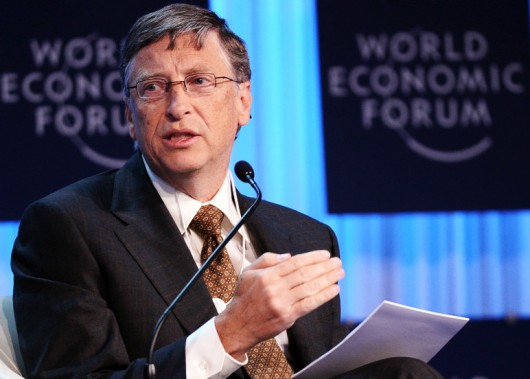
Bill Gates Donate World Economic Forum

The Bill and Melinda Gates Foundation gave (RED), an organization that fights AIDS, the best 10th-anniversary gift ever: a $50 million match for all Global Fund donations in 2016.

The foundation announced its pledge at the 2016 World Economic Forum in Switzerland according to Look to the Stars.

(RED) and the Fight Against Aids

“Over the past decade, (RED) has enrolled millions of people and dozens of brands in the global fight against AIDS,” said Bill Gates, co-founder of the Bill & Melinda Gates Foundation, in a statement at the 2016 World Economic Forum.

“Today’s match will provide the Global Fund with up to $100 million to help save 60,000 lives, prevent 2.3 million new infections and generate more than $2 billion in economic gains for developing countries,” he said. “That’s an amazing return on investment.”

The Bill and Melinda Gates Foundation and the (RED) campaign has actively supported the Global Fund over the years.

Since its inception in 2006, (RED) has raised $350 million thanks to partners, events and products sold according to the organization’s website.

“We owe a debt of gratitude to all the companies, the creative collaborators and the activists who step-up to fight AIDS with (RED),” said (RED) CEO Deborah Dugan in a statement in January 2016.

A portion of the profits from (RED) branded products, like Beats by Dr. Dre Solo 2 headphones, Apple iPods and GAP clothing, benefit the Global Fund to Fight AIDS, Tuberculosis and Malaria.

The Gates and the Global Fund

The Global Fund was established in 2002 to end AIDS, malaria and tuberculosis as epidemics through government, civil society and private sector partnerships according to its website.

To date, the Gates Foundation has contributed a total of $1.4 billion to the Global Fund, which includes the issuance of the long term promissory note of $750 million according to the Global Fund’s website.

“The Global Fund is one of the most effective ways we invest our money in every year,” said Bill Gates at the 2012 World Economic Forum. “By supporting the Global Fund, we can help to change the fortunes of the poorest countries in the world. I can’t think of more important work.”

The Bill and Melinda Gates Foundation and the (RED) campaign even partnered together through Snapchat in honor of World AIDS Day 2015.

Every time a user sent a Snapchat message using a (RED) filter, the Bill and Melinda Gates Foundation agreed to donate $3 to the organization’s fight against AIDS according to Re/code.

– Summer Jackson

Photo: CNN

April 22, 2016
https://borgenproject.org/wp-content/uploads/borgen-project-logo.svg 0 0 Borgen Project https://borgenproject.org/wp-content/uploads/borgen-project-logo.svg Borgen Project2016-04-22 01:30:122024-12-13 17:54:11Gates Foundation Pledges $50 Million to (RED) Campaign
Global Poverty, Refugees and Displaced Persons

Bayern Munich Donates $1 Million to Refugees

soccer
The 2013 UEFA Champions League winner, FC Bayern Munich, is donating $1.11 million to refugees in Germany who arrived via Hungary and Austria. There is a training camp set up to supply food and enroll refugees in German classes. Bayern Munich will also donate soccer equipment to the incoming refugees.

Germany has taken 20,000 refugees in Munich alone and plans on taking 800,000 asylum seekers before the year is over. In 2014, the entire European Union took 626,000 refugees.

There are many aspects about Germany that makes it attractive for refugees. Germany has the strongest economy in Europe and is one of the safest countries in the world. Refugees in Germany get to enjoy a strong human rights record and free education for their children.

The police force in Germany asked Germans to stop donating items for the incoming refugees because the volume of aid they were taking in became overwhelming.

Germany estimates that each refugee costs about $14,500, which means 800,000 refugees will cost $11 billion this year. There will be $6.7 billion set aside in 2016 for refugees agreed to by the government.

Bayern Munich’s example is just a small package of what Germany is offering to refugees. The entire community has been involved in aiding refugees. Industries are going to provide job opportunities for refugees in Germany and there will be recruitment at refugee centers.

On September 12, Bayern Munich walked out with one German child and one refugee child to symbolize integration and to encourage Germany.

– Donald Gering

Sources: Al Jazeera 1, Al Jazeera 2, The Guardian, The Independent, UNHCR
Photo: PBS

September 30, 2015
https://borgenproject.org/wp-content/uploads/borgen-project-logo.svg 0 0 Borgen Project https://borgenproject.org/wp-content/uploads/borgen-project-logo.svg Borgen Project2015-09-30 01:15:222024-12-13 18:05:04Bayern Munich Donates $1 Million to Refugees
Global Poverty

Where Should I Give My Money?

Give-My-Money

There are countless aid organizations, charities and foundations working to fix the world’s problems. From technology-based companies to loan providers, to construction companies, to sustainable agriculture, the options are truly endless.

If you are a donor who wants to make a difference, but you are overwhelmed by the volume of deserving organizations, here are some tips on how to choose the charity that’s right for you:

1. Decide what area of support interests you.
Do you want to feed the hungry, shelter the homeless, heal the sick and injured or stabilize a suffering economy? There are many different categories of aid that each function for different purposes. Decide which type of aid you are most passionate about.

2. Ask yourself who you want to help.
Maybe you are more inclined to help refugees escaping violence than children needing surgery, or maybe you understand more about providing technology to darkened communities than rebuilding communities affected by natural disasters. Different groups of people are affected by different conflicts and issues. Once you narrow down the country and specific group of people you want to help the most, it becomes easier to choose which organization will fit your needs.

3. Do a background check on the organization or charity.
Donating money can be incredibly rewarding and beneficial, if you are donating to the right cause. Many false organizations exist that scam good-hearted donors, exploiting their lack of knowledge about the aid organization market to cheat them out of their hard-earned profits. Call the office and ask questions about where and how your money will be used. Research the organization and look at reviews from other donors.

4. Ask fellow donors where they donated.
Asking local community members or friends and family where they like to donate money is a good jumping-off point. This will help to get your own ideas flowing.

5. Work for the organization.
If you have enough free time to volunteer at one of the organization’s events or intern in its offices, you can get a first-hand, inside look into how the organization operates and exactly what is being done to reach its goals.

6. Decide how much money you want to spend.
Many people think that donations to charity must occur in lump sums, but there are many flexible program subscriptions that offer monthly payments. Decide which payment plan is right for you and what you can afford to give.

If you follow these steps and choose your charity wisely, your donations could drastically improve or even save the lives of people around the world.

– Hanna Darroll

Sources: Forbes, Charity Navigator
Photo: Zero Hedge

September 12, 2015
https://borgenproject.org/wp-content/uploads/borgen-project-logo.svg 0 0 Borgen Project https://borgenproject.org/wp-content/uploads/borgen-project-logo.svg Borgen Project2015-09-12 08:35:352020-06-30 09:09:58Where Should I Give My Money?
Aid, Global Poverty, Philanthropy

The Benefits Of Corporate Philanthropy

Corporate Philanthropy
Although much important philanthropic work is done by volunteers on the ground, it is important to remember that some of the most significant contributions to worthy causes come in the form of monetary aid. Donations from wealthy individuals and groups are the life-force for nonprofit organizations trying to help those in need. Some of the most influential benefactors are large corporations which donate to causes as small as funding local sports tournaments and as large as making a stand against human trafficking.

Companies invest billions of dollars each year in efforts to make a positive impact on the world. According to the 2012 Giving in Numbers report generated by the Committee Encouraging Corporate Philanthropy (CECP), corporate giving is on the rise. From the survey of 240 companies, the CECP discovered that giving in the year 2012 totaled US$20.3 billion. This sum was a substantial increase from the previous year and continues the rise in corporate donations observed in the 5 years prior. From 2007 to 2012, the CECP recorded a 42 percent increase in corporations’ giving numbers.

Matched employee donations account for a large part of these numbers for at least 181 of the 240 companies surveyed. Per company, the average total amount raised from employee payroll deductions in 2012 was $2.33 million. The efforts of employees to donate to worthy causes are beneficial to the corporations for which they work as it makes the corporations, as a whole, appear more charitable.

Employees are more likely to contribute to causes when they have wide access to those that are important to them and are not restricted in their giving opportunities. In order to meet their corporate philanthropy objectives, some companies have begun to utilize social giving platforms that allow employees to form groups around the issues about which they are most passionate. An example of one of these platforms is Givelocity, a social network that allows people to join “giving circles” revolving around the issues users find most important. Companies that are comfortable with doing business online may find that these platforms provide a new method to get their employees involved in philanthropic activities.

These glowing facts and statistics aside, there is a dark side to corporate philanthropy. One might wonder whether companies donate to causes because they care about their impact or merely because they want to bolster their own success. Donating to the community creates a heroic image for companies both large and small, and the goodwill that corporate philanthropy generates can increase customer interest and improve consumer opinions. Although corporate donations are impactful now, one might worry that if generosity becomes bad for business, companies might choose selfishness instead.

Whether or not the motives of giving corporations are wholly admirable, it cannot be denied that the efforts of companies to give back to the community are effective in growing local economies. Corporate donations are, after all, derived from the community in the first place and are rightly used to generate income back in that community. In areas below the poverty line, companies are able to generate new markets and opportunities for people who may never have had access to certain products before. In this way corporate philanthropy benefits both the buyer and supplier. From a savvy business perspective, new consumer income is readily available to go right back to the company, but it also means a higher quality of life for those taking advantage of the growing economy.

– Katie Pickle

Sources: Houston Chronicle, The Corporate Social Responsibility Newswire
Photo: Causecast

July 6, 2015
https://borgenproject.org/wp-content/uploads/borgen-project-logo.svg 0 0 Borgen Project https://borgenproject.org/wp-content/uploads/borgen-project-logo.svg Borgen Project2015-07-06 13:33:132020-07-11 11:31:49The Benefits Of Corporate Philanthropy
Aid, Global Poverty

Goodeed and Freerice: Two Easy Ways To Help

goodeed_and_freerice
Helping those in need has never been easier with Goodeed and Freerice, websites that make it incredibly simple for those with computer access to make a difference in the lives of the less fortunate.

Goodeed allows users to donate to a cause for free. How is that possible, donating for free? On the website, you watch a twenty-second advertisement, and the revenue from watching the ad goes to one of three causes: trees, vaccines or meals.

The trees are in the East Khasi Hills in the Meghalaya forest in India. This area is known as the wettest place on earth and is under serious threat. Goodeed partnered with WeForest to not only conserve local biodiversity and the livelihood of the people but also to promote women’s entrepreneurship and empower the indigenous community.

The vaccines are delivered to Chad, where the goal is to completely eradicate polio. Today, 80 percent of people get vaccinated for polio, and Goodeed wants that percentage to be 100. Lastly, the meals go to Kenya schools to ensure that students get at least one nutritious meal a day. Goodeed teamed up with the World Food Programme to make this happen.

Each person can make a total of three donations a day, a grand total of 60 seconds of your time to support three worthwhile causes.

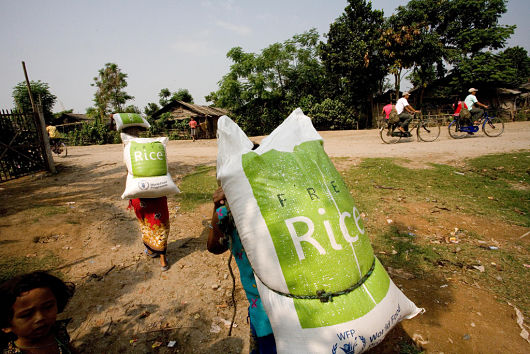
Freerice operates on a similar platform of effortless community involvement. Freerice is an English vocabulary test where, with each question answered correctly, 10 grains of rice are donated.

Freerice works with the World Food Programme to deliver rice to areas in need. They fed 27,000 refugees of Myanmar in Bangladesh for two weeks, and in Cambodia, they provided take-home rations of rice for over 13,500 pregnant and nursing women who needed it over the span of two months. In addition, they have sent rice to Uganda, Nepal and Bhutan.

Freerice is an educational tool for children in the First World, as well as an asset to the Third World. Melissa Foor, a middle school teacher in the United States, used Freerice as a vocabulary lesson for her students. Her classroom, as well as those of other inspired teachers in the school, raised 1,000,000 grains of rice. The students practiced vocabulary and learned a lesson on helping others.

There is a fine line between what people are willing to sacrifice to help others and what they are not. Goodeed and Freerice have made this sacrifice so minimal that making a difference in the lives of others takes no more than 60 seconds, and you can even have a little fun while doing it.

– Hannah Resnick

Sources: Freerice, Goodeed, The Next Web, World Food Programme
Photo: World Food Programme

June 23, 2015
https://borgenproject.org/wp-content/uploads/borgen-project-logo.svg 0 0 Borgen Project https://borgenproject.org/wp-content/uploads/borgen-project-logo.svg Borgen Project2015-06-23 15:46:142024-05-27 09:25:16Goodeed and Freerice: Two Easy Ways To Help
Charity, Global Poverty

What are Charitable Contributions?

what-are-Charitable-Contributions

We all know that giving to charity is both personally satisfying, in that it allows us to give to the causes we support, as well as financially satisfying, when we fill out our taxes and collect on deductions.

And that’s great, but what is a charitable contribution?

According to the IRS, “a charitable contribution is a donation or gift to, or for the use of, a qualified organization. It is voluntary and is made without getting, or expecting to get, anything of equal value.”

The IRS states that “qualified organizations include nonprofit groups that are religious, charitable, educational, scientific, or literary in purpose, or that work to prevent cruelty to children or animals.” Qualified organizations have 501(c)3 status. Whether or not an individual organization is qualified can be found using the IRS Exempt Organizations Select Check tool.

Charitable contributions are not tax deductible for certain organizations. For instance, donations to sports clubs and chambers of commerce are not deductible. Neither are donations to political candidates or labor unions.

Though many people think of charitable contributions as simply consisting of cash, contributions are far from limited to money. Items such as clothing, jewelry and cars are tax deductible to varying degrees when donated. It is important to note that not all noncash contributions are accepted as tax deductible. For instance, service costs cannot be deducted, and blood donated to a blood bank or blood drive cannot be donated for monetary value.

Volunteer work is not deductible. However, costs directly resulting from volunteer work are deductible. For instance, the cost of gasoline used while travelling to and from volunteer work can be deducted.

There is a variety of paperwork which must be filled out in the process of claiming a deduction from a charitable donation. This paperwork depends on the size and nature of the donation. For example, to receive a deduction on any donation of $250 or more, cash or noncash, a receipt is required. Any noncash donation worth $500 or more means filling out IRS form 8383.

The most important thing about charitable contributions, however, won’t be found in tax codes or deductions. It will be found in the satisfying reward of giving time, money, possessions and effort to fight for a cause that you believe in. That’s something to which no monetary value can be assigned.

– Andrew Michaels

Sources: TurboTax Blog, IRS, IRS,
Photo: Business 2 Community

June 15, 2015
https://borgenproject.org/wp-content/uploads/borgen-project-logo.svg 0 0 Borgen Project https://borgenproject.org/wp-content/uploads/borgen-project-logo.svg Borgen Project2015-06-15 08:09:222024-12-13 17:51:28What are Charitable Contributions?
Activism, Advocacy, Development

Crowdfunding for Development

crowdfunding
In 2014, the space-based video game ‘Star Citizen’ raised almost 40 million dollars via crowdsourcing, earning it a Guinness World Record for the largest single amount ever raised through crowdfunding. To put this in context, funding for all of the specialized agencies of the U.N., including WHO, UNICEF and UNDP, totalled about 20 billion dollars in 2011, only 500 times the amount raised for a single video game.

Crowdfunding, the raising of funds for a particular venture or project directly from the population through the internet, has been gaining considerable steam in recent years. Worldwide crowdfunding volume in 2011 was over one billion dollars. In the U.S. alone, there are over 190 platforms for crowdsourcing.

In 2012, social causes made up 30 percent of all crowdfunded projects. This statistic reveals that it is possible to enthuse the public about socially beneficial projects, consequently reducing the burden on the government.

Floating Doctors is just one example of such a project. The organization aims to provide free medical care and deliver medical supplies to isolated populations of Central America. The unique approach of this project is that they voyage by ships to reach these populations and their ships are completely self-sustained in their ability to serve as a doctor’s office. They do not require the existence of a permanent hospital building in the locations they serve. In 30 days, they have been able to raise 3,000 U.S. dollars on KickStarter, a crowdfunding platform.

Another example is Energy for Old Fadama. It is trying to provide solar energy to a large urban slum in Ghana. In 18 months, the organization has equipped 20 community buildings with solar energy and are also trying to empower women in the community by providing them the opportunity to be small solar system entrepreneurs. So far, Energy for Old Fadama has raised 17,000 euros from 59 backers.

Several platforms dedicated specifically to civic projects are starting to appear. According to Deutsche Welle, one such platform, Germany-based nonprofit BetterPlace.org, has collected 10 million euros for 5,000 projects in 147 countries since its launch in 2007.

StartSomeGood is another example. This platform, as the name suggests, supports projects focussed on social good. The platform generates revenue for itself only if a project on its platform meets its fundraising goal. Start Some Good also asks fundraisers to decide on a “tipping-point goal”, an amount required to launch all projects. Donations are only processed if a campaign raises enough to meet its tipping-point. In this way, donors are assured that their money is going toward a goal that will be realized.

Like any good investor, a donor should also be able to evaluate a project for its merit. BetterPlace accommodates this by allowing donors to rate projects and ask questions to project organizers. Incorporating more approaches like donor questions and tipping-point goals will give crowdfunding campaigns more credibility.

Crowdfunding allows for innovations for development to be realized. As it grows, crowdfunding might well become another mainstream approach, just like aid from governmental and intergovernmental sources, to secure funding for civic projects.

– Mithila Rajagopal

Sources: Daily Crowd Source, Deutsche Welle, Guinness World Records, Statista, Start Some Good, World Watch
Photo: Flickr

May 30, 2015
https://borgenproject.org/wp-content/uploads/borgen-project-logo.svg 0 0 Borgen Project https://borgenproject.org/wp-content/uploads/borgen-project-logo.svg Borgen Project2015-05-30 12:00:222024-12-13 17:51:24Crowdfunding for Development
Activism, Development, Global Poverty

Top 7 Donors to Gaza and West Bank

U.N. Secretary General Ban Ki-Moon has stated that Palestinians in Gaza currently face an “enormous reconstruction task.” While rebuilding will probably be left up to humanitarian aid organizations, these organizations will depend on donations from the international community. International organizations play an important role in the economy of the Palestinian territories.

1. United States ($440 million)

Despite being in a difficult position in the Middle East, the United States is the largest donor to the Palestinian territories. On top of military aid to Israel, the U.S. has contributed humanitarian and economic recovery aid to the Gaza and West Bank in an attempt to alleviate poverty and suffering in those areas.

2. European Union ($370 million)

The European Union provides aid to the Palestinian territories in order to improve areas that are important in forming a thriving and peaceful state and relieving poverty. The European Union’s aid assists the Palestinian Authority in providing social assistance, supporting public service delivery, paying the salaries of public workers and supporting the private sector strengthens the rule of law and improves sanitation and water. Its total humanitarian assistance for Gaza and West Bank this year is at around $42.3 million. Two-thirds of this is allocated for emergency response and food assistance in Gaza.

3. UNRWA ($310 million)

UNRWA is seen mostly as a stabilizing agency in Gaza and West Bank, providing education, health care and food in those areas. Although Israel has accused the organization of being one-sided and members of U.S. Congress are concerned that U.S. aid to UNRWA could be funding Hamas, UNRWA has continued to provide services to Palestinian refugees in the Middle East.

4. United Kingdom ($136 million)

Although the United Kingdom believes that Israel has a right to self-defense, it is currently debating if they should still sell arms to Israel. Support from the United Kingdom for Gaza and West Bank is also large. In 2014, the United Kingdom will give $19 million in aid to the Palestinian Authority, which will be used to provide education needs as well as alleviate hunger and poverty in the Palestinian territories.

5. Japan ($76 million)

Japan is very outspoken in its support for the Palestinian territories. In July, Japan promised $5.5 million in humanitarian aid to Gaza to assist in distributing medicine, food and improving water and sanitation. Some of Japan’s 2014 bilateral aid spending will go to West Bank, improving public services in Jordan Valley and strengthening water infrastructure in Jericho City.

6. Germany ($55 million)

Germany’s aid programs in Gaza and West Bank highlight economic development, security, governance, environment and water infrastructure as important areas to work on. On top of strengthening institutions to provide and regulate water services, Germany works with the Palestinian Ministry of Women’s Affairs to empower women to take on management positions in the water sector. Germany also works with refugee communities in the West Bank and provides psychosocial support in Gaza’s schools.

7. France ($40 million)

Through the French Development Agency’s investments in water and energy, France has been supporting Gaza and West Bank humanitarian rebuilding efforts. Last year, France gave $25.7 million in aid to the Palestinian Authority. In July, President François Hollande stated that France would give almost $15 million to Gaza. Almost $11 million of that will go to the Palestinian Authority, and the rest will go to Gaza-based NGOs.

Christopher Gunness, a spokesman for UNRWA, said that the work ahead of them in reconstruction efforts is enormous. “Some estimates say as many as 10,000 homes have been damaged or destroyed, affecting tens of thousands of people. So the catastrophic human displacement crisis is morphing into a homelessness crisis on a massive scale.”

– Colleen Moore

Sources: Devex, International Business Times
Photo: The Guardian

August 18, 2014
https://borgenproject.org/wp-content/uploads/borgen-project-logo.svg 0 0 Borgen Project https://borgenproject.org/wp-content/uploads/borgen-project-logo.svg Borgen Project2014-08-18 12:00:432024-06-05 01:58:00Top 7 Donors to Gaza and West Bank
Page 2 of 41234

Pages

Nothing Found

Sorry, no posts matched your criteria

Get Smarter

  • Global Poverty 101
  • Global Poverty… The Good News
  • Global Poverty & U.S. Jobs
  • Global Poverty and National Security
  • Innovative Solutions to Poverty
  • Global Poverty & Aid FAQ’s
Search Search

Take Action

  • Call Congress
  • Email Congress
  • Donate
  • 30 Ways to Help
  • Volunteer Ops
  • Internships
  • Courses & Certificates
  • The Podcast
Borgen Project

“The Borgen Project is an incredible nonprofit organization that is addressing poverty and hunger and working towards ending them.”

-The Huffington Post

Inside The Borgen Project

  • Contact
  • About
  • Financials
  • President
  • Board of Directors
  • Board of Advisors

International Links

  • UK Email Parliament
  • UK Donate
  • Canada Email Parliament

Get Smarter

  • Global Poverty 101
  • Global Poverty… The Good News
  • Global Poverty & U.S. Jobs
  • Global Poverty and National Security
  • Innovative Solutions to Poverty
  • Global Poverty & Aid FAQ’s

Ways to Help

  • Call Congress
  • Email Congress
  • Donate
  • 30 Ways to Help
  • Volunteer Ops
  • Internships
  • Courses & Certificates
  • The Podcast
Scroll to top Scroll to top Scroll to top