Economy and Political Unrest in Sri Lanka
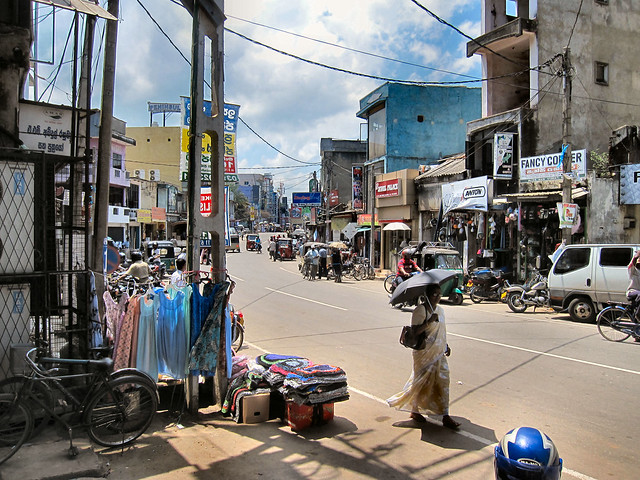
Sri Lanka is a teardrop-shaped island off the southern coast of India. It is home to more than 21 million people, despite consisting of only 25,332 square miles. Its largest city, Colombo, has a millennia-long history as a prominent trading port and is currently a popular tourist destination.
The Democratic Socialist Republic of Sri Lanka was previously a British colony called Ceylon and kept that name until 1972. It is governed by an elected president and unicameral parliament with a prime minister, as well as a judicial branch. The most popular languages are Sinhala, Tamil and English with several other indigenous dialects. The country is overwhelmingly Buddhist with significant Hindu and Muslim minorities and a small number of Christians (primarily Roman Catholic). Religion plays a significant role in the lives of Sri Lankans.
Sri Lankan Civil War
Similar to British rule in Rwanda, the British colonial government favored the Tamil people, an ethnic minority concentrated in the northern and eastern regions. The British gave the Tamil people a position in the colonial government and Sinhalese land. After Sri Lanka gained independence in 1948, the government deported many Tamil people and greatly reduced its power in favor of the Sinhalese majority. Ethnic tensions rose in the following years, exacerbated by differences in religion, income and development. This tension gave birth to the Liberation Tigers of Tamil Eelam or the Tamil Tigers which advocated for an independent Tamil state. In 1983, the Tamil Tigers attacked Sri Lanka government troops, starting a 26-year civil war.
It is estimated that 100,000 people died in the conflict, with atrocities and human rights abuses committed on both sides. The Tamil Tigers are notorious for its use of child soldiers and suicide bombers, forcibly recruiting Sri Lankan civilians or using them as human shields. Accusations have pointed to the Sri Lanka government shelling their own designated safe zones, food distribution lines and hospitals. People have also accused the government of mass rape and ethnic cleansing. Attempts to bring perpetrators to justice have been slow-moving.
A New Economy
Since the end of the war in 2009, Sri Lanka’s economy has grown by 5.8 percent every year. The economy is transitioning from a rural base to an urban manufacturing base, especially in the garment industry. This increasing wealth has expanded the middle class and reduced the poverty rate from 15.3 percent in 2006 to 4.1 percent in 2016. There have also been significant improvements in public health which have paved the way to some of the highest life expectancies in Asia; 72 for men and 78 for women. In less than a decade of peace, Sri Lanka became a development success story.
Political Unrest
Despite the unprecedented economic success, Sri Lanka is not immune to political extremism and unrest. In 2018, president Maithripala Sirisensa fired the prime minister, Ranil Wickremesinghe. The country installed Mahinda Rajapaksa, a former president accused of serious human rights abuses, in his place. Wickremesinghe refused to accept his replacement, effectively giving Sri Lanka two competing prime ministers for several months before being re-appointed. With such recent political unrest in Sri Lanka, it is unlikely that it will reach nonviolent political stability in the near future.
– Jackie Mead
Photo: Flickr
