3 Pathways To Rule of Law in Papua New Guinea
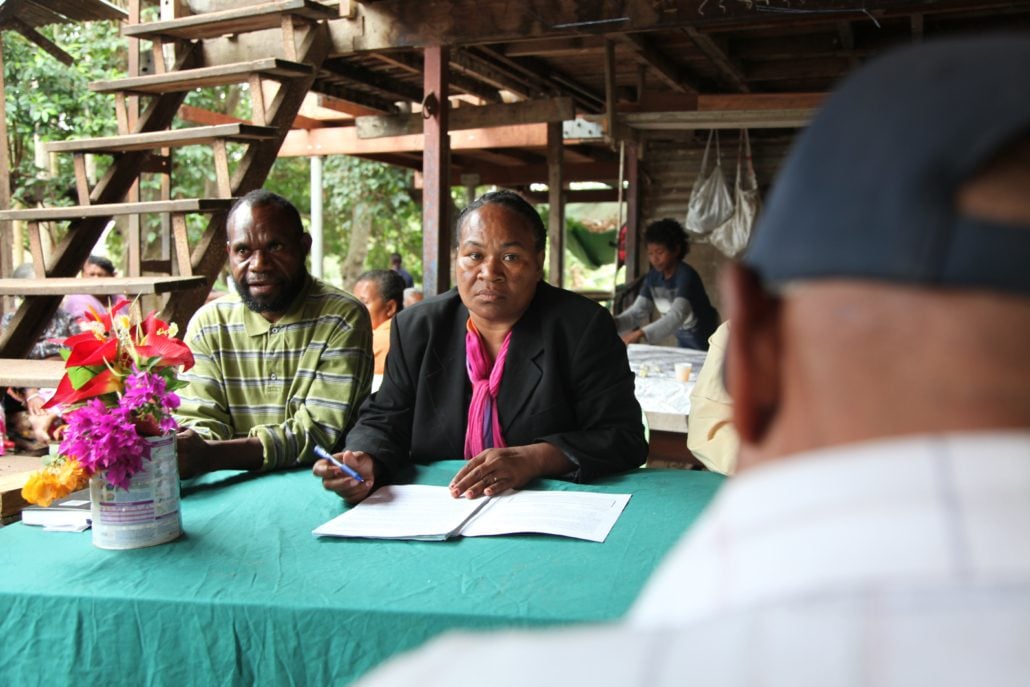 Issues regarding the rule of law in Papua New Guinea (PNG) are a matter of reach. The country has constitutional rights, courts, police and public institutions, yet many Papua New Guineans, particularly those in remote areas, cannot readily access them. Limiting factors like distance, cost, lack of legal knowledge and inconsistent government services make it difficult to navigate conflict within the law, often pushing communities to look outside formal systems. This fragility, however, does not mean that PNG lacks governance. It means that governance remains uneven across the country.
Compounding the challenge, economic shocks and natural disasters can intensify political instability – particularly for those living in poverty. The Asian Development Bank (ADB) identifies these pressures as interacting sources of fragility: they weaken government capacity to deliver services, reduce poverty and manage risks. Papua New Guinea faces some of the most complex and intersectional poverty in the world and when citizens cannot access reliable courts, health care or education, public institutions can lose legitimacy – the gap between constitutional promise and reality widens.
1. Rights Need Accessible Institutions
PNG’s Constitution protects civil and political rights, but basic procedural barriers make it difficult to enforce them. One constitutional review found that PNG frames socio-economic and cultural rights largely as guiding principles rather than rights, making it difficult to legislate enforceable protections. For people without access to legal services, rights to protection, education and health remain difficult to claim.
The formal justice system also cannot operate alone. Poverty in Papua New Guinea is not just about money; it’s about compounding factors. Most Papua New Guineans live outside urban centers, which means access to courts, police and other state services can become remote in every sense of the word. Rural communities also account for 88.5% of PNG’s population, 61.5% of whom experience multidimensional poverty. For the many citizens who are isolated from city centers, the village courts and customary systems become the first stop to keep the peace.
Village courts often provide the most accessible forum for dispute resolution. They sit closer to communities and can incorporate customary processes, though they still require safeguards for human rights and gender equality. Australian support has helped strengthen this local infrastructure. In 2026, PNG’s Village Courts and Land Mediation Secretariat report showed the total network to consist of 14,496 village courts, operated by more than 15,000 officials, 900 of whom are women. These courts strengthen state fragility and the rule of law in Papua New Guinea by providing fundamental access to state justice.
2. The Issue of Parliamentary Supremacy
The Papua New Guinea rule of law also depends on political institutions that constrain power. The 2011–12 constitutional crisis exposed the consequences when political leaders treat constitutional limits as negotiable. The crisis followed the removal of Prime Minister Sir Michael Somare and produced competing claims to executive authority. Research from the Australian National University characterized the fragility and the rule of law in Papua New Guinea issues during this period as a serious retreat from previous years. Fluid political loyalties and incentives prioritized parliamentary survival over institutional reform.
Fifteen years later, the Lowy Institute argues that PNG’s party law can exclude citizens from meaningful democratic participation. Political parties mostly lack deep membership structures, leaving voters with limited influence over candidate selection or party policy between elections. While more accountable political parties would not solve every justice problem, they could give citizens greater ability to demand service delivery and legal reform.
3. Power of the Local
PNG also has active solutions that address fragility at the community level. Femili PNG, a local organization that began operating in Lae in 2014, helps survivors of family and sexual violence access police, medical, welfare and justice services. Between July 2014 and June 2024, Femili PNG admitted 7,452 survivors as clients. Now, in 2024-25 alone, Femili PNG assisted 1,652 survivors and delivered more than 33,000 services. The organization works to connect survivors to services rather than expecting them to navigate a fragmented system alone.
Australia’s law and justice partnership aims to extend this work. Providing an estimated $500 million in bilateral assistance to PNG in 2026–27, Australia will allocate a total ODA of $680.5 million. Its development program supports security, policing and law and justice services, while the Australia–PNG Law and Justice Partnership aims to strengthen accessible justice at national and community levels. Funding to support state courts and police can help tackle fragility and the rule of law in Papua New Guinea, but assistance must also strengthen village courts, survivor services and trusted local mediators.
Pathways Forward
Most Papua New Guineans live in rural communities with higher levels of multidimensional poverty, which means formal legal institutions cannot alone secure the rule of law. The rule of law is not something a single piece of paper – it is the practice and tradition, reinforced with every new judgement and decision, that there is no person or power above the law. When most people in a country have challenges accessing justice, power rather than law becomes the stronger force. So, all of these local leaders, village courts, churches, rural communities and NGOs are not support structures: they are access points to justice.
– Matilda Beikoff Smart
Matilda is based in Brisbane, Australia and focuses on Good News and Politics for The Borgen Project.
Photo: Wikimedia Commons
