Zimbabwe’s Friendship Bench
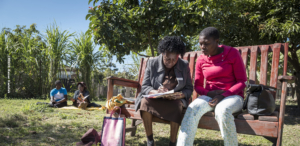 In Zimbabwe, an ongoing revolution is transforming mental health care, driven by an unlikely group: the country’s grandmothers. These women, with little formal training, sit on park benches, offering not just a shoulder to lean on but evidence-based counselling that’s changing lives. Currently, they are using digital tools to extend their reach beyond the benches, bringing support to even the most isolated communities.
Mental Health Landscape in Zimbabwe
Zimbabwe’s road to its current mental health crisis took shape from years of trauma, from colonial history to the long fight for independence. Over time, socio-economic challenges, including hyperinflation, rampant unemployment and a failing health system, have deepened the emotional toll. As of 2021, the country faces one of the highest suicide rates in the world (23.6 per 100,000), alongside widespread depression and post-traumatic stress. With just 18 psychiatrists serving a population of 17 million, mental health care in Zimbabwe has been inaccessible for most and barely recognized.
The Birth of the Friendship Bench
The Friendship Bench began with a simple idea. Dr. Dixon Chibanda, a psychiatrist working in Harare, realized that Zimbabwe’s mental health crisis needed something different from more doctors. So, he turned to a deeply rooted tradition in Zimbabwean culture: the matriarchs of the community.
In 2006, psychiatrist Dr. Dixon Chibanda partnered with local health authorities to train a group of elderly women, many of whom had no formal education in mental health, in a simple yet effective form of therapy called Problem-Solving Therapy (PST). These women, affectionately known as the “grandmothers,” were among the few people with the time and willingness to serve as lay health workers, especially given the country’s severe shortage of mental health professionals. By shifting the model to rely on available, community-rooted personnel, something positive began to take shape.
Sitting on brightly painted benches outside local clinics, these grandmothers became trusted figures in their neighborhoods. They offered more than advice, they listened. Through open, empathetic conversations rooted in cultural familiarity, they used behavioral therapy techniques to address kufungisisa—a Shona term that translates loosely to “thinking too much” and often describes depression or deep emotional distress. Their approach was grounded in traditional values like kusimudzira (to uplift), kuvhurika pfungwa (opening up the mind) and kusimbisa (to strengthen). These weren’t just abstract ideas; they were culturally resonant tools for healing.
Clinical trials showed that after just a few sessions on the bench, 98% of people who had previously considered suicide were no longer suicidal six months later. People who arrived feeling hopeless left with a sense of dignity, strength and direction.
Taking a Digital Leap
The pandemic could have halted the progress of the Friendship Bench, but instead, it propelled it into a new era. With Zimbabwe’s already impressive mobile phone penetration (90% of the country has access), the grandmothers began reaching out through WhatsApp and voice calls, extending their therapy services to people who could not make it to a physical bench.
The shift kept the spirit of Zimbabwe’s Friendship Bench intact. This digital pivot meant that counselling could reach those in remote villages, women unable to leave their homes and even young people navigating mental health challenges in crowded urban centers. Unexpectedly, it also helped improve communication between the grandmothers and their supervisors, strengthening the support system behind the scenes. What started as a grassroots intervention under a tree had quietly evolved into a scalable, hybrid model.
A Model for Accessible Global Mental Health
As of 2025, more than 2,000 grandmothers in Zimbabwe are delivering therapy to at least 500,000 people across the 11 provinces. But the model has not stopped at the country’s borders. It is currently in more than nine countries, including Kenya, Malawi and even the United States (U.S.), with each country tailoring the approach to its own cultural and social contexts. Yet wherever it goes, the core stays the same: community-led care, empathy, accessibility and the belief that healing can begin with a simple conversation.
Scaling Zimbabwe’s Friendship Bench
According to experts, scaling the Friendship Bench model further will depend on strong collaboration between Zimbabwe’s government, local health authorities and international partners. Sustaining the program’s momentum could mean finding smart ways to integrate it into existing public health and technology infrastructures.
The mobile phone industry, for example, offers real potential, not just for reaching clients, but for training grandmothers, supervising their work, collecting data and enabling real-time support through virtual platforms. By continuing to build on what’s already available, the Friendship Bench could go even further, reaching more people, in more places, with the same message: healing doesn’t have to be out of reach. By adapting an age-old tradition of community care to the digital age, Zimbabwe has created a model for mental health that could potentially be replicated globally.
– Sriya Regulapati
Sriya is based in Vancouver, Canada and focuses on Business and Global Health for The Borgen Project.
Photo: Friendship Bench
