Top 10 Facts About Girls’ Education in Indonesia
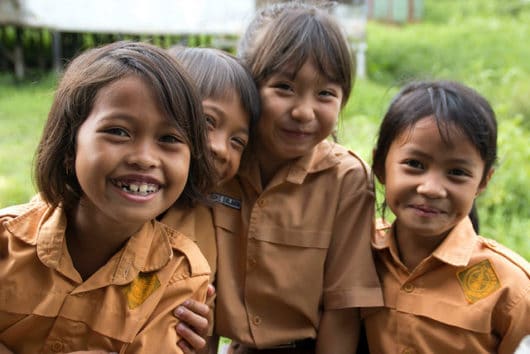
Education in Indonesia has reached gender parity, with no significant gender gap in enrollment percentages. However, the schools there continue to reinforce gender stereotypes through their teachings. The top 10 facts about girls’ education in Indonesia explore issues within the gender-biased curriculum as well as the changes being made to combat them.
Top 10 Facts About Girls’ Education in Indonesia
- In Indonesia, students’ enrollment in school seems no longer influenced by gender. According to UNICEF, 92.8 percent of girls and 92.7 percent of boys are enrolled in primary school. Also, 62.4 percent of girls and 60.9 percent of boys are enrolled in secondary school. Therefore, gender parity is a notable accomplishment among the top 10 facts about girls’ education in Indonesia.
- However, schools in Indonesia tend to have gender-biased textbooks. In these textbooks, men are cited more often than women and there are more illustrations of boys than girls. Within the illustrations, boys are shown in more diverse roles while girls are shown in more stereotypically feminine roles.
- Gender stereotyping is also projected in the way students are conditioned to choose their subjects of interest. Women in Indonesia prefer subjects like Social Sciences while men prefer subjects like Technical Sciences. While women are discouraged to choose subjects such as Math or Biology, men are discouraged to choose subjects such as Humanities as they are considered feminine in nature.
- In Indonesia, girls are more likely than boys to drop out of school. According to UNICEF, for every 10 children that drop out of school at the secondary level, seven are girls. One of the primary reasons for this is early marriage and the stereotypical mindset of society.
- Close to 84 percent of men in Indonesia are in the labor force, while only around 51 percent of women occupy the same position. Also, most of the top government and private positions are held by men. As a result, there is a huge difference in pay between men and women in Indonesia. While the gross national per capita income for men stands at 13.391, for women it is as low as 6.668.
- On the brighter side, the PAUD KM 0 ‘Mekar Asih’ is an early education model that seeks to educate students equally without any gender discrimination. They provide a gender-neutral curriculum where children can see themselves in any role irrespective of their sex.
- Centers like PAUD ensure that both mother and father be equally involved in their child’s academic development. It is one of the ways in which they try to convey the idea of equality between the sexes to the children. For instance, the centers invite fathers to come in for storytelling in order to shatter the stereotypical image of women as caregivers.
- The PAUD KM 0 early education model has been adopted in over 300 districts and 34 provinces. The program also engages women and mothers by forming groups at various locations. They provide them with training by organizing workshops and through campaigning.
- According to Kurniati Restuningsih, Head of the Sub-Directorate of Curriculum, “The Ministry of Education and Culture promotes gender mainstreaming at an early age as a way to improve equality and diversity and eliminate gender discrimination which unfortunately still occurs in many communities.” The program seeks to empower girls at a young age to stay in education and pursue careers they would otherwise be stopped from pursuing.
- The Ministry of Education and Culture also conducts a Mothers of Early Childhood Education program called ‘Bunda PAUD’. The specialty of this program is that it is fully run by women, from First Lady, Irina Jokowi, to wives of governors, mayors, and regents. This is to provide girls with a strong female role model in a significant leadership position.
These top 10 facts about girls’ education in Indonesia highlight the issues with the gender-biased curriculum in Indonesia and also emphasizes the various efforts put forth by the Ministry of Education and Culture in order to close the gender gap.
– Anna Power
Photo: Flickr
