Ten Facts About World War II
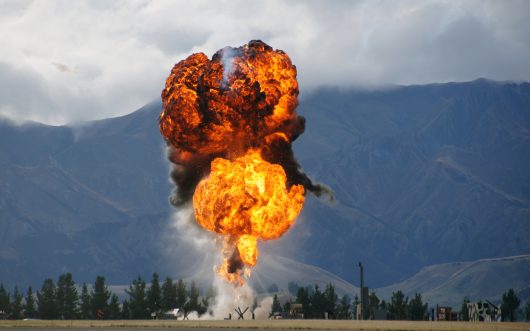
World War II was an expansive war fought between the Axis powers (Germany, Italy and Japan) and the Allied power (Great Britain, Russia and the U.S.) that lasted from 1939 until 1945. With such a complex narrative, here are only 10 facts about World War II.
- World War II was not only fought in Europe.
In the North African Military Campaigns between 1940 and 1943, the Axis powers attempted to cut off Middle Eastern oil supply to the Allies. These campaigns took place in Western Egypt, Eastern Libya, Algeria, Morocco and Tunisia. Ultimately, the Axis powers did not achieve their goal and the Allied powers neutralized the German threat. World War II was also fought in the Pacific. On December 4th, 1941, Japan attacked Pearl Harbor damaging the American Pacific fleet. Japan went on to conquer the Philippines, the Dutch East Indies, Hong Kong, Malaya, Singapore and Burma. However, after 1943, American forces slowly removed the Japanese from power in the pacific front. Full Japanese surrender came after the U.S. dropped the atomic bombs, Hiroshima and Nagasaki in 1945. - In total WWII claimed the lives of approximately 60 million people.
- The Holocaust claimed the lives of six million Jews.
- World War II was a continuation of World War I.
At the end of WWI, the Treaty of Versailles was signed. The treaty placed most of the blame on Germany, requiring them to pay large amounts of reparations and forcing the country to disarm. This greatly angered and humiliated the German people. Hitler used the German discontent to run as German Chancellor in the 1930s in which he promised to restore Germany. - The immediate cause of WWII was the German invasion of Poland.
Although facts about World War II show a multitude of causes for the war, the invasion of Poland was a crucial event. On September 1, 1939, Germany invaded and within weeks successfully conquered Warsaw. Germany annexed West Prussia, Poznan, Upper Silesia, and the former Free City of Danzig. As a response to the invasion, Britain and France declared war on Germany. - The U.S was involved in WWII before the Pearl Harbor attack.
At the start of WWII, President Franklin D. Roosevelt declared the U.S. would practice neutrality. However, on March 11, 1941, the Lend-Lease Act passed which allowed the U.S. to provide military aid to allied nations during WWII. - Stalingrad was a major turning point in the war.
On July 9, 1942, Hitler ordered the capture of the Soviet Union city of Stalingrad. As a response, Stalin deployed the armed forces to defend Stalingrad and prohibited the civilians from leaving the city. Multiple counter-offensive attacks lead to Soviet victory. - The Japanese used Kamikazes aircrafts.
Kamikazes aircrafts were manned by Japanese soldiers who were instructed to crash into Allied ships. In total, kamikazes destroyed more than 300 U.S. ships which resulted in 15,000 casualties. - Germany surrendered in May of 1945, while Japan did not surrender until September.
- The Marshall Plan gave aid to Europe to rebuild after World War II.
The Marshall Plan gave $12 billion to Western European countries in economic turmoil caused by WWII.
World War II is still a popular topic today because it was one of the most violent and complex wars in history. These 10 facts about World War II only give a very brief overview.
– Karla Umanzor
Photo: Flickr
