Ukraine Bounces Back After Revolution of Dignity
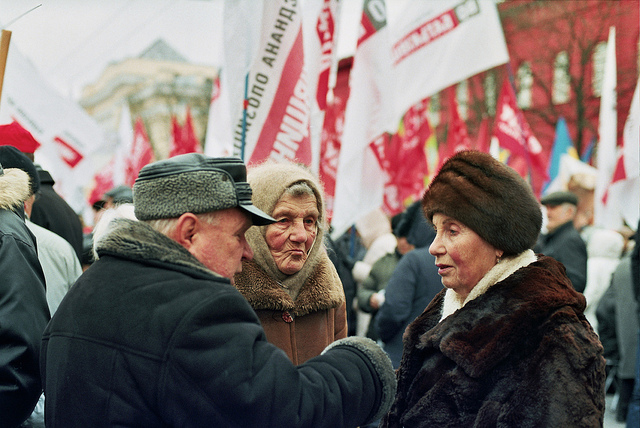 In November 2013, student protests in Ukraine turned into a full-fledged revolution against government corruption that has since been dubbed the Revolution of Dignity. Now, with a new government in place, the country is attempting to align itself with its European neighbors and become a stable democracy. With multiple roadblocks in the way, such as the annexation of Crimea by Russia, Ukraine will need to rely on its allies in order to achieve its goals.
How the Revolution of Dignity Began
Ukraine’s Revolution of Dignity started out as a series of student protests to pressure the prime minister to sign an association agreement with the European Union. However, as the protests raged on, they became a catalyst for the rest of the country to express its discontent with larger issues with the government like the regime’s power grabs and rampant corruption.
Despite these issues, protests only became a revolution when violence broke out between the government and protesters on Nov. 29, 2013. After this point, the goal became to overthrow the government and establish a more democratic state, one free of corruption and acting in the people’s best interests. In 2014, the people in overthrowing the government, reinstating the previous constitution and holding new elections in May.
While the revolution was successful, it was not without consequence. The destabilization in the country helped lead to the annexation of the southeastern Crimea region by the Russian Federation. On top of that, while the previous regime was friendly to the Russian government, the new one looked for a more independent governance supported by the E.U. and other western allies. With tough challenges ahead, Ukraine needed to look to allies for help.
What Allies Are Doing to Help
Since the protests initially started to pressure the Ukrainian president to sign an agreement with the E.U., it comes as no surprise that the E.U. is a key ally in helping Ukraine handle its political turmoil. One of the first things the newly elected government did was pass the Ukraine-European Union Associated Agreement and join the Deep and Comprehensive Free Trade Area. These moves strengthen the nation’s economic, political and cultural ties with Europe through mutually beneficial relationships.
While the U.S. is not as geographically close to Ukraine as the E.U., it has a vested interest in keeping the region stable and independent. Currently, over $204 million is planned in foreign aid for Ukraine. Among this, 33 percent is for peace and security, 32 percent goes toward human rights, democracy and governance, 29 percent is for economic development, and six percent goes toward health. With this aid, the U.S. hopes to keep Ukraine free of Russian influence and welcome them into the western world.
Through USAID, foreign aid is being used to help out local communities of Ukrainians. In 2017, the organization helped 50 communities effectively manage resources and become sustainable without the central government. This not only fights corruption but also helps improve the everyday lives of Ukrainians who face instability in the face of recent changes.
Continuing Progress in Ukraine
The aftermath of the Revolution of Dignity and the struggle with Russia has left many Ukrainians in a state of upheaval. With an uncertain future and violence a real possibility, it is key that allies help the country through this traumatic point in its history. The humanitarian impact of political uncertainty is often understated in the media, but it is real. While there are larger political reasons for Ukraine’s allies to help it, the aid these allies give to the Ukrainian people has an impact on the ground that can help save many lives.
– Jonathon Ayers
Photo: Flickr
