Key Facts About Poverty in Indonesia
The sovereign archipelago of Indonesia is on track to rapid urbanization; in fact, it is the largest country in Southeast Asia, the world’s third most populous democracy and is ranked 16th in GDP. Indonesia also happens to possess the sixth worst inequality of wealth in the world. The nation’s boom in economic viability has been beneficial for some, but Indonesia still persists as a developing country marked by profound wage disparity. The following facts about poverty in Indonesia offer insight on the various forces surrounding the country’s income inequality.
Top 10 Facts About Poverty in Indonesia
- The statistics. Indonesia has a population of 261 million; of those, 28 million citizens live below the poverty line, with approximately 10 percent of the population making significantly less than the median income.
- Hope in relativity. These statistics may seem indomitable, but poverty in Indonesia has been cut by more than half since 1999. The country has proactively worked on addressing relative poverty — those that generate less than the median income — with the brunt now lying in absolute poverty (those that live below the poverty line). The alleviation of Indonesia’s poorest is more challenging, as they are frequently moored to rural environments that lack proper support.
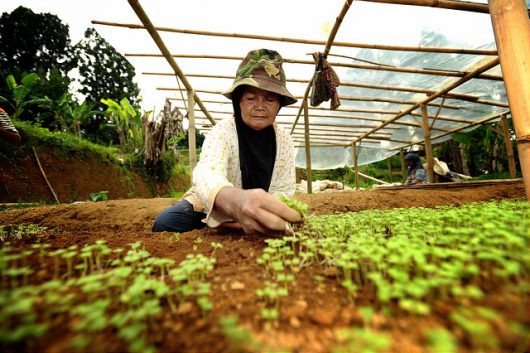
- Rural poverty. Indonesia’s rural communities are typically much poorer than the urban ones, with poverty rates ranging from 13.2 percent to a startling 29.15 percent. Rural poverty focuses on just subsistence, but even this becomes difficult without infrastructure. The people living in these isolated villages often lack access to healthcare, markets and agricultural extension services, and are not equipped with the vocational training needed to succeed in urban communities.
- Urban poverty. Poverty reduction efforts can be seen most in urban hubs. In the last year alone, the urban poverty rate improved from 7.72 percent to 7.02 percent. Unequal dispersion of wealth remains starkly apparent in the cities, but momentum continues today with World Bank’s National Slum Upgrading Program (KOTAKU) bettering the lives of more than 9.7 million of Indonesia’s urban poor. KOTAKU accomplishes such a feat by actively improving city infrastructure.
- Health access. Nonpartisan groups are currently working to provide mobile clinics and health training to the areas that need it the most. Comprehensive access to healthcare is hopefully on the horizon, as Indonesia launched an ambitious single-payer healthcare program in 2014. The program intends to offer coverage to every Indonesian by 2019.
- Lack of education reinforces the poverty cycle. Education in Indonesia has steadily increased in accessibility, but rural districts are typically limited to one public primary school with a rare secondary school. Net enrollment in such areas remains below 60 percent; moreover, the quality of education offered often suffers from politicisation and unqualified teachers, allowing little opportunity for meritocratic mobility.
- Children in poverty. Children comprise about 30 percent of Indonesia’s population. As dependents, they are one of the most vulnerable demographics in society. Indonesia has made strides in protecting their basic rights and needs, including cutting the child mortality rate in half and implementing child-focused resources, such as the Family Hope Program.
- Food instability. Protectionist food policies leave the country’s poor vulnerable to domestic price hikes. Due to food import quota, licensing and tariff activity, up to 70 percent of an Indonesian household’s income ends up being spent on food alone. In times of duress, such as escalated rice prices in 2015, the poor risk malnutrition while those marginally above the poverty line end up falling below it.
- Gender inequality. Women in Indonesia are statistically rated with a lower life expectancy, education and per capita income than Indonesian men. Despite this, women-led enterprises not only contribute 10 percent of Indonesia’s GDP, but they also reduce the volatility of local economic downturns. Gender equity and poverty reduction are critically linked.
- Solutions. President Joko Widodo continues to address poverty in Indonesia by channeling welfare aid to targeted households. Affordable Food for the Poor, launched in 2015 by CIPS, focuses on the long-term by publicising policy recommendations on food security. With the development of sustainable infrastructure, better access to a competitive education system and steps towards gender equity, regional and entrepreneurial gaps will fill and bring forth a more prosperous people.
Potential for Growth
These top 10 facts about poverty in Indonesia provide a salient foothold into the country’s current state. Indonesia is projected for great growth and under the right dispersion of assets, national poverty reduction efforts can continue to succeed.
– Yumi Wilson
Photo: Flickr
