Kenya’s Geothermal Energy Revolution
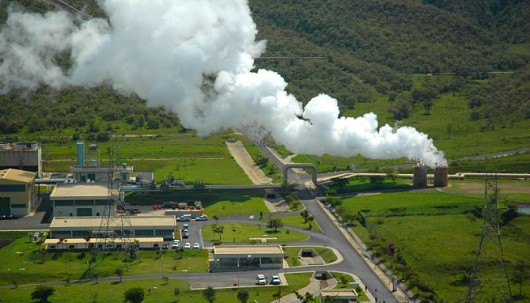
Once the cradle of humanity several millennia ago, Africa’s rift valley is again about to give birth to something new. Nestled amongst the cliff walls that formerly contained a prehistoric lake, a seemingly primordial vapor rises, pungent with the smell of sulphur.
This is Kenya’s Hell’s Gate National Park, the doors to which open to a much needed energy oasis for this developing African country. As famous for its Maasai heritage as it is for its abundant thermal springs, Hell’s Gate has recently become a hotspot for sustainable geothermal energy development in east Africa.
The burgeoning Olkaria geothermal plant located within the park has spearheaded this effort to tap Kenya’s ideal thermal resources. With assistance from the World Bank, the power plant has dug into the earth to provide carbon-free power to Kenyans. Annually, the plant drills more than 40 wells, each of which can provide 18 megawatts per year in clean energy. The plant hopes to reach 580 megawatts in the coming years.
Energy efforts such as these could not have come at a better time for Kenya. Currently only 16 percent of the population has access to electricity. For those who do, the rationing of power has become a regular nuisance, as electricity is both undependable and inefficient.
Fortunately, Kenya has the geothermal potential to turn its energy crisis around. A report by the Geothermal Energy Association noted Kenya as “one of the fasted growing geothermal markets in the world.”
It predicted that “Kenya will lead the world with substantial additions to their geothermal infrastructure over the next decade and become a center of geothermal technology on the African continent.”
In total, the east African Rift Valley has the capacity to power 150 million homes, a World Bank report estimated. Geoffrey Muchemi, the geothermal development manager for the Kenya Electricity Generating Company claimed that, ideally, in 10 years’ time Kenya could rival the entire US energy capacity at around 3,000 megawatts.
For Kenya, geothermal represents a more reliable and sustainable energy option in comparison to other popular sources. Hydro-electric power, once a staple of the Kenyan power grid, has begun to dry up. Due to often unpredictable rainy seasons, it frequently fails to provide enough energy and runs 42 percent below capacity. Another main power source, Diesel, runs at only 60 percent of its capability and needs constant maintenance.

In comparison, geothermal runs almost always at 100 percent. While geothermal represents only 13 percent of Kenya’s energy capacity, it contributes nearly a quarter of the grid’s power. It is already carrying more than its fair share of Kenya’s energy needs.
However, geothermal has its faults. Unlike other power options, it requires highly skilled technicians. In a developing country such as Kenya, geothermal training programs are hard to come by.
Fortunately, the UN identified this problem decades ago and established the first Geothermal Training Programme in Iceland in 1979. Every year, Kenya’s Electricity Generating Company sends eight employees for training.
Despite its complexity, geothermal power has the potential to change millions of lives in Kenya. After the creation of the power plant, people could work longer hours allowing business owners like Elizabeth Kyalo, the owner of a hair salon, to send her children to school. With electric streetlights, residents fear less about nighttime muggings and experience a greater sense of security. From the sulfurous springs of Hell’s Gate national park, safety and success are just beginning to rise.
– Andrew Logan
Sources: The World Bank 1, The World Bank 2, Geothermal Energy Association, The Guardian
Photo: Power Engineering International
