How to Help People in Iraq from the US
 While the people of Iraq certainly underwent extreme oppression under the former totalitarian leader Saddam Hussein, the United States’ stated mission to spread democracy by overthrowing Hussein and invading the country in 2003 has not proven to be a success by many standards.
While it has indisputably achieved important strategic military objectives, former President George W. Bush’s decision to do this has also cost U.S. taxpayers over $2 trillion thus far, resulted in approximately half a million civilian and combat casualties, devastated the quality of life for millions of Iraqi citizens and unfortunately, it does not appear to be a conflict that will be ending anytime soon.
Perhaps the two most damaging results of this conflict for Iraqi society have been the decline of education and widespread health problems and mental illness, both of which are byproducts of the violence taking place across the nation.
Fortunately, organizations and individuals across the globe have recognized these problems and have become actively involved determining how to help people in Iraq. Listed below are these two problems, the methods in which certain humanitarian organizations are seeking to combat them and also ways in which the average citizen can help to be a part of the solution.
Education
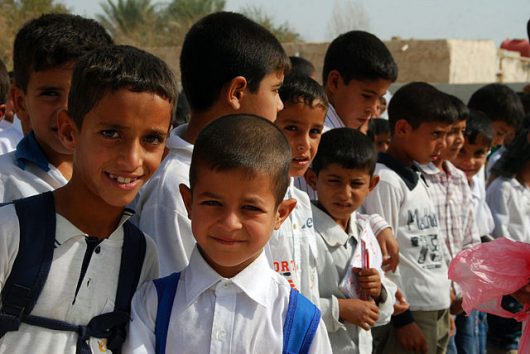
Education is necessary for the stability of any society, and, generally speaking, provides children with a safe and healthy socialization process, which is why it is important to consider the fact that roughly 3.5 million children in Iraq attend school infrequently, if at all.
From 2011 to 2013, the British Council and members of the European Union supported a project called the Support to Improving the Quality of Education in Iraq program, which was intended to improve educational conditions in Iraq. The project cost approximately $10 million and implemented programs designed to provide resources, improve teaching skills and develop high-quality curriculums. Overall, the project was a success, allowing 800,000 students of all ages in southern and central Iraq access to a quality education.
Another organization that fights for the improvement of education in Iraq, among other things, is the International Rescue Committee (IRC). Similarly to the British Council’s approach, the IRC is concerned with finding a long-term solution when trying to solve the problem of how to help people in Iraq get an education. They seek to do so by providing well-trained teachers, safe learning environments and reducing the problem of overcrowded schools. You can donate to their cause here.
Perhaps the largest organization that is making the largest strides for the improvement of Iraqi education is UNICEF. In 2016 alone, the organization helped to allow 682,000 children access to an education and provided over 520,000 children with school supplies such as backpacks and stationery. They have also created new ways of how to help people in Iraq by providing cash to families who are particularly vulnerable, offering summer classes to students who have fallen behind and even operating mobile schools in various parts of the nation. You can donate to their efforts here.
Healthcare
In a country where there an estimated 11 million people are speculated to need some form of humanitarian aid, there is no organization more noticeably devoted to providing adequate healthcare to Iraqi citizens in need than Doctors Without Borders (DWB). The organization currently has ongoing projects in almost the entire country with the exception of the southeastern region and works in five major cities or villages including Baghdad, the nation’s capital.
With many medical facilities and resources destroyed, medical care in Iraq is expensive and hard to come by. Millions of citizens have been displaced from their homes and others find themselves miles away from the nearest medical facility. While their mission is not over, DWB has effectively countered this negativity with tremendous success, providing healthcare and first aid to millions of people across the country, putting their own lives on the line to do so.
Currently, their main agenda is providing aid to those affected by the ongoing crisis in Mosul, the country’s second largest city. On the western side of the city, an estimated 60,000 civilians are trapped by the ongoing fighting, which has consistently produced large numbers of civilian casualties and severe displacement. To help solve this problem of displacement, DWB has created displacement camps in different areas of the country, camps who have seen dramatic influxes of people in the recent months.
In June 2017, DWB opened a project in western Mosul and reported a high number of patients needing life-saving treatments. In their June 2017 update, Jonathan Henry, the Emergency Coordinator for the DWB project in west Mosul, stated that “this influx of wounded patients is yet another example of the horrific suffering and indiscriminate violence suffered by civilians, including women and children, throughout the battle for Mosul.” You can donate to DWB here.
Above all, as an American, when asking the question of how to help people in Iraq, the quickest, easiest and best thing you can do is reach out to your congressional leaders and express to them a desire to increase the U.S. foreign aid budget. In doing so, you help to ensure that the wealthiest nation in the world will do more than it currently is to bring these atrocities to an end and allow the country and its neighboring regions to one day see an era of development and prosperity.
– Hunter Mcferrin
Photo: Google
