The Untapped Potential of Female Labor in Pakistan
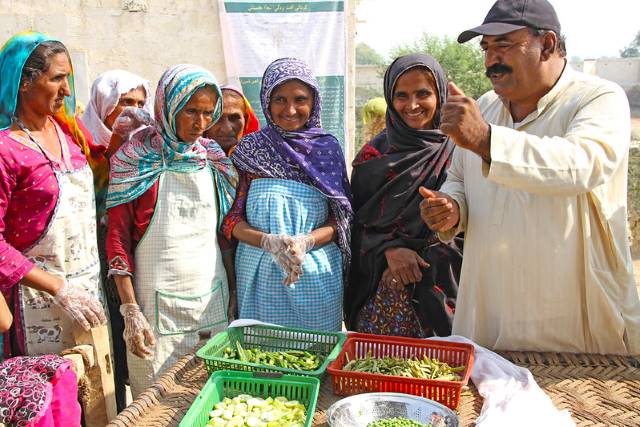 The Karachi branch of Caritas Pakistan works to provide technical assistance and job training to the women of small Pakistani farms in several villages as part of its Acre for Women campaign. The campaign’s goal is to leverage the untapped potential of female labor in Pakistan. Providing training and opportunities to women will expand food security among the country’s vast population of subsistence farmers by encouraging self-sufficient practices with the resources on hand, ranging from basic water efficiency to crop rotation.
A Nascent Workforce
Amir Robin, an Acre for Women regional coordinator, explained both the long- and short-term benefits of training the women of several independent farms that range as small as a single acre. In an interview with UCA News, he states that aside from increasing food security, such training helps household farms minimize the cost of adapting to changing environmental conditions.
Female participation in the Pakistani labor force runs as low as 25%, according to World Bank estimates. The government aims to increase the amount to 45% by 2025. Accelerating Pakistan’s economic growth by boosting female labor involves eliminating the reasons for female labor’s systemic underuse.
Educational Disparities
First, women face limited access to formal education or vocational training. Girls make up about 53% of children that do not attend school in Pakistan, therefore, girls benefit the most from development programs. Such programs include those sponsored by the Engro Foundation, the “social investment arm” of Engro Corporation, a conglomerate company headquartered in Karachi, Pakistan. By sponsoring new government schools and refurbishing old ones with computer labs, Engro aims to increase the literacy rate among girls.
In light of COVID-19’s effect on unemployment rates, expanding educational opportunities remains the primary short-term focus of increasing female participation in the labor force. Engro’s programs are demonstrating fast results. More than 19,000 self-employed women are improving their livelihoods through vocational training in “animal husbandry practices, entrepreneurship in milk collection and livestock extension services in the dairy value chain.” Additionally, a surge of technologically literate women helps overcome difficulties in the job market due to greater access to advanced occupations.
Farm Income Depends on Women
Pakistan’s largest source of potential growth lies in its agricultural sector. Around 64% of Pakistanis live in rural areas and mostly work in agriculture. A large portion of the national economy depends on the output of family farms. There are two significant reasons why discounting women as a source of skilled labor in farm management is becoming an increasingly untenable prospect.
- Subsisting on relatively small parcels of land leaves farmers vulnerable to fluctuations in output. Because population growth and regular divisions of hereditary ownership make land parcels ever smaller, families that make do with smaller farms do not have the luxury of maintaining inefficient practices when handling their crops or their labor pool. A report by Victoria University says Pakistan’s high concentration of household farms means greater efficiency can be achieved, in this case, by including female labor. This translates into direct income boosts for families along with greater business activity thanks to new surpluses.
- Running a successful farm with little land is already dependent on women. Despite lacking gainful employment, women are informal participants in the Pakistani economy through unpaid domestic work. Victoria University’s study correlates a lack of job training and reduced output from inefficient practices, meaning that a lack of trained women is a bottleneck stifling household income growth.
Individual Growth for Women
Households stand to benefit from elevating women in the agricultural labor pool. Furthermore, developing female labor in Pakistan by addressing women’s exclusion in skilled practice will reverse the economic misfortune that prior restrictions have inflicted on women.
Because most women tie their fortunes as self-employed laborers to those of their families, increasing farm income is an effective way to enrich farming women’s income. Growth for Rural Enhancement and Sustainable Progress (GRASP) is yet another initiative operating in Pakistan working to achieve this goal. Its primary objective, according to coverage by Intracen (International Trade Centre), is training women to care for livestock and teaching them how to trade their produce. Rather than simply teaching women how to produce more, job training affords them additional autonomy by empowering them to take on a managerial role in the distribution process.
Economic Empowerment for Women
Sharmeela Rassool, a Pakistani country representative to the United Nations, emphasizes the importance of individual autonomy when it comes to increasing the participation rate of female labor in Pakistan. “For many women, entrepreneurship offers a path to economic empowerment,” she wrote in the Pakistani newspaper Dawn. More and more women are using their educational attainment to run businesses outside the agricultural sector.
While COVID-19 has slowed economic growth across Pakistan, it has also exposed systemic inequality, raising an opportunity to put women in a starring role for economic recovery. The gradually decreasing gender wage gap indicates that the current trend of a diversifying workforce has yet to reach its ceiling. Overall, women’s inclusivity in Pakistan has the potential to create widespread benefits for Pakistan, helping the nation to rise out of poverty.
– Samuel Katz
Photo: Flickr
