Between Borders: The Calais Refugee Camps
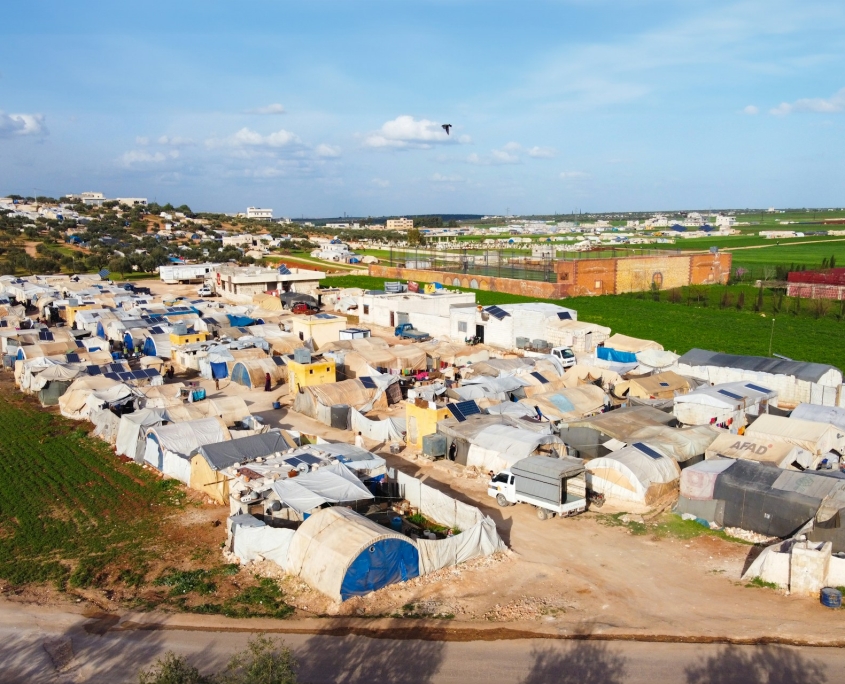 The French refugee crisis erupted over a decade ago. However, the reality is that France, and Calais especially, is still receiving hundreds of refugee arrivals, and these asylum seekers are still in need of help. There have been people living in or around the outskirts of Calais since the 1990s, the number of whom caused the Red Cross to open the first official welcome center in a neighboring town in 1999. Despite its closure after three years, informal settlements never went away.
These makeshift Calais refugee camps became known as the Jungle, which was formed by hundreds of discarded tents and shelters to accommodate displaced victims of conflict and poverty. This too was evacuated by the French authorities in 2009. When the refugee crisis intensified in 2015, another Jungle emerged, and by the end of the year, there were approximately 4,500 refugees living in Calais. Currently, this figure stands at an estimated 1o,000. The situation is improving, but the work is not yet done.
A Short History of the Jungle
The Calais refugee camps have a turbulent history, being flooded with arrivals, then being bulldozed and evacuated, before re-emerging. Starting as a government-controlled space, nongovernmental organizations (NGOs) and charities became increasingly involved, such as Refugee Rights. The NGO Help Refugees conducted a census in February 2016, which found that the Calais refugee camps were home to 5,497 residents, including 651 children, more than 400 of whom were unaccompanied. By November of the same year, violence had broken out within the camps as refugees began to be evicted.
In October 2018, two years after the demolition of the Jungle, Refugee Rights returned to Calais to examine the condition and status quo of the refugees, finding that mental health had declined and the atmosphere was one of exhaustion, despite the sustained efforts of volunteers.
There have been studies and reports, such as a 2018 Cambridge Review of International Affairs study, investigating the balance of governmental and charity-based involvement in handling the ongoing refugee crisis. Such reports ask whether the government should be doing more, such as taking on sole responsibility for search and rescue (SAR) operations. Data and field research from organizations like Refugee Rights demonstrate that something needs to change.
An Inside Perspective
This cycle has replayed multiple times over the last 10 years in the camps of Calais. To better understand how this repetition can be ended and the status quo for refugees can be altered, The Borgen Project interviewed an individual who worked at the Calais refugee camps from 2023 to 2024.
The Borgen Project’s source, who wishes to remain anonymous for professional reasons, worked both in the Calais refugee camps and in the U.K. with an involved charity. For the purposes of anonymity, this individual is referred to as W.
W described the atmosphere of the camps: “The sense of desperation is palpable and grew with the increasing hostility of the political environment even in the short time I spent there. During my stay in the winter, the weather conditions were brutal, promising frostbite, trench foot and many sleepless nights in the freezing cold.” W added that during the time spent volunteering in Calais, five people lost their lives at the border.
However, W continued: “In stark contrast to all the misery in Calais is so much hope and here, hope is more than just a feeling, it is a survival skill. I was struck repeatedly by the resilience and positivity of the communities I met and even on the worst days, there were beautiful moments. A South Sudanese dance party. An Arabic lesson in exchange for an English one. The offer of breakfast around a camping stove.”
There is often a focus on the desperation of refugee situations, but less so on hope and joy. Having an insight into the glimpses of community and happiness is not a reduction of the struggle of displacement, but evidence of the effect charitable aid can have on people’s lives, be that food, shelter, legal advice or companionship. This is exactly the work Red Cross provides to the Calais camps, with a project that functions across three main services: supporting unaccompanied children, providing health care and reuniting families.
The Language of Asylum
Language has become a weighted topic in today’s climate, with extensive debates over connotations, etymology and underlying meanings. The language surrounding refugees and the Calais refugee camps has been scrutinized over time. When asked about the term “Jungle,” W stated: “The term ‘Jungle’ was used by its inhabitants, voluntary workers and media alike, but during my time there, very few people used the term.” W added: “Although we now refer to them as ‘camps,’ there are no official camps in Calais or Dunkirk, only unauthorized, illegal settlements.”
As recently as 2020, videos and photos have been released of capsized boats carrying refugees to Europe’s shores, prompting dismissive responses from some audiences. Despite language becoming more carefully considered in public discourse, there is still a pervasive sense of indignation toward refugees seeking shelter and protection from conflict in their home countries.
Female Refugees in Calais
In 2019, the number of displaced people worldwide was estimated at 79.5 million, and in the same year, the number of refugees in the EU was 6,570,500. Almost 50% of them were women. Rates of underage or forced marriage and sex trafficking rise in times of conflict and poverty, making women one of the most vulnerable demographics. This is supported by U.N. Security Council Resolution 1325, which recognizes that girls and women are disproportionately affected by armed conflicts. According to U.N. data, at least one in five female refugees or displaced women has experienced sexual violence. A World Health Organization (WHO) report acknowledges the same, but does not account for undocumented immigrants, thus underestimating the magnitude of the issue.
When asked about women’s experience, W answered: “There are relatively few female refugees in Calais. The vast majority were men and many were unaccompanied minors aged 13-17, often risking their lives on the dangerous journeys in hopes of providing their families with a safer route. For example, Libya is one of the most dangerous countries in the world for sex trafficking, so for refugees coming to Europe from countries like Sudan and Eritrea, it is rare for men to bring their wives and children with them. Nonetheless, there is a small presence of women and children.”
The gender imbalance in Calais demonstrates the persistent demand for more representation and female-directed aid in these situations.
A Look Toward the Future
The Calais refugee camps are not a thing of the past, and though media representation may have dwindled, charitable aid persists. Care4Calais works both in the camps and in the U.K. to offer field support and organize food, clothing and supply packages to refugees, visiting sites twice a week to deliver direct aid, charge phones and bring hot tea, food and firewood, as well as engaging in social activities with them.
According to W, companionship plays an important role in supporting the refugees in Calais. W shared that communication often happened without words due to language barriers: “One day, I played Connect 4 with a Sudanese man for hours. We didn’t exchange more than a handful of words, but it was nonetheless a mutually meaningful experience.”
Another NGO, Safe Passage, has been present in Calais since 2016, providing legal aid to help ensure stable futures for refugees. Since its establishment, Safe Passage has protected 3,500 children and reconnected them with their families, granted 260 visas, overturned five anti-refugee policies and trained more than 260 individuals to continue legal advising for future refugees.
With the dedication and support of NGOs in collaboration with governments, places like the Calais refugee camps can become better-supported spaces for displaced people. Organizations such as Red Cross, Care4Calais and Safe Passage continue to demonstrate that sustained charitable and legal support makes a measurable difference in the lives of those who have fled conflict and poverty.
– Jaya Noonan
Jaya Noonan is based in London, UK and focuses on Good News for The Borgen Project.
Photo: Unsplash
