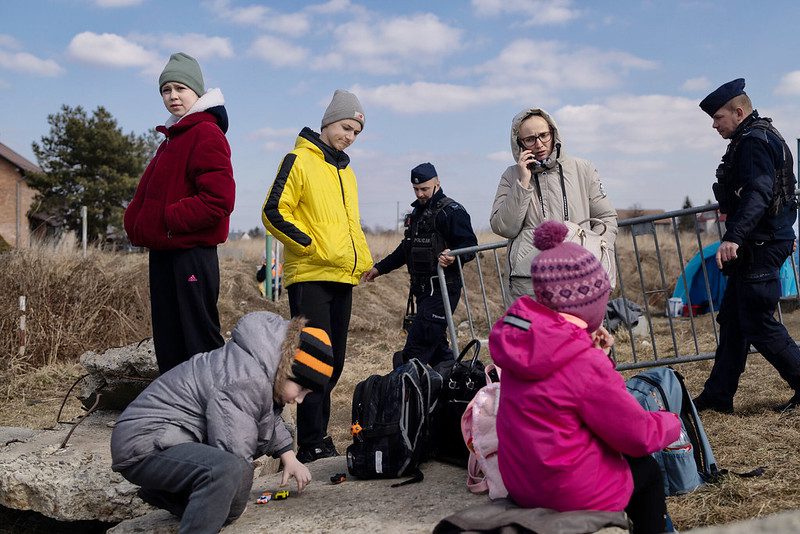
 As the Ukrainian-Russian war persists, Ukrainians seek refuge in the major cities of neighboring countries. With Poland bordering the west of Ukraine, several migrants have opted for migration to areas such as Gdańsk, Kraków and Warsaw.
The Big Picture
Ukraine has faced devastating losses within the past two years, including 23,606 civilian casualties and 8,791 civilian deaths, as revealed by U.N. statistics. Along with these impacts, medical services such as clinics and hospitals have been severely disturbed in southern and eastern Ukraine due to destruction and unpredictable attacks from the Russians and restrictions on civilian activity.
According to Intereconomics, approximately 3.5 million Ukrainians have opted for migration to Poland since the beginning of the war, increasing Poland’s population drastically. Poland’s capital, Warsaw, has increased in population by 17% since the beginning of the war.
The Perceptions of Locals
Some locals find this change difficult to deal with, seeing the constant flow of Ukrainians as a burden to the city’s regular day-to-day flow. However, many of those who welcome refugees with open arms see it as a chance for Ukrainians to show their hard work and entrepreneurship in the Polish workforce.
One of these individuals includes 33-year-old Monika Kryszcuk, a Polish citizen born and raised in Warsaw who has witnessed how immigration rates have progressed firsthand. During an interview with The Borgen Project, Kryszcuk explains the Ukrainian migration to Poland is prevalent but not bothersome to her. She says that part of the reason she feels sympathetic for the migrants is that Poland has been where Ukraine is in past years.
“Poland was one of the most damaged countries in the second world war. Therefore we know how it is to flee your home, leave everything behind and just try to survive,” states Kryszcuk.
Present vs. Past
According to BBC News, by July 4, 2022, almost 1.2 million Ukrainians had applied for temporary residence in Poland. Kryszcuk says that the number of Ukrainians still migrating to Poland is now much lower than last year. She remembers several Ukrainian concerts, marches and protests in Warsaw’s streets, in the months of May and March 2022, calling for an end to the war. Now, she says that protests still happen but are less ostentatious.
In 2022, Kryszcuk and her mother would go to Warsaw’s train stations and pass out critical supplies such as clothes, water and canned food to Ukrainians migrating to other parts of Poland. Kryszcuk says people, including herself, now prefer to offer help by sending aid to organizations working inside Ukrainian borders, considering the escalating humanitarian situation there.
Efforts to Help
Kryszcuk says that she sees Ukrainian grandmothers every day on the streets of Warsaw who have most likely never before left the borders of Ukraine. Now, they are in a foreign country, scared and lost, not knowing what to do next.
The situation many Ukrainians have faced for the past year and a half is dire and there is no resolution in clear sight. However, Kryszcuk explains that people can help struggling Ukrainians through online donations. With Poland being one of the top countries for Ukrainian refugees to migrate to, Polish Humanitarian Action is a notable charitable organization to support to help the cause.
Janina Ochojska established PAH in 1992 and has helped more than 14.5 million people globally. The organization provides resources such as food and aid for those internally displaced or outside refugees fleeing their homes.
Additionally, anyone can support Ukrainian refugees through Poland’s government website under the title “Pomagam Ukraine” (Help Ukraine). Through the website, any individual is able to donate food, clothes and other essentials to refugees. The website includes updates on the refugee situation in Poland as well as a guide for donors who want to effectively support people in these types of difficult circumstances.
Looking Ahead
Overall, Warsaw, and Poland as a whole, have welcomed Ukrainian refugees with open arms. Organizations working on the ground in Poland provide assistance and crucial aid to these vulnerable Ukrainians, providing them with another chance at living normally as the war rages on back in their home country.
– Nina Donlin
Photo: Flickr

Anuradha Koirala Strives to Rescue Victims of Human Trafficking in Nepal
In 1949, Koirala was born into a well-educated and affluent family, showered with love from her parents. Her life seemed like a carefree fairy tale until her marriage during which suffered physical abuse, mistreatment and humiliation from her husband. Koirala blamed domestic violence for enduring three miscarriages.
Finally, she was able to escape her horrible marriage and start a grocery store in a small town to make a living. However, Koirala didn’t forget the pain of her marriage. She determined to use her experience to help abused victims of human trafficking in Nepal. Thus, she embarked on her own rescue mission, tracing the footsteps of trafficked girls.
A Background on Human Trafficking in Nepal
Nepal and India share an open border of 1,850 kilometers, which has made human trafficking in Nepal one of the most lucrative markets in the world. The Human Trafficking Rescue Program estimated that there are more than 54 women trafficking cases in Nepal every single day. According to investigations from the United Nations and local non-governmental organizations, approximately 12,000 to 15,000 Nepalese young girls and women are victims of human trafficking each year. These individuals hold hopes of finding well-paid employment abroad, but their dreams turn into nightmares. Most of them end up in brothels in India, enduring rape and becoming slaves to addiction. Furthermore, these exploited women are at high risk of contracting sexually transmitted diseases, including hepatitis and HIV/AIDS.
Maiti Nepal Helps Rescue Human Trafficking Victims
In 1993, Koirala used her meager income to establish the nonprofit organization Maiti Nepal, meaning “Mother’s Home Nepal.” The organization offers medical care, rehabilitation services and educational training services to trafficked girls, enabling them to reintegrate into society. Its vision is to create a society free from exploitation against women. As the organization developed, the United Nations Children’s Fund (UNICEF) decided to provide financial support to Maiti Nepal.
Moreover, Maiti Nepal collaborated with UNICEF to launch a dance program “KinderKulturKarawane” to release girls’ inner pain and rebuild their confidence. Many survivors have found a positive outlet through dance, expressing their emotions and boosting their physical and mental well-being. Additionally, survivors incorporate their stories into dance performances, raising awareness among the public about the dangers of human trafficking and the common tactics used by traffickers.
Currently, Maiti Nepal has established 11 temporary shelters in different border towns, providing counseling services, health care and life skills training. The organization‘s transit homes serve not only as temporary residences for victims of human trafficking but also as interception points to rescue children and women. It collaborates with border police, conducting regular raids on brothels and searching for traces of traffickers along the Nepal-India border.
Maiti Nepal became the world’s first social organization to utilize AI technology for tracking criminals and missing girls in 2018. The American software company, NowtRKit, provided the facial recognition technology program for tracking human traffickers to Maiti Nepal free of charge. The adoption of this technology significantly enhanced Maiti Nepal’s border surveillance efforts, enabling the organization to intercept criminals crossing the border more efficiently and preventing human trafficking. Koirala stated that in 2022, the organization helped police rescue 499 women and children.
The work of combating human trafficking is fraught with danger. Koirala remains confident even though she receives life-threatening letters from criminal groups every day. From the moment she decided to establish Maiti Nepal, she understood the kind of difficulties she would face.
Looking Forward
Through the relentless efforts of Koirala and Maiti Nepal over the past 30 years, the Nepalese government has designated September 5th as “Anti-Trafficking Day.” The government has continuously worked towards improving relevant laws, protecting victims and strengthening sentencing measures. Koirala regards every assisted girl as her own child. She hopes for the day when Maiti Nepal can disband, signifying the end of trafficking in Nepal and the cessation of torment for Nepalese girls.
The work of Maiti Nepal has received recognition and support from various sectors both domestically and internationally for their efforts against human trafficking in Nepal. Koirala’s steadfast belief and selfless dedication set an example for this organization and inspired more people to join the fight, bringing hope and transformation to trafficked girls.
– Mingjun Hou
Photo: Flickr
Making Progress: primary education in India
Advancing Primary Education in India
Education is a fundamental right for children, and according to UNICEF, the period between 0 and 8 years represents the period of greatest development. In terms of education access and quality, India has made significant progress in recent years. According to enrollment data, it is estimated that eight out of 10 children aged 3 to 6 years are in an Early Childhood Care and Education (ECCE) program, with the state of Karnataka having the highest percentage (86.6%). This is mainly due to the implementation of laws made by the Indian government to strengthen the education system. These laws are the National Early Childhood Care and Education Policy (ECCE) (2013) and the Children’s Rights to Free and Education Obligation (RTE) (2009), which entered into law on April 1, 2010.
Among the strategies used to improve the primary education system is the participation of UNICEF in India. This project aims to achieve three main areas of focus in educational development in the country. First, improving early childhood education by increasing enrollments. Second, a reduction in out-of-school children in nine high-concentration states. Finally, building on teaching and education quality by improving learning environments in selected states. In view of this, UNICEF’s work is centered on strengthening early childhood education systems, in order to achieve inclusive and equitable development for all children aged 3 to 6 years, as well as SDG 4, Goal 4.2.
Primary Education in India as a Basic Right
Taking into account the laws and policies on early childhood education made by the government and strengthened by UNICEF, the right to education is being recognized and prioritized. In addition, this advancement is influencing other areas of children’s rights, such as gender equality, protection and care and access to information. According to the Convention on the Rights of the Child, which was adopted by the General Assembly of the United Nations (UNGA) on November 20, 1989 and enforced in September 1990, articles 28 and 29 (access to education and education) affirm and declare that every child has the right to education, primary education should be free and that access to education should teach them to understand their own rights and to respect other people’s rights, cultures and differences.
It is not only UNICEF but also other organizations in India that work and defend to promote these rights, such as Humanium and Smile Foundation India.
Looking Forward
India is currently the most populous country in the world (with around 1.425 billion people) and this contributes significantly to global human development. Indeed, India is home to almost one-sixth of the world’s population and children make up 25.69% of society. Investments in primary education in India help prevent child marriage, reduce poverty and improve the well-being of families and communities across the country.
– Letícia L. Lacerda
Photo: Flickr
Public Housing in Singapore and its Socioeconomic Benefits
Tucked in the bottom corner of Southeast Asia, Singapore is presenting a hopeful solution to addressing global poverty. Once known for its widespread slums and poverty, 80% of its population were squatting in unsafe conditions and makeshift homes. Now, 50 years later, 80% of the population has access to safe and secure public housing in Singapore, a long-term solution that has helped to address the problems of poverty.
Poverty in Singapore
Poverty still exists in Singapore because, despite strong support from the government, there is still a problem of inequality and high costs of living. However, considering that most of the population is living in affordable government-provided housing, and home ownership is one of the highest in the world at 88.9% home ownership in 2021, the country looks to be heading in the right direction.
Public Housing
The idea of public housing in Singapore began in 1959 following a realization that private housing was unable to keep up with the growing economy. This was resulting in overcrowding, racial tensions and poor living conditions, according to Bloomberg. Following this, the government set up the Housing Development Board (HDB) to address the problem and by 1965, 400,000 people had moved into government-funded housing.
By 1985, the government-owned 76% of the land in Singapore, compared to 31% in 1949 and this has allowed for the building of this system of cheap and efficient housing.
Although modest in size and design, these houses have proper security, running water and electricity, according to Billion Bricks. There are 23 self-contained towns that hold this public housing around the coast of Singapore. Buildings go through the process of standardization to create easy assembly and uniformity.
This system is consistently praised for its ability to address problems of poverty, whilst also creating socioeconomic growth through racial integration and sustainable awareness. The HDB has created social cohesion by building communities within the apartments through public spaces, mixed-ethnicity and mixed-income integration and public gardens.
The positive implications of this system are endless. Both social cohesion and access to housing have a positive impact as people live in environments of stability and security. Support for the government has also increased, as there has been an establishment of higher levels of trust between the people and the state. As a result, the commitment of the government to provide for the people has increased, with 2017 seeing $1.19 billion in spending on public housing, according to the World Bank.
This is all good news for Singapore. The small country has balanced social well-being, government control and security to address deep-rooted problems of poverty.
What is Next?
The public housing in Singapore is unique in nature, and while the 60 years of creation is not easily replicable, it does provide some indication of how important government planning and support are in addressing poverty and promoting socioeconomic improvements. The Singaporean approach could be a lesson, particularly on the importance of social integration, planning and innovative urban design.
– Daisy How
Photo: Flickr
Migration to Poland Amid the Conflict in Ukraine
The Big Picture
Ukraine has faced devastating losses within the past two years, including 23,606 civilian casualties and 8,791 civilian deaths, as revealed by U.N. statistics. Along with these impacts, medical services such as clinics and hospitals have been severely disturbed in southern and eastern Ukraine due to destruction and unpredictable attacks from the Russians and restrictions on civilian activity.
According to Intereconomics, approximately 3.5 million Ukrainians have opted for migration to Poland since the beginning of the war, increasing Poland’s population drastically. Poland’s capital, Warsaw, has increased in population by 17% since the beginning of the war.
The Perceptions of Locals
Some locals find this change difficult to deal with, seeing the constant flow of Ukrainians as a burden to the city’s regular day-to-day flow. However, many of those who welcome refugees with open arms see it as a chance for Ukrainians to show their hard work and entrepreneurship in the Polish workforce.
One of these individuals includes 33-year-old Monika Kryszcuk, a Polish citizen born and raised in Warsaw who has witnessed how immigration rates have progressed firsthand. During an interview with The Borgen Project, Kryszcuk explains the Ukrainian migration to Poland is prevalent but not bothersome to her. She says that part of the reason she feels sympathetic for the migrants is that Poland has been where Ukraine is in past years.
“Poland was one of the most damaged countries in the second world war. Therefore we know how it is to flee your home, leave everything behind and just try to survive,” states Kryszcuk.
Present vs. Past
According to BBC News, by July 4, 2022, almost 1.2 million Ukrainians had applied for temporary residence in Poland. Kryszcuk says that the number of Ukrainians still migrating to Poland is now much lower than last year. She remembers several Ukrainian concerts, marches and protests in Warsaw’s streets, in the months of May and March 2022, calling for an end to the war. Now, she says that protests still happen but are less ostentatious.
In 2022, Kryszcuk and her mother would go to Warsaw’s train stations and pass out critical supplies such as clothes, water and canned food to Ukrainians migrating to other parts of Poland. Kryszcuk says people, including herself, now prefer to offer help by sending aid to organizations working inside Ukrainian borders, considering the escalating humanitarian situation there.
Efforts to Help
Kryszcuk says that she sees Ukrainian grandmothers every day on the streets of Warsaw who have most likely never before left the borders of Ukraine. Now, they are in a foreign country, scared and lost, not knowing what to do next.
The situation many Ukrainians have faced for the past year and a half is dire and there is no resolution in clear sight. However, Kryszcuk explains that people can help struggling Ukrainians through online donations. With Poland being one of the top countries for Ukrainian refugees to migrate to, Polish Humanitarian Action is a notable charitable organization to support to help the cause.
Janina Ochojska established PAH in 1992 and has helped more than 14.5 million people globally. The organization provides resources such as food and aid for those internally displaced or outside refugees fleeing their homes.
Additionally, anyone can support Ukrainian refugees through Poland’s government website under the title “Pomagam Ukraine” (Help Ukraine). Through the website, any individual is able to donate food, clothes and other essentials to refugees. The website includes updates on the refugee situation in Poland as well as a guide for donors who want to effectively support people in these types of difficult circumstances.
Looking Ahead
Overall, Warsaw, and Poland as a whole, have welcomed Ukrainian refugees with open arms. Organizations working on the ground in Poland provide assistance and crucial aid to these vulnerable Ukrainians, providing them with another chance at living normally as the war rages on back in their home country.
– Nina Donlin
Photo: Flickr
Strengthening Mental Health Initiatives in Sweden
Government Policies
Options Available to Patients
Outlook on the Future
– Nicholas DeLuca
Photo: Unsplash
Cricket is Reducing Gender Violence in India
Domestic Violence in India
Although many aspects of society seem to be taking notable leaps forward, there has been little progress in alleviating gender violence in India. In fact, according to a report by the World Economic Forum (WEF), India ranked 134th out of 145 countries for gender parity in 2018, down from 130th in 2017.
Although some structural changes have made a difference in politics and the business sector, with 83.3% of legal frameworks that enforce gender equality under the SDG indicator now in place in India, women still face a lot of discrimination in their day-to-day lives. At any hour, between 30 and 40 women are victims of domestic violence, and that is just the documented figure. Sexist views are part of Indian society, so much so that 50.6% of men and an astonishing 54.4% of women believe that there are situations in which justifications exist for a husband beating his wife.
One contributing factor to the elevated figures around gender violence in India is the custom of dowry. Beliefs and customs around dowries have resulted in the treatment of women as an economic burden. For this reason, a woman has to shell out a required sum of monetary compensation in return for bridal acceptance from the groom. Despite outlawing this practice of paying dowries more than 60 years ago, stories still emerge of marital property disputes that end in murder. India’s National Records Bureau reported that in 2020, on average, dowry-related conflicts led to the killing of 19 women, while 1,700 women committed suicide over “dowry-related issues.”
Parivartan
It is these behaviors that Parivartan, which translates to ‘transformation’ in English, is trying to highlight and erase from Indian society. A collaboration that began in 2008 between the Indian Office of the International Centre for Research on Women (ICRW) and Apnalaya, a small community-based NGO, adopts the model of the U.S. “Coaching Boys Into Men” program and receives funding from The Nike Foundation. Through sports, the program aims to build attitudes and behaviors that end gender violence in India. Young cricketers are encouraged to challenge their views on “eve teasing,” a term that serves to describe the popular and generally accepted ‘boys’ sport’ of sexually harassing women in the streets.
The coaches and mentors in the program act as role models to the younger boys, who in turn develop positive behaviors to take back and share with their community. The program focuses on the idea of empowering women through changing the behaviors of men – achieving gender equality is not possible without changes in men’s lives as well as women’s, as it is more often the men who are committing the violence.
The program runs in local communities and schools, thereby targeting boys from all social classes. The interventions in schools coached athletes from the middle to higher-middle level of economic strata, while the community-level projects takes place in the slums of Mumbai.
Research conducted through a questionnaire showed that the views of participating athletes changed over time. Despite the young age of many of the athletes, their views when starting the program tended to reflect that men are supposed to be “tough, unfaithful and unemotional.” By the end of the program, these perceptions had largely changed.
Looking Ahead
Apart from the ongoing efforts and trends in India, the idea that sport can serve to drive social change and encourage international development continues to gain popularity across the world, with projects such as Grassroot Soccer in South Africa and Fight for Peace in Brazil. This raises hope that one day, sports participation can play a major role is ridding society of gender inequalities and violence.
– Almaz Nerurkar
Photo: Flickr
Addressing the Neglect of Elderly Syrian Refugees’ Health
More than 5 million Syrian people fled their homes to neighboring countries, such as Lebanon and Jordan, due to mass displacement in the wake of conflict. Many of these refugees are older people with different health issues who seek assistance. Despite the best efforts of the humanitarian response, some elderly Syrian refugees’ health is neglected due to a lack of data, institutional biases and underfunding.
Identifying the Prevalence of Health Issues
As a result of the demands of the current Syrian refugee crisis, Lebanese health and social workers have identified the prevalence of non-communicable diseases among older Syrian refugees, such as diabetes, blood pressure, high cholesterol and heart disease. Additionally, psychologists have observed that many people have to confine themselves to homes due to bone and joint complications, leading to social isolation and mental health problems. Elderly Syrian refugees’ health is neglected because of poor hygiene and access to clean water.
This, along with the fact that many people live in small, cold tents with many people living in it, leads to pulmonary complications and skin disorders like scabies. Additionally, lack of food causes malnutrition, which impairs their immune system, making them susceptible to diseases such as flu and diarrhea.
According to a 2014 Handicap International and HelpAge International report, many of their patients with Syrian refugee status suffer from mental illnesses such as depression, anxiety, post-traumatic stress disorder and psychosis. HelpAge International’s Chief Executive Officer, Toby Porter, claims that the lack of psychosocial care for older people negatively impacts their family’s well-being.
Senior Refugees Face a Variety of Problems
In 2021, according to the Vulnerability Assessment of Syrian Refugees in Lebanon (VASyR), primary health care and hospital care were less accessible for households with the lowest expenditures. The study demonstrates that those with the least resources were the least likely to receive the necessary care, likely due to a lack of adequate insurance or the ability to pay out-of-pocket for medical care. Thus, this highlights the need for greater financial support for medical care so that those with the least resources can still access the care they need.
A 2022 Conflict and Health article suggests that there needs to be more awareness of the needs of older refugees in the aid sector, which focuses mostly on children, women and young adults regarding financial support and medical services. Providing assistance to older refugees should be a priority. Social workers have noted that even though hearing aid and eyeglass campaigns are often conducted, they benefit children and young adults.
According to social workers, donors should prioritize older refugees, allowing them to receive adequate medical care and assistance. A Caritas Lebanon Migrant Centre (CLMC) Board Committee member, Kamal Sioufi, commented: “Older refugees have so many needs, which are not yet a priority for the humanitarian aid actors responding to this crisis.”
Urgent Steps Needed for Improved Care
According to a Handicap International and HelpAge International report, it is also essential to improve the accessibility of health care for people with specific needs. It is crucial that psychological distress services are readily available and tailored to meet the needs of individual clients. The health care staff should have training in diagnosing chronic diseases and receive adequate consultation time. Providing complete information about how to manage patients’ conditions will enable them to help them more effectively. Health care professionals should receive essential psychological distress services as well as training on how to assist elderly individuals.
Since 2013, HelpAge International has been working with older Syrian refugees in Lebanon. Around 2,000 patients have benefited from health consultations, nutrition lessons, cooking classes and social events. Furthermore, HelpAge has trained humanitarian and government workers on older people’s health issues.
Working Together
Organizations like HelpAge International have been providing health consultations, nutrition lessons and training for humanitarian workers to better support the elderly Syrian population. Continued efforts and support can potentially improve their living conditions by providing them with the care and assistance they require.
– Simran Raghav
Photo: Flickr
GuardDV is Empowering Survivors of Gender-Based Violence in Puerto Rico
The declaration came after the Puerto Rico Gender Equality Observatory reported, in 2020, that the rate of femicide had increased 62% from the previous year. Alarmingly, more than 25% of those murders were classified as intimate partner violence.
While a nuanced issue, there is a clear correlation between domestic and gender-based violence and the experience of poverty. For example, the recent spike in femicides in Puerto Rico follows shocks like 2017’s Hurricane Maria and COVID-19, which have had a devastating impact on Puerto Ricans’ income and access to basic resources. As of 2018, 44% of the U.S. territory’s population was living in poverty — an inordinate percentage compared to the national poverty rate of about 12%. Poverty exacerbates domestic tensions as well as the circumstances that make it difficult for women to leave abusive homes, heightening financial insecurity and increasing the risk of continued exposure to violence.
Law 54
In 1989, Puerto Rico introduced the “Domestic Abuse Prevention and Intervention Act” to address intimate partner and gender-based violence. Commonly known as Law 54, the legislation designates domestic violence as a felony. Furthermore, it requires law enforcement to complete a comprehensive report on any domestic violence case, even when charges are not filed, in order to improve accuracy in recording domestic violence incident rates.
While Law 54 recognizes the seriousness of the problem, many cases of domestic and gender-based violence in Puerto Rico remain undocumented. For example, in most of the U.S., police departments report rape at “four times the rate of homicide,” according to the American Civil Liberties Union. Yet, in 2010, the Puerto Rico Police Department reported more than 1,000 homicides and just 39 rapes. The ACLU estimated that only about 1% of rape cases in Puerto Rico were reported that year, with the actual number being some 100 times higher.
The anomaly raised questions about the accuracy of reporting claims of domestic violence, adequacy of investigation and effectiveness in providing legal and social protection to survivors. In a 2012 investigation, the ACLU concluded that there was “dramatic under-enforcement of violations of protection orders” and “inadequate staffing of both specialized domestic violence PRPD units and specialized domestic violence prosecution units.” These and other challenges, such as a lack of coordination between investigators and prosecutors, have hindered progress in preventing domestic violence and protecting victims.
How GuardDV Empowers Survivors
Zayira Jordan developed GuardDV in 2018. A survivor of domestic violence, she wanted to use technology to serve other survivors and help ensure their physical and emotional security. The mobile application allows survivors to access “real-time information about the safety of their surroundings,” alerts them to potential protection order violations and provides a “panic button” for use in threatening situations. GuardDV uses three different kinds of technology. Active GPS and International Mobile Equipment Identity (IMEI) together make it possible to accurately identify the locations of survivors and offenders. Facial recognition ensures that an offender is always carrying the phone linked to their court-registered IMEI code, requiring offenders to visually log in to the app for random check-ins throughout the day.
How the App Works
Implementing smart monitoring through apps like GuardDV has proved to be critical for empowering survivors of gender-based violence in Puerto Rico. The app demonstrates how technology can help bring comfort and security to survivors, and accountability to offenders. Additionally, it offers hope for how technology can help prevent instances of gender-based violence for victims and survivors who remain in abusive environments, increase reporting and ensure efficient physical, emotional and legal protection for those who most urgently need support.
– Lucy Gebbie
Photo: Wikimedia Commons
3 Facts About Elderly Poverty in North Korea
3 Facts About Elderly Poverty in North Korea
Increasing Rate of Poverty Risk Among the Elderly Population: North Korea’s elderly population, aged above 65 years, is rapidly rising. In 2008, the aging population increased from 5.3% to 8.5%, predicting a growth of 14% by 2033. Increasing demand to assist the elderly population in a country with low economic growth and sustained workforce opportunities brings income and health concerns.
Limited Pension System: North Korea has a limited pension system. It provides minimal support in providing financial assistance to the elderly. Reports from Radio Free Asia (RFA) indicate that the social security pension offers about 1,000 won per month. This is around $0.12. Many elderly citizens are unable to cover basic living expenses with limited income, leading them to remain in poverty and hindering their retirement plans.
Housing Conditions: Many elderly individuals live in poor housing conditions due to a lack of proper infrastructure. This leads to inadequate heating and structural issues. Roughly 90% of North Korea’s housing environment was constructed between the 1950s and 1990s. This was to solve the resulting housing crisis after the damage of numerous facilities and buildings during the Korean War in 1953.
Efforts of North Korean Authorities to Address Elderly Poverty
According to sources from Daily NK, an initiative was implemented by the Propaganda and Agitation Department of the North Korean communist party’s Central Committee to identify and register the homeless elderly population aged 60 years and above. It strived to build new facilities for nursing homes, aiming to provide care and support for abandoned or neglected elderly individuals. Nevertheless, North Korean citizens expressed concern regarding the initiative, with the possibility of elderly residents feeling compelled to return to their families despite the lack of resources to ensure proper caregiving. Additionally, there are speculations of potential mistreatment or neglect in the absence of familial support.
Efforts by NGOs in Alleviating Poverty
Non-governmental organizations (NGOs) strive to mitigate the struggles endured by the elderly population in North Korea. Although the government gives limited information on solutions, these NGOs endeavor to improve the quality of life for the elderly by providing assistance through their food aid program and awareness-raising initiatives.
Helping Hands Korea (HHK) is a Christian NGO that was founded by Tim and Sunmi Peters in Seoul. Since 1996, it has addressed the physical, emotional and spiritual needs of North Koreans in crisis. One of its projects aims to provide food, medicine and clothing to the most vulnerable in society, especially the elderly.
Other initiatives focus on promoting elderly poverty awareness to encourage governmental priorities and bring elicit action on the potential policies. In 2020, the United Nations released the “Needs and Priorities Plan.” It targeted the provision of humanitarian assistance while implementing sustainable development goals. It aims to give food and nutritional support to 3.3 million people in North Korea. The plan also will give health services to 5.5 million people and clean water and sanitation to 300,000 people.
Looking Ahead
North Korea is making efforts to overcome its challenges to improve its economy. While it may not be in the government’s best interest, collaboration with international organizations supports the funding of elderly poverty. With continued effort, North Korea could achieve a future that is free of elderly poverty. And this can potentially improve living conditions and reduce the burden on younger generations.
– Cherine Jang
Photo: Flickr
United States’ Intervention in the Venezuelan Refugee Crisis
Thankfully, many state and non-governmental organizations have stepped in to help out with the crisis. The largest contributor to the humanitarian response, however, is the U.S. State Department. Through its various branches, the State Department gives aid to the refugees, helping to heal the divide between the U.S. and Venezuela.
The Crisis
The origins of Venezuela’s crisis began long before the last few years. Arguably, they go all the way back to when investors found large oil reserves in the country in the 1920s. While their economy grew exponentially due to this discovery, it resulted in an increasing reliance on oil.
Years later, President Hugo Chavez utilized the nation’s oil wealth to expand social services, but also greatly expand his presidential powers to near-dictatorial levels. This is partly responsible for Venezuela’s consistent ranking as one of the most corrupt countries in the world.
Chavez’s successor Nicolas Maduro took power in 2014 and continued to enact corrupt policies while consolidating more presidential power. At the same time, the price of oil declined sharply and the Venezuelan economy declined with it, according to the Council on Foreign Relations (CFR).
Since then, the people of Venezuela have faced an extreme lack of economic opportunity, food scarcity, lack of medical resources, crime and lack of proper housing, giving rise to the Venezuelan refugee crisis. At the same time, they have continually tried and failed to oust their corrupt government from power. Because of all this, millions of migrants and refugees have fled to neighboring countries and other parts of the world.
State Department Aid
Though relations between the government of the U.S. and Venezuela have soured, the State Department is still intent on helping Venezuelans both within their own country and living abroad as refugees.
Since 2017, the U.S. State Department has given more than $2 billion in aid towards the Venezuelan crisis, making it the largest donor in the world. The State Department works through two separate agencies to assist Venezuelans. These are the Bureau of Population, Refugees, and Migration (PRM), which is a subsidiary of the State Department itself, while the other is USAID.
PRM primarily focuses on supporting refugees living outside of Venezuela. Its work helps provide a range of essential services including shelter, health care, water, sanitation, hygiene, education and more. Workers distribute this aid in 17 countries throughout South America, Central America and the Caribbean. PRM also utilizes refugee coordinators to work diplomatically with local government officials.
By contrast, USAID is more focused on helping Venezuelans in Venezuela with the same kind of necessary support PRM provides. However, it also assists refugees living in neighboring countries such as Brazil, Colombia, Ecuador and Peru.
Latest Developments
Thankfully, the U.S. government affirmed its continued support for Venezuelan refugees at the ninth Summit of the Americas in June 2022. There, President Biden announced an additional $314 million in aid to Venezuelan refugees scattered throughout the western hemisphere.
The aid funding goes to both PRM and USAID with the former receiving $103 million and the latter receiving $171 million. An additional $40 million for development was also given to USAID.
And though much work between the U.S. and Venezuela has helped millions of refugees, there is a need for continued action. With time and effort, the State Department’s latest round of aid could alleviate much of the suffering. And if the U.S. and other governments continue to give crucial humanitarian assistance, there is hope that one day, Venezuela’s refugee crisis will be a thing of the past.
–Jonathon Crecelius
Photo: Flickr